
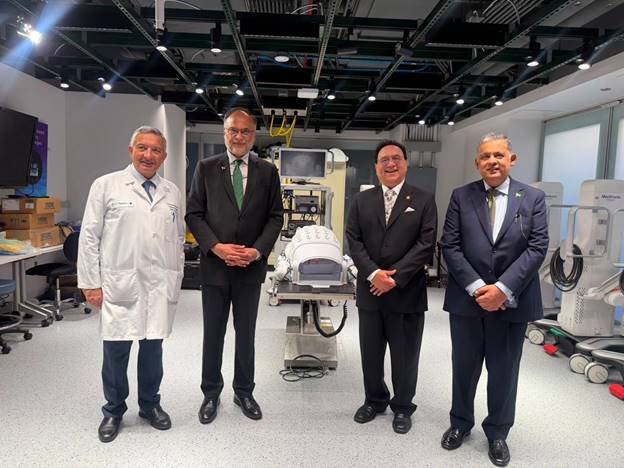
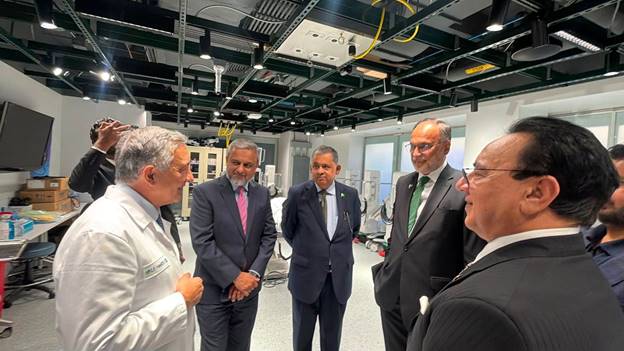
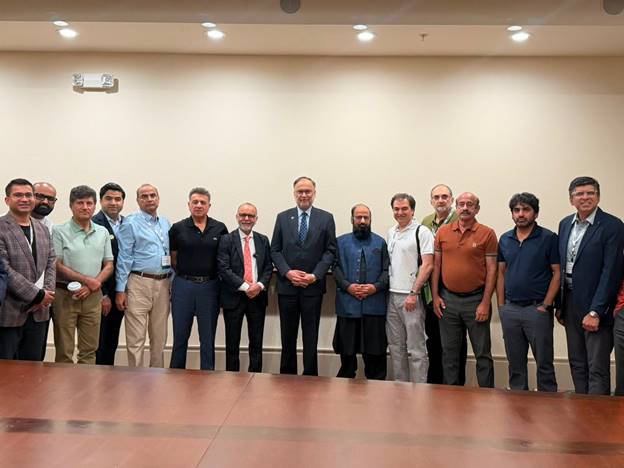
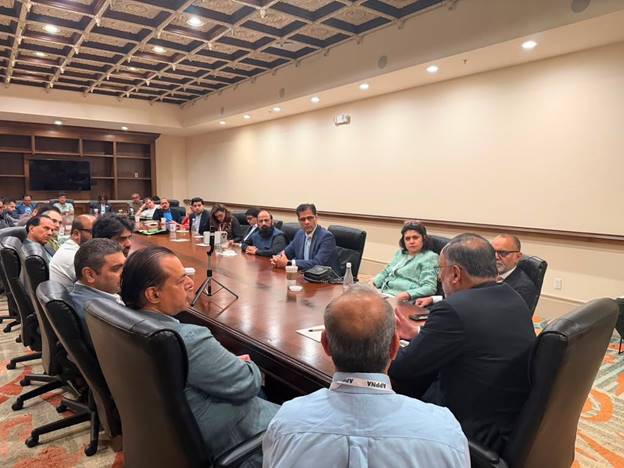
Minister Iqbal shared Pakistan's intention to benefit from internationally recognized models of academic medicine and integrated healthcare systems, noting that such experiences could provide valuable insights for the development of Pakistan's emerging medical institutions
Ahsan Iqbal Holds Successful Meetings during US Visit
By Elaine Pasquini
Washington, DC: As part of his visit to the United States beginning July 5, 2026, Pakistani Federal Minister for Planning, Development and Special Initiatives Ahsan Iqbal visited the University of Illinois Chicago (UIC) to explore opportunities for academic, research and healthcare collaboration between Pakistan and the United States.
During the visit, Minister Iqbal held discussions with the University's Provost, Vice Provost and Dean of the medical faculty on potential areas of cooperation between the UIC, Prime Minister Shehbaz Sharif’s proposed Jinnah Medical Complex and Research Center (JMCRC) and the Pakistan Kidney and Liver Institute and Research Center (PKLI). The dialogue focused on future collaboration in medical education, research, innovation and advanced healthcare.
Sharing Prime Minister Sharif’s vision for the Jinnah Medical Complex, Minister Iqbal said the government of Pakistan is committed not only to developing state-of-the-art healthcare infrastructure but also to building international academic and clinical linkages that will help the institution emerge as one of the leading medical centers in the region.
Highlighting that PKLI is advancing towards cutting-edge robotic surgery, he expressed Pakistan's interest in learning from UIC's globally recognized expertise in robotic surgery, medical research and innovation. To initiate institutional engagement, he connected PKLI President Professor Dr Saeed Akhtar virtually with the University's leadership and medical faculty, enabling an initial discussion on possible areas of cooperation and future engagement.
The two sides exchanged views on expanding collaboration under the US-Pak Knowledge Corridor by incorporating medical sciences alongside higher education. Potential areas discussed included faculty and student exchanges, scholarships, joint research initiatives, advanced surgical training and institutional partnerships.
Minister Iqbal also shared Pakistan's intention to benefit from internationally recognized models of academic medicine and integrated healthcare systems, noting that such experiences could provide valuable insights for the development of Pakistan's emerging medical institutions. Recalling Pakistan's successful academic partnership with the United States, the minister noted that during his previous tenure he played a key role in expanding the Pakistan-US Fulbright Scholarship Program by securing Pakistan's financial contribution, helping make it one of the largest Fulbright programs in the world.
Also during his US visit, Minister Iqbal participated in the 49th Annual Convention of the Association of Physicians of Pakistani Descent of North America (APPNA) in Orlando, Florida, where he held a series of engagements with the Pakistani-American business community, urging overseas Pakistanis to become active partners in Pakistan's journey towards sustainable development and economic transformation.
Addressing the convention, the minister highlighted the Pakistani government's vision of placing human capital development at the center of national planning through Pakistan’s five-year National Economic Transformation Plan (URAAN). He emphasized that Pakistan's future depends on investing in education, healthcare, population management, innovation and technology while strengthening partnerships with overseas Pakistani professionals.
Inviting overseas Pakistani physicians to contribute their expertise, Minister Iqbal proposed an innovative telemedicine backup model under which a panel of ten US-based medical specialists for each of Pakistan's sixty districts would be established . The panel would provide backend clinical support to junior doctors serving in remote and underserved areas, enabling them to consult directly with overseas specialists and deliver quality healthcare through modern digital technologies. This initiative, he stressed, would strengthen knowledge transfer, improve healthcare delivery and expand access to specialist medical care across Pakistan.
Highlighting the transformative potential of Artificial Intelligence, the minister called upon overseas Pakistani doctors to help Pakistan develop AI-driven healthcare solutions, digital health platforms and technology-based medical innovations that can modernize the country's healthcare system.
He also drew attention to Pakistan's major human development challenges, including Hepatitis C, diabetes, tuberculosis, polio, rapid population growth and child stunting, stressing that these issues require coordinated national efforts supported by global expertise and innovation. Prime Minister Sharif, he related, has approved the establishment of the National Population Council, which will be chaired by the Prime Minister with all chief ministers as its members to ensure a coordinated national response to population management. Iqbal further shared that Hepatitis C elimination programs are currently underway in Islamabad, Gilgit-Baltistan and Azad Jammu & Kashmir, while a nationwide diabetes awareness campaign will soon be launched to promote preventive healthcare.
During an interactive question-and-answer session, Minister Iqbal underscored the importance of responsible democratic discourse, stating that while peaceful political expression is a constitutional right, political differences should never undermine state institutions or Pakistan's international image. Stressing that politics must remain separate from the state, he also added that no democratic country allows its sovereign institutions to be weakened by partisan agendas. He urged Pakistanis to express differences responsibly while safeguarding national sovereignty and the country's global reputation.
Later, during separate meetings with members of the Pakistani American business community in Orlando, the minister invited overseas entrepreneurs, professionals and investors to play a leading role in Pakistan's economic revival by promoting exports, technology partnerships and productive investment.
Referring to Marka-e-Haq, when the Pakistani military was victorious against India’s unprovoked attacks in May of last year, the minister said that under the leadership of Prime Minister Sharif and Field Marshal Syed Asim Munir, Pakistan demonstrated exceptional national unity, professional excellence and technological capability in safeguarding its sovereignty.
Concluding his engagements, Minister Iqbal reaffirmed that the Pakistani government is committed to strengthening the rule of law, ensuring policy continuity, improving the investment climate and fostering long-term partnerships with overseas Pakistanis. The Pakistani diaspora remains one of the nation's greatest strategic assets, he said, and invited overseas professionals to become active partners in realizing the vision of URAAN Pakistan and building a prosperous, resilient and globally competitive Pakistan.
Rizwan Saeed Sheikh, ambassador of Pakistan to the United States, accompanied Minister Iqbal during his important visit to the US.
(Elaine Pasquini is a freelance journalist. Her reports appear in the Washington Report on Middle East Affairs and Nuze.Ink.)
