
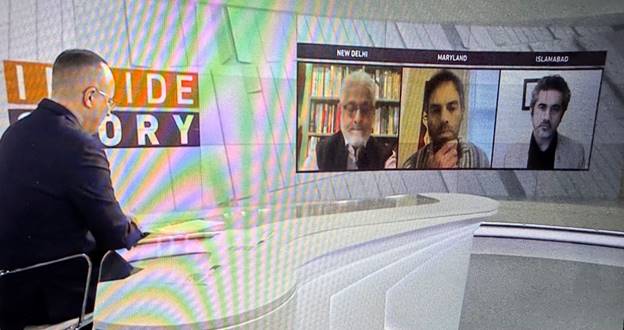
(Left to right): Mohammed Jamjoom, Sidddharth Varada Rajan, Michael Kugelman, and Zeeshan Salahuddin
Indus Water Treaty Analyzed on Al Jazeera’s ‘Inside Story’
By Elaine Pasquini

Washington, DC: The Indus Water Treaty, signed in 1960, which delineates how the river’s resources are to be shared between India and Pakistan, was recently put to the test after New Delhi suspended its participation following the April 2025 attack in India-administered Kashmir that India claims was carried out by armed groups linked to Pakistan which Pakistan has denied. The river, a lifeline for more than 252 million people in Pakistan, is vital to agriculture, energy production, economic development, and therefore a matter of national interest. Until this dispute, the treaty was one of the world’s longest-lasting agreements.
To discuss these events and the future of this important accord, Al Jazeera’s Inside Story host Mohammed Jamjoom engaged a panel of experts on the July 2, 2026, episode of the current affairs program.
Initiating the conversation, Sidddharth Varada Rajan, founding editor of The Wire, an independent investigative news organization based in New Delhi, said India has been signaling for some time that it wants to renegotiate or revisit the treaty, not due to issues of climate change or water flows, but because of the problem of terrorism India claims is emanating from Pakistan-based terrorist groups.
“I think when the Pahalgam attack happened in April last year there was an expectation that the Modi government was going to respond,” he said. “They seized upon the Indus Water Treaty and decided to go and ‘hold it in abeyance,’ as they put it.”
This is a political declaration aimed at conveying to domestic Indian public opinion that the government was taking a robust and tough stand, he argued. Restricting water flows in the short-term would cause some discomfort to Pakistan, but in the medium to long-term the costs in terms of money, disruption, floods on the Indian side and lost diplomatic and political goodwill are too enormous to really lead to a situation where there would be an end to the flow of water from India to Pakistan, he added.
With regard to suspension of the treaty, just as the document has no provisions for either side to unilaterally walk away, its text is very clear – there is no sunset clause, there is no exit clause – the treaty also lacks any kind of enforcement mechanism.
Pakistan and India need to work out any modifications that are needed with the functioning of the Indus Water Treaty because this is a problem that India and Pakistan jointly confront. “There is no other alternative,” Rajan emphasized. “We occupy the geography that we are in. India and Pakistan are neighbors. They share water resources.”
Zeeshan Salahuddin, advisory director at Tabadlab, an Islamabad think tank on geopolitics, noted the treaty is intended as a protectionism mechanism for Pakistan that is a lower riparian country. Therefore, shutting off the taps upstream could really affect one-quarter of the country’s GDP, 80 percent of its agricultural output and the vast majority of its drinking water. Pakistan has sought adjudication from multiple international forums including the permanent Indus Commission which India pulled out of.
The Court of Arbitration to which India has refused to appoint its two subject matter experts, as well as other neutral experts, have ruled in Pakistan’s favor that this term “hold the Indus Water Treaty in abeyance” that India has used has no actual practical or legal value, Salahuddin said.
Article 12 of the treaty allows for updates to be made based on shifting realities on the ground. That should be done, he said, but in “consultation, through negotiation, through dialogue, by coming to the table and not by holding a proverbial gun to Pakistan’s head by turning off the tap up-river.”
The end result, Salahuddin concluded, is that no one in Pakistan is going to “sit by idly should it come to the point where India actually shuts off the tap and we watch a population of 252 million people starve and be denied the basic fundamental right of water as agreed upon under the Indus Water Treaty.”
Michael Kugelman, senior fellow for South Asia at Washington, DC’s Atlantic Council, pointed out that following the India-Pakistan conflict last year India took a number of non-military punitive steps against Pakistan, including closing down borders, severely cutting down trade, and for the first time suspending the Indus Water Treaty, “or, as India describes it, ‘holding it in abeyance,’ something it has never done before.”
With respect to legal mechanisms that come into play and whether India has the ability to unilaterally suspend participation in this treaty, Kugelman argued that it’s a matter of interpretation. “The spirit of the treaty would strongly suggest, if not stipulate, that neither country pull out unilaterally even if only in a temporary context,” he said. “There are all kinds of stipulations built into the treaty that allow for the two sides to resort to various mechanisms when they are unhappy about some aspect of the treaty or something that one side has done that the other does not agree with. Until last year when India suspended the treaty those mechanisms had been successful because ultimately each side agreed to the resolution of those mediation measures that took place. I think the bottom line is it’s the spirit of the treaty that suggests there should not be any type of effort on the part of either country to pull out unilaterally.”
There have been complaints from both sides that there needs to be adjustments, not just because of new climate and environmental considerations, but also new economic realities and demographic realities with both countries’ populations having risen significantly in the decades since the treaty was signed. “But I would argue that until India decided to suspend the treaty it had survived and been very successful,” Kugelman stated. “I think both sides benefit by having this treaty back in place without any one country backing out of it unilaterally.”
(Elaine Pasquini is a freelance journalist. Her reports appear in the Washington Report on Middle East Affairs and Nuze.Ink.)
