
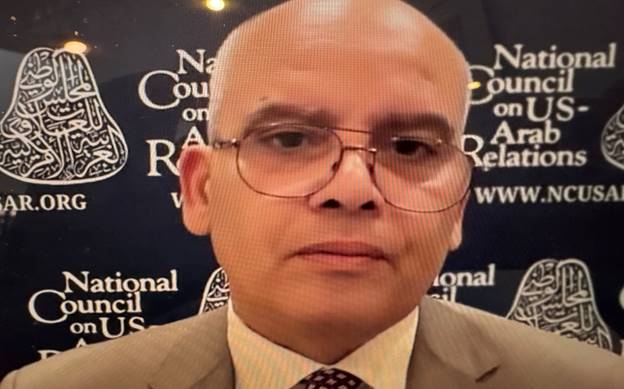
Abderrahim Foukara
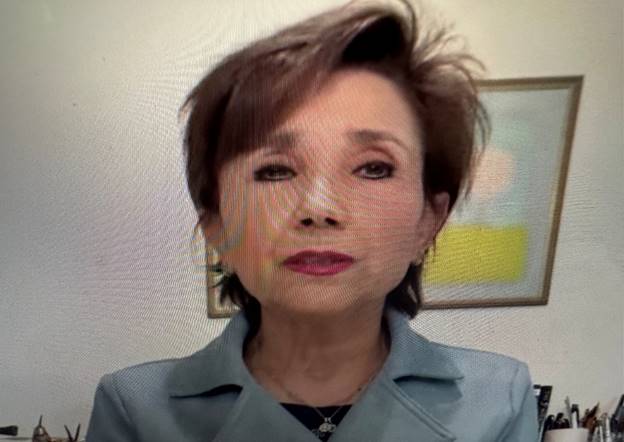
Amb Amal Mudallali

Amb (Ret) Thomas R Pickering
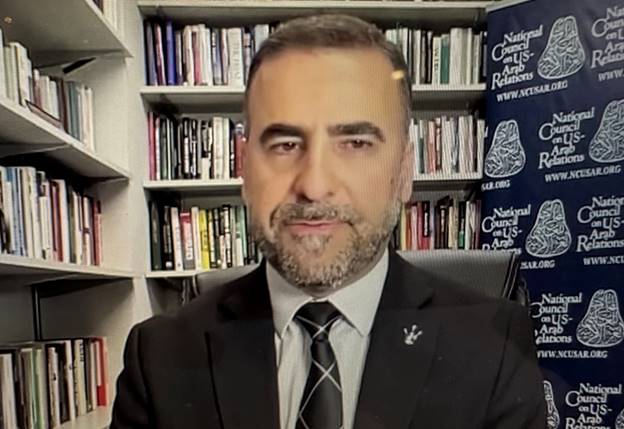
Fadi Hilani
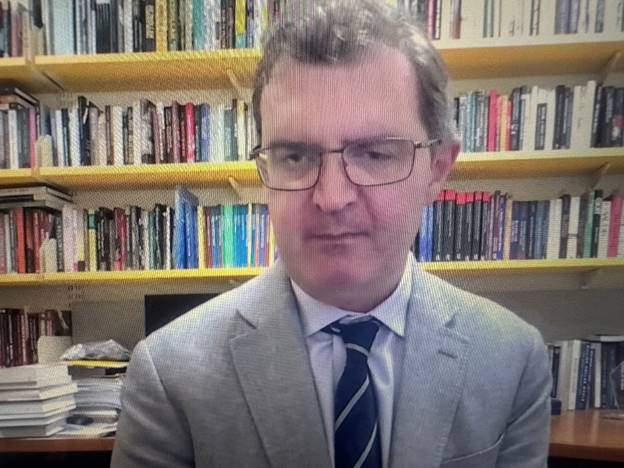
Kristian Coates Ulrichsen
National Council on US-Arab Relations Examines US-Israel-Iran War, Lebanon and GCC
By Elaine Pasquini

Washington, DC: “Following months of conflict involving the United States, Israel and Iran, the region stands at an inflection point between renewed escalation and a potential diplomatic breakthrough,” Fadi Hilani of the National Council on US-Arab Relations (NCUSAR) said in opening comments on the Council’s June 4, 2026, webinar.
But Lebanon remains central to the regional equation, he added, and since the outbreak of hostilities earlier this year, the conflict between Israel and Hezbollah has resulted in significant loss of life, large-scale displacement and extensive infrastructure damage.
Abderrahim Foukara, distinguished fellow for US-Arab affairs and media leadership at NCUSAR, moderated a panel on this topic and whether the US and Iran can initiate a peace deal separate from the situation between Israel and Lebanon or if Iran will continue to insist that Lebanon be part of any peace agreement.
Amb (Ret) Thomas R Pickering, former US ambassador to the United Nations, Russia, Jordan, India, El Salvador, Nigeria and Israel, where he served from 1985 to 1988, argued in his recent article in Foreign Affairs that for any deal between Iran and the United States to stick it would need a buy-in from Israel.
There is, however, a major problem with Israeli prime minister Binyamin Netanyahu concerning “an Israeli tradition that when things like Gaza and October 7 occur, they must have a thorough examination including the responsibility of the prime minster for it,” he said. Netanyahu will be facing this probe when his term ends in October.
“Bibi [Netanyahu] has a kind of lifelike attachment to continuing in office come what may,” Pickering opined. “Bibi will do almost anything, almost anywhere, but principally in Lebanon, to make sure that the Lebanese problem continues in existence and blocks the question of any Iranian agreement.”
Another important issue, the ambassador said, is Israel’s possession of a nuclear weapon which the government never acknowledges and is not part of the non-proliferation treaty but is clearly a part of their defense.
Ironically, Iran has discovered the Strait of Hormuz as its “nuclear option,” Pickering noted. “It can exercise it, stop world commerce, screw up world economies; it can cut a 20 percent oil supply, 40 percent to China. The US can stop it, too, but it can’t overcome it without going to war in Iran and taking over the entire country.”
Amb Amal Mudallali, former Lebanese Permanent Representative to the United Nations, said that President Donald Trump wants an agreement in Lebanon in order to have an agreement with Iran.
Unlike Israel that wants a regime change in Iran, “American policy is now looking for a deal which will extract the president from this situation, open the Strait of Hormuz and bring back energy markets and supply lines to their pre-war levels,” she argued. “The American administration wants a way out of this as soon as possible.”
With respect to President Trump’s desire to enlarge the Abrahim Accords, she said, in view of the war as well as the worsening humanitarian situation in Gaza where Palestinians are still being killed every day by Israeli forces, no one is “in a hurry now to go and join the Abraham Accords without any political solution in the region.” Saudi Arabia’s leadership made it very clear that without a pathway for a Palestinian state there is no normalization, she added.
In addition, the need remains in southern Lebanon for a United Nations presence, Mudallali said, noting that due to pressure from Israel and the United States, the United Nations Interim Force in Lebanon (UNIFIL) will be out of southern Lebanon the end of this year causing a vacuum in the region.
Established in 1978, Security Council Resolution 1701 passed in 2006 following the war between Israel and Hezbollah allows UNIFIL to assist the Lebanese Armed Forces in patrolling south Lebanon.
Kristian Coates Ulrichsen of Rice University’s Baker Institute for Public Policy said that President Trump wants to disentangle himself from the Iran conflict and Lebanon, but the Iranians are doing their best to keep Lebanon and Iran connected. “I think President Trump is realizing too late that even if he tries to keep them separate it’s not going to be as easy as he had hoped,” he argued.
Gulf leaders, he opined, are very concerned about Trump being so anxious to get to some agreement with the Iranians that he will “do what is best – not necessarily for the US, or the US and its regional partners – but for him.”
Dynamics in the region are changing, too, as both Saudi Arabia and the UAE are deepening relations with China, Ulrichsen pointed out. If restrictions on the Strait of Hormuz continue, there will be an acceleration and deepening of relationships with China because of the country’s need for energy from the Gulf, including Iran.
With respect to Gaza and the great fanfare by President Trump in presenting his 20-point plan and creation of a Board of Peace last October, nothing has happened on the ground to improve the situation, he stressed. “The condition of the people in Gaza has not improved.”
“Gaza remains subject to attacks, and I think the concern in the Gulf is that an agreement with Iran will follow the same path,” Ulrichsen said. “President Trump will announce it, will announce his own terms but then nothing will actually change on the ground.”
Because of the war and closure of the Strait of Hormuz, the economic global situation is at a stage where some of the shortages of oil or oil products will begin to be felt, he warned.
Governments around the world may have to start making very difficult choices in allocation of resources the longer this blockage continues over the summer. “We’re beginning to get to the point where this is going to get real for a lot of people including in the US with high gasoline prices as people start going on vacations,” he stated.
In conclusion, Fadi Hilani pointed out that the Middle East is entering a new phase in which diplomacy, regional agency and strategic adaption are becoming as important as military power. He also reminded the audience that de-escalation is not the same as resolution. Ceasefires must be translated into durable political arrangements. Negotiations must produce sustainable frameworks for security and regional actors must find ways to balance competition with cooperation.
(Elaine Pasquini is a freelance journalist. Her reports appear in the Washington Report on Middle East Affairs and Nuze.Ink.)
