
HR McMaster Spotlights the Future of Transatlantic Relations on Battlegrounds Program
By Elaine Pasquini

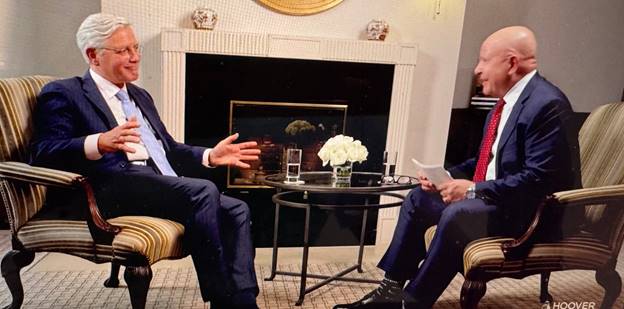
Palo Alto, CA: With relations between the United States and the European Union as tense as they’ve been for decades, Lt Gen HR McMaster (ret), former US national security advisor, author of Battlegrounds: The Fight to Defend the Free World and currently a senior fellow at Stanford University’s Hoover Institution, engaged Norbert Röttgen, deputy chairman of Germany’s Christian Democratic Union (CDU) party and member of the German Bundestag, on the future of NATO, the European Union and transatlantic relations, during his June 9 Battlegrounds program.
Asked by McMaster about the future of NATO and threats to the organization, Röttgen said in the digital world with the new possibility of artificial intelligence NATO is facing a real challenge of truth and credibility being undermined. “But it is functioning as well as it has in the past,” he stressed.
With presently some 40,000 American troops in Germany and about 80,000 in Europe, the US and European countries remain closely interlinked. We have strong economic relationships with companies working both in the US and in Germany. There are cultural links and friendship groups of all sorts, he said. “So, there is a normality that is ongoing. However, we have also the public communication that from time to time is not only critical, but it has an element of hostility which is something we deeply deplore.”
Regarding the desire of President Donald Trump and other American presidents for European countries to spend more money on defense, Röttgen said it was a “lack of responsibility” on Germany’s part to not pay more for its defense. His country was “hesitant, reluctant and resistant, and now we have to race against time,” he said.
McMaster pointed out, however, that Europeans are ramping up their spending on defense and critical infrastructure in an aggressive way, something which Röttgen, who travels frequently to Washington, noted is appreciated on Capitol Hill.
Delineating Germany’s foreign policy priorities, the first is that Europe must become the guarantor of peace and security in Europe, he said. “We have to assume this responsibility with the back-up of America. But there has to be a division of labor and conventional defense of Europe, and European security must become a European responsibility. This is the overwhelming goal we need to achieve.”
Priority number two is to either “retain, or maybe regain, our ability and capability to pursue a policy that serves our own interests, to assert ourselves,” Röttgen said. Both Germany and Europe have placed too much economic dependency on China, he opined. This could initiate retaliation against Germany if China were to “fundamentally disagree with a political decision we make” which could “place our ability to decide in a sovereign way and pursue our own interests in jeopardy.”
Finally, Röttgen stressed the importance of Americans and Europeans to continue in dialogue. “It gives expression to our emotional attachment,” he said. “We are friends and want to stay friends We are tied, not primarily and only by interests, but by values. We are living in dangerous times. But, if we stay together, we will prevail.”
(Elaine Pasquini is a freelance journalist. Her reports appear in the Washington Report on Middle East Affairs and Nuze.Ink.)
