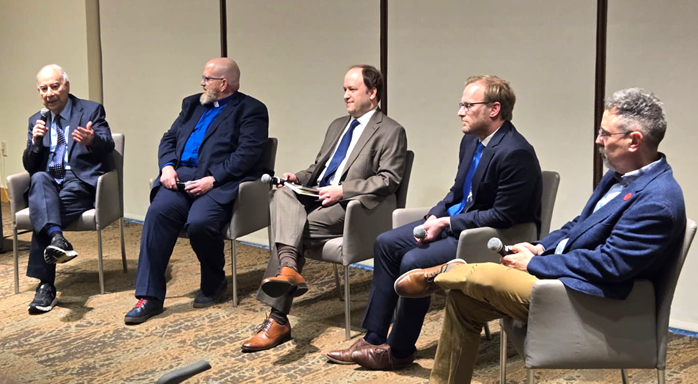
Dr Akbar Ahmed speaking to the panelists and audience during the screening of his movie ‘Journey into Europe’ at American University on April 13, 2026
The New Andalusia: Reimagining La Convivencia to Challenging the Clash of Civilizations
By Haider Waseem Anwar, Anum Tahir, and Sohaib Waseem Anwar
I. Introduction
The work of Dr Akbar Ahmed, who is a Distinguished Professor and the Ibn Khaldun Chair of Islamic Studies at American University in Washington, DC, highlights the pressing issue of declining pluralism in our modern-day paradoxical reality. This comment examines recent discussions about Dr Akbar's work to amplify the message that human progress is obscured by conflict and restrictive spaces that limit our prospects for coexistence and compassion. This present-day paradoxical reality is also succinctly described by Jonathan Sacks in his book titled ‘The Dignity of Difference’, where he mentions:
Too often in today’s world, groups speak to themselves, not to one another: Jews to Jews, Christians to fellow Christians, Muslims to Muslims, business leaders, economists, and global protestors to their respective constituencies. The proliferation of channels of communication - email, chat groups, the Internet, online journals, and thousands of cable and satellite television channels - means that we no longer broadcast. We narrowcast.
Dr Akbar's work and his voice call for a rethinking and resurfacing of the ideas of co-existence, which he describes through his work as the norms of our ancestral history. Therefore, he continues to promote among his readers the notion of meaningful dialogue and partnerships as a means to negate the misconstrued idea of ‘Clash of Civilizations’.
II. The Historical Blueprint: Lessons from the Salon Talks and the Film Screening
The Salon Talks with Dr Akbar, held on April 18th, 2026, offered a masterful distillation of his decades of anthropological and sociological research on the relationship between the Western and Islamic worlds. Drawing upon his vast experience as both a global diplomat and an academic, Dr Akbar provides a diagnostic framework for understanding the fractured nature of modern society. At the core of his argument was ‘Sulh-i-kul’ (meaning peace with all or embracing the universe), while the aim of his thesis was to revitalize the ‘La Convivencia’ (meaning coexistence or living together) to challenge the idea of the Clash of Civilizations and the framed narratives that overlook key historic references, places, and figures.
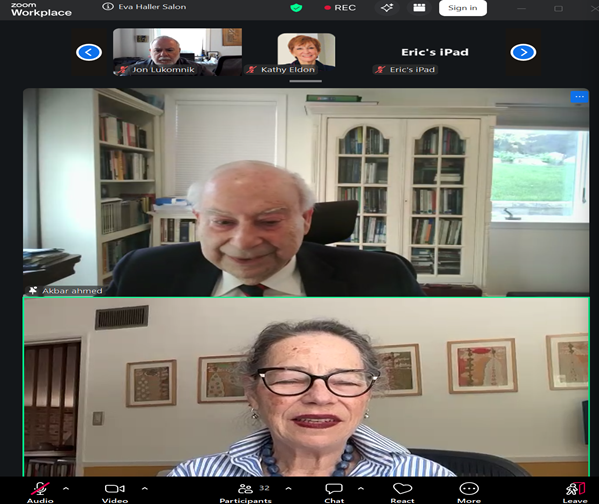
Dr Akbar Ahmed speaking at the Saturday Salon Talks held by Eva Haller and Heidi Haller Groshelle on the topic ‘Islam in Europe: Lessons for Us in the USA’ on April 18, 2026
Hiedi, who hosted the Salon Talk, wrote to Dr Akbar afterward to express her appreciation: “Hello Akbar - Thank you for sharing your precious time with us on Saturday [Salon Talk]. Your talk was packed full of information that expanded my knowledge tremendously. I bet that happened to everyone who joined us.” - Heidi Haller
In his talk, Dr Akbar recalled his early days at the American University in Washington, DC, after the 9/11 terrorist attacks. Knowing the Muslim community and experiencing American society, he realized the fractures that could emerge in post-9/11 times. To counter the false caricatures and deliberate manipulation of the Muslim identity in the West, Dr Akbar set out to study the Muslim identity in the West and help the Muslim World better understand the West. Starting with an understanding of America, Dr Akbar argued that national and cultural behavior can be mapped into three distinct categories: the primordial, the pluralist, and the predator. While primordial identity is rooted in traditional tribal loyalties, and pluralism upholds diversity and mutual respect, it is the rise of the ‘predator’ identity that defines today’s global crisis.
Dr Akbar explained that primordial societies have been left out, often divided by borders in the post-colonial era, and their resources have been exploited by the neo-colonial nationalist environment, pushing them to the peripheries of societies. The dominance of predator identity drives hyper-nationalism, economic protectionism, the erosion of democratic norms, and the harsh securitization of minorities. In the West, it appears in the dangerous appeal of the Clash of Civilizations narrative, where immigrants and Muslims are cast not as citizens or contributors, but as existential threats to cultural and political cohesion. To uphold pluralism and resist predatory tendencies, Dr Akbar urged a reinvigoration of the historical moments when interfaith harmony was not abstract but a lived, daily reality.
To do this, Dr Akbar pointed powerfully to the era of La Convivencia, the period of coexistence in Andalusia, Spain, as the ultimate historical counter-argument to the clash of civilizations. During this golden age, Muslims, Christians, and Jews actively collaborated. Dr Akbar produced a documentary and a book with a collection of interviews with the same title Journey into Europe as part of his project and that of his team. The documentary, which was screened on April 13th, 2026, structures this exploration into three distinct historical phases: the golden age of La Convivencia in Andalusia and Sicily, the era of Ottoman expansion in the Balkans, and the modern epoch of European colonization and immigration. To supplement this idea, Dr Akbar’s talk also resurfaced exemplary leaders from across the Muslim world and the West, such as Sultan Salah al-Din Ayubi, Caliph Omar, Frederick II, Holy Roman Emperor, Rabbi Moses ben Maimon (Maimonides), George Washington, and Thomas Jefferson. He also gave examples of the intertwined interests of European Muslims (Tatars in Poland) fighting against the Ottomans; and an example of Jewish Scholars (Maimonides) from Córdoba, Spain, advising Salah ad-Din Ayyub. Pluralism and interfaith interaction were what he referred to in his talk as the mingling of rivers that confluence into an ocean.
Connecting the dots to Dr Akbar’s work, Journey into Europe, we now wonder perhaps La Convivencia can be reimagined by achieving Sulh-i-kul between the West and the East. Dr Akbar’s primary historical finding is that Islam is not an alien presence in the West. Instead, through the collaborative efforts of Muslims, Christians, and Jews during the Middle Ages, Islamic scholarship and pluralism directly contributed to the European Renaissance and Enlightenment. This shared heritage demonstrates: first, that a harmonious multi-faith European identity is not just a theoretical ideal, but a historically proven reality. Second, the Enlightenment and civil society are not merely constructs that are alien to Muslim contributions. Both these arguments refute the
clas
h of civilizations.
Snapshots from Dr Akbar’s screening of his movie
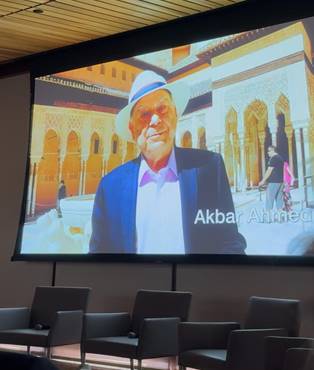
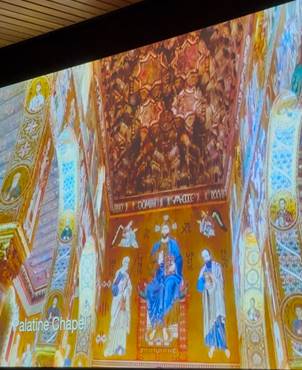
‘Journey into Europe’ at American University on April 13, 2026. Left image shows Dr Akbar in Alhambra. Right Image shows Palatine Chapel
III. The Modern Crisis
However, the documentary also starkly outlines the severe contemporary crises that threaten the West's framed identity. Dr Akbar highlights the devastating consequences of unchecked nationalism, most chillingly through the Srebrenica genocide, and documents the modern struggles of integration, the refugee crisis, and the alarming rise of right-wing xenophobia across countries like France, Germany, and the UK. During his journey to Europe, Dr Akbar witnessed both Antisemitism and Islamophobia, and, with his experience on the distinguished Runnymede Commission on Antisemitism in the late 90s as Pakistan’s High Commissioner to the UK and Ireland, leading into the current crisis, he explained: Unchecked nationalism spurs hate in various forms.
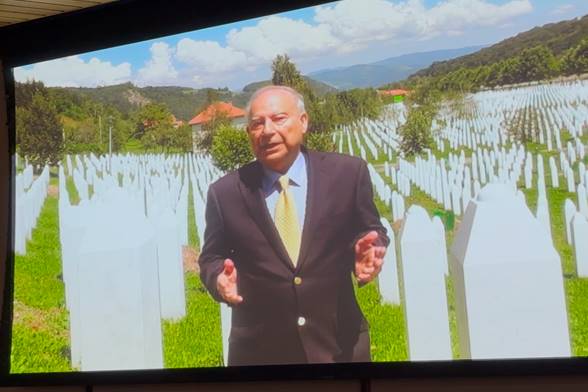
Image from the screening of ‘Journey into Europe’, Dr Akbar at the Srebrenica–Potočari Memorial
Therefore, the modern crisis and issue of Islamophobia is inextricably linked to the securitization of migration, a phenomenon where the migrant is aggressively framed as an imminent and existential security threat. Throughout the world, the politics of exclusion dictate restrictive and anti-migrant policies that damage the pluralist foundations of society. Ultimately, Dr Akbar’s argument, alongside his film, concludes that for us to challenge this clash and heal the fractures, we must reclaim its historical roots in pluralism, universal humanism, and mutual respect.
IV. Conclusion: Challenging the Clash, Forums for Dialogue, and Building a ‘New Andalusia’
Recognizing the shared history is merely the first step. The true challenge, as Dr Akbar posed to the audience, was being actionable: what will it take to actively build bridges between the deeply entrenched positions of the West and the East today? The answer requires a shift from the rhetoric of ‘clash’ to a sustained ‘dialogue of civilizations’. Politically, this means de-securitizing our approach to the migrant and rejecting the impulse to treat minorities purely at the periphery or as security issues. Educationally, it demands a reimagining of how we teach our global history, elevating our intertwined intellectual triumphs over our historic military conflicts. By revisiting great examples of compassion and coexistence and the pluralist peaks of our shared past, Dr Akbar provides a roadmap for bridging the existing divide.
Finally, at the community level, the creation of a ‘New Andalusia’. Dr Akbar called for meaningful dialogue and interaction at workplaces, neighborhoods, and across communities. His emphasis on Sulh-i-kul encourages individuals and community members at all levels, and especially the leadership, to interact, keeping peace for all at the forefront, which originates from the practice of understanding ‘the others’ perspective - fittingly summed up by referring to ‘Tartan’, a woven Scottish fabric, symbolizing the essence of inter-faith harmony. This is not a call for historical nostalgia, but a practical blueprint for the present moment. Dr Akbar’s impassioned address and work made abundantly clear: it takes immense courage to listen to ‘the other’ and to actively replace fear with understanding. All three of us, as the authors of this article, have had the privilege of joining Dr Akbar at various forums where he has presented the dialogue of civilizations. As members of the younger generation, it is a matter of pride that we have been part of this struggle.
(Authors: Haider Waseem Anwar: Currently a PhD Candidate in Urban and Regional Sciences at Texas A&M University and a Research Associate at the Hazard Reduction & Recovery Center. He also holds a master’s in international relations from Central European University, with a focus on the Securitization of Migration in Europe.
Anum Tahir: Currently serving as the Deputy Commissioner, Inland Revenue Service, Federal Board of Revenue, in Pakistan. She is a former Lecturer of English Literature at Forman Christian College University. She holds an MPhil in English Literature from Kinnaird College for Women Lahore, and has been the President and Editorial Board Member of the English Magazine Club at Kinnaird College for Women.
Sohaib Waseem Anwar: Currently an MBA candidate at Kogod School of Business, American University, where he also works as a Research Associate in corporate sustainability. He holds a master’s in environmental engineering from the State University of New York and an MSc in Corporate Environmental Management from the University of Surrey in the UK.)