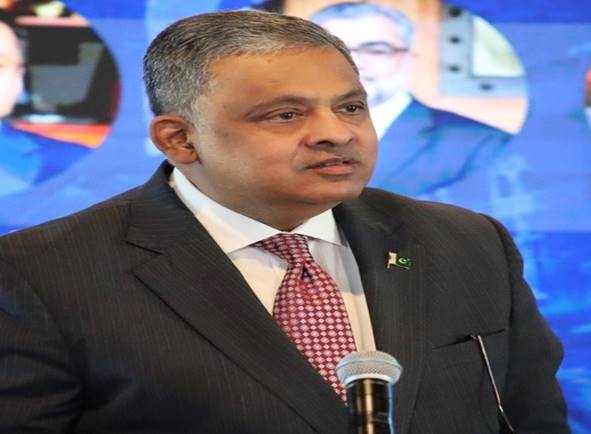
Despite threats arising from eastern and western borders, adverse conditions, and other challenges, Pakistan has always played a positive and successful role in regional and global peace and security, Ambassador Sheikh said
“Pakistan Plays an Important Role on Regional and Global Levels”: Ambassador Rizwan Saeed Sheikh
By Elaine Pasquini

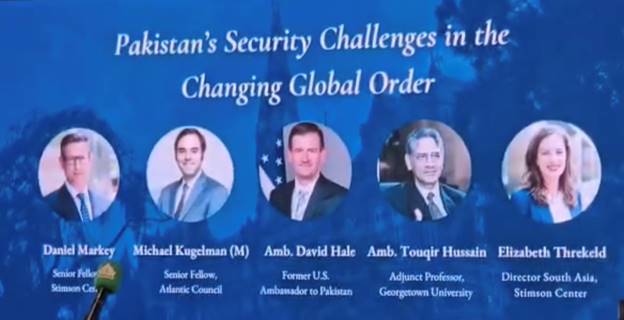
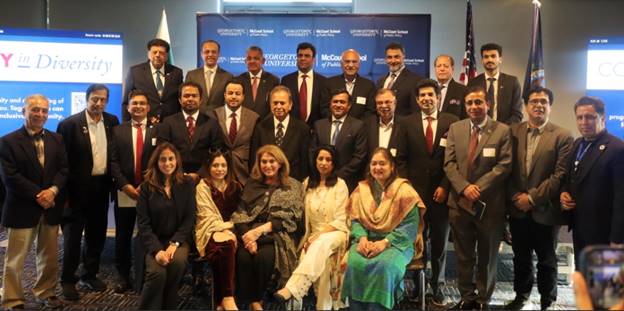
Washington, DC: “Pakistan’s Security Challenges in the Changing Global Order” was the topic of the fourth annual Pakistan-US conference hosted by Georgetown University’s McCourt School of Public Policy on April 20, 2026.
Delivering the keynote address, Rizwan Saeed Sheikh, Ambassador of Pakistan to the United States, noted: “For the past eight decades, Pakistan has been playing an important role on regional and global levels, both directly and indirectly,” he said, stressing the country’s geographical, political, and economic global importance.
Despite threats arising from eastern and western borders, adverse conditions, and other challenges, Pakistan has always played a positive and successful role in regional and global peace and security, Ambassador Sheikh said. In the current conflict, the expression of trust in Pakistan by the concerned parties as well as other countries in the region is a matter of pride and satisfaction. “Pakistan is playing its role with utmost sincerity, humility, sense of responsibility, and dedication,” he added.
His country has always played a leading role in efforts for peace, and “its role in establishing regional and global peace needs no introduction,” he continued. “Pakistan’s positive efforts and facilitation in the US-Iran conflict should be viewed in light of its successful diplomatic history.”
Due to its geographical location, “Pakistan can provide an important economic corridor between China, Central Asia and the Gulf states, and the closure of the Strait of Hormuz has further highlighted the country’s geographical importance in terms of corridors and logistics, he said.
While historical events have highlighted the country’s importance, the “challenges faced have also affected its economic and financial development,” he said. “We are among the world’s oldest civilizations, and we will continue to play our role in regional and global peace and economic affairs.”
Pakistan’s founder Mohammed Ali Jinnah had predicted that the country would become “a center of the world,” the ambassador noted. Even today after eight decades, “this vision of Quaid-i-Azam is still our guiding principle and destination.”
Ambassador Sheikh thanked the organizers for holding the conference, along with the leadership of Pakistani students studying at Georgetown University, especially Rai Hassan Masood Kharral, and the president of the International Academy of Letters, Ghazanfar Hashmi.
Other speakers included Michael Kugelman from the Atlantic Council, Elizabeth Threlkeld and Daniel Markey from the Stimson Center, Ambassador Touqir Hussain, adjunct professor at Georgetown University, and David Hale, former US ambassador to Pakistan, who analyzed the various challenges faced by Pakistan and its journey of economic development, along with its important future role at the global level.
(Elaine Pasquini is a freelance journalist. Her reports appear in the Washington Report on Middle East Affairs and Nuze.Ink.)