Origins and Trajectory of the Iranian Nuclear Program Analyzed at Stimson Center
By Elaine Pasquini

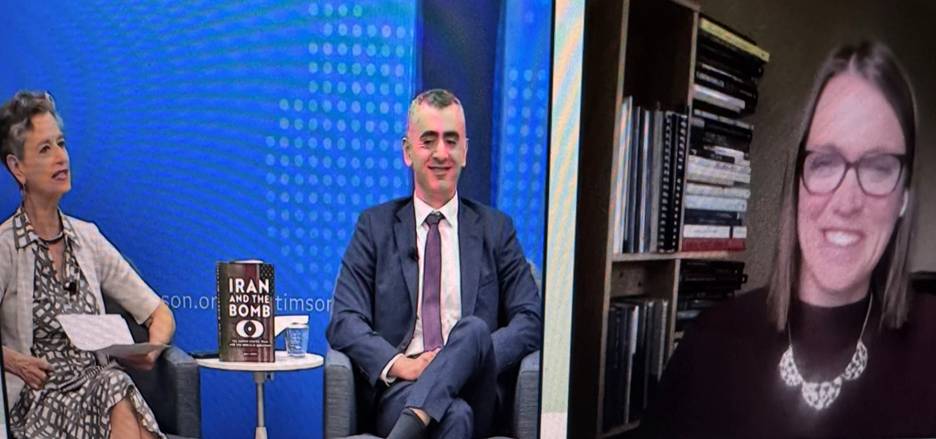
Washington, DC: Sina Azodi, author of Iran and the Bomb: The United States, Iran and the Nuclear Question, was Barbara Slavin’s special guest at the Stimson Center on May 18, 2026.
The book by the Iranian-American assistant professor of Middle East Politics and director of the Middle East Masters Program at George Washington University provides insights into Iranian decision-making about its nuclear program from the time of the rule of Reza Shah Pahlavi, 1941 to 1979, up to Operation Midnight Hammer when the US attacked Iran’s nuclear sites on June 22, 2025.
Slavin, author of Mullahs, Money and Militias: How Iran Exerts its Influence in the Middle East, and a distinguished fellow at the Stimson Center, noted that the US shared its nuclear expertise with Iran in 1957 when, under the Shah, the two countries enjoyed friendly relations.
At that time, Azodi said, “The Shah didn’t know what he wanted. The US simply gave Iran a nuclear program. The country was simply too underdeveloped that it couldn’t support an industrial size and large nuclear program.”
But, by the 1970s this program fundamentally changed, he explained. According to documents in the Jimmy Carter Presidential Library that he reviewed, the Iranian military under the direction of the Shah were working on nuclear weapons designs by that time.
Since then, three main drivers have pushed the Iranian nuclear program forward, he said.
First, the leaders of the Islamic Republic and the Shah strongly believed that Iran is alone in the region, no one likes the country and “if push comes to shove nobody will help it.” Azodi stressed. “And this is why Iran has to be prepared for the eventuality that a country will attack, and Iran has to defend itself on its own feet.”
Second, the Shah believed that Iran’s nuclear program was the symbol of the country’s modernization, which to him was synonymous to Westernization, meaning that if Iran made itself look like Western countries, it would also be modernized. His thinking was that since many Western countries had nuclear programs and they were all modernized and industrialized, Iran had to look like them. Iran’s current leaders share this mindset also, Azodi said.
Third, Iran, with a population of 93 million, feels it should have a nuclear program, especially uranium enrichment, to meet its energy needs, which are required to support modernization and Iran’s self-sufficiency.
Within internal Iranian debates on the need for nuclear weapons, some people don’t think they serve Iran’s national security interests in the long-term, but others, hardliners and the military, think if they had the bomb they wouldn’t have been attacked by Israel and the US.
Kelsey Davenport, director of the nonproliferation policy at the Arms Control Association, said that both the US and Iran are going into negotiations with maximalist positions and have different views on the talks.
“What we see on the Iranian side is a sort of kicking the can down the road on the nuclear program,” she said. “They are solidifying the ceasefire, dealing with the Strait and then taking some time to try to negotiate the details of the nuclear program.”
This strategy, Davenport argued, was a mistake in that President Donald Trump “doesn’t have the patience” for drawn-out negotiations. “It’s not his preferred style and the United States is not going to kick the nuclear can down the road when he has invested so much time in trying to create this narrative that Iran’s nuclear program poses a threat.”
But, if both sides are willing to show a little more flexibility, she said, they could narrow the gaps to meet both the Iranian concerns and the US concerns on the nuclear issue.
Slavin pointed out that, as far as we know, Iran’s nuclear program is suspended. She referred to an article in the Institute for Science and International Security that reported several underground nuclear sites in Iran were essentially still closed off and much of the enriched uranium “looks bottled up in sites where any movement can be easily detected, making the enriched uranium more difficult to access and use.”
“It seems the idea of kicking the can a little bit down the road would not be that dangerous despite what Donald Trump has said,” she argued. The focus instead, Slavin suggested, should be on the Strait of Hormuz issue which is of more concern right now to the international economy and Americans who are trying to buy gasoline.
According to Davenport, the Iranians want a nuclear program and uranium enrichment because it has become a national project that is deeply entwined in the identity of the state. “I also think Iran has wanted to keep open the option for weaponization if the strategic environment shifts and politically it has determined that nuclear weapons are necessary for the security for the state to deter future attacks,” she stated. “It is a contention between the US and Iran in negotiations as the US wants Iran to have no uranium enrichment.”
In conclusion, Slavin quoted a portion of the Forward section to Azodi’s book written by former diplomat John Limbert who was one of the hostages held in Iran in 1979.
“Limbert talks about the many times that Iran was invaded or forced to sign unequal treaties,” Slavin said, “one of which was the Treaty of Turkmenchay when Iran had to give up a lot of territory to Imperial Russia in 1828.” In his Forward comments, Limbert wrote: “The ghost of these humiliations still haunts US-Iran encounters, although most American officials believe that Turkmenchay is a drink one buys at Starbucks.”
(Elaine Pasquini is a freelance journalist. Her reports appear in the Washington Report on Middle East Affairs and Nuze.Ink.)