
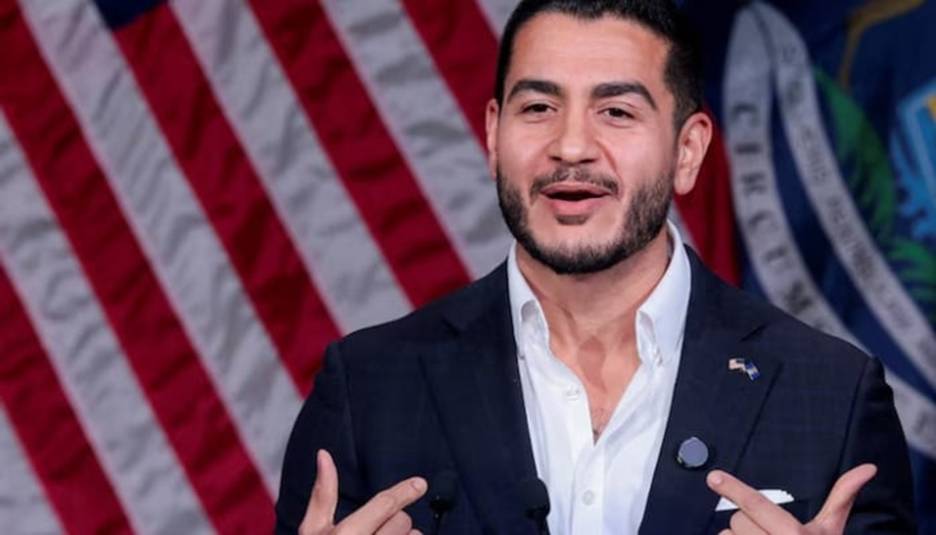
Democratic Senate candidate Abdul El-Sayed smiles after his victory in the US midterm elections, during an Election Night rally in Detroit, MichiganS, November 4, 2026 — Reuters
‘InshaAllah’ Turns into ‘Alhamdulillah’
Islamabad: “InshaAllah” has turned into “Alhamdulillah” for Abdulrahman Mohamed El-Sayed, the first Muslim elected to the United States Senate, who celebrated his historic victory over Republican Mike Rogers with a religious expression of gratitude.
Addressing jubilant supporters in Detroit on November 4 after his victory in Michigan’s closely contested Senate race, the 42-year-old Democrat recalled how he had repeatedly used the Arabic expression “InshaAllah” (God willing) during his election campaign whenever supporters asked whether he would win. “But today, tonight, we can turn that InshaAllah into a...” he told the crowd, deliberately pausing for supporters to complete the sentence with “Alhamdulillah” (Praise be to Allah). El-Sayed repeated the expression and added, “For the right-wing ops, that just means praise be to God.”
His remarks carried particular significance after his Muslim identity and use of Islamic expressions had become major targets of criticism during the campaign, with opponents portraying his religious faith as a potential threat to American national security.
Rather than attributing his victory to an individual political leader, El-Sayed thanked ordinary supporters who had knocked on doors, made telephone calls, contributed money and participated in the campaign. “You took a chance on the unlikeliest of candidates. So thank you. This is all yours,” he said, describing the victory as the achievement of a grassroots movement built around keeping money out of politics, putting money back into people’s pockets and providing Medicare for All.
His victory over former Republican congressman Mike Rogers made him the first Muslim ever elected to the US Senate. The election was held on November 3, and major American news organisations projected El-Sayed as the winner the following day.
El-Sayed refused to retreat in the face of attacks on him. Responding at a news conference in Detroit on October 26, he described the allegations as “deflections and deceptions based on no evidence”. He said his name and religious identity had nothing to do with the economic difficulties facing American households.
El-Sayed also rejected the allegations concerning the Muslim Brotherhood, telling Fox News: “I have never been a member of the Muslim Brotherhood, I never will be a member of the Muslim Brotherhood.”
Following his election victory, the senator-elect turned his attention to Vice President JD Vance, delivering one of the most memorable lines of his victory speech. Addressing Vance affectionately as “JD, habibi”, he pointed out that the vice president would be constitutionally required to administer his oath when the new Senate convenes in January. “JD, habibi, it is an irony — you are constitutionally obligated to swear me in in January,” he told the cheering crowd.
In another emotional part of his victory speech, El-Sayed paid special tribute to his wife, Dr Sarah Jukaku, acknowledging her support throughout his political journey.
Sarah Jukaku, an Indian-origin American psychiatrist, has herself attracted considerable attention following her husband’s victory because of her family’s ancestral connections with India’s southern state of Karnataka. Her family belongs to the Nawayath Muslim community, whose historical roots in the coastal towns of southern India stretch back several centuries. The family traces its ancestry to Bhatkal, a coastal town in Karnataka, approximately 140 kilometres from Mangaluru. Sarah’s father, Dr Jukaku S. Tayeb, is a nephrologist who studied medicine at Bangalore Medical College before moving abroad and eventually settling in Michigan in the 1980s.
Born and raised in Michigan, Sarah met El-Sayed while both were studying at the University of Michigan. Their relationship developed during their university years, and they married in May 2006. They have two daughters. He later discovered that Urdu was not his wife’s family’s native language and that her ancestral community in Karnataka had its own regional linguistic heritage. - The News International
