Revisiting University of Karachi-II: Human Stories from Karachi-VI
By Dr Ahmed S. Khan
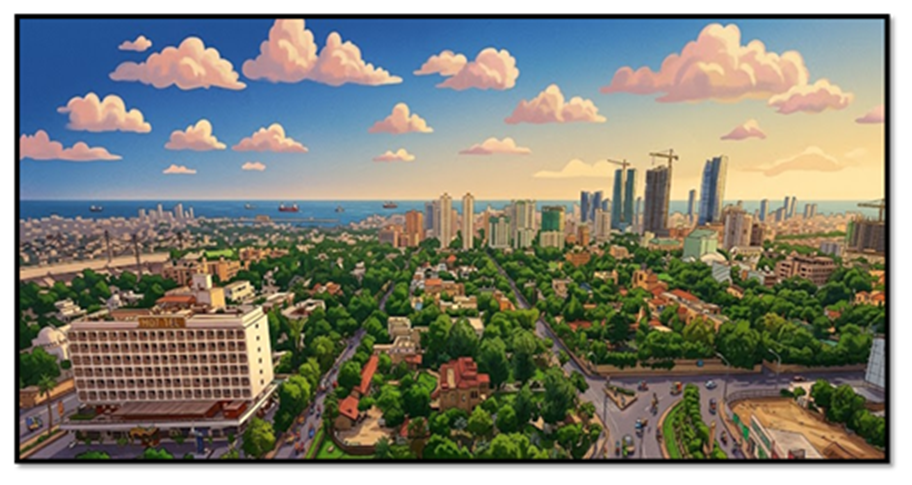
“You will yet be the glory of the East; would that I could come again, Karachi, to see you in your grandeur.”
— Sir Charles Napier, Governor of Sindh
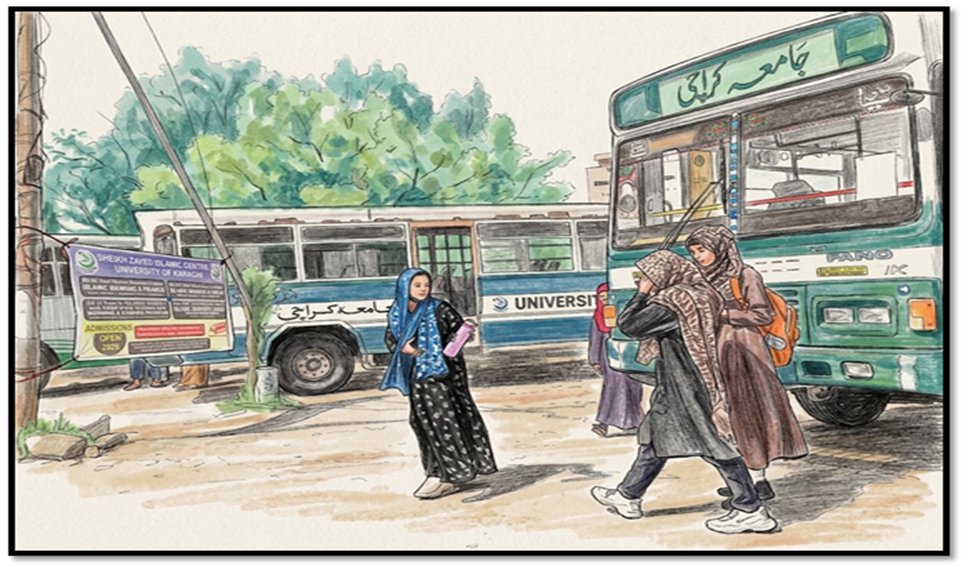
As everyone started enjoying karak chai, I asked, “Aap sub loog kaysay haiN (How are you all doing?)”
“Alhamdulillah, Allah kay sukar hay, sub khairiat hay,” one young student answered.
“Karachi University ka kya haal hay (How is Karachi University doing?)” I inquired.
“Haal is not good, as you can see” another student answered.
Then an elderly professor, who looked like Einstein, joined in: “Fifty years ago, the University Grants Commission did an excellent job of supervising the universities and advancing the cause of higher education. Then it was replaced by the Higher Education Commission. Again, the ruling elite brought in their own so-called ‘academic leaders’ who claimed to know everything about higher education, but the reality was quite the contrary. And then the federal role of the HEC was substituted by giving provinces their own HECs, and the decline of higher education started all over Pakistan. The majority of academic leaders governing HECs and universities in Sindh and across Pakistan are political appointees who are not only arrogant, but whose ignorance is reaching new heights.”
He took a sip of tea and continued: “In the 1990s, when I visited the Planning Division in Islamabad, one high-level bureaucrat told me that, ‘We will cut funding to state universities; they are not giving back value for money.’ Fast forward to the 2000s: due to massive funding cuts, student fees have skyrocketed. The fees range from Rs 35k to Rs 100k, depending on the field of study. In tough economic times, many families do not even earn this kind of money. As a result, many families have stopped sending their children to university for higher education. Many boys are forced to quit their studies and get some kind of job to support their families. Also, as a result, girl students outnumber male students at the university.”
Another young professor observed: “Waderas Inc and its supporters have destroyed Karachi, and like many universities in Sindh, they want total control of the University of Karachi, and they are working on it through their political clout. Look at the appointments. No one who deserves to be a vice chancellor is appointed on merit anymore; they are all political appointees, drinking buddies, people who cannot pronounce words correctly or write a paragraph in English without making errors! And such a breed of people is leading universities; one can guess what the outcome will be!”
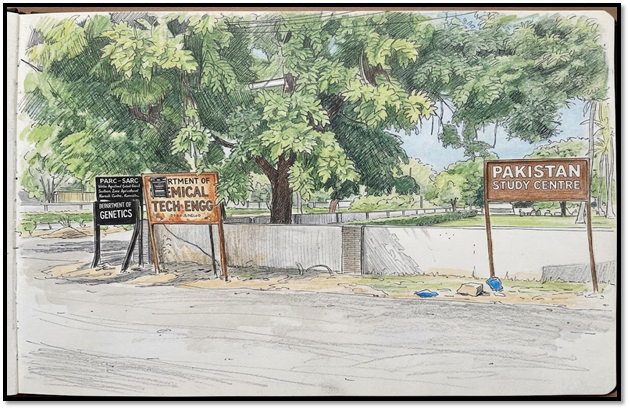
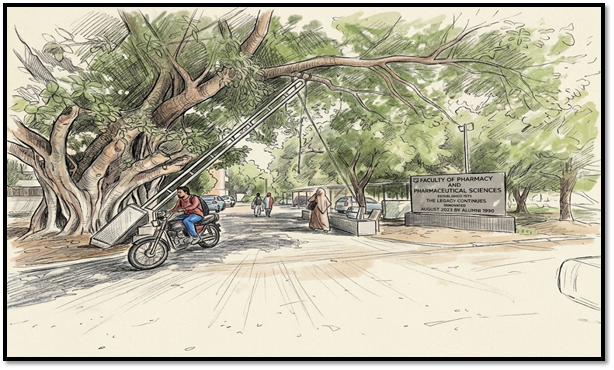
Another young professor expounded: “Fifty years ago, the university was a very clean place. Its majestic structure was impressively designed by a prominent architect, but today its concrete walls and roofs are corroded due to lack of maintenance and are waiting for heavy rains to crumble down. The structure looks more like ruins than well-maintained buildings.”
A sage-looking professor observed: “There is an unregulated mushrooming of private institutions. Lacking adherence to any rules or protocols of any sort, like country, private schools calling themselves colleges and universities are selling snake oil, raking in huge sums of money, and in return not providing quality education. Rather, they are diploma mills where ‘Nikamma’ goes in and ‘Nikamma’ comes out, and this pattern is being repeated from Karachi to Peshawar!”
They all nodded in agreement.
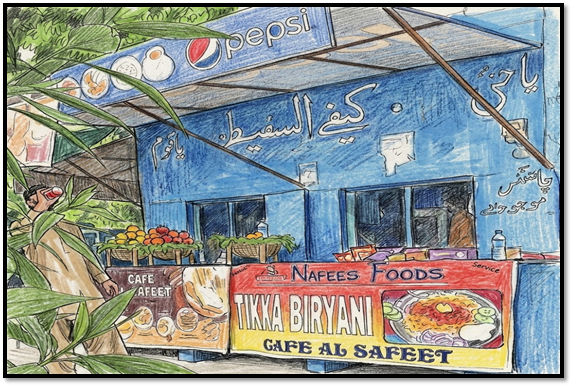
“How did the university campus get transformed into a food court?” I asked.
The Einstein-looking professor again answered: “Fifty years ago, there used to be two main cafeterias at the university where students would go to get inexpensive but quality meals, tea, and snacks. But today, due to poor leadership, the university resembles a food court; all major departments are surrounded by food shops and tea stalls, inviting students for biryani, nehari, tikka, samosas, and tea. As a result, students are spending more time at these meeting points rather than in their respective departments. Many students come directly from home to these food points and leave for home from here as well. In short, it’s a reflection of our society which has changed from Dar-ul-Kitab to Dar-ul-Kabab.”
I said, “Fifty years ago, students were very healthy and well-dressed; now students appear to be stunted?”
The sage-looking professor said: “That is true. Many families have been facing economic hardship during the last three decades, and inflation has impacted caloric intake, which in turn has affected the growth of the youth. Yes, today’s young generation is stunted, and it will impact brain size and brain capacity. Perhaps it is part of the script!”
The Einstein-looking professor joined in: “Well, talking of script! The people of Karachi are the torchbearers of Quaid-i-Azam and Allama Iqbal’s Pakistan. Karachi is the economic engine of Pakistan, and yet the colonial remnants are discriminating against the people of Karachi. Since the waderas came into power in 1972, Karachi has been going down. People up north living in their grand mansions remain clueless; they are following the script of their masters. The same script led to the division of the country in 1971, and now the same is being repeated! Only God knows where this discrimination and lawlessness will end!”
The sage-looking professor interjected: “This is the age of knowledge. We gained independence in 1947, and we are going backwards. China, gaining independence in 1948, has emerged as the second-largest economy in the world, thanks to its visionary and honest leadership! Even look at our South Asian neighbors. India, Bangladesh, Sri Lanka, and even Nepal have invested heavily in the development of their intellectual capital. Their youth are ready to provide future leadership. Our youth are fleeing the country, dying on the high seas, being drowned, gunned down by border forces in Europe, and being swallowed by pythons and other deadly animals of the Central American jungles in attempts to find a better future for them!”
The Einstein-looking professor added: “Looks like we did not gain independence in 1947. The colonial masters are controlling us through colonial remnants; they write the script for our corrupt actors! Look at the economic data and where we stand. We are in a state of economic meltdown; we borrow merely to keep up with debt servicing! The dumb and corrupt are on top! No regard for rules or protocols of any sort!”
“What happened to student leadership?” I asked.
The sage-looking professor replied: “Fifty years ago, the University of Karachi celebrated its 25th anniversary by celebrating its Silver Jubilee. The university had a very active student union and the presence of strong student groups like Jamiat, NSF, and liberals. Despite ideological differences, these groups provided students with a steppingstone toward responsible citizenship and leadership skills. To have total control over educational institutions, a ban on student unions was imposed, and since then there has been a vacuum in creating young leaders, indeed a national crisis. Today corrupt mafias, Wadera Inc and Paindoo Inc are pushing the country towards uncharted waters!”
“What is the state of teaching and learning?” I inquired.
The Einstein-looking professor answered: “In terms of teaching and learning, we are at the bottom of global education indices! Countries like China, Singapore, Japan, and South Korea are at the top! More than 40 million Pakistani children do not go to school! Thanks to Fake degrees! Fake schools! Fake teachers! Fake Mullahs! Fake leaders! We have become Fake Inc. We rank number one in terms of plagiarism of academic papers! Our fake leaders have not read a single book in their entire lives! Look at the state of libraries across the nation!”
The sage-looking professor observed: “We are not providing academic growth opportunities for our professors! Professional and technical currency among faculty plays an important role in the process of teaching and learning. As a result, many professors lack the appropriate credentials to be university professors. They lack experience in research and scholarship. Many departments are headed by people serving in ‘in-charge’ positions rather than by proper chairs or heads of departments. There are still many vacant professor positions due to a lack of resources, and they are being filled by cooperative lecturers and lecturers!”
The Einstein-looking professor said: “Today, global economies are being transformed by artificial intelligence. We gained independence, yet we never changed our methods of teaching and learning. We kept using the colonial educational policies of Lord Macaulay of 1836, whose aim was to produce low-cost administrative clerks and Westernized elite to rule the masses. Lord Macaulay’s policies have succeeded. This Westernized, corrupt, arrogant elite has hijacked Quaid-i-Azam and Allama Iqbal’s Pakistan. It is the 21st century; it is the era of brain power and freedom; countries cannot be ruled with a Genghis Khan mentality and brutality!”
The sage-looking professor recited Shauq Bahraichi's famous couplet:
Barbaad GulistaaN karnay koo buss aik He Ulloo Kafee Thaa
Her Shaakh pay Ulloo Baithaa hay Anjaam-e-GulistaaN Kya Hoga
To ruin the garden, a single owl was enough;
Now an owl sits on every branch. What will become of the garden?
The Einstein-looking professor recited Akbar Allahabadi’s famous couplet:
Kiss Kiss koo Yaad Ke’jeay, Kiss Kiss koo Ro’iay
Aaram baRi Cheez hay, Munh Dhank kar So’aiy
Whom should one remember, and for whom should one weep?
Comfort is a precious thing; cover your face and sleep.
A smiling student remarked, "Perhaps for this reason, the wittiest verse painted on the back of our trucks reads: 'Horn Ahista Baj'ain, Qaum Soo Ra'hi Hai' (Blow the horn softly, the nation is sleeping)."
A synchronized smile spread across all lips as they sipped karak chai.
Irfan looked at his watch and signaled to me that the time for the talk was approaching. We stood up, thanked the group for their insightful discussion and enlightenment, shook hands with them, and started walking toward the talk venue.
(Continued next week)
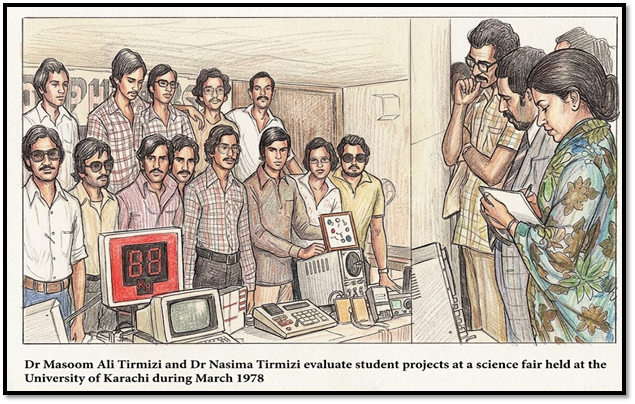
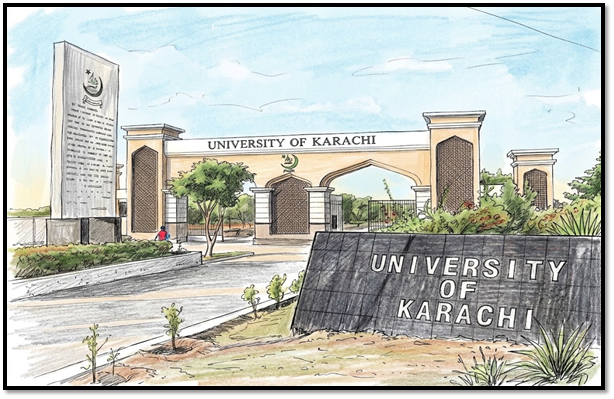
In celebration of its Silver Jubilee, the University of Karachi organized several student events—including a science fair and quiz and speech competitions. Additionally, the university published official volumes documenting its first 25 years and constructed the prominent Silver Jubilee Gate.