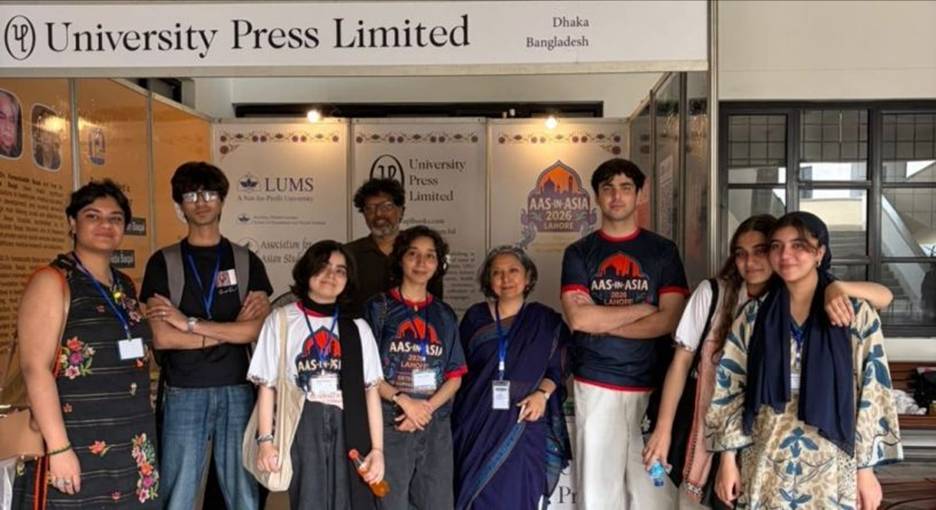
Mahrukh Mohiuddin of the Dhaka-based University Press Limited stall with volunteers and attendees in Lahore. For the first time, the Association of Asian Studies was convened in Pakistan drawing scholars and voices from across South Asia from Kathmandu to Lahore to celebrate the region’s shared cultural heritage. – Photo Abdul Rehman Sheikh
How an Asian Studies Conference in Lahore Bridged Geographical Gaps
By Noor e Emaan
Lahore, Pakistan
When the Association of Asian Studies announced at their last annual conference in Kathmandu, October 2025, that the next year’s conference would be held in Pakistan for the first time, a thought that crossed many minds was: Will the Indians be able to attend.
The apprehension turned out to be well-founded. Thirteen Indian academics were invited to attend the event, hosted at the Lahore University of Management Sciences, 25-27 September 2026. Not one of them was granted a visa.
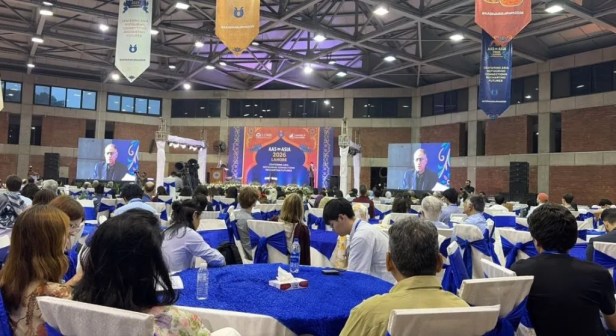
Opening ceremony - Photo Hamid Khan
Visas for Indians to Pakistan, and vice versa, have become almost impossible in the aftermath of the India-Pakistan conflict in May 2025. In this situation, some Indian scholars declined to participate even online, for fear of repercussions at home, the Bangladeshi origin conference host Elora Shehabuddin , president of AAS, and gender studies professor at UC Berkeley , told Global Southasia over email.
Dr Shehabuddin, who is also Director, Chowdhury Center for Bangladesh Studies at Berkeley, said that they had “experienced the reverse situation a few years ago” in India, when Pakistanis weren’t able to attend an AAS-in-Asia at Ashoka University.
So this time they had a backup plan: Hybrid sessions that enabled the Indians to participate virtually.
“All the Indians joined online,”anthropologist Ali Khan, who helped organise the conference, told Global Southasia. “I wrote to embassies, ministry of Interior, ministry of foreign affairs, explaining that we wanted to show we were better than denying visas to scholars, as had happened when it happened in Delhi. There was no response.” The Pakistani hosts worked hard to obtain visas for Indian and Indian-origin applicants, said Dr Shehabuddin, acknowledging how they reached out to contacts at the Pakistan foreign office and in embassies and high commissions around the world. However “even colleagues who’d been to Pakistan recently” weren’t granted visas.
“I guess visas are all about reciprocity so maybe in the end Pakistan didn’t want to come across as more open than has India in recent years,” she added.
Still, there was “a strong regional turnout, with South Asia making up the largest share, though most of that is Pakistan itself,” said Ali Khan, who is also Dean, Mushtaq Ahmad Gurmani School of Humanities and Social Sciences at LUMS.
However, they did manage to obtain visas for a few Indian-origin scholars based at universities in America or Europe.
South Asia comes to Lahore
More than a thousand participants and speakers from across the world attended the conference, with over 300 sessions and roundtables on diverse topics spanning research, politics, literature, religion and much more.
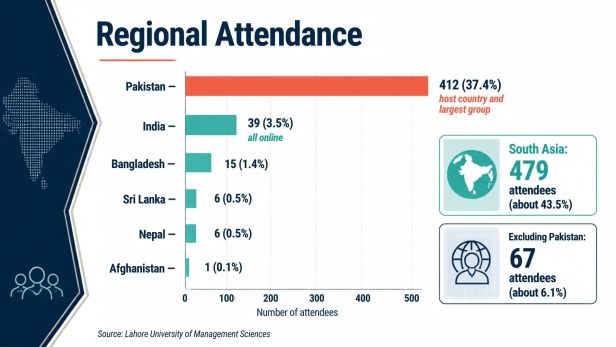
The Lahore University of Management Sciences shared attendance data for the Association of Asian Studies conference held in Pakistan in September - Canva
As a student at LUMS, I volunteered at the conference and was able not only meet, but also observe the interactions between the academics and intellectuals of South Asia.
In one hybrid session, Vazira Zamindar, historian and author of “The Long Partition and the Making of Modern South Asia,” sat with Safoora Arbab, from the Metta Center for Non-Violence, Petaluma, California. They were joined online by Rajeev Kadamani, Assistant
Professor at OP Global Jindal University, in India and Ajay Skaria, Professor at University of Minnesota.
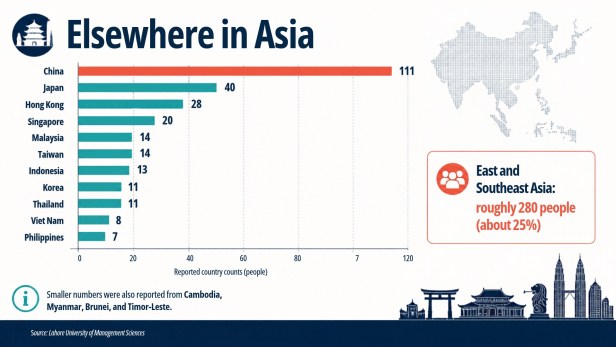
The Lahore University of Management Sciences shared attendance data for the Association of Asian Studies conference held in Pakistan in September. Canva
The session focused on Dr Zamindar’s new graphically illustrated book titled “When We Are Strangers,” about the relationship between Gandhi and Baccha Khan and how they are taught across South Asia today. The book, published by Penguin India is not sold in Pakistan, so the author brought in a few copies to distribute it to the session participant. However, it can be purchased online .
This act of bringing books that are not available within Pakistan and the fact that scholars in India could not attend due to visa issues showcases a disturbing reality. Trade and visa policies hinder cross border interactions. Only if an Indian scholar is affiliated to a university outside India can they hope to attend conferences in Pakistan.
The message is chilling, it affects the future of educational integration, possibly hindering the chances of future events such as the Association of Asian Studies.
Still, the cross cultural interaction through academia fostered a sense of shareness between the students and participants. Many students sat with professors and researchers from areas such as Sri Lanka and Bangladesh outside sessions.
“The conference was fantastic. LUMS did a really excellent job,” said Dr Shehabuddin.
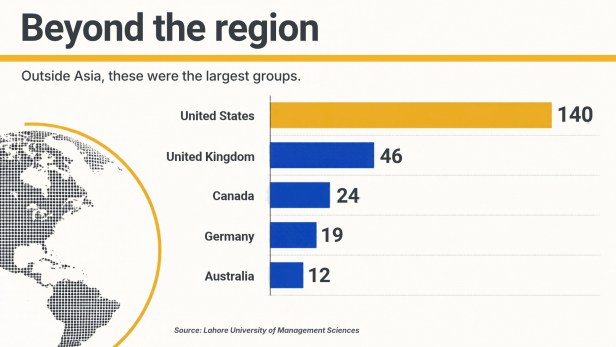
The Lahore University of Management Sciences shared attendance data for the Association of Asian Studies conference held in Pakistan in September - Canva
I had the opportunity to talk to the Managing Director of University Press Limited Mahrukh Mohiuddin, daughter of Mohiuddin Ahmed, the UPL founder who died in 2021. The Dhaka-based academic publishing house has been producing social science and politics related books since 1975.
She told me that this was her first time visiting Pakistan, along with her husband. She said that their understanding of Pakistan had until now been mainly formed through second hand sources like meeting Pakistanis elsewhere, or through literature. And yet, she said she felt a feeling of familiarity with the people of Lahore.
Such educational conferences are important, she said, since “they bring the conversation of South Asia from the people of South Asia” instead of narratives and perceptions from an outside perspective. “The narratives are shaped by Western scholars, but here (in the conference) they are shaped by the local scholars who are having conversations outside biases.”
States impose animosities and hostilities on the people, so that connections are lost, she added.
Cross-borders
Being held in Kathmandu in 2025 and now in Lahore allowed participants to maintain a continuous space for interaction and connection.
Exhibitions and performances focusing on history and culture over the three days included a special exhibition of the Toshakhana (Treasure House) of Ranjit Singh in the LUMS corridors, and a timeline of the Koh-e-Noor diamond.
A singing performance by Alya Rasheed of Dhrupad in praise of Lord Shiva, comparing him to the sun, moon and stars was followed after placing the art form in the contextual history of South Asia by Ayesha Nadir Ali. They even invited their mentors, the Talwandi brothers, Ali Hafeez Khan and Labraiz Afzal Khan, to perform different raags and taranahs towards the end in the style of Dhrupad.
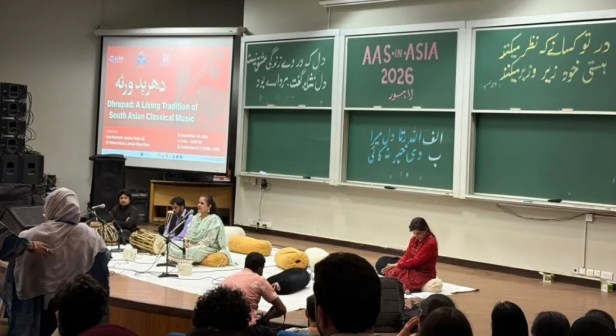
Dhrupad performance praising Lord Shiva - Photo Hamid Khan
The closing ceremony included elements of South Asian cultures such as a performance based on the works of the iconic poet Amir Khusro, by the renowned Kathak dancer and choreographer Adnan Jahangir, reminding viewers of a beloved, shared historical past.
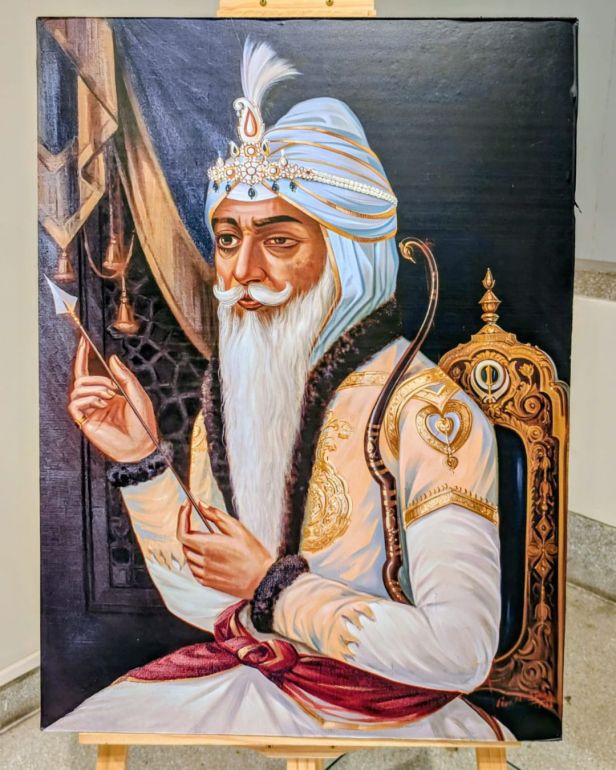
Painting of Ranjit Singh in LUMS - Photo by Aminah Mubashar
Students engaged actively with conversations around the conference. In a roundtable called “Third World vs the Global South”, students raised the questions on how internal LUMS violations of labour rights connect to the broader talks on exploitation of South Asian labour internationally by “first world” countries.
Platforms that promote education and scholarly research or work can also, thus, become a bridge between people. Learning about each other’s daily lives, at a level that does not involve political institutions, humanises the “other” in our minds. Such exchanges, upholding values of shared cultures, do not in any way invalidate the regional identity of the participants.
London-based Dr Krisna Uk, consultant director of AAS, termed the conference as “a great chance for people to meet with publishers and scholars coming from various places in the world.”
She also acknowledged the Pakistanis who came from different regions, whose presence further diversified the experience of the conference.
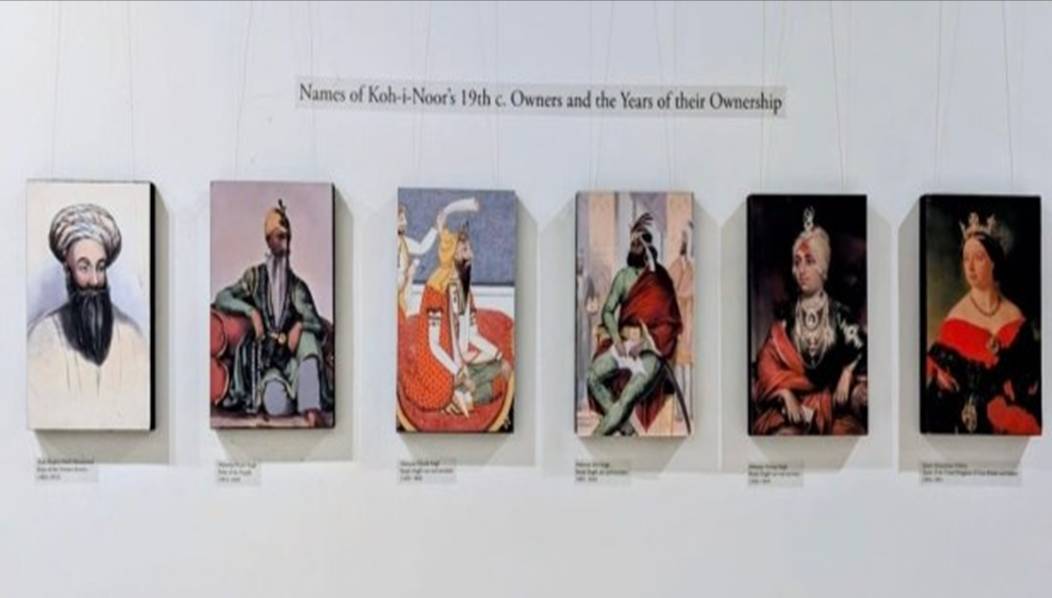
A timeline of Kohe-Noors’s owners, a part of the larger exhibition at LUMS - Photo Aminah Mubashar.
This is what AAS in Asia was able to achieve. Hopefully, there will be more such conferences in Pakistan, giving students access to top scholars. Perhaps it will also open doors to allow Pakistani scholars and students to also visit other Southasian countries.
For this to happen, universities and organisations need to continue to work on providing greater accessibility in terms of financial costs and affordability. The possibility of connection despite geography and border-politics is an endeavour that academia needs to embrace.
Founded in 1941, originally as publisher of the Far Eastern Quarterly (now the Journal of Asian Studies), the Association has undergone several developments in the quest to better serve “the broadening disciplinary and geographical interests of its membership”.
Next year’s conference will be in Malaysia “so fingers crossed that that’ll be easier for applicants from both India and Pakistan.” says Elora Shehabuddin.
(Lahore-based Noor e Emaan is an undergraduate student at LUMS, who first wrote for Global Southasia, then Sapan News, as a high school student. This is a Global Southasia syndicated feature sapannews.com)