
Mohamed Tarek (Light) Wins the 2026 Clash Royale League World Championship
By Dr A. Khan
Chicago, IL
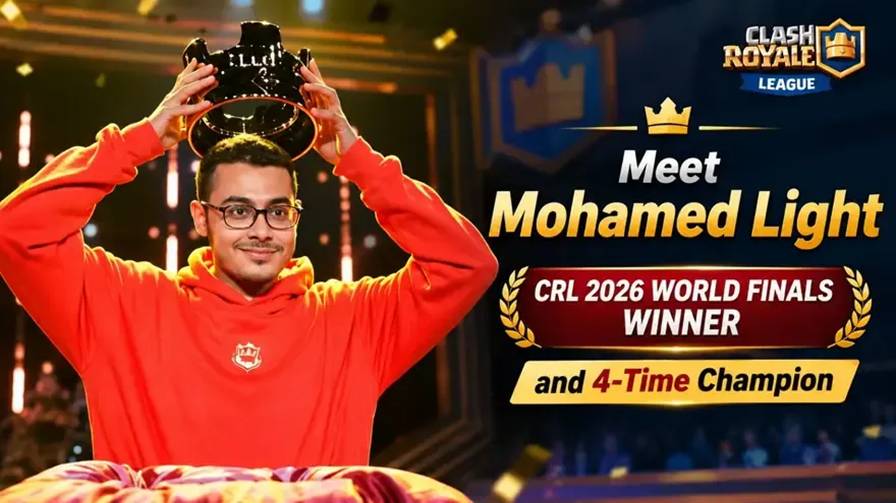
Mohamed Tarek, better known as Mohamed Light, won the 2026 Clash Royale League World Championship, which was held in China. Originally from Damietta, a port city in Egypt, he is a graduate of the Faculty of Computers and Information at Mansoura University. Mohamed Light is a professional Egyptian esports player who has established himself as one of the most successful competitors in the history of Clash Royale.
His 2026 victory marked his fourth world championship title and his third consecutive championship after winning in 2024 and 2025. In the grand final, he defeated Brazilian competitor Pedro and earned $200,000 in prize money. His success is often attributed to his ability to adapt to different opponents, recognize patterns, manage resources efficiently, and make effective decisions under pressure. His career demonstrates that competitive mobile gaming requires significant strategic thinking, analytical skills, and problem-solving ability.
Video games are popular among young people in both developing and developed countries. However, there are notable differences in the types of games that tend to dominate these markets.
In many developing economies, popular games include Garena Free Fire, PUBG Mobile, Roblox, Call of Duty: Mobile, Mobile Legends: Bang Bang, Ludo King, EA Sports FC Mobile, Stumble Guys, Clash of Clans, and Yalla Ludo. In developed economies, popular games often include Roblox, Fortnite, Minecraft, Candy Crush Saga, Call of Duty, Grand Theft Auto V, EA Sports FC, League of Legends, Clash Royale, and Rocket League.
While some of these games exist in both markets, differences extend beyond the devices used to play them. They also involve gameplay mechanics, player preferences, and the experiences they offer. In developing economies, highly popular games often emphasize fast-paced multiplayer competition, accessibility, and relatively simple gameplay mechanics. Titles such as Free Fire, PUBG Mobile, and Mobile Legends focus on survival, teamwork, combat, and direct competition with other players. Casual games such as Ludo King emphasize familiar rules, ease of access, and social interaction, and do not require and promote high level thinking.
In contrast, gaming preferences in developed economies often encompass a wider range of genres, including open-world exploration, role-playing, simulation, sports, and creative sandbox games. Titles such as Minecraft, Grand Theft Auto V, League of Legends, Fortnite, and Clash Royale frequently require varying degrees of strategic planning, creativity, resource management, adaptation, and problem-solving. These differences may be influenced by factors such as income levels, access to technology, internet infrastructure, gaming culture, and consumer preferences.
Clash Royale is a particularly interesting example because it demonstrates that mobile gaming can involve sophisticated strategic thinking. Players must manage limited resources, anticipate opponents' moves, recognize patterns, assess risks, and adapt their strategies in real time. Success requires balancing immediate tactical decisions with long-term planning. As a result, the game challenges the common assumption that mobile games are necessarily less intellectually demanding than PC or console games.
The achievements of players such as Mohamed Tarek highlight the educational potential of strategy-based games. Educators in developing countries may benefit from exploring how carefully selected video games can be incorporated into learning environments to help students develop critical thinking, strategic planning, decision-making, and problem-solving skills.
