Revisiting Nazimabad, Once the Intellectual Capital of Pakistan-I: Human Stories from Karachi VII
By Dr Ahmed S. Khan
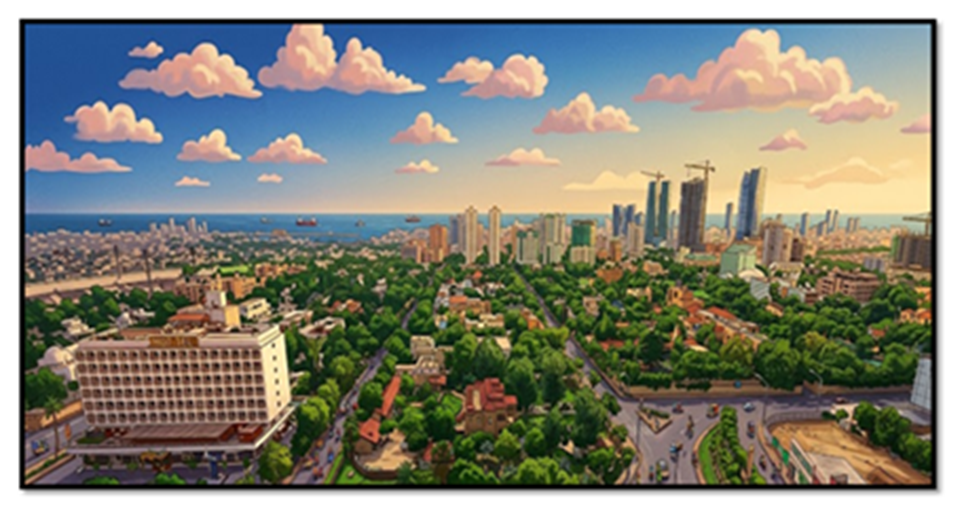
“You will yet be the glory of the East; would that I could come again, Karachi, to see you in your grandeur.”
— Sir Charles Napier, Governor of Sindh
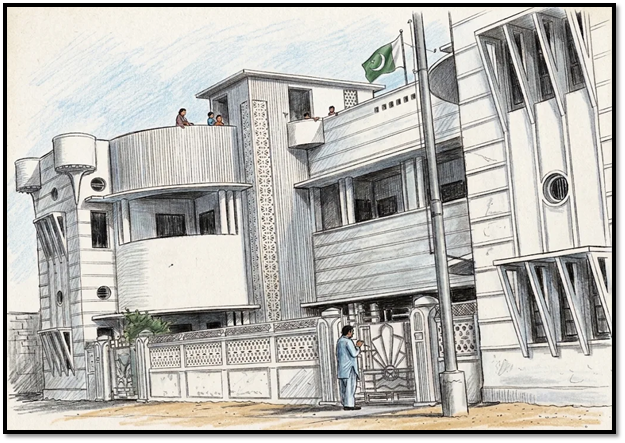
Darussalam — Our family home — Circa 1950s
As we drove from DHA to Nazimabad to visit the site of our family home, "Darussalam" (Nazimabad No 3)—once one of the area's most famous residences where General Musharraf’s family formerly lived—memories came rushing back. Like Darussalam, many other prominent buildings in Nazimabad, such as Rehmani Manzil, Sabtain Manzil, Jahaz Wali Kothi, and Gol Kamray Wala Makan, were landmark properties celebrated for their distinct architecture and locations.
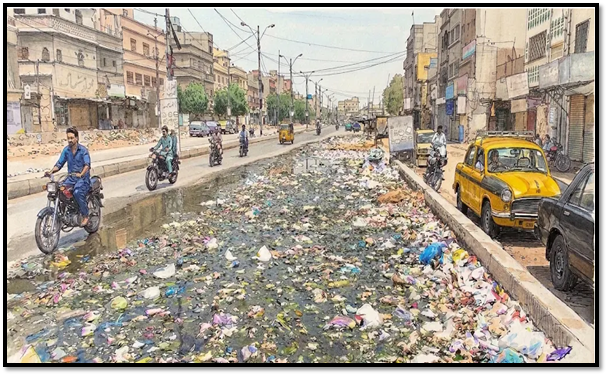
As we entered Nazimabad from the Chowrangi heading toward the petrol pump, Irfan gave a brisk tour of all five blocks. I was deeply saddened to see the widespread decay across roads, utility poles, buildings, parks, schools, bazaars, and even the general condition of the residents. Nazimabad appeared to be in worse shape than the underdeveloped rural areas of Sindh. Seeing this state of disarray triggered a rush of memories about its history, development, and evolution into the elite seat of Pakistan's intelligentsia.
Nazimabad was established in the early 1950s to resettle millions of Muslim refugees (Muhajirs) who migrated from India following Partition under immense hardship. Before independence, the land was a semi-arid, scrub-filled region located roughly 10 kilometers from downtown Karachi, dotted with small villages. In 1950, the Pakistani government acquired this land to relieve severely overcrowded temporary Muhajir camps, naming the area after Khawaja Nazimuddin, the nation's second Governor-General and later Prime Minister. Officially laid out in 1952 with subsidized plot distributions, Nazimabad benefited from structured urban planning designed for Karachi—the nation's capital at the time—featuring broad avenues, tree-lined streets, and generous green spaces across designated blocks. Settlers acquired plots at subsidized prices and relied on loans from the House Building Finance Corporation to construct their homes.
As the settlement matured, it evolved from a simple housing project into a powerhouse of Pakistani cultural identity—often affectionately called the "Paris of Karachi." The neighborhood became the premier home for the country's literary, artistic, and athletic elite. The air in Nazimabad's blocks routinely echoed with the sounds of street cricket, community mushairas (poetry recitals), and lively neighborhood debates. Family-oriented landmarks like the Relax, Nayab, and Shalimar cinemas flourished, drawing households out for afternoon matinees and community gatherings. Institutions like the Karachi School of Art and prominent medical centers took deep root, cementing Nazimabad's status as a prestigious, upper-middle-class haven defined by a tight-knit and civilized civic fabric.
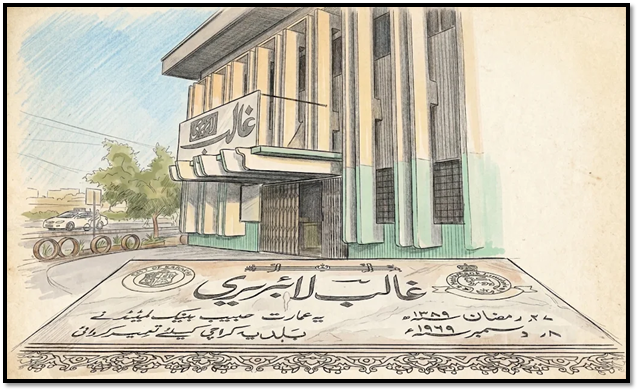
Ghalib Library — Circa 1969
During the 1950s through the 1970s, as Karachi became the vibrant hub for the country’s intelligentsia, Nazimabad entered its intellectual, cultural, and sports golden age. Memorable scenes flashed through my mind's eye: columnist Ibrahim Nafees walking in front of his home in Nazimabad No 1; artist Sadequain opening the door of Sabtain Manzil to welcome guests in Nazimabad No 1; columnist Nasrullah Khan strolling down a street in Nazimabad No 2; humorous poet Dilawar Figar trying to hail a rickshaw in Paposh Nagar (Nazimabad No 5); and seeing Zulfikar Ali Bhutto arrive in a Toyota Corona in the late 1960s to inaugurate the Pakistan People's Party office at Gole Market (Nazimabad No 3). I recalled Zaheer Abbas practicing his cricketing skills at Eidgah Cricket Ground in Nazimabad No 3, and hockey player Hanif Khan demonstrating his dribbling skills at the Bakhtiari Youth Center. In short, Nazimabad was home to countless celebrities and intellectuals, including Iqbal Mehdi, Ibn-e-Insha, Rais Amrohvi, Jaun Elia, Majnun Gorakhpuri, Mushfiq Khwaja, Dr Alia Imam, Allama Talib Jauhari, and Hakim Mohammed Said.
What truly set Nazimabad apart from its global counterparts — such as Montparnasse in Paris, Bloomsbury in London, Greenwich Village in New York, and Zamalek in Cairo — was the multi-dimensional nature of its heritage. While most historic global hubs excelled primarily in one discipline, whether fine arts, political theater, or literature, Nazimabad simultaneously anchored high intellect and physical athletic grit. In this master-planned garden suburb, a short walk down a tree-lined avenue could take you past an academic compiling regional history, a progressive orator organizing women's rights forums, and a dusty street where cricket dynasties like the Mohammad brothers or a young Javed Miandad were reinventing subcontinental sports. This rare intersection of refugee resilience, mid-century urban planning, and a concentration of diverse talent made Nazimabad a unique phenomenon in modern history.
Nazimabad boasted an extensive network of libraries, including the Ghalib, Allama Shabbir Usmani, Jigar Muradabadi, Al-Huda, and Sehba Akhtar libraries. There was also a popular network of neighborhood "Anna Libraries," where residents could borrow books for a token fee of one anna (when a rupee comprised 16 annas). Readers of all ages avidly consumed books, magazines, and digests—from Ibn-e-Safi’s spy novels to works by A.R. Khatoon, Naseem Hijazi, and Razia Butt, alongside various national and international digests. The major libraries were more than reading rooms; they served as the primary gathering spots for poets, researchers, and the literary elite.
The neighborhood was also a pioneering center for sports and early localized T20 cricket, including tape-ball innovations in the late 1970s. A young cricketer named Musa began wrapping tennis balls with electrical tape, sparking a new era of tape-ball tournaments during Ramadan nights. Key sporting venues included the Eidgah Ground, Nazimabad Gymkhana Cricket Ground, and the Bakhtiari Youth Center.
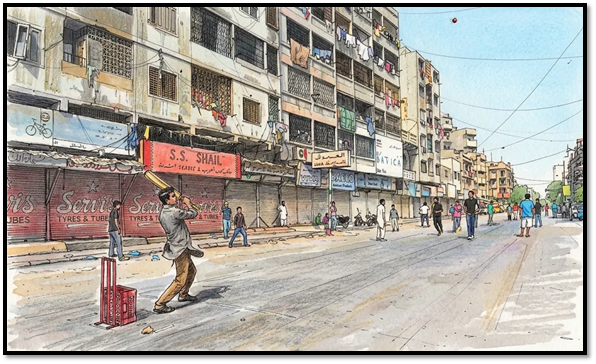
Tape ball cricket on the streets of Nazimabad
Additionally, Nazimabad housed major tertiary and general medical centers — such as A.O. Hospital, Dr Ziauddin Hospital, Abbasi Shaheed Hospital, and Hamdard University Hospital (Naimat Begum Al-Khidmat Hospital) — though most of these institutions face significant operational challenges today. The stretch from Chowrangi to the petrol pump formed an academic avenue featuring several prominent institutions, including Sir Syed Government College for Women, Premier College, City College, Government College for Education, and Government College for Men. Students across these institutions frequently united on civic issues, organizing demonstrations that typically began at Sir Syed College Chowrangi and concluded at Government College for Men near the petrol pump.
As Irfan drove past Government College for Men, my alma mater, my mind drifted back to the early 1970s during my undergraduate science studies. Two specific incidents stood out:
The Police Encounter: After finishing a long chemistry lab exercise involving the synthesis of aspirin, my classmates and I walked toward the bus stop, unaware that student demonstrations had occurred along the main road. Hearing the heavy thud of police boots, we realized officers were arresting students indiscriminately. We ran into the streets of Nazimabad No1 to evade them. The following day, we learned several students had been detained and stripped of their wallets and watches. One student reported this to an instructor from the National Cadet Corps (NCC), who went to the local police station, secured the students' release, and ensured their belongings were returned.
Air Marshal Asghar Khan’s Visit: While standing in the college garden one afternoon, Air Marshal Asghar Khan entered the gate and approached our group. He shared that the police were attempting to arrest him for speaking candidly on national issues. Supported by student union leaders like Ahmed Dara, students prevented the police from entering the campus and safely escorted Air Marshal Asghar Khan out through the back exit. Student union leaders actively resolved campus issues, supported by dedicated and considerate faculty members during what was a vibrant era for Karachi.
The decline of Nazimabad accelerated during the late-1980s and 1990s, driven by severe civic neglect, shifting demographics, and political instability. The communal atmosphere fractured following a tragic mid-1980s traffic accident in which a speeding bus killed a student named Bushra Zaidi, triggering widespread rioting fueled by poor urban infrastructure and systemic inequities.
Roughly 43% of Nazimabad's original families eventually left the neighborhood, relocating to newer developments like Gulshan-e-Iqbal or coastal areas such as DHA and Clifton. Many young residents emigrated abroad due to persistent systemic inequities linked to the regional quota and domicile system.
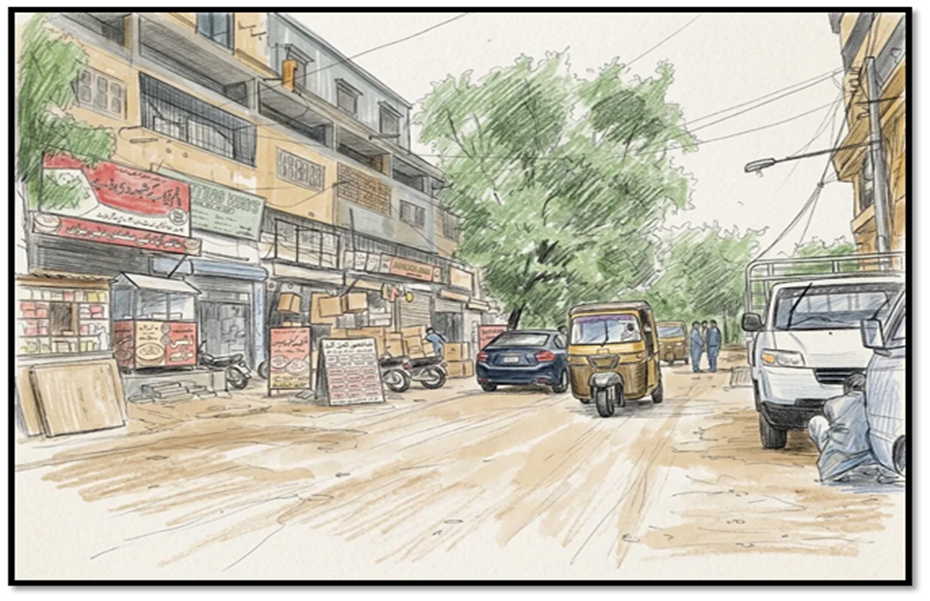
In the wake of this mass departure, lax building regulations and commercial pressures transformed the area. In Nazimabad Nos 1, 2, and 3, original family homes were demolished and replaced by dense, poorly constructed multi-story apartment buildings and wedding halls. This rapid densification overwhelmed the infrastructure, leading to severe water shortages, failing sewerage systems, and crumbling roads damaged by heavy commercial traffic. The small gardens and open spaces where children once played have largely disappeared due to illegal land encroachments ("China cutting").
Today, while managed under Karachi's municipal administrative framework, Nazimabad retains its historical roots, architectural remnants, Urdu bazaars, and community cricket traditions, while its population of millions navigates severe infrastructure deficits, sanitation challenges, and urban congestion.
(Continued next week)