Wit, Wisdom and Innocence: Human Stories from Karachi - I
By Dr Ahmed S. Khan

“You will yet be the glory of the East; would that I could come again, Karachi, to see you in your grandeur.” — Sir Charles Napier, Governor of Sindh
From an 18th-century fishing village called Kolachi to a bustling global megacity, Karachi’s evolution has been defined by strategic trade and massive migration. British railway and port developments laid the foundation, while the post-1947 influx of refugees turned the young nation's capital into an industrial powerhouse.
By the 1960s, Karachi was widely celebrated as the "New York of the East." It became Pakistan’s economic engine and financial hub, driving a massive share of the country’s industrial output, national revenue, and global trade.
From 1960 to 1980, Karachi was a dynamic, flourishing cosmopolitan city with immense global potential. This era is widely remembered as Karachi’s golden age.
By the 1990s, however, political corruption, feudals (waderas), and criminal mafias took hold of the city. Decades of misrule led to severe decay in public services and urban infrastructure, leaving this once-vibrant metropolis severely neglected. Today, Pakistan’s economic engine urgently needs maintenance, repair, and genuine ownership.
Yet, the true strength of Karachi has always been its people. Through unwavering resilience and community support, they continue to endure and adapt. During my recent visit, my friends Irfan and Iqbal were generous hosts who guided me through the city. Connecting with everyday Karachiites revealed their remarkable hospitality, warmth, and sharp, witty wisdom—as the following stories capture.
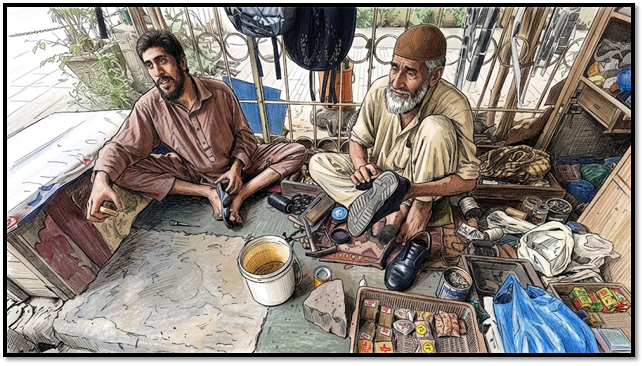
Mochi Sahib: The Sage
Irfan and I were driving from Nazimabad No 3 toward Gulshan-e-Iqbal. As we neared the Eidgah ground—once the famous cricket pitch where legends like Zaheer Abbas played in their youth, though now looking more like a garbage dump—Irfan’s phone rang. He pulled over to the side of the road to answer the call.
Looking out from the passenger window, I noticed a small area on the footpath where a mochi (shoe mender) and his assistant were hard at work. Since Irfan was engrossed in his conversation, I decided to step out of the car to get my shoes polished.
Approaching the cobbler, I greeted him, "Assalamu Alaikum! Can you please polish my shoes?"
"Wa Alaikum Assalam! Absolutely," he replied warmly. "As soon as I finish this shoe, I’ll take care of yours. It will only take five minutes. Take off your shoes and set them right here."
Curious, I asked, "What is your name?"
"Abdul Wahid Khan," he answered.
"Abdul Wahid Sahib, how much do you manage to earn every day? Two to three thousand rupees?" I inquired.
"No, sir, not that much," he said with a humble smile. "But Allah is merciful, and He provides enough for us to survive. Poor people often pass by with broken sandals; I repair their shoes for free without taking a single rupee."
As Abdul Wahid Sahib continued working, I noticed a colorful arrangement of small packets displayed at the front of his workstation—it was naswar (a powdered tobacco mixture).
"What are the different colors for? Are they different strengths? And how much do they cost?" I asked.
"No, sir," he explained. "They are different flavors! Each packet is thirty rupees, but they all do the same thing. Just one pinch, and a man feels like he’s floating in the sky!"
After finishing the repair he was on, he turned his attention to my shoes. First, he unlaced them and brushed away the street dust. Then, using his fingers, he worked boot polish into every nook and cranny of the leather. After a quick sprinkle of water, he took a large brush and began buffing—holding and rotating the shoe with one hand while skillfully gliding the brush from heel to toe with the other. The leather immediately began to shine.
Finally, he retrieved a small bottle containing a clear liquid and carefully applied it along the outer edges of the soles.
"What is that?" I asked.
"Yeh chamak hai!" (This is the shine!) he replied with pride.
Looking into his radiant eyes, a deeper question came to mind. "Insaan ki chamak kya hai?" (What is the true shine of a man?)
Without hesitation, he answered: "Pakka iman." (Strong faith)
"And what is man's second shine?" I asked.
"Achay akhlaq." (Good manners.)
His words revealed the true depth of his character. Sitting on that dusty pavement was no ordinary cobbler—indeed, he was a true street sage.
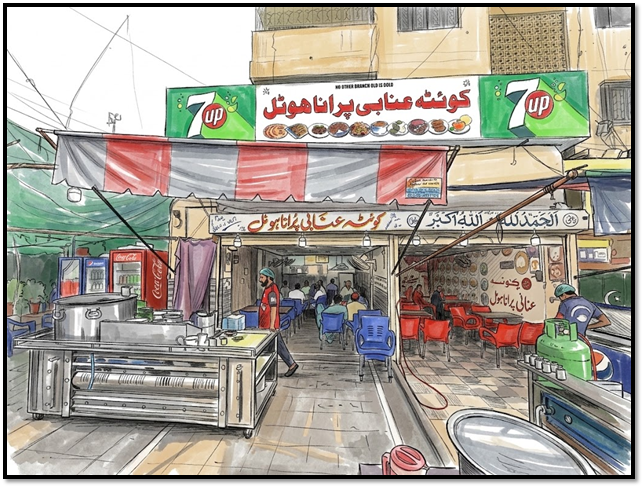
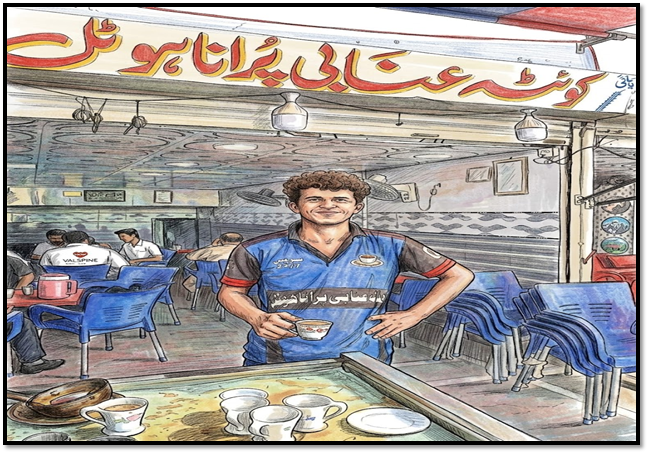
Waiter serving chai!
Quetta Unabi Purana Hotel: Ustad-Jee’s Secret to the Perfect Cup of Chai
Following a sumptuous dinner along the Gulshan-e-Iqbal food street, Irfan led our group—including our friend Iqbal—to the area’s most famous spot for tea: Quetta Unabi Purana Hotel. He insisted they served the best chai in town, noting that while many copycats had cropped up nearby, there was only one original. The shop's sign proudly declared: "Old is Gold."
As night fell, the hotel's colorful plastic chairs spilled onto the footpath, transforming the street into a vibrant lounge. Waiters and the Ustad-jee (tea master) darted around in matching branded t-shirts. In Karachi, as businesses shut down for the night, these Quetta hotels expand their seating onto empty sidewalks—much like nations claiming maritime economic zones—creating lively "chai zones" where friends and families gather to relax.
After ordering, I decided to observe Ustad-jee’s craftsmanship and strike up a conversation.
"Assalamu Alaikum, Ustad-jee! Aap Kasay haiN? (How are you?)" I asked.
"Theek hoon, Allah ka shukr hai (I am fine with grace of Allah)," he replied warmly.
"How long have you been making tea?"
"Ten years now," he said, turning the stove flame up.
"So, what is the secret to your delicious chai?" I inquired.
"Asli maal!" he declared proudly. "Quality ingredients—the best tea leaves, sugar, and pure milk."
To prove his point, Ustad-jee showed me the premium leaves they bought in bulk (a 40 kg bag costing more than Rs 50,000), pointed to a container of crystal-clear sugar, and lifted the lid off a massive pot of simmering, cream-rich milk.
"That's all great, Ustad-jee, but how do you get such a distinct flavor?" I pressed.
"After mixing the ingredients, I let it boil for a long time."
"I do the exact same thing at home," I countered, "but my tea never tastes like yours."
He shrugged with a grin, insisting it was simply a mix of top-tier ingredients and his decade of expertise.
His answers hadn't revealed any hidden magic, but as we chatted, I watched him strain our tea into paper cups. When he finished, he set down his large iron-mesh strainer. Looking closely, I noticed the strainer was covered in a thick, dark crust of tea leaves that appeared to have built up over weeks, fully embedded in the wire mesh.
It suddenly hit me: that unwashed, heavily seasoned strainer was probably infusing every brew with months of concentrated flavor. That was Ustad-jee’s true secret recipe!
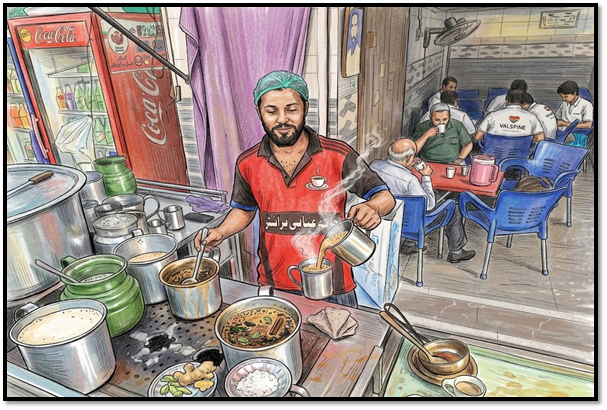
Ustad Jee displaying his craft!
Mini Mart’s Khan Sahib: Providing "Community Service" for Stress Relief
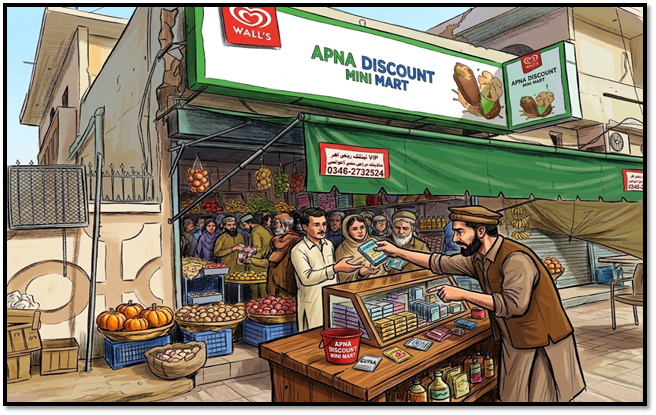
During a visit to DHA, Karachi, I stopped by a mini-mart to buy some snacks. I gathered my items and waited in line to check out. The counter was crowded, and the shopkeeper, a local Khan Sahib, was incredibly busy. I watched a strange, fast-paced transaction repeat itself: a customer would approach, extend a closed fist to hand Khan Sahib money, and in a swift, seamless motion, Khan Sahib would slip something back into their hand before the customer quickly hurried off.
After waiting nearly twenty minutes, it was finally my turn. Curiosity getting the better of me, I asked him, "What is everyone buying? What exactly are you handing them so quickly?"
Khan Sahib replied that he was simply helping people deal with their stress. For just 25 rupees, they were buying a khula (loose) cigarette for Rs 15 and a small sachet of gutka for Rs 10. (Gutka is a potent, highly addictive dry powder made of crushed areca nut, tobacco, slaked lime, and wax—a substance unfortunately linked to rising mouth cancer rates among Karachi’s youth).
Khan Sahib explained that the combined buzz of the cigarette and gutka lasts for about two hours. In his eyes, providing two hours of stress relief for 25 rupees was a necessary public service.
"Aap kon sa brand cigarette detay hain?" (What brand of cigarette do you give them?) I asked.
"Sab se sasta wala," (The absolute cheapest one), he replied.
I then asked what happened to K2, a cigarette brand that was wildly popular among the masses during the 1970s.
Khan Sahib, the self-proclaimed provider of community service, flashed a grin and delivered a perfectly timed, comical reply: "K2 peenay walaay to kub kay K2 chaRh chukay!" (The people who used to smoke K2 climbed the K2 summit long ago!)
With his unique blend of "social work" and sharp wit, Khan Sahib turned out to be a brilliant hybrid of Abdul Sattar Edhi and Moin Akhtar.
Hibib Ullah: The Technology Novice
Even in today's era of artificial intelligence, many people in the developing world remain disconnected from modern technology. The digital divide between urban and rural areas can be so vast that it often feels as though people are living in completely different centuries.
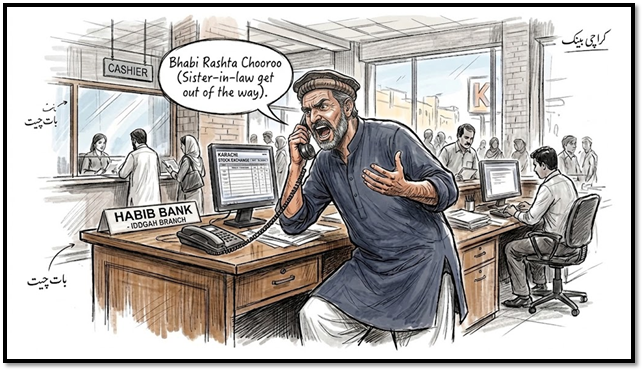
My friend Irfan shared a humorous story about a bank employee who was entirely new to such technology. Hibib Ullah worked as a messenger at Habib Bank’s Iddgah branch during 1990s. Hailing from a rural area in northern Pakistan, he had very little exposure to the devices his colleagues used every day.
Irfan, a senior staff member at the branch, recalled a day in early1990s when the office was quietly buzzing with routine work. Suddenly, the staff heard a distressed Hibib Ullah yelling into a landline phone repeatedly: "Bhabi, rasta chooroo!" ("Sister-in-law, get out of the way!").
Confused, his coworkers gathered around to ask what was wrong. Frustrated, Hibib Ullah explained, "Bhabi rasta nahi chor rahi" ("Sister-in-law is not getting out of my way. I have been trying to dial a number for quite some time, but she just won't let me through!")
It turned out that Hibib Ullah was trying to make a call through the old telephone exchange system, but the line was busy. Every time he dialed, he heard an automated female voice stating: "The number you have dialed is busy; please try again later." Unfamiliar with recorded messages, Hibib Ullah assumed a real woman was on the line, stubbornly blocking his call.
Amused, the staff gently explained that there was no "Bhabi" blocking his path—it was simply a recorded message indicating the telephone lines were occupied, and he just needed to try again later.
While the story is lighthearted, Hibib Ullah is not alone in his confusion. For countless people across developing nations, the rapid pace of innovation means they are still navigating a world where basic technology and digital literacy remain entirely foreign.
(Continued next week)