
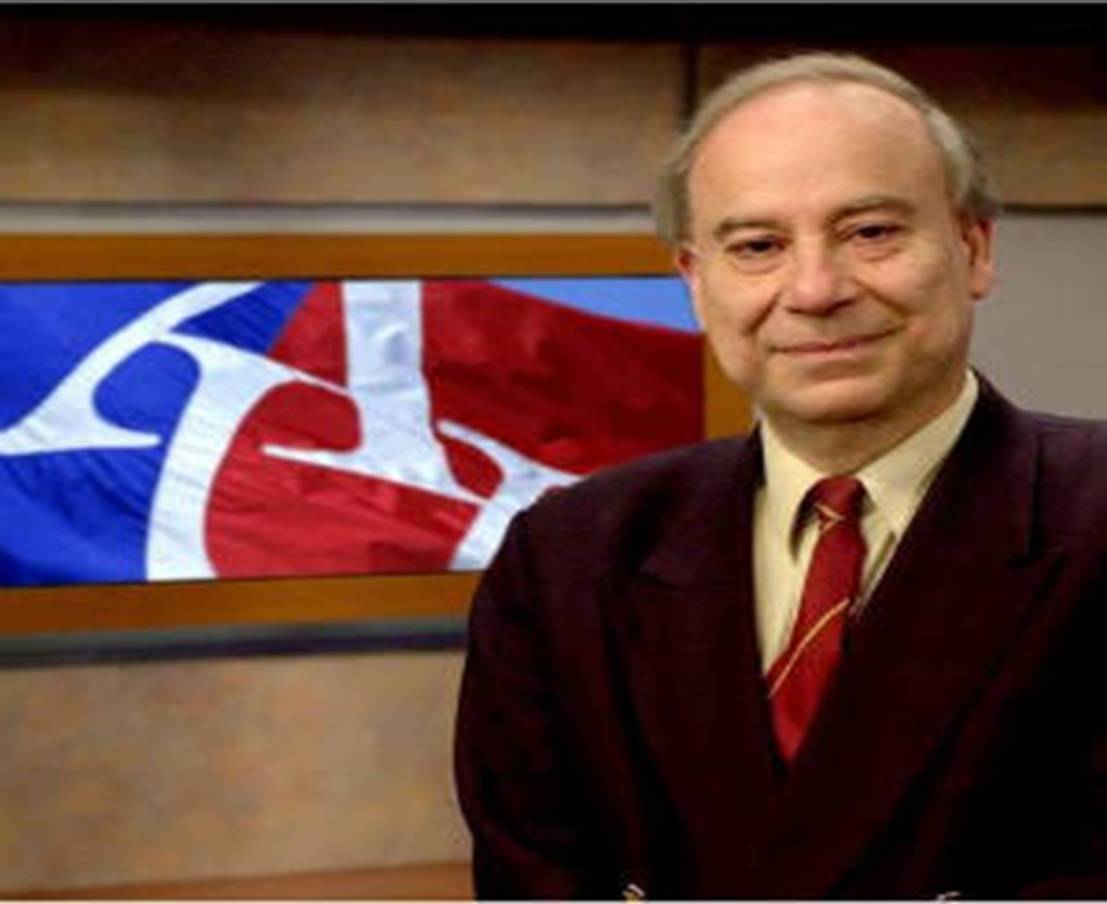
Photo American University
Ambassador Akbar Ahmad Khan - True Ambassador of Humanity
( In the herculean task of cementing inter-faith bonds in today’s troubled world, Dr Akbar Ahmed, Ibn Khaldun Chair of Islamic Studies at American University, Washington, DC, stands out. “Functioning between both worlds, through his writing and broadcasting,” Wikipedia testifies, “Ahmed has attempted to bridge the Muslim-West world divide and encourage communication between both groups”. He has published several insightful books – work of dedicated scholarship – based on his journeys into the United States and Europe in the company of a select group of researchers - and excelled in the role of advisor to President George W. Bush and Prince Charles on Islam. His lectures in places such as the US Congressional retreat in Greenbrier, the National Defense University in Washington DC, the State Department and the House of Lords in London, have been well received. Hence, the ardent desire of the late Barry Hoffman, Hon Consul General of Pakistan in Boston, who symbolized Jewish-Muslim friendship, “If there were only 1,000 Akbar Ahmeds! It would be such a wonderful world.” Reverend John Bosco concurs with him in his tribute to the accomplished Pakistani. – Editor)
By Rev John Bosco
London, UK

Last month, I had the chance to attend a theatre production organized by SOAS, University of London. The play, titled “Gandhi and Jinnah Return Home,” is based on Professor Akbar Ahmed’s work and directed by Manjula Kumar. This production explores the eternal 'What if' questions of history and concludes on a hopeful note, envisioning a peaceful future for South Asia.
As a viewer, I found it fascinating how the play intertwined the lives and legacies of Mahatma Gandhi and Quaid-i-Azam Muhammad Ali Jinnah, two pivotal figures in the history of the Indo-Pak subcontinent. Written by Akbar Ahmed, the production was a powerful and thought-provoking examination of their stories, delving into their experiences, beliefs, and interactions.
Watching this play reminded me of my first encounter with the author, Professor Akbar Ahmed, in 2012 at Lambeth Palace, the London residence of the Archbishop of Canterbury. This meeting was facilitated by a mutual friend, Mr James Shera, MBE, a Pakistani Christian, the first Pakistani mayor of Rugby, and the only Pakistani in the UK with a road named after him. Sadly, Mr Shera passed away this February.
Rev Rana Youab Khan, the assistant to the archbishop in interfaith matters, organized a round table discussion. During this discussion, some of us had the chance to raise questions about the mistreatment of minorities in Pakistan, particularly Christians. It was my first interaction with Professor Akbar Ahmed, accompanied by his daughter Amineh Hoti. I noticed that he listened patiently to some tough questions from us and acknowledged the mistreatment of minorities. He also praised the contributions of Christians in the subcontinent in the fields of health and education. He mentioned that he received his elementary education from Burn Hall School, founded in 1943 by members of Saint Joseph's Missionary Society of Mill Hill (MHM). He expressed great respect for the Christians and admired the priests who taught him respect and love for others.
During the meeting, he shared that for a moment, Muslims and Christians had connected, both intellectually and emotionally. He saw hope for humanity in that moment. This was very encouraging to me, given his deep understanding of diversity and different faiths.
Before this meeting, I did not know much about Professor Akbar Ahmed. I must admit that my knowledge of his services throughout his professional career in Pakistan and abroad was limited. Ambassador Akbar Ahmed Khan is a distinguished professor and the Ibn Khaldun Chair of Islamic Studies at American University and a Wilson Center Global Fellow in Washington, DC. He was Pakistan High Commissioner to the UK and Ireland. Professor Ahmed’s career has included distinguished posts in both academia and public service. He has won the Star of Pakistan award, the inaugural Gandhi Peace Award, and, with Professor Judea Pearl, the inaugural Purpose Prize.
I will always remember when he voiced his concern in his 2017 HuffPost article, “Stop Killing the Christians of Pakistan.” He underscored the profound ironies of Pakistan, pointing out that the nation's founder spent his first and last Christmas in a church with the Christian community to show his support for minorities. Muhammad Ali Jinnah, the Quaid-i-Azam, was dedicated to ensuring that Pakistan's minorities were fully included as citizens and treated as equals. The Quaid would be deeply distressed and heartbroken to see this fundamental challenge to his broad and inclusive vision for Pakistan. Building bridges of understanding and compassion between our faith communities is more crucial and urgent than ever in this global crisis of pluralism.
He also emphasized that we have two choices in Pakistan: support and protect the minorities in the spirit of the Quaid or watch the nation disintegrate before our very eyes. He was optimistic that many Pakistanis are responding passionately and swiftly to the Quaid’s vision.
I'm not certain if he will succeed in uniting the people of Pakistan and India as depicted in his recent play “Gandhi and Jinnah Return Home.”
However, through his various articles, interviews, and the few times I have had the opportunity to interview him, I have observed that he believes in humanity and cherishes God's creation, regardless of religion.
He is dedicated to peacebuilding. I believe that if we had more individuals like Ambassador Akbar Ahmed, who strives to foster peace among different religions and shape Pakistan in the spirit of Jinnah, we would be better off.
He not only promotes harmony but also spreads the message of love, advocating for both countries to coexist as they did before partition, tolerating each other and encouraging cross-cultural understanding. He firmly believes in respecting others’ positions and replacing criticism and defensiveness with calmness, clarity, curiosity, and compassion. When peace and harmony are maintained, things continue to run smoothly without delay. In other words, while war destroys and disrupts, peace builds, strengthens, and restores. Although he served as an ambassador for Pakistan in the UK, I would say he’s an Ambassador of Humanity.
(Rev John Bosco is anchor and freelance writer, interfaith activist, community leader and spokesman of the Pakistani Chistian community. john316bosco@gmail.com )
