Image The Republic of Rumi
Goethe—Europe’s Rumi
Akbar Ahmed, Frankie Martin, Dr Amineh Hoti
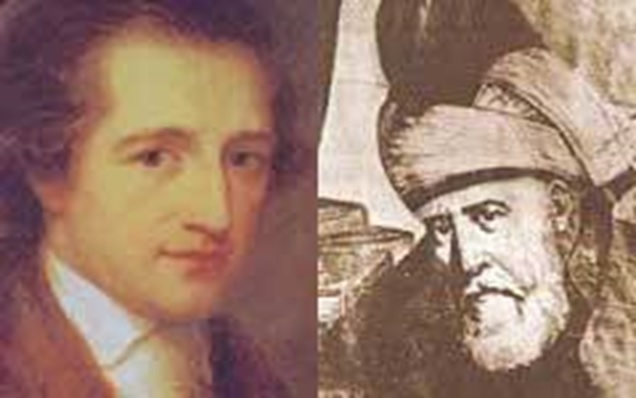
During fieldwork in Germany for our study Journey into Europe about Islam in Europe, the subject of Johann Wolfgang von Goethe, Germany’s greatest literary figure, frequently came up. At a time when anti-Islamic and anti-migrant sentiment was surging—the popular Alternative for Germany (AfD) party ran on the slogan “Islam is not a part of Germany”—Muslim leaders asked, how can Islam be incompatible with Germany when Goethe himself wrote entire works reaching out to the Islamic world and authored a beautiful poem about the Prophet of Islam? Bekir Alboğa, the head of the largest Islamic organization in Germany, the Turkish-Islamic Union for Religious Affairs (DITIB) told us that Goethe “wrote a wonderful poem about our Prophet” and was “like a brother to me.” Another Muslim official, Ayşe Aydin, who directed press for DITIB, proudly and dramatically recited versus from Goethe’s Faust, considered the greatest work of German literature, for us when we met her at Cologne’s Central Mosque. She stated, “I am very German!”
It is difficult to overstate the importance of Goethe for Germany, and for Europe as a whole. The most eminent thinkers, political figures, artists, and composers of the continent engaged with and were profoundly influenced by Goethe. Friedrich Nietzsche, for example, argued that Goethe is probably the closest a human being can come to the idea of the Übermensch or Superman, that person who realizes and fulfills their human potential. Ludwig van Beethoven, Franz Schubert, and Franz Liszt all set Goethe’s works to music.
And yet, in other parts of the world including in the United States, Goethe is not very well known. He is often referred to as the “Shakespeare of the German language” to situate his importance. Hollywood’s Shakespeare in Love (1998), for example, was followed by Young Goethe in Love (2010). The comparison between Goethe and Shakespeare, laudatory as it may be, is imprecise. We might not ask so much if Germany has produced a Shakespeare but if anyone has produced a Goethe. While Goethe authored the most famous German poetry, novels, and plays, he was also a groundbreaking scientist working in optics, physics, and biology, a literary, theater, and music scholar, a painter, and a philosopher. Goethe founded the scientific field of morphology, established the first system of weather stations, discovered the volcanic origin of a mountain, was “ an early proponent of the idea of an Ice Age,” came close to the discovery of evolution later posited by Darwin, and has a genus of blazing red flowering plants (Goethea), a mineral (goethite), and a crater on the planet Mercury named after him. There are an estimated 10,000 studies based on Goethe’s scientific works alone. In this, Goethe is more akin to the great polymaths of the Golden Age of Islam such as Al-Farabi, Avicenna, and Averroes. Like them, Goethe sought to reconcile reason, science, and philosophy with the divine, religion, and what he called “Nature”—and always in the context of the spiritual Unity of all. He had a natural and unceasing curiosity about the world and a desire to experience it viscerally.
While Goethe may have been unfortunately overshadowed by Adolf Hitler as the most widely known German after the Second World War, the comparison between the two is useful. Both Hitler and Goethe provide us clues to the ontological exploration of the nature of the European continent and therefore Western Civilization which remains of the utmost relevance. At the heart of Europe and the West, there is the “darkness” which authors like Joseph Conrad wrote about and which Hitler represents. But on the other hand, if we accept that Goethe also represents Europe, there is a Europe of love and lightness. Both Hitler and Goethe raise fundamental eschatological and ontological questions for the definition and identity of Europe. In no other continent are there two such opposed models of philosophy and leadership. It is a stark binary of darkness and light.
Today, amid increasingly dire assessments of the global situation and the rise of far-right movements seemingly veering in the direction of the Hitler extreme of the identity polarity, particularly concerning the “Other,” Goethe’s example is essential—not just for Europe and the West, but for the world at large. For us, the authors, Goethe is a great “Mingler,” a person who has reached
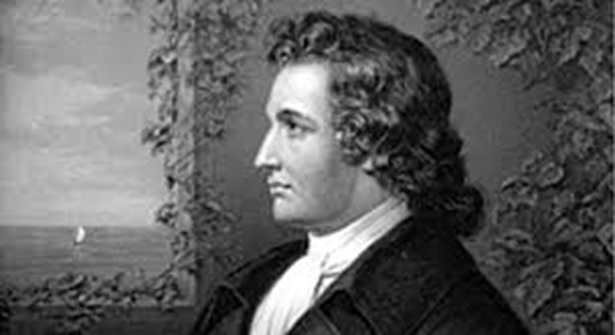
At the age of 23, he wrote his poem “ Mahomet’s Song” in honor of the Prophet of Islam, while at the age of 70 he said he was considering “devoutly celebrating that holy night in which the Qur’an in its entirety was revealed to the prophet from on high.” Important aspects of his thinking display Islamic, and especially Sufi concepts such as wahdat al-wujud or the Unity of Being. This was all despite the deep and longstanding ethnic and religious opposition to Islam in Europe – Photo Erfurt Tourismus
out to the “Other” in the interests of facilitating human coexistence and dialogue. In his work and life, Goethe stressed a larger human unity and universal humanism. He opened the German and European heart and mind to embrace the world’s cultures and religions, especially those from the East. Of particular note is his embrace of Islamic ideas and philosophies which ranged across his life and which he sought to introduce to Europe in the cause of love and friendship. At the age of 23, he wrote his poem “Mahomet’s Song” in honor of the Prophet of Islam, while at the age of 70 he said he was considering “devoutly celebrating that holy night in which the Qur’an in its entirety was revealed to the prophet from on high.” Important aspects of his thinking display Islamic, and especially Sufi concepts such as wahdat al-wujud or the Unity of Being. This was all despite the deep and longstanding ethnic and religious opposition to Islam in Europe.
Here, we would like to discuss Goethe’s ideas concerning human coexistence and reaching out to the “Other.” We will see that Goethe rejects a totalizing “Self” and “Other” binary while preserving the integrity of each in the context of the relationship. The Self shapes the Other and the Other shapes the Self and the encounter enriches each. This is a natural process, as Goethe believed we are all connected in the greater loving Unity. That Goethe embraced Islam, figures like the Prophet, and great Muslim poets like Hafiz, does not mean that he is any less Goethe, German, and European. Instead, he believed that the East and Islam could help Germans and Europeans become better versions of themselves. Westerners trying to understand life, God, and their place in the world would be greatly helped by learning about the way Muslims understand life, God, and their place in the world. Then, collectively, humanity may move to ever greater heights in love and fraternity. Goethe founded the Western academic field of “world literature” to facilitate such a process. There was no limit for Goethe in seeking inspiration, also drawing from, for example, Chinese poetry and Hindu sources. Goethe authored poems invoking the Hindu “Godhead Kamarupa,” wrote over thirty poems to Hafiz, and dedicated others to Rumi. Like Rumi, Goethe’s oeuvre is an Ocean, and dipping into to it yields jewels of wisdom and vision which may benefit us today—Westerners, Muslims, and the larger world. If we are to make a comparison involving Goethe, then, perhaps it could be as the Rumi of Europe.
The Life of Goethe
Johann Wolfgang Goethe was born in 1749 in Frankfurt; his father was a prominent lawyer and politician and his mother was the daughter of the chief administrator of the city. Goethe’s education was typical for his class, including Latin, the Bible, and French. While he wanted to study classical philology at the University of Göttingen, his father’s wishes for him to study law prevailed, and he attended the University of Leipzig. Even then, Goethe’s own interests shone through, and he is described in accounts as only a nominal law student, devoting his time instead to art, science, and literature. Goethe also begins to write poetry and plays during this period. He moved on to finish his studies at the University of Strasbourg, where he met an important mentor, the great German scholar Johann Gottfried Herder, and experienced an intellectual awakening. This awakening particularly concerned literature and poetry which he
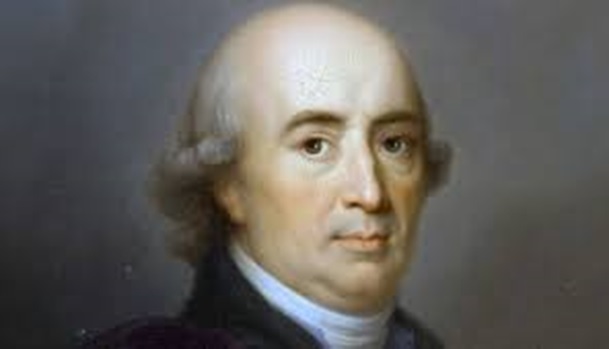
Goethe moved on to finish his studies at the University of Strasbourg, where he met an important mentor, the great German scholar Johann Gottfried Herder, and experienced an intellectual awakening. Goethe developed a love of Shakespeare under Herder’s tutelage and hosted Germany’s first “ Shakespeare Day”
Charles J. Engard, “Introduction.” In Goethe’s Botanical Writings. Translated by Bertha Mueller. (Honolulu: University of Hawaii Press, 1952), p. 3; Douglas Miller, “Introduction.” In Johann Wolfgang von Goethe, Scientific Studies. Edited and translated by Douglas Miller. (New York: Suhrkamp Publishers, 1988), p. ix.
Mark Riegner, “Horns, Hooves, Spots, and Stripes: Form and Pattern in Mammals.” In David Seamon and Arthur Zajonc, eds., Goethe’s Way of Science: A Phenomenology of Nature (Albany: State University of New York Press, 1998), p. 179.
Katharina Mommsen, “Goethe’s Relationship to Islam,” The Muslim, vol. 4, no. 3, 1967, p. 12.
Katharina Mommsen, “Goethe’s Relationship to Islam,” The Muslim, vol. 4, no. 3, 1967, p. 12.
A. N. Wilson, Goethe: His Faustian Life (London: Bloomsbury, 2024), p. 262.
Wilson, Goethe, p. 263.
Johann Wolfgang von Goethe, West-Eastern Divan. Translated by Eric Ormsby. (London: Gingko, 2019), p. 119.
understood as linked to the development of nations such as the Germans and others—for example, Goethe developed a love of Shakespeare under Herder’s tutelage and hosted Germany’s first “ Shakespeare Day.” “Shakespeare Day” was an early example of Goethe reaching beyond his own immediate cultural environment to embrace non-German authors, ideas, and philosophies, which would also include Islam and the Qur’an.
In 1771 Goethe returned to Frankfurt with his licentiate in law and settled down to practice, before moving to the city of Wetzlar. It was here where he began his esteemed literary career. He started writing Faust and published two works of tragedy which brought him wide renown. The first was Götz von Berlichingen (1773) about a sixteenth century German soldier and poet, and the second was The Sorrows of Young Werther (1774). It was this second work, Werther, in which the title character suffers from unrequited love to the point of suicide, that made Goethe, at the age of 24, instantly famous across Europe. Napoleon carried a copy with him on campaigns and the book became the first German work translated into Chinese. Both these works put Goethe at the vanguard of Sturm und Drang (Storm and Stress), an early Romantic movement in Germany which challenged Enlightenment scientific rationalism by embracing and centering emotional, artistic, and viscerally human experiences.
In 1775, Goethe, the literary toast of Europe, made a decision which was perhaps surprising. He accepted the invitation of Duke Karl August of Weimar to assume a state administrative post and serve as the Duke’s chief advisor. He would remain in Weimar for the rest of his life. While he continued his interest in the arts, serving as Minister of Arts and shaping public education, he also had other responsibilities, serving as Minister of War, Minister of Finance, and Minister of Mines. With access to university scientific collections and state resources, Goethe turned his attention to natural sciences, for example osteology, geology, and botany.
Goethe was able to get away from his many duties to travel to Italy in 1786, and he spent the next two years there. Here he felt rejuvenated in encountering the “foreign,” remarking, “Nothing, above all, is comparable to the new life that a reflective person experiences when he observes a new country. Though I am still always myself, I believe I have been changed to the very marrow of my bones.” It is only through contact with the “Other,” Herder believed, that we can know ourselves. As he put it, “Human individuality is a strange thing: it is only during the last year, when I have had to depend solely on myself and at the same time be in daily contact with complete strangers, that I have really come to know my own.”
While in Sicily, Goethe had what we would consider a eureka moment, a sudden onset of awareness which transformed and shaped the rest of his life. In Goethe’s case, it was the awareness that plants were not distinct entities to be rigidly classified and studied in the common empirical manner, but that each plant was a process, of life pursuing a kind of “ideal plant” totally interrelated with its surroundings and expressed in many different ways.
Goethe returned to Weimar, where he was relieved of most of his administrative duties. He went on to establish the Weimar Court Theater as its director. In the succeeding decades, Goethe published furiously from his base in Weimar, producing numerous works including poetic works such as Hermann and Dorothea (1782-1784), plays including Faust Part I (1808), novels like Elective Affinities (1809), and scientific works such as Metamorphosis of Plants (1790), Contributions to Optics (1791-1792), and Theory of Colors (1810), which challenged Isaac Newton’s arguments for not sufficiently capturing how human beings experience color. In 1832, Goethe died at the age of 82 in Weimar, shortly after completing Faust Part II.
God, Science, and the Urphänomen
Central to Goethe’s philosophy is the idea of a Divine Unity and what he called the Urphänomen or primary phenomenon. As scholars have argued (see below), we should understand the development of Goethe’s thinking about Unity in the context of his engagement with Islam and how he found it in accordance with aspects of the Western tradition such as Greek influences which also perceived the world as a unity.
We can see this in Goethe’s Sicilian eureka moment concerning plants. At the time, the empirical model of scientific observation practiced by scholars like Carl Linnaeus was one of rigid categorization, in which each entity was seen as a whole type in and of itself. While useful for observing nature, Goethe argued, there is a limit. This is because, as he explained, “ all things in nature have a clear relationship to one another.” Even when we are examining something we believe is “an individual, it nevertheless remains an aggregation of living and independent parts...These organisms are partly united by origin; partly they discover each other and unite. They separate and seek each other out again, thus bringing about endless production in all ways and in all directions.” Living things, he elaborated, “appear under a thousand conditions, to arise and vanish, to solidify and melt, to freeze and flow, to expand and contract…Genesis and decay, creation and destruction, birth and death, joy and pain, all are interwoven with equal effect and weight.” If things appear separate and distinct from each other, Goethe wrote, this is an “illusion” for “One and many are the same.” “All is like, all unlike,” he said—“the particular is the general made manifest under different conditions.” Nature, he affirmed, “has neither core/ Nor outer rind./ Being all things at once.”
Consequently, for a scientist to try to categorize everything individually is impossible, and is like “ attempting to drink up the ocean.” Instead Goethe felt it was important to conduct science with a humility in our human limitations and with an awareness of the whole in mind. Goethe stated, “He who has the understanding to declare his limitations is closest to perfection.” Indeed, “Nature forces us to alter our classifications and to defer to her independent working and working of things.” We should be looking for process as much as individual cases, and process takes us to an awareness of unity.
Concerning plants, this means an awareness that life is leading plants along a particular trajectory. What form the plant takes is contingent on a host of factors “from without as well as from within” the organism, including soil, air, light, water, and climate. If we could identify what is at the heart of the process itself, what the organism “wants to be” we would reach a higher understanding of it. This ideal, akin to Plato’s theory of “forms,” is Goethe’s concept of the Urphänomen. For plants, the Urphänomen is the leaf, and for animals (or vertebrates at the least) it is the spine. As he wrote to Herder, “it came to me in a flash that in the organ of the plant which we are accustomed to call the leaf lies the true Proteus who can hide or reveal himself in all vegetal forms. From first to last, the plant is nothing but leaf, which is so inseparable from the future germ that one cannot think of one without the other.” “Empirical observation,” Goethe explained, “must first teach us what parts are common to all animals, and how these parts differ. The idea must govern the whole, it must abstract the general picture in a genetic way. Once such an Urphänomen is established, even if only provisionally, we may test it quite adequately by applying the customary methods of comparison.”
Other terms Goethe uses for the Urphänomen include “God” and “the Divine” and he reported that he was “seeking the divine in herbis et lapidibus [in herbs and
stones].” Once one discerns the divine Urphänomen, we can go no further because we have perceived the Unity.
As Goethe states, “The highest state of mind we can attain to…is wonderment, and if the primary phenomenon excites wonderment we must be content with that. It cannot give us anything more, and we should not look beyond it for anything more; this is where the line is drawn. But the sight of a primary phenomenon is generally not enough for people. They think there must be more to see, and they are like children who look in a mirror and then turn it round to see what’s on the back.” And because we are talking about God in the Urphänomen, we are also talking about love—for how does a plant grow if not in love? In his poem “The Metamorphosis of Plants,” Goethe writes,
“Love in its holiness
Strives to the highest fruit of the same movement of thought,
Same outlook on things, in harmonic contemplation,
Thus the pair make their bond, and find out a loftier world.”
In “the scent of blossoms and the gentle stirring of a warm breeze,” Goethe wrote, we feel “a being that comes lovingly close to us all.” Plants in their forms display, Goethe stated, “a happy mobility and flexibility, enabling them to adapt themselves to the many conditions throughout the world which influence them, and to be formed and reformed in accordance with them.
It is here where Goethe discerns a kind of evolutionary—he would use the term morphological—process at work. Humans and animals such as apes, Goethe argues, should not be so rigidly separated, because there is much that unites them in the larger Unity. Goethe discovered that a particular bone, the intermaxillary bone, which scientists argued separated apes from humans, was in fact also present in humans. Goethe contended, “Man is very closely related to the animals. Unity of the whole makes every creature into that which it is. Man is man as well through the form and nature of his upper jaw as he is man through the form and nature of the tip of his little toe. And thus is every creature only one tone, one hue of a great harmony, which one must thus study in the whole and at large, lest every particular become a dead letter.” Charles Darwin later credited Goethe in his preface to On the Origin of Species for presenting a theory of organism change over time, placing him as one of the key thinkers in the history of evolutionary theory.
Another important point that Goethe makes concerns the human role in science. The human element must not be separated from scientific inquiry. It was not possible for the scientist to have a “God’s eye view” of phenomena from an “objective” position outside of the human being—as we necessarily must engage with the world from our own human perspective. In Goethe’s Theory of Colors, he writes, “Throughout nature, as presented to the senses, everything depends on the relation which things bear to each other, but especially on the relation which man, the most important of these, bears to the rest.” Goethe called carrying out scientific inquiry in this manner “delicate empiricism” and voiced his belief that “You have to be slow and gentle with nature if you want to get something out of her.” Again, we have to remember the unity of all and remind ourselves that the
J. W. Goethe, Italian Journey. Translated by W. H. Auden and Elizabeth Mayer. (San Francisco: North Point Press, 1982), p. 135.
Goethe, Italian Journey, p. 135.
Goethe, Italian Journey, p. 404.
Johann Wolfgang von Goethe, Scientific Studies. Edited and translated by Douglas Miller. (New York: Suhrkamp Publishers, 1988) , p. 132.
Goethe’s Botanical Writings. Translated by Bertha Mueller. (Honolulu: University of Hawaii Press, 1952), p. 24.
Goethe, Scientific Studies , p. 304.
Goethe’s Botanical Writings , p. 214.
Goethe, Maxims and Reflections. Translated by Elisabeth Stopp. Edited by Peter Hutchinson. (London: Penguin Books, 1998), p. 83.
Goethe, Maxims and Reflections, p. 76.
Goethe, Scientific Studies , p. 38.
Goethe’s Botanical Writings , p. 227.
Goethe, Maxims and Reflections, p. 150.
Goethe’s Botanical Writings , p. 100.
Goethe’s Botanical Writings , p. 83.
Goethe, Italian Journey, p. 363.
Andy Blunden, “The Germ Cell of Vygotsky’s Science.” In Carl Ratner and Daniele Nunes Henrique Silva, eds., Vygotsky and Marx: Toward a Marxist Psychology (Abingdon, Oxon: Routledge, 2017), p. 133.
Carl Hammer Jr., Goethe and Rousseau: Resonances of the Mind (Lexington: University of Kentucky Press, 1973), p. 162.
Goethe quoted in Johann Peter Eckermann, Conversations with Goethe: In the Last Years of His Life. Translated by Allan Blunden. (London: Penguin Books, 2022), p. 266.
Dalia Nassar, Romantic Empiricism: Nature, Art, and Ecology from Herder to Humboldt (New York: Oxford University Press, 2022) p. 268, note 37.
Goethe, Maxims and Reflections, p. 109.
Goethe’s Botanical Writings , pp. 161-162.
Robert J. Richards, The Romantic Conception of Life: Science and Philosophy in the Age of Goethe (Chicago: University of Chicago Press, 2002), p. 375.
See Charles Darwin, “An Historical Sketch of the Progress of Opinion on the Origin of Species.” In The Origin of Species: The Works of Charles Darwin, Volume 16. Edited by Paul H. Barrett and R. B. Freeman. (Abingdon, Oxon: Routledge, 2016), pp. xiii-xxi; Robert J. Richards, “Did Goethe and Schelling Endorse Species Evolution?” In Joel Faflak, ed. Marking Time: Romanticism and Evolution (Toronto: University of Toronto Press, 2017), pp. 219-238; Matthew Bell, “Introduction.” In Johann Wolfgang von Goethe, The Essential Goethe (Princeton: Princeton University Press, 2016), pp. xxviii-xxix.
Goethe’s Theory of Colours. Translated by Charles Lock Eastlake. (London: John Murray, 1840), p. 75.
Goethe quoted in Eckermann, Conversations with Goethe, p. 233.
Subject or Self is not separate from the Object or Other. As Goethe argues, “The manifestation of a phenomenon is not detached from the observer—it is caught up and entangled in his individuality.”
Reconciling Reason and Religion
The great philosophical polymaths of the Islamic Golden Age like Al-Farabi, Avicenna, and Averroes made the argument to their own societies that philosophy and reason were fully compatible with revelation and religion. Some were skeptical, however. These included people with more orthodox religious interpretations, who may have been more inclined to literalism as not wanting to stretch or enlarge the precise bounds of inquiry they believed were presented by revelation and religion. In Goethe’s case, in many ways public moods were going in the other direction. Goethe’s Europe was in thrall of the Enlightenment with its focus on reason and science. Iconic figures like Voltaire strode like a colossus across the continent.
Goethe’s views are captured in Faust, in which the protagonist, an academic, makes a pact with the Devil in pursuit of god-like knowledge, thus transgressing the limits of humanity with tragic results. Goethe’s Faust was the prototype for the title character in Mary Shelley’s novel Frankenstein (1818), which adopts this message of warning for a Europe obsessed by science
A scientist himself, Goethe was certainly not arguing against science. It was instead a need for balance and the necessity of preserving respect and reverence for Nature and the divine that concerned him. Goethe’s arguments are full of caution for humanity to not throw off the balance too far and allow a narrowly conceived reason and science to eclipse the divine. This desire he linked with the human ego, which believes that it is “all about me.” When we look at weeds, for example, Goethe observed, we see them as unwelcome and accord them a negative connotation, but from the perspective of “Nature” weeds are “ children of universal Nature, cherished as much by her as the wheat he carefully cultivates and values so highly.”
When man looks at nature, Goethe said, he has a desire to “ bring what he finds there under his control.” While reason “aspires to the divine,” it is not possible for it to actually equate with the divine.” Goethe discerned that “we find professional men of science who are so full of book-learning and theories that they have forgotten how to look and listen. These people quickly become bound up in themselves.”
Goethe believed that Europeans were in danger of being overwhelmed by more and more complicated knowledge produced by people who were perhaps moving too far in the direction of seeking the divine itself. It was leading people away from an awareness of balance with God and natural world, making life more and more “artificial and complicated.” Modern society was growing too fractured and “atomistic,” Goethe felt. He spoke against what he called the “hydra of empiricism” and the “gloomy empirical-mechanical-dogmatic torture chamber.” There were endless schemas humans were coming up with to explain and master Nature on their own terms. These attempted to fit Nature into conceptual boxes humans came up with, but which bore little relation to how Nature actually functions. The idea of a “Natural System,” for example, Goethe argued, is “a contradiction in terms. Nature has no system; she has, she is life and its progress from an unknown center toward an unknowable goal.” The reality was that “no man has the capacity for making a definitive presentation of any subject whatsoever.”
Goethe contended, speaking of such desires in man to master Nature, that before long it is inevitable that “these objects will thrust themselves upon him with such force that he, in turn, must feel the obligation to acknowledge their power and pay homage to their effects.” Goethe’s views are captured in Faust, in which the protagonist, an academic, makes a pact with the Devil in pursuit of god-like knowledge, thus transgressing the limits of humanity with tragic results. Goethe’s Faust was the prototype for the title character in Mary Shelley’s novel Frankenstein (1818), which adopts this message of warning for a Europe obsessed by science. Other Goethe works on this theme include his poem “The Sorcerer’s Apprentice” (1797), which was later animated and popularized by Disney in the United States.
Through his scientific and literary works, Goethe provides Europe and the world with a model of how they may right and restore the balance between religion and reason. Goethe shows how we can remain at the cutting edge of scientific learning and push forward towards new horizons of discovery without bringing destruction on ourselves. He seeks to preserve our human wonder at what the sciences and fields of inquiry like mathematics can achieve, while also reminding us what they cannot. While “One hears that only mathematics is certain,” Goethe states, “Mathematics cannot eliminate prejudice, prevent willfulness, or resolve partisan differences.” He called for sciences such as physics to be carried out with love, remarking, “Physics…must use all its powers of love, respect, and reverence to find its way into nature and the sacred life of nature.” The key once again is an awareness of the Unity of Nature and the divine and to respect our place within it.
Goethe and Islam
Following our outline of some of Goethe’s main ideas and themes, let us move now to his interaction with and interest in Islam, which is remarkable and persisted his entire life and career. As such it is an important influence on him, and we can gain further insights into Goethe’s thinking and philosophic and religious outlook on matters such as the Divine Unity by examining this relationship.
Goethe, Scientific Studies , p. 307.
Goethe’s Botanical Writings , p. 82.
Johann Wolfgang von Goethe, The Essential Goethe (Princeton: Princeton University Press, 2016), p. 977.
Goethe quoted in Eckermann, Conversations with Goethe, p. 264.
Goethe quoted in Eckermann, Conversations with Goethe, p. 466.
Goethe quoted in Eckermann, Conversations with Goethe, p. 573.
Goethe, Maxims and Reflections, p. 157.
Goethe, Maxims and Reflections , p. 55.
Goethe’s Botanical Writings , p. 116.
Goethe’s Botanical Writings , p. 225.
Goethe, The Essential Goethe, p. 977.
Goethe, Maxims and Reflections, p. 176.
Goethe, Scientific Studies , p. 310.
Goethe, Scientific Studies , p. 310.
In terms of his own identity, the clue we have to understand Goethe is not to try to work out whether he had converted to Islam or not—although he did write that
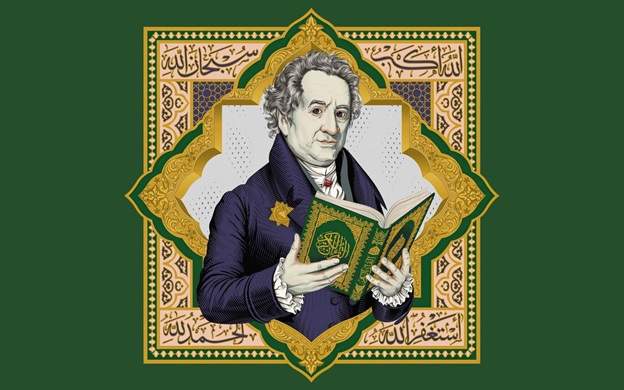
In terms of his own identity, the clue we have to understand Goethe is not to try to work out whether he had converted to Islam or not—although he did write that he “ does not reject the suspicion” that he may be a Muslim— but to assess his love for the Prophet of Islam, which as any Muslim will tell you is the gold standard and the yardstick to measure Islamic identity. Goethe is imbued with the spirit of Islam. That is apparent from the poem he dedicated to the Prophet, who he described as an “extraordinary man.” His love and affection seen through his awe are clearly evident. We believe it is not reading too much into Goethe to link his interest in Islam to his worldview characterized by an awareness of a larger, loving Unity of the divine and Nature in which all beings are a part – Image Weltmuseum Wien
he “ does not reject the suspicion” that he may be a Muslim— but to assess his love for the Prophet of Islam, which as any Muslim will tell you is the gold standard and the yardstick to measure Islamic identity. Goethe is imbued with the spirit of Islam. That is apparent from the poem he dedicated to the Prophet, who he described as an “extraordinary man.” His love and affection seen through his awe are clearly evident. We believe it is not reading too much into Goethe to link his interest in Islam to his worldview characterized by an awareness of a larger, loving Unity of the divine and Nature in which all beings are a part. This was also the conclusion of the Goethe scholar Katharina Mommsen, who wrote, “It was this doctrine of the Oneness of God, of His uniqueness, that Goethe always valued most highly, and when we speak of this poet’s relationship to Islam we will have to recognize this doctrine of the unity of God as the main source of Goethe’s indebtedness.” In support of her argument, Mommsen cites Goethe’s statements like this one on the Prophet: “Mahomet…raises himself to God, the One, the Everlasting, Unlimited, to whom…all limited glorious beings owe their existence.”
When Goethe first encountered Islam as a young man, prior to writing and publishing early works such as The Sorrows of Young Werther, Goethe identified with Islam and its Prophet on a deep level as Islam accorded with what he instinctively felt and believed. In 1772, at the age of 23, Goethe read the Qur’an and wrote his poem in honor of the Prophet. The poem is infused with energy, vitality, and passion, as Goethe draws on the metaphor of the Ocean in conveying the Prophet’s mission. The account traces the outlook of the great religious teacher—in our case the Mingler—as they go on a journey of awareness and perspective, from the micro to the macro, from the particular to the universal, from the individual brook and stream to the Ocean of Unity. While Goethe does not compare himself to the Prophet or any other great religious leader or prophet, it is not a stretch to see that he is hoping that he himself can attempt to rouse and orient his countrymen in precisely this direction. Here is Goethe on the Prophet of Islam:
“See the rocky spring,
Clear as joy,
Like a sweet star gleaming!
like determined leader,
Hurries all his brother streamlets
Off with him.
Add their waters. Now he rolls
O’er the plain in silvery splendor,
And the plain his splendor borrows;
And the rivulets from the plain
And the brooklets from the hill-sides
All are shouting to him: ‘Brother,
Brother, take thy brothers too,
Take us to thy ancient Father,
To the everlasting ocean,
Who e’en now with outstretched arms,
Waits for us,—
‘Come ye all, then!’—
Now, more proudly,
On he swells; a countless race, they
Bear their glorious prince aloft!
On he rolls triumphantly
Cedar houses bears this Atlas
On his giant shoulders. Rustling,
Flapping in the playful breezes,
Thousand flags about his head are
Telling of his majesty.
And so bears he all his brothers,
And his treasures, and his children,
To their Sire, all joyous roaring,
Pressing to his mighty heart.”
In a letter to Herder the same year he wrote this poem, Goethe states that “I would like to pray like Moses in the Qur’an: Lord, make room in my narrow breast.” This allusion to a verse in the Qur’an’s 20 th Surah captured Goethe’s desire for the loosening of his tongue and to help unleash his creativity. Goethe also began studying Arabic, and we have Goethe’s writings in Arabic from this period recording Qur’anic verses which he identified with. They capture Goethe’s emerging worldview of a Divine Unity, including on the “oneness and goodness” of God and “The rising and setting of the sun are the Lord’s and wherever you turn, there is God’s countenance.” He also noted Qur’an (13:8), “every people has been given a teacher for its instruction,” and he repeated this and similar verses throughout his life, giving us an insight into Goethe’s thinking about the “Other.” He told a young scholar later on, for example, “What God says in the Qur’an is true: We have never sent a prophet to any people, except in its own language.’”
Of the Qur’an itself, for those wishing to study and understand it, Goethe cites the Dutch scholar Jakob Gohl, who wrote, “The principal aim of the Qur’an seems to have been to bring together the adherents of the three discrete religions prevailing at that time in populous Arabia, who for the most part lived and mingled with one another.” Goethe describes the Qur’an as a “sacred book” which “arouses amazement” and “will remain supremely effective for all time to come.” Goethe captures the unity of Islam which transcends our own individual egos and perspectives in this verse: “How foolish that everyone praises his own opinion in what pertains to him. If Islam means submission to God, we are all living and dying in Islam”
Fred Dallmayr, Dialogue among Civilizations: Some Exemplary Voices (New York: Palgrave Macmillan, 2002), p. 152.
Johann Wolfgang von Goethe, “Notes and Essays for a Better Understanding of the West-Eastern Divan.” In Johann Wolfgang von Goethe, West-Eastern Divan. Translated by Eric Ormsby. (London: Gingko, 2019), p. 365.
Fred Dallmayr, Dialogue among Civilizations: Some Exemplary Voices (New York: Palgrave Macmillan, 2002), p. 152.
Johann Wolfgang von Goethe, “Notes and Essays for a Better Understanding of the West-Eastern Divan.” In Johann Wolfgang von Goethe, West-Eastern Divan. Translated by Eric Ormsby. (London: Gingko, 2019), p. 365.
Mommsen, “Goethe’s Relationship to Islam,” p. 18.
Mommsen, “Goethe’s Relationship to Islam,” p. 18.
Mommsen, “Goethe’s Relationship to Islam,” p. 15.
Henry Wadsworth Longfellow, The Poets and Poetry of Europe: With Introductions and Biographical Notices (Philadelphia: Carey and Hart, Chestnut Street, 1845), pp. 295-296.
Mommsen, “Goethe’s Relationship to Islam,” p. 15.
Mommsen, “Goethe’s Relationship to Islam,” p. 15.
Mommsen, “Goethe’s Relationship to Islam,” p. 16.
Mommsen, “Goethe’s Relationship to Islam,” p. 16.
Goethe, “Notes and Essays for a Better Understanding of the West-Eastern Divan,” p. 367.
Goethe, “Notes and Essays for a Better Understanding of the West-Eastern Divan,” pp. 367, 369.
Goethe, West-Eastern Divan, p. 165.
The West-Eastern Divan
In 1819, Goethe published his poetic collection West-Eastern Divan, a book that is by all measures astonishing and has been described as revolutionary by scholars. Two centuries later, it retains its ability to amaze, delight, and even shock. The book, which contains some of Goethe’s most beautiful and popular poetry, was inspired by the
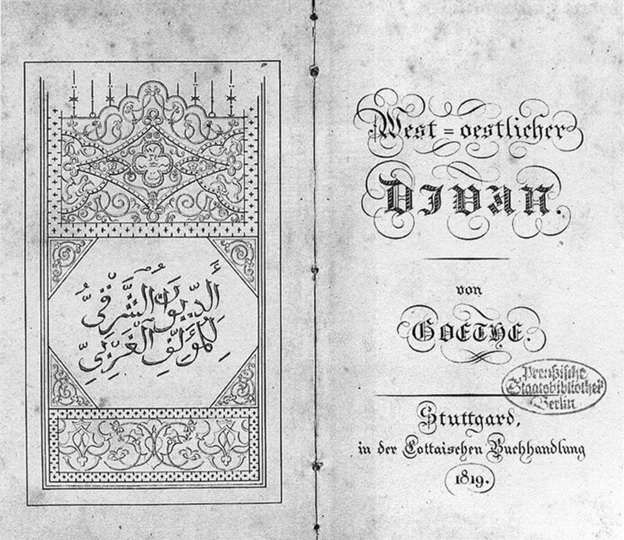
In 1819, Goethe published his poetic collection West-Eastern Divan, a book that is by all measures astonishing and has been described as revolutionary by scholars. Two centuries later, it retains its ability to amaze, delight, and even shock – Wikimedia Commons
fourteenth century Persian poet Hafiz, who Goethe had read five years earlier. Goethe instantly felt a strong connection with Hafiz, who he called his “twin.” That Hafiz was writing over four centuries before Goethe, and in a different part of the world was no obstacle. Goethe decided to craft a “reply” to Hafiz in this book, entitled a “divan” or collection of poems by one author in Islamic culture, which would exist in a zone beyond space and time. But it would not only be a reply to Hafiz, it would be a reply on behalf of the West to the East in general, containing a message about where both should go in the future. The work is effused with positivity, love, and hope which leap off its pages. It is a celebration of life and its possibilities.
The layers of meaning went even deeper than this, however. West-Eastern Divan is perhaps Goethe’s most elegant statement about human identity and the relationship between the Self and Other. For Goethe, the same principle applies to relationships between individuals, nations, civilizations, and religions—each is enriched by the other and can help the other “find themselves.” As Goethe writes to Hafiz, the “spark” “spirals on from you, with eternal glow, to fire up a German heart afresh” and “In the art of your rhymes I hope to find myself.”
Crucially, the relationship between Self and Other is one forged through love, the central theme of Hafiz and of the Sufis of Islam. Love brings two people together, and they become something greater than themselves as individuals. Furthermore, Goethe argues, they have a profound effect on each other’s identity. When we are in love, it is impossible for us to imagine ourselves as an isolated individual. In this case, the Other has a direct effect on the Self. We then become even greater when linked to the Other in this profound way. This is because we then are uniting in accordance with the Divine Unity of all. As Goethe writes in the Divan, “God gives me a likeness of Himself in the Beloved’s eyes.” Ultimately, at the highest level of identity, we are One: “What makes you great is that you cannot end, and that you never begin, that is your destiny. Your song is spinning like the starry vault, beginning and end everlastingly the same, and what the midpoint brings is manifestly what remains at the end and in the beginning ever was.”
While ultimately, we are all One, and no time more so than when we are in love, we nonetheless remain two people. We each have and retain our own names and identities and motivate and inspire each other to ever
Goethe, West-Eastern Divan, p. 57.
Goethe, West-Eastern Divan, p. 57.
Goethe, West-Eastern Divan, p. 525.
Goethe, West-Eastern Divan, p. 55.
greater heights. In the book, Goethe, who calls himself Hatem after the pre-Islamic Arab poet, expresses his
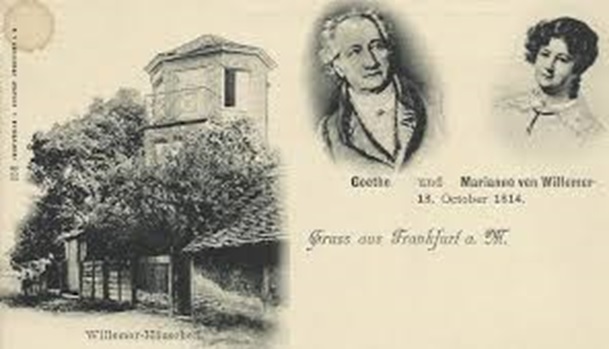
In the book, Goethe, who calls himself Hatem after the pre-Islamic Arab poet, expresses his feelings to a German woman he has fallen in love with, Marianne von Willemer, an Austrian actress and dancer , who he calls Suleika, the Islamic name of the Egyptian official’s wife who falls in love with Joseph in the biblical story . Marianne in fact contributes several of her own poems to the collection which merge with Goethe’s poetic voice
feelings to a German woman he has fallen in love with, Marianne von Willemer, an Austrian actress and dancer , who he calls Suleika, the Islamic name of the Egyptian official’s wife who falls in love with Joseph in the biblical story . Marianne in fact contributes several of her own poems to the collection which merge with Goethe’s poetic voice. While other people, Goethe writes, may claim that identity lays in one’s own self and being “true to oneself” and “what one is,” he feels differently—for him his identity is forged through his relationship with another person, in this case “Suleika”: “Because of the way she lavishes herself on me I become a genuine self; were she to turn away from me, I’d instantly lose myself.”
In West-Eastern Divan, Goethe contends that the same love which elates and invigorates the lover of one’s beloved should also drive relations between nations, religions, and civilizations. The poetic image he uses is of the leaf of the Gingko biloba tree, an Eastern tree in Goethe’s Western garden. The leaf is shaped like a heart and has two distinct lobes. The poem, widely known by German speakers, goes like this:
“The leaf of this tree, that from the East has been entrusted to my garden, gives a secret meaning to savor as it gladdens those who know.
Is it One living being that divides itself within itself? Is it two that have chosen each other so as to be seen as One?
To answer such questions I have discovered the correct sense: do you not feel that in my songs I am both double and One?”
Thus, for Goethe the individual person in relation to the beloved and Europe in relation to Islam and the Orient are similar in that they are distinct and also unified, one and also two. In keeping with this idea, Goethe is clear in the Divan that he does not seek to imitate Hafiz. That would be becoming Hafiz, which is absurd and not how identity works—the West cannot “become” the East, whatever that would mean. Goethe is not interested in simply aping or copying the Other. For one thing, the book is in German, not in Persian or another Muslim language like Arabic. Secondly, we know where we are situated geographically, i n the case of the Gingko biloba tree, for example, we are clearly in Germany. In another poem, which is set near Erfurt, Germany, Goethe gazes upon a field of poppies through morning mist on a land on which the Prussians had fought the French under Napoleon. Now, “scornful of the god of war,” the flowers “companionably…cover the fields in amiable streaks.” He then connects to Hafiz in his own setting: “Red and white, entangled, speckled—nothing lovelier can I gaze upon. But, Hafiz, how is it that your Shiraz comes to the gloomy regions of the north?” In another verse, Goethe wishes that Hafiz could enjoy his favorite wine from the Rhine.
And yet, in the work’s rhyming patterns, imagery, themes, motifs, references, and symbols such as pearls and nightingales, there are plentiful examples from Islamic culture and religion—as well from the Bible, Greek and Roman mythology, and other “Western” sources. Goethe draws from Arabic poetry, including pre-Islamic poetry, Tatar proverbs, Persian poets, Ottoman Sultans and Grand Muftis, and Persian Shahs. He also frames Western figures in a new light: Napoleon becomes Tamerlane and Goethe’s German patron, Grand Duke Karl August, becomes Shah Shuja, the Persian ruler in Hafiz’s time. Goethe refers to certain Christian theologians as “dervishes,” and describes himself as a “frugal dervish.” Sometimes Goethe will reference both Christian and Islamic sources concurrently, as in Goethe’s statement, “Why do you try to discover whence magnanimity flows? Cast your cakes into the water; who knows who will enjoy them.” Here we have allusions to both the Bible’s Book of Ecclesiastes (11:1) “Cast thy bread upon the waters” and Hafiz, who wrote, “Do good and cast it into the floods.” And when Goethe praises the world’s women in the chapter “Chosen Women” of the Divan, he selects women shared between the traditions, focusing on Mary, the mother of Jesus, the aforementioned Suleika, Khadija, the wife of the Prophet, and Fatima, the daughter of the Prophet. “We find all of them on high,” Goethe exclaims, “And whoever has sung women’s praise deserves to stroll with these women in eternal places.”
The entire book, in fact, is framed as a “hijrah,” a reference to the Prophet’s journey from Mecca to Medina. In Goethe’s case, he states that he is fleeing the turmoil of Europe embroiled in the Napoleonic wars for the East and the direct revelation of the Qur’an, which he states is closer to the divine. It is as though Europe is losing some of this direct awareness and he wants to retrieve it for Europe as it modernizes in the nineteenth century. Germany and Europe, then, are in need of the same loving “spark” of Hafiz which rejuvenated Goethe.
Goethe, West-Eastern Divan, p. 211.
Goethe, West-Eastern Divan, p. 197.
Goethe, West-Eastern Divan, p. 27.
Goethe, West-Eastern Divan, p. 27.
Goethe, West-Eastern Divan, p. 213.
Goethe, West-Eastern Divan, pp. 115, 143, 145.
Goethe, “Notes and Essays for a Better Understanding of the West-Eastern Divan,” p. 438.
Goethe, West-Eastern Divan, p. 161.
Goethe, West-Eastern Divan, p. 315.
These Eastern and Western forms come together to produce a unique voice which brings both together in a kind of magical zone where the walls separating cultures and religions are removed. While East and West are not so different, Goethe writes, there are lamentable misunderstandings between people, and “when people are divided by mutual contempt, neither will acknowledge
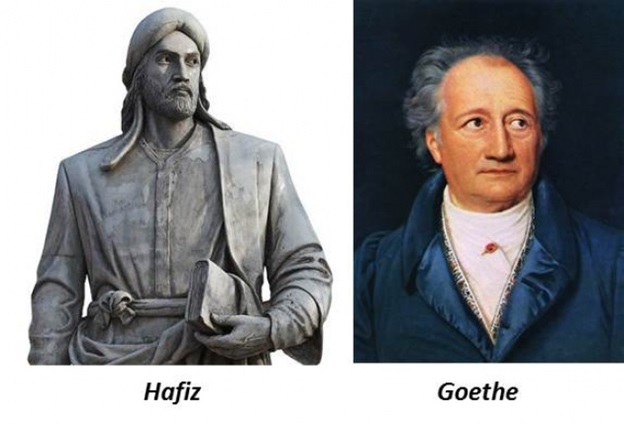
Goethe, addressing Hafiz, states that he was inspired to perform essentially the same task as Hafiz, expressing universal love and unity, but in the context of his own culture: “I am like you utterly for I have taken within myself from our own sacred books that splendid image of the Lord’s likeness that was impressed upon that veil of veils, quickening me in my silent breast, despite denial or oppression’s theft, with the serene image of belief.”
that they are striving for the same thing.” Yet each people are in fact striving to understand God in their own ways. Goethe, addressing Hafiz, states that he was inspired to perform essentially the same task as Hafiz, expressing universal love and unity, but in the context of his own culture: “I am like you utterly for I have taken within myself from our own sacred books that splendid image of the Lord’s likeness that was impressed upon that veil of veils, quickening me in my silent breast, despite denial or oppression’s theft, with the serene image of belief.”
The result concerning East and West, Islam and Christianity, is an expression of the way life actually is when conveyed through love as God intends. As Goethe writes, “To God belongs the Orient! To God belongs the Occident! Northern and southern lands rest in the peace of His hands.” This alludes to the Qur’anic verse, “East and West belong to God. He guides whomever He will to the right way” (Qur’an 2:142). Other statements of warm embrace Goethe makes include “The Orient has gloriously crossed over the Mediterranean,” and “Though you are separated from your beloved, as Orient is from Occident, the heart races across all deserts. Everywhere it is its own escort. For those who love, even Baghdad is not far.” In another comment on identity, Goethe states, “Whoever knows himself and others will recognise this too: Orient and Occident are no longer to be separated.”
The process of becoming greater through the “Other” is described in the poem “Holy Longing” in the Divan. It is in fact a kind of death, because in the process you are
Goethe, West-Eastern Divan, p. 125.
Goethe, West-Eastern Divan , p. 47.
Goethe, West-Eastern Divan , p. 13.
Goethe, West-Eastern Divan , p. 169.
Goethe, West-Eastern Divan , p. 221.
Goethe, West-Eastern Divan , p. 577.
leaving behind your old self. Here, we see clear influences of Sufi Islam, which utilizes the image of the moth dissolving itself in the flame. Goethe applies the Sufi concept of fana or annihilation here, which is central to Sufi doctrine and is the first step to self-abnegation and movement towards the divine object. The moth gives up its life because of its passion for the flame, and merges with the divine. In this case, Goethe has replaced the moth with the butterfly because that is a symbol of the soul in Greek culture and mythology. Goethe sums up the process with the memorable phrase, “Die and Become!” which became popular in Germany. When we experience love of the Other which is itself a Divine love, our “old” self “dies” and we become something greater in the embrace. This idea was a central inspiration to Nietzsche in his Thus Spake Zarathustra and developing the idea of the Übermensch or Superman. If we fail to pursue this course, we are not really alive—as Goethe says, we are a “dreary guest on the dark earth.” Here is Goethe’s “Holy Longing”:
“Tell it to no one except for the wise, for the rabble will scorn it at once. I will praise the living being that longs for death in flame.
In the cool of nights of love, which begot you, where you begot, strange sensation comes upon you when the silent candle shines.
You will no longer be enveloped in the shadowing of the dark, and a desire seizes you anew to rise to a higher consummation.
No distance deters you, you come flying and spellbound, and at last, greedy for the light, Butterfly, you are burnt up.
And as long as you do not possess this—this: Die and Become! You are nothing but a dreary guest on the dark earth.”
One final observation we will make concerning the remarkable Divan is to note that when it was first published in Germany, Goethe wrote a guide to its references and style which accompanied it. This guide was itself part and parcel to the goal and function of the Divan in promoting understanding and reaching out in love. Goethe explains in the guide that with his earlier works, he did not feel the need to explain them and wanted people to find use in them and come to their own understandings, but in this case, “I’ve decided to elucidate and explain and instruct, and to do so solely so that readers who have little or no familiarity with the East may gain a more immediate understanding.” What follows is a kind of “Islam 101” with Goethe serving as instructor. He discusses the history and politics of areas like Arabia and Persia, introduces the Qur’an, the Prophet, and the Islamic religion, and provides an overview of great poets such as Hafiz, Rumi, and the Persian poet Sa’di. Of Sa’di, for example, Goethe, after discussing his work, themes, and importance, writes that his work is “eminently profitable and beneficial for Westerners like ourselves.”
Goethe also provides in this piece not just a guide to the Muslim world, but a guide to Westerners writing about Islam and the East in general including China. He explains to his audience that much of this work was biased. Of early work on the Orient, for example, Goethe states that European writers tended “to confuse our imaginations—rather than to assist them…the one-sidedness of the hostile Christian viewpoint limits us through its own limitations; only in more recent times has that view broadened a bit as we’ve gradually gotten to know the events of those wars through Oriental writers.” There were exceptions, however, to these early limitations, and he praises Marco Polo as “outstanding,” explaining, “everywhere he lets us learn so many particular qualities of human forms and customs, of landscapes, trees, plants and animals.” In other words, Marco Polo conveyed a genuine knowledge that was not corrupted by ideological prejudice. As with any good ethnography, it is an exercise which should be conducted with empathy and veracity.
Finally, Goethe makes an important point in his guide which attempts to link the world of the Prophet, the Qur’an, and poets like Hafiz to what Europeans already knew. Is not the Christian religion itself from the Orient? Goethe notes, “all our peregrinations through the Orient were occasioned by the Holy Scriptures, we come back to them over and over as to springs of water, supremely vivifying even if occasionally muddied, coursing in concealment in the earth only to gush forth, pure and fresh, yet again.” The conscious interaction with the Orient through the Hebrew scriptures, in fact, stretched far back into Goethe’s life. As a child, he recounted in his memoirs, his imagination was captivated by the Jewish patriarchs of the Old Testament—“I would steep myself in the first books of Moses, and there, amidst the widespread tribes of herdsmen, find myself both in the greatest solitude and the greatest company.” In returning to such themes in explaining the Divan, Goethe was suggesting to Europeans that a part of the world that they viewed as “foreign” was not as far away from them as they might have imagined.
Goethe and the “Other”
We might see West-Eastern Divan as a culmination of many years of Goethe pondering ways of facilitating human coexistence, what the barriers to coexistence are, and how they may overcome. In The Sorrows of Young Werther, Goethe’s doomed protagonist identifies “misunderstandings” as leading “ to more complications in the affairs of the world than trickery and wickedness,” and laments, “to be misunderstood is my fate.” According to Goethe, the novel was so popular because “there is so much unspoken suffering, so much hidden dissatisfaction and ennui, and so many individuals who feel at odds with the world and in conflict with society.”
In the modern Europe of his day, Goethe noted, “Our social relationships are lacking in real love and goodwill…nobody has the courage to be warm and genuine, so that an honest man with natural inclinations and sentiments has a really hard time of it.” Goethe further observed that European bureaucracy, later to be analyzed by scholars like Max Weber, was lacking in empathy for others: “surely love and kindness also have an important place in the life of a public servant, who is dealing with people all the time.” We already see themes in Werther which Goethe would return to throughout his life in attempting to help connect people with one another in love. As he writes in the novel, “There is no truer, warmer pleasure in this world than to behold a great soul opening up towards oneself” and “how foolish it is to judge others by one’s own standards.”
The theme of bridging divides caused by misunderstandings is also evident in Goethe’s initial journey to Italy as a young man, during which he pondered the common stereotypes that Germans have for “southerners” such as Italians, for example that they are lazy and shun work. Yet Goethe again argued that such ideas are misinformed and mistaken. Each culture should be seen in and of itself in its own unique context. He wrote, “What is meant here by working is not, of course, to be compared with what working means in the north, for there Nature compels people to make provision, not merely for the next day or the next hour, but for the distant future, to prepare in fair weather for foul, in summer for winter…we must not judge the nations of the south, which Heaven has treated so benevolently, by our standards.” Goethe dreamt of a Europe in which “the Netherlands and Germany learn from Italy,” and “southerners” learn from the “north.”
Concerning the Jewish community, the central internal “Other” in Goethe’s Germany and Europe, Goethe’s approach was one of curiosity and empathy. In his memoirs, he recounted the prejudicial environment towards the Jews in Frankfurt where he grew up, for example, he heard stories which “hovered darkly before my young mind about the Jews’ cruelty to Christian children.” When Goethe finally mustered the courage to enter the Frankfurt ghetto, however, he found the Jews to be “human beings” who were “industrious and affable.” “I was well received everywhere,” he reported, and “I had no rest until I had made frequent visits to their school, had attended a circumcision and a wedding, and gotten myself an idea of the Feast of Tabernacles.”
While Goethe was deeply influenced by and admired Jewish authors such as Baruch Spinoza, he only makes sparing comments on Jews generally—which stands in contrast to the effusiveness with which he embraced Islam. He is not anti-Jewish, but neither is he pro-Jewish. As scholars have argued, Goethe’s opposition to the French Revolution and Napoleon’s imposed Enlightenment reforms in German lands such as Jewish emancipation—meaning that Jews and Christians were to be treated as equal citizens of the state—reflected Goethe’s belief that Germany should chart its own unique organic course of development in accordance with his larger theories of life. Yet we also should note that some of Goethe’s most ardent supporters were Jews. Scholars have recognized the “ extraordinary veneration of Goethe for generations” among Jews and described Goethe as their “patron saint.” Even the German public memory of Goethe was shaped by Jews, who authored the majority of Goethe biographies. Goethe’s work and example were an essential component of the process by which Jews embraced and demanded acceptance into German identity. The full-blown racist and nationalist anti-Semitism which would consume Germany at the turn of the twentieth century and after with the rise of the Nazis was still many decades in the future at the time in which Goethe lived.
The Jews of Germany and Europe thus embraced Goethe, his optimistic view of multiplicity in Unity, and inclusive conception both of religion and the possibilities of being German and European. As noted above in the discussion of the Divan, Goethe believed that each people or nation approaches God in their own unique ways. Each has had their own process for first discovering, experiencing, and finally naming God. While each name is different, the process for finding God is the same. And yet, humans often focus on what Goethe called “idiosyncrasies”—superficial differences which seem “repugnant, or at best ridiculous, to another nation. They also are the reason why we tend to respect a nation less than it deserves.” Such people with exclusivist views claim “that a special book, a special prophet has prescribed a particular course of life especially for him, and that this path alone leads to salvation for all.” It goes back to the ego for Goethe, as such people “desire privileges and confer them on themselves. The sight of God’s wide world, the recognition of the endless, immutable workings of His universe are not to their liking. On the contrary, they consider privileges, exceptions and miracles for the sake of their precious selves, their church, their school, as perfectly natural.” No religion is safe from such opinions, as Goethe writes: “‘Out with all Jews and heathen!’—so much for the perfervid Christian’s tolerance. ‘A curse on Christians and heathen!’ mutters a Jew in his beard ‘All Christians to be impaled, all Jews to be burnt!’ sings a Turkish child, mocking Christians and Jews.”
These are all examples of misunderstandings, Goethe writes, and he is confident that minds can change: “Those who embrace such an exclusive doctrine have always been amazed to find that outside their circle there are also sensible and decent people interested in developing their moral character as much as possible. They have no choice but to concede that these outsiders have also benefitted from a revelation, perhaps a special revelation.” Goethe told his assistant and associate Johann Peter Eckermann that he believed “the power of God” was at work in “great men who had lived before Christ among the Chinese, Indians, Persians and Greeks…just as much as in some great Jews of the Old Testament.” Concerning Christianity, Goethe affirmed that “once people have understood the pure teaching and love of Christ for what it is, and have fully internalized it and made it their own, they will feel enlarged and liberated as human beings, and will no longer care much about minor differences in forms of worship.”
While we often think of others and people who are different on the basis of characteristics such as religion and nation as the “enemy,” Goethe states, “At God’s table both friend and foe are seated.” Speaking of himself personally, he said, “In my mind there dwells only my friend and no other, nor a trace of an enemy.” We should not hate “enemies,” Goethe believed, but rather we should learn “to appreciate the good points” and “merits” of “opponents.” We need to have empathy for others, Goethe taught, to imagine ourselves in their shoes. He stated, “If we put ourselves in the place of other people, the jealousy and hatred we so often feel about them would disappear, and if we put others in our place, pride and conceit would greatly diminish.” Even to “tolerate” the Other is offensive to Goethe, as he contended, “Tolerance should really only be a passing attitude: it should lead to appreciation. To tolerate is to offend.” And living at the start of the age of European nationalism, with its talk of defending the “homeland,” he believed that “The world at large, no matter how vast it may be, is only an expanded homeland.”
In reality, Goethe argues, not only do people with more exclusivist views not know the “Other,” but they also do not know themselves. “The true character of a nation,” he attests, “is seldom recognized or understood, not by outsiders or even the nation itself. Nations, like human beings, are unaware of the workings of their inner nature, and ultimately we are surprised, even astounded at what emerges.” Again, knowledge not only about the Other but about the Self becomes of great importance, and as he demonstrated in the Divan they are connected—we cannot discover ourselves and our own potential without the “Other.”
Goethe even takes some issue with Socrates’ dictum “know thyself” by saying that we must not take it as implying a kind of solitary pursuit. This is because “Man knows himself only insofar as he knows the world…Each new subject, well observed, opens up within us a new vehicle of thought. Most helpful of all are our fellow men, since they have the advantage of judging us and our environment from their own points of view, and may therefore achieve more precise knowledge of our mentality than we ourselves are capable of attaining.” For example, Goethe pointed to the merits of Islamic philosophy, which he noted, following scholars such as Al-Farabi, was based in dialectic and debate and was similar to that of the Greeks. Goethe concluded that “The philosophical system of the Muslims is a handy yardstick that we can apply to ourselves and others to find out how far we have actually progressed in mental virtue.”
Goethe noted some of the obstacles and challenges facing efforts to gain an accurate understanding of the world and the “Other”—and thus the “Self.” As pointed out above in the discussion about reason and modernity, Goethe felt that many people were perplexed. As in our own time, as Goethe remarked of his, “various points of view compete with one another in the world, to the confusion of scholars and ignorant men alike. The times are split by factions that understand themselves as little as they understand their diametrical opposites.” Also like our current time, Goethe lamented the spread of misinformation through technology, observing, “nowadays the printing press has made it so easy to propagate falsehood to a wide audience.” This especially makes it difficult for the youth to determine which path they should take. But we must not tire in seeking knowledge, particularly about the “Other.”
Global Dialogue and “World literature”: Goethe’s Lessons for Coexistence
What can we hope for in a dialogue between cultures, religions, nations, and civilizations? While universal peace may prove unlikely, Goethe wrote, “we do have hope that unavoidable controversies will gradually become less acrimonious, wars less cruel and victory less arrogant…We must get to know the particular characteristics of nations to understand them, to be able to have dealings with them. For these idiosyncracies are like language and currency: they not only facilitate dealings among nations, they make them possible. The surest way to truly universal tolerance is to accept the particular characteristics of individuals and whole peoples, yet at the same time to adhere to the conviction that the truly valuable is characterized by its being part of all mankind.” Goethe was hopeful that humanity was at least “ultimately moving in the right direction” despite the fact that “the demons that slow us down are always there, interfering everywhere and getting in our way.”
Out of the misery of war, Goethe believed there would come an awareness about how interconnected we all are. Most people, Goethe reflected, “live their lives in their own little world, not realizing how much we are affected by outside influences.” Goethe hoped that peoples’ perspectives could be widened after conflicts, that “all nations, thrown together at random by terrible wars, then reverting to their status as individual nations, could not help realizing that they had been subject to foreign influences, had absorbed them and occasionally become aware of intellectual needs previously unknown. The result was a sense of goodwill. Instead of isolating themselves as before, their state of mind has gradually developed a desire to be included in the free exchange of ideas.”
While Europe’s emerging ethnic nationalists were interested in, above all, literature from their “own” nation and people, Goethe called for Europeans to envision literature as global. While it is natural for someone to “love his homeland,” Goethe said, he believed that arts such as poetry are about “the good, the noble and the beautiful, which are not tied to a specific province or country.” Goethe calls on us not to remain “stuck to the soil” of our own nation, and rather to be “like the eagle, who soars high above the lands of the earth, letting his gaze roam free.” Such a position, Goethe stated, is “above nationhood,” whereupon a person “feels the weal or woe of a neighboring nation as keenly as if it were one’s own.”
Goethe consequently founded the field of “world literature” in the West. He declared, “National literature has more or less had its day…the age of world literature is at hand…everyone should now do what they can to hasten its arrival
Goethe consequently founded the field of “world literature” in the West. He declared, “National literature has more or less had its day…the age of world literature is at hand…everyone should now do what they can to hasten its arrival. As discussed above, Goethe believed that humanity’s search to understand God and life itself is expressed in particular ways in each location, and he felt that these differences could be at the core of the dialogue, to explore the different ways in which each of us approach life. Poetry, for example, Goethe said, “is cosmopolitan, and the more interesting the more it shows its nationality.”
What Goethe has in mind when he speaks of world literature, we should note, is not only exchanging the masterworks of each culture and religion, but exchanging everything including “everyday” items like newspapers and media. Ultimately, however, what he really wants is for people of different backgrounds to meet and interact with each other. He is clear that he seeks not only for “the various nations” to “take note of one another and their creative efforts” but for people to meet, because “only personal contact can establish and solidify true relationships.” Goethe teaches us that in the process of dialogue, we have the opportunity to “observe carefully where we all stand, how close to or how distant from one another, and then harmonize to the best of our ability with those who own the belief which we ourselves profess.”
Global interfaith and intercultural dialogue is also essential to the pursuit of science, Goethe believed. He stated, “In New York there are ninety different Christian sects, each acknowledging God and our Lord in its own way without interference. In scientific research—indeed, in any kind of research—we need to reach this goal.” He affirmed, “It is impossible to exaggerate the necessity for sharing of ideas, for co-operation, criticism, and opposition, if we wish to keep to the right path and to forge ahead.” In his “Plea for Unity and Co-operation” (1822), he argues that only through international collaboration can scientific progress be made. In any case, human knowledge knows no national boundaries, as “The history of science is a great fugue in which the voices of nations are heard one after the other.”
Goethe also had an important message for his own people, the Germans, and hoped to encourage them to go in this direction and develop themselves through interacting with others which could shape their own unique contribution and destiny. Goethe felt that it was actually “part of the German character to appreciate everything foreign for what it is, and to adjust to foreign peculiarities.” He also, however, detected potential flaws, advising his countrymen not to be “stuck in the past” looking back on an idealized earlier era. And he warned, “There is no greater danger for the German than to extol himself as compared with his neighbour and by means of him.”
Towards the end of his life, he articulated his vision for Germany thusly: “Germans have been contributing to such mediation and mutual acceptance. He who studies German finds himself in the marketplace where all nations offer their wares. He plays the role of interpreter while enriching himself. And that is how we should see the translator, as one who strives to be a mediator in this universal, intellectual trade, and makes it his business to promote exchange. For whatever one may say about the shortcomings of translations, they are and will remain most important and worthy undertakings in world communication. The Qur’an says: ‘God has given each people a prophet in its own language.’ Thus every translator is a prophet among his people.”
Goethe’s goal, as he put it in one work, was making “a contribution toward harmonious relations in general.” His attitude can be summed up as “Freisinn” (Openmindedness), the title of a poem in the Divan. When we have openmindedness, we head out into the Ocean of new experiences—as Hafiz said, we should not “hug the shore.” Goethe writes, “Let me be reckoned only in my saddle!...I ride out freely in all distant directions, with only the stars over my cap./ He has set the stars for you as guides over land and sea; so that you may be delighted in them, gazing always into the heights.
Goethe, West-Eastern Divan, pp. 41-42.
Goethe, “Notes and Essays for a Better Understanding of the West-Eastern Divan,” p. 345.
Goethe, “Notes and Essays for a Better Understanding of the West-Eastern Divan,” p. 387.
Goethe, “Notes and Essays for a Better Understanding of the West-Eastern Divan,” p. 463.
Goethe, “Notes and Essays for a Better Understanding of the West-Eastern Divan,” p. 465.
Goethe, “Notes and Essays for a Better Understanding of the West-Eastern Divan,” p. 443
Johann Wolfgang von Goethe, From My Life: Poetry and Truth (Parts One to Three). Translated by Robert R. Heitner. Edited by Thomas P. Saine and Jeffrey L. Sammons. (Princeton: Princeton University Press, 1987), p. 113.
Johann Wolfgang von Goethe, The Sorrows of Young Werther. Translated by Michael Hulse. (London: Penguin, 1989), p. 29.
Goethe quoted in Eckermann, Conversations with Goethe, p. 457.
Goethe quoted in Eckermann, Conversations with Goethe, p. 573.
Goethe quoted in Eckermann, Conversations with Goethe, p. 577.
Goethe, The Sorrows of Young Werther, p. 74.
Goethe, The Sorrows of Young Werther, p. 76.
Goethe, Italian Journey, p. 316.
Goethe, Maxims and Reflections, p. 100.
Goethe, From My Life: Poetry and Truth (Parts One to Three) , p. 119.
Goethe, From My Life: Poetry and Truth (Parts One to Three) , p. 120.
Goethe, From My Life: Poetry and Truth (Parts One to Three) , p. 120.
See, for example, Klaus L. Berghahn and Jost Hermand, eds., Goethe in German-Jewish Culture (Rochester: Camden House, 2001).
Nicolas Berg, “Why Was Goethe the ‘Patron Saint of German Jews’? Reconsidering a Central Topic of George L. Mosse’s Oeuvre 30 Years Later,” Journal of Contemporary History, vol. 56, no. 4, 2021, p. 945.
Kenneth M. Ralston, Thinking Through German Literature with Andrew Jaszi: A Foundational Approach Applied to Goethe and Kafka (Rochester: Camden House, 2025), p. 36.
See Goethe’s poem “Prooemion” in Christopher Middleton, ed., Johann Wolfgang von Goethe: Selected Poems. (Princeton: Princeton University Press, 1983), p. 227.
Johann Wolfgang von Goethe, Essays on Art and Literature. Edited by John Gearey. Translated by Ellen von Nardroff and Ernest H. von Nardroff. (Princeton: Princeton University Press, 1986), p. 225.
Goethe, Essays on Art and Literature, p. 200.
Goethe, Essays on Art and Literature, p. 200.
Goethe: Selected V erse. Translated by David Luke. (London: Penguin, 1964), p. 120.
Goethe, Essays on Art and Literature, p. 200.
Goethe quoted in Eckermann, Conversations with Goethe, pp. 647-648.
Goethe quoted in Eckermann, Conversations with Goethe, p. 647.
Goethe, West-Eastern Divan, p. 163.
Goethe, “Notes and Essays for a Better Understanding of the West-Eastern Divan,” p. 547.
Goethe, Maxims and Reflections, pp. 48, 116.
Goethe, Maxims and Reflections, p. 101.
Goethe, Maxims and Reflections, p. 116.
Goethe, Essays on Art and Literature, p. 227.
Goethe, Essays on Art and Literature, p. 225.
Goethe’s Botanical Writings , p. 235.
Goethe quoted in Eckermann, Conversations with Goethe, p. 204.
Goethe’s Botanical Writings , p. 170.
Goethe quoted in Eckermann, Conversations with Goethe, p. 376.
Goethe quoted in Eckermann, Conversations with Goethe, p. 376.
Goethe, Essays on Art and Literature, p. 207.
Goethe quoted in Eckermann, Conversations with Goethe, p. 582.
Goethe quoted in Eckermann, Conversations with Goethe, p. 278.
Goethe, Essays on Art and Literature, p. 228.
Goethe quoted in Eckermann, Conversations with Goethe, p. 428.
Goethe, Maxims and Reflections, p. 138.
Goethe, Maxims and Reflections, p. 138.
Goethe quoted in Eckermann, Conversations with Goethe, p. 613.
Goethe quoted in Eckermann, Conversations with Goethe, p. 189.
Goethe, Essays on Art and Literature, p. 228.
Goethe, Essays on Art and Literature, p. 225.
Goethe, Maxims and Reflections, p. 53.
Goethe, Scientific Studies , p. 312.
Goethe’s Botanical Writings , p. 222.
Goethe, Scientific Studies , p. 304.
Goethe quoted in Eckermann, Conversations with Goethe, p. 108.
Goethe quoted in Eckermann, Conversations with Goethe, p. 528.
Goethe, Maxims and Reflections, p. 104.
Goethe, Essays on Art and Literature, pp. 207-208.
Goethe’s Botanical Writings , p. 237.
Goethe, West-Eastern Divan, p. 11, note 13.
Goethe, West-Eastern Divan, p. 11.
Conclusion
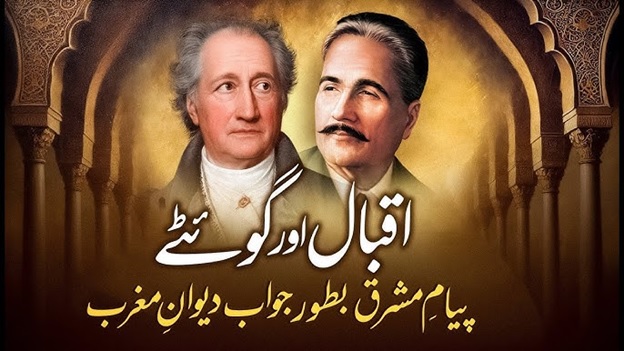
In 1923, the great South Asian Muslim poet Muhammad Iqbal published his poetic collection, Message from the East in reply to Goethe, who he called “the Sage of the West.” One of its poems depicts Goethe and Rumi meeting and conversing in paradise. The effect which Hafiz had on Goethe, Goethe had on Iqbal
In the two centuries after Goethe issued his invitation of dialogue to the East, various poets, musicians, and writers have answered the call. In 1923, the great South Asian Muslim poet Muhammad Iqbal published his poetic collection, Message from the East in reply to Goethe, who he called “the Sage of the West.” One of its poems depicts Goethe and Rumi meeting and conversing in paradise. The effect which Hafiz had on Goethe, Goethe had on Iqbal. Iqbal explained, “Our soul discovers itself when we come into contact with a great mind. It was not until I had realized the infinitude of Goethe’s imagination that I discovered the narrow breadth of my own.” In Iqbal ’s magnum opus, Javid Nama (Book of Eternity), Iqbal assumes the name Zinda-rud, or “living stream” which is derived from Goethe’s poem about the Prophet. Accompanied by his guide Rumi, he meets illustrious figures from different religions, cultures, and nations. In the end, he reaches the “Divine Presence” and concludes,
“Oneness of vision converts the motes to the sun;
be one of vision, that God may be seen unveiled.
Do not look slightingly on oneness of vision;
this is a true epiphany of the Unity.”
Another reply from the East came from the Palestinian scholar Edward Said, author of Orientalism (1978) which challenged biased European views of the Orient and Islam. Along with the Argentine-Israeli Jewish conductor and pianist Daniel Barenboim, Said formed the West-Eastern Divan Orchestra in 1999 in Goethe’s city of Weimar to bring together musicians of different cultures and religions such as Arabs and Israelis. Said described
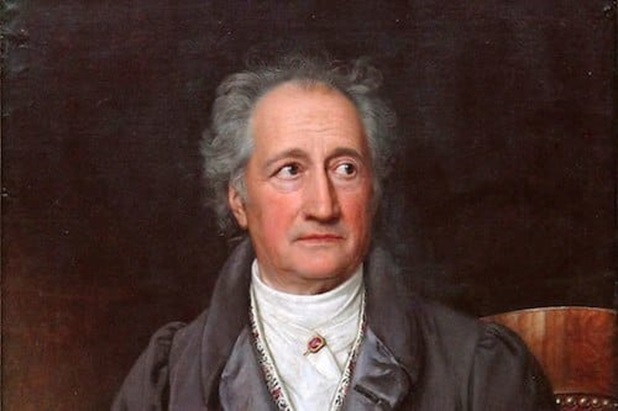
Goethe urges people to “unite with all their powers, with heart and mind, with reason and love, and get to know one another.” If we can do this, Goethe assures us, “things will happen which are as yet beyond anyone’s imagination.” Let us pursue Goethe’s vision of a better world of dialogue and understanding between peoples with his same confidence, energy, and loving optimism
Goethe’s Divan, after which the orchestra is named, as “extraordinary” and “unique in the history of European culture.” For Goethe, Said explained, art “was all about a voyage to the ‘other,’ and not concentrating on oneself, which is very much a minority view today...It’s become quite rare to project one’s self outward, to have a broader perspective.” Said believed that the orchestra, conducted “in the spirit of Goethe,” could help facilitate dialogue in the manner of the original Divan. Out of this initiative came the Barenboim–Said Akademie in Berlin, which Said and Barenboim co-founded to further the work of the orchestra, conferring degrees and diplomas in music.
More recently, the Pakistani-American poet Shadab Zeest Hashmi, in “ Walled City: A Qasida Cycle” (2017),
Shadab Zeest Hashmi, “Goethe: The Sufi of Weimar,” 3 Quarks Daily, January 6, 2014.
Muhammad Iqbal, Javid-Nama. Translated by Arthur J. Arberry. (Abingdon, Oxon: Routledge, 2011), p. 139.
Goethe, Maxims and Reflections, pp. 176-177.
Goethe, Maxims and Reflections, p. 177.
Daniel Barenboim and Edward W. Said, Parallels and Paradoxes: Explorations in Music and Society. Edited by Ara Guzelimian. (New York: Vintage Books, 2004), p. 7.
Barenboim and Said, Parallels and Paradoxes, p. 11.
Barenboim and Said, Parallels and Paradoxes, p. 7.
imagines Goethe, Iqbal, and Rumi all meeting on earth, in Lahore by the historic Roshnai Gate, in The Gate of Lights. In the poem, Hashmi writes, Iqbal
“dreams of paradise
as an essence contoured by poetry—
where Goethe reads Faust to Rumi
and Rumi proclaims him brother.”
It was through Iqbal, Hashmi explains, that she first encountered Goethe, whose Divan, she said, “ brings me ‘home’ which is neither a place nor a time but a yes .” By this she means “the cosmic yes...Yes has a way of flowering in some unknown darkness and resurfacing just when it seems to have faded away.”
At a time when there is such conflict, hatred, and misunderstanding in the world, the example of Goethe can inspire us. “Look within yourself,” Goethe tells us, “and you will find everything, and rejoice that out there, by whatever name you may call it, there is nature which says an unconditional yes, assenting to all that you have found within yourselves!” After all, “there is nothing outside us that is not also within us” and “God…has spread and implanted a portion of His infinite love everywhere.” Goethe reminds us again and again of what he calls “the divine power of love” which “finds the familiar ever new because it is reborn each moment.” “Love is truly a new beginning,” Goethe declares, and without love, “nothing could either be done or achieved.” We should “appreciate goodness everywhere” and “delight in all the ranges of life.” Even if someone believes “that help and hope have failed,” Goethe says in his Divan, “still there always remains the healing solace of a kindly word,” and he teaches that one is “really only alive when one enjoys the good will of others.” He asks, “What purpose would those countless suns and planets and moons serve, those stars and milky ways, comets and nebulae, those created and evolving worlds, if a happy human being did not ultimately emerge to enjoy existence?” Goethe urges people to “unite with all their powers, with heart and mind, with reason and love, and get to know one another.” If we can do this, Goethe assures us, “things will happen which are as yet beyond anyone’s imagination.” Let us pursue Goethe’s vision of a better world of dialogue and understanding between peoples with his same confidence, energy, and loving optimism.
Ambassador Akbar Ahmed is Distinguished Professor of International Relations and holds the Ibn Khaldun Chair of Islamic Studies at the American University, School of International Service. He is also a global fellow at the Wilson Center Washington DC. His academic career included appointments such as Nonresident Senior Fellow at the Brookings Institution; the First Distinguished Chair of Middle East and Islamic Studies at the U.S. Naval Academy in Annapolis, MD; the Iqbal Fellow and Fellow of Selwyn College at the University of Cambridge; and teaching positions at Harvard and Princeton universities. Ahmed dedicated more than three decades to the Civil Service of Pakistan, where his posts included Commissioner in Balochistan, Political Agent in the Tribal Areas, and Pakistan High Commissioner to the UK and Ireland.
Frankie Martin is a doctoral candidate in anthropology at American University and a senior researcher for Akbar Ahmed’s quartet of Brookings Institution Press studies on Western-Islamic relations.
Amineh Ahmed Hoti is Fellow-Commoner at Lucy Cavendish College, University of Cambridge. She was also a senior researcher for Akbar Ahmed’s quartet of Brookings Institution Press studies on Western-Islamic relations. Her most recent book is Gems and Jewels: The Religions of Pakistan (2021).
Ilona S. Yusuf, “Fluidity in Words: Exploring Themes in the Poetry of Shadab Zeest Hashmi.” In Mitali P. Wong and M. Yousuf Saeed, eds., The Changing World of Contemporary South Asian Poetry in English: A Collection of Critical Essays. (Lanham, MD: Lexington Books, 2019), p. 250.
Shadab Zeest Hashmi, “Goethe: The Sufi of Weimar,” 3 Quarks Daily, January 6, 2014.
Shadab Zeest Hashmi, “Goethe: The Sufi of Weimar,” 3 Quarks Daily, January 6, 2014.
Goethe, Maxims and Reflections, p. 137.
Goethe quoted in Eckermann, Conversations with Goethe, p. 192.
Goethe quoted in Eckermann, Conversations with Goethe, p. 559.
Goethe, Essays on Art and Literature, p. 147.
Goethe, Maxims and Reflections, p. 36.
Goethe, Maxims and Reflections, p. 96.
Goethe, Maxims and Reflections, p. 66.
Goethe, West-Eastern Divan, p. 29.
Goethe, West-Eastern Divan, p. 153.
Goethe, Maxims and Reflections, p. 69.
Goethe, Essays on Art and Literature, p. 101.
Goethe, Maxims and Reflections, pp. 176-177.
Goethe, Maxims and Reflections, p. 177.