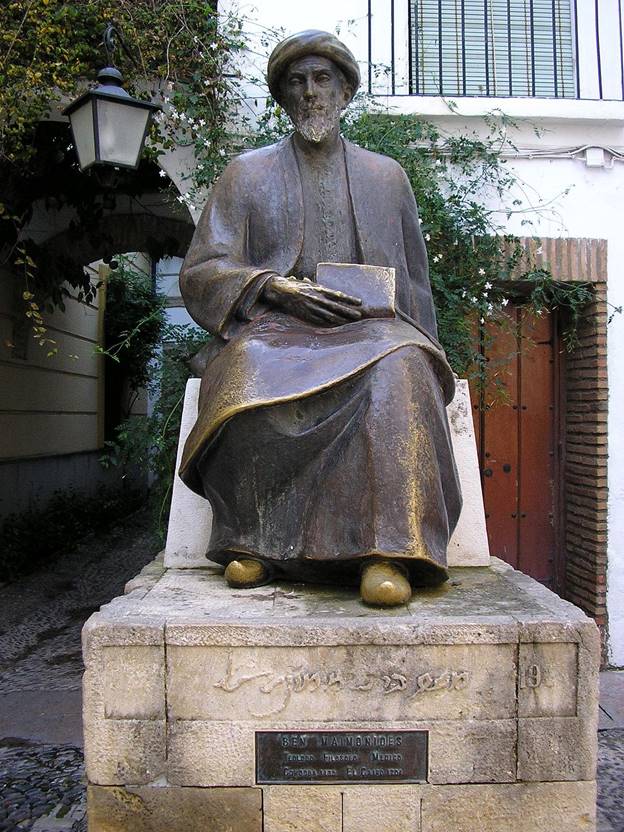
Maimonides can help unlock the door to peace in the Middle East and between Jews and Muslims elsewhere because he is shared by both communities. As such, he can transcend bitterly demarcated divisions. More broadly, Maimonides also has important lessons for humanity concerning how to coexist with one another at a juncture in history where we are facing abominable ethnic, religious, and national violence and threats to the world at large including climate change, the danger of out-of-control AI, and the threat of nuclear war
Maimonides: A Bridge between Faiths for the 21st Century
By Dr Akbar Ahmed, Frankie Martin, Dr Amineh Hoti
There are perhaps few figures in Jewish history who can match the stature of the celebrated Rabbi Moses Maimonides. For the Jews, the inscription on his tombstone in Tiberias, Israel describes his extraordinary status: “From Moses to Moses, there has never been another Moses.” This saying captures the extent to which Maimonides, who lived in the twelfth and early thirteenth centuries, transformed the practice and interpretation of Judaism itself. Maimonides has been described as “the foremost Jewish scholar of all time.”
Maimonides’ feats seem superhuman. First, he synthesized and systemized the entire corpus of Jewish law into his magisterial 14 volume Mishneh Torah or “The Repetition of the Torah.” The Mishneh Torah covered every aspect of Jewish life in extensive detail, from judicial codes and marriage law to ritual purity, customs and behavioral stipulations, and the observation of the Sabbath and the various holidays. It was the first time such a task had been attempted since Rabbi Judah the Patriarch completed his Mishnah, the first work of rabbinic literature, over one thousand years prior which formed the basis of the Jewish Talmud. The contemporary scholar Joel Kraemer attests that the Mishneh Torah “altered the whole realm of rabbinic literature” and “became the benchmark for all subsequent writing on Jewish jurisprudence.” As such, in the history of Judaism, Maimonides “has been placed second to Moses as a law-giver who brought order into the almost boundless collections of Hebrew tradition and discussion.”
The Mishneh Torah alone would have assured Maimonides greatness, but he went even further. He subsequently authored another work, Guide for the Perplexed, which has been described as “the most important work of Jewish philosophy ever written.” Guide for the Perplexed applies philosophical reasoning to the Jewish tradition and reconciles reason, logic, science, and philosophy with the religious revelation of the Jewish texts. For Jews, then, Maimonides provides both an authoritative and widely consulted legal code as well as a guide for interpreting it on a rational and logical basis. It is for this reason that Guide for the Perplexed was revived during the Age of Enlightenment in Europe as Jewish intellectuals grappled with the challenges of modernity and the advances of science and technology. They were aware that Maimonides had already been thinking in this manner centuries earlier. We should note also that aside from being among the greatest Jewish rabbis and philosophers, Maimonides was also a prominent physician who authored ten medical treatises. Today, Maimonides remains a towering figure of Jewish thought. Jews know him as the Rambam, a Hebrew acronym for Rabbi Moshe ben Maimon (Moses, son of Maimom)—Maimonides being the Greek rendering of Moses, son of Maimon.
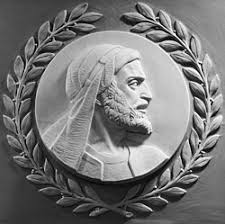
The fact that Westerners typically know Maimonides by his Greek name is an indication of his cross-cultural relevance. He had a profound impact on the Christian world including the Latin West, influencing figures such as Thomas Aquinas and Isaac Newton. In the Muslim world, Maimonides is called Ubayd Allah (faithful servant of God), a title reserved for those seen as closest to God
Maimonides’ impact was by no means restricted to the Jewish community, however. The fact that Westerners typically know Maimonides by his Greek name is an indication of his cross-cultural relevance. He had a profound impact on the Christian world including the Latin West, influencing figures such as Thomas Aquinas and Isaac Newton. In the Muslim world, Maimonides is called Ubayd Allah (faithful servant of God), a title reserved for those seen as closest to God. In Maimonides’ work we see a dazzling array of influences and citations as he synthesizes and incorporates the work of the Jewish sages, the great Islamic scholars, and the corpus of the Greeks and directs them at an overarching objective—seeking to comprehend God, nature and the universe, and discern the best way to live one’s life and treat others.
Such diverse influences are the result of his own background—he is the product of the culture of convivencia or coexistence between Jews, Christians, and Muslims in Andalusia, Spain under Muslim rule, and he channeled these influences into his interpretation of Judaism. Yet he is also a universal figure for all people because of his compassion for humanity and reaching across religious boundaries. During his own lifetime, as he was serving as court physician to one of the greatest rulers of Islam, Saladin, and interacting with the prominent scholars of the Muslim world, he was also serving as head of Egypt’s Jewish community and corresponding with and advising the world’s Jewish populations, from Europe and the Maghrib to Yemen and Mesopotamia. As a physician, he treated people from all religious backgrounds, rich and poor alike.
As such, for us, Maimonides is a great Mingler, or someone who reaches beyond their own group to embrace the “Other.” Here we will explore those aspects of Maimonides’ thought important for the task of fostering coexistence among diverse peoples. While Maimonides is known by many Jews and non-Jews alike as a great Jewish rabbi, the cross-cultural and interfaith aspect of Maimonides is underappreciated. We can see in our world today the necessity of such people who can bridge cultures and religions. Currently, the crisis in the Middle East has never been worse, and dialogue between Jews and Muslims specifically has effectively broken down amid acrimony and despair. Anti-Semitism and Islamophobia are rising precipitously worldwide—in countries like the US levels of both have never been higher according to published reports.
Maimonides can help unlock the door to peace in the Middle East and between Jews and Muslims elsewhere because he is shared by both communities. As such, he can transcend bitterly demarcated divisions. More broadly, Maimonides also has important lessons for humanity concerning how to coexist with one another at a juncture in history where we are facing abominable ethnic, religious, and national violence and threats to the world at large including climate change, the danger of out-of-control AI, and the threat of nuclear war. Resolving such challenges requires serious thinking on the topics of interest to Maimonides. On the nature of humanity, the role of science and religion in human life, and how to treat the “Other,” we can learn much from Maimonides some eight hundred years after he lived. Most crucially, perhaps, is that even though he experienced instability and crises in his own life and times, he never lost his sense of optimism and hope concerning what is possible. Reading Maimonides refreshes us. If we are indeed living in, as the French philosopher Bernard-Henri Lévy argues, the “Age of Madness,” then Maimonides can be our antidote. To meet the challenges of the present and future, Maimonides would agree, we must have hope, optimism, and love for each other and the unitary totality of which we all are a part.
The Life of Maimonides
Maimonides was born in Cordoba, the glittering capital of Muslim Spain, around 1138. His father, Maimon ben Joseph, was a rabbi, judge, and scholar, part of a line of Jewish sages going back generations. Maimonides was born into a thriving Jewish community in Andalusia during what is known as a “Golden Age” in Jewish history. In Andalusia, Jews, Christians, and Muslims lived, worked, and created an extraordinary culture together. Multiple aspects of life including music, art, food, literature, clothes, and philosophical ideas were shared between the three communities.

In Andalusia, Jews, Christians, and Muslims lived, worked, and created an extraordinary culture together. Multiple aspects of life including music, art, food, literature, clothes, and philosophical ideas were shared between the three communities – Image The Children of Abraham - Defence Journal
Jewish figures reached the apex of society under Muslim rulers. The mighty Umayyad caliph Abdur Rahman III had a Jewish chief minister while the Jewish poet Samuel ibn Naghrillah served as the vizier of the Muslim ruler of Granada. Jews also served in senior positions in the Muslim kingdoms of Seville, Almeria, Zaragoza, and Albarracin. While the Jews spoke Arabic, in Andalusia Hebrew became a language of poetry and philosophy “for the first time in a thousand years” as Jews emulated what Muslims were doing in Arabic. Writing of Maimonides in Andalusia, Joel Kraemer makes the point that in contrast to the modern period, where the result of Jews assimilating into majority cultures was often the “abandonment of Judaism,” in Andalusia the reverse was true: “Arab-Islamic” culture enriched Jewish culture and “enhanced their attachment to Judaism.
Andalusia became a major center of Jewish law and Talmudic interpretation. The yeshiva in Lucena, Andalusia, known as an “entirely Jewish city” and “the Pearl of Sepharad” was particularly renowned and attracted scholars from far and wide. For centuries, the center of Jewish scholarship had been the Talmudic academies in Babylon, the directors of which were known as the geonim, but the rise of Lucena changed this dynamic. Such was the stature of Lucena’s rabbinic scholars among the Jews of the world that Lucena “equaled if not surpassed the geonim of Babylon.” Maimonides’ father, the judge of the Jewish court of Cordoba, was educated at the Lucena yeshiva.
In his education in Andalusia, then, Maimonides was deeply rooted in his father’s instruction and scholarship and that of the great Lucena scholars, who Maimonides refers to as “my teachers.” At the same time, Maimonides’ education was firmly in the convivencia mode encompassing Jewish, Christian, and Muslim sources and the ancient Greek philosophers and scientists. One of Maimonides’ teachers was a student of the great Andalusian Muslim philosopher Ibn Bajja.
Politically, Maimonides’ Spain had, in the century since the fall of the Umayyad Caliphate of Cordoba, splintered into smaller kingdoms known as taifas. Maimonides grew up at an important point in the history of Andalusia amid the rise of the Almohad Dynasty from North Africa in the south and the continuing Latin Catholic “Reconquista” of the Iberian Peninsula in the north. Like the previous Almoravid Dynasty who overthrew the Umayyad Caliphate, the Almohads were austere tribesmen from North Africa who saw the multireligious societies of Andalusia, living in their cultured cities and prosperous farms, as effete and decadent. In 1147, the Almohads, who practiced a tribally-influenced version of Islam, took Cordoba. The Almohads preached doctrinal “monotheism” to the extent that they rejected the existence of any sect not their own. All Jews, Christians, Shia Muslims, and even Sunni Muslims not adhering to the Almohad interpretation of Islam were compelled to accept Almohad Islam, depart Almohad territory into exile, or risk execution. A Jewish refugee who fled Almohad rule in the Maghrib, Solomon ben Judah Hakohen, related in 1148 that when the Almohads entered one city, the Jews were told to convert or be executed, and “one hundred fifty Jews were slaughtered for the unity of God’s Name…For this I mourn and cry…the communities of the Maghrib were all destroyed…not one remained…bearing a Jewish name.” The Egyptian Muslim historian al-Nuwayri, who lived in the thirteenth and fourteenth centuries, later recorded that the Almohads allowed “no holy building (kanīsa) [meaning church or synagogue] in any district.”
In this environment, Maimonides’ father made the decision to relocate with his family. We do not know precisely when this occurred because it is not documented, but it was probably after the Almohad invasion. Like Minglers such as Rumi, whose family fled the Mongol invasions, Maimonides was developing as a person in the midst of challenging and uncertain circumstances. For about twelve years, Maimonides’ family moved in Andalusia. We are not sure exactly where they resided, but there is evidence they lived in Seville for a period of time. In 1159 or 1160, when Maimonides was 21 years old, the family relocated again, this time to Fez in Morocco. It is not known why Maimonides’ family decided to head deeper into Almohad territory from Andalusia, instead of, for example, traveling to the Jewish communities in Christian Europe. There was undoubtedly a compelling reason, and evidently a calculation that it was better than the possible alternatives at the time. It is also the case that “Almohad oppression was not uniform or universal,” so the family’s movements at any given time could have been contingent on what they assessed the situation to be like in particular locations. While scholars have offered many theories and there is speculation on this question in writings about Maimonides over the centuries, we remain unsure regarding this important part of Maimonides’ biography.
It was during this period that, it was later claimed, Maimonides converted to Islam to escape persecution, but it is not known for certain if this actually occurred. Maimonides’ father, Maimon ben Joseph, did, however, author his work Epistle of Consolation in which he argued that it is permissible in Judaism to outwardly convert from Judaism under duress while continuing to practice secretly. Maimonides would make the same argument in two works, Epistle on Martyrdom concerning the Maghrib, and Epistle to Yemen concerning a similar situation that had arisen there in which Jews were being persecuted by Muslim rulers. Maimonides argued that in case of the Almohads, as they were only requiring Jews to make a public statement—after which it was possible to continue practicing Judaism in private—converting was preferable to being executed. He contended, “There has never yet been a persecution as remarkable as this one, where the only coercion is to say something.” He furthermore argued that the Almohads themselves “know very well that we do not mean what we say, and that what we say is only to escape the ruler’s punishment and to satisfy him with this simple confession.” In any case, Maimonides undoubtedly knew that in Islam, simply reciting the Islamic declaration of faith with no inner conviction did not actually make one a Muslim—it was a meaningless or empty gesture. The best option, however, Maimonides argued, would be to flee the persecution entirely and relocate to a place where one could openly practice Judaism, as “The world is sufficiently large and extensive.”
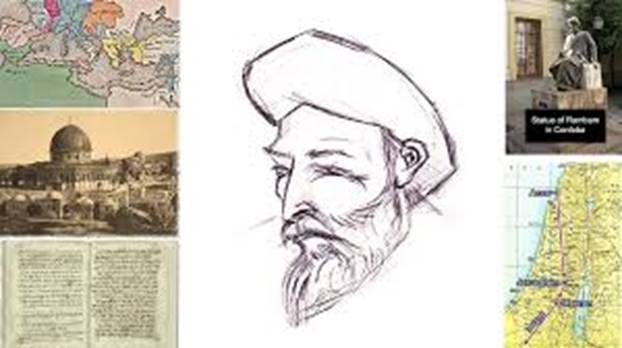
The best option, however, Maimonides argued, would be to flee the persecution entirely and relocate to a place where one could openly practice Judaism, as “The world is sufficiently large and extensive.” Around 1166, this is just what Maimonides’ family did. They departed for Palestine and visited Jerusalem, where Maimonides spoke of walking “through the House of the Lord with great feeling…we walked through the deserts and the forests seeking God; I will not forget it.”
Around 1166, this is just what Maimonides’ family did. They departed for Palestine and visited Jerusalem, where Maimonides spoke of walking “through the House of the Lord with great feeling…we walked through the deserts and the forests seeking God; I will not forget it.” Yet while the family may have wanted to settle in the Land of Israel, they decided, possibly due to an inability to earn a living there, to relocate once again to Egypt, where they finally settled. The instability of the area beset by the Crusades also could have influenced their decision.
In Fustat, on the outskirts of Cairo, Maimonides finally found some stability. Following his father’s death shortly after arriving in Egypt, Maimonides set down roots. He married into a prominent Egyptian Jewish family and, having completed his Commentary on the Mishnah—which he began in Morocco and wrote over a period of seven years—he was embraced and respected as a great jurist, becoming a sort of one man “High Court of Appeal.” From Egypt, Maimonides looked back at his recent past and the trials he faced, remarking, “evil days and hard times have overtaken us and we have not lived in tranquility; we have labored without finding rest,” but he voiced relief at his new situation: “Only recently have I found a home.” During his first few years in Egypt, Maimonides also lectured on “the ancient sciences” including logic, mathematics, and astronomy.
Around five years after arriving in Egypt, he was named head of the Jewish community, representing it before the state administration and receiving a state salary. By his mid-thirties, he “was already looked to as Rabbi of all Israel throughout the Muslim lands.” He ruled on numerous cases of which we have records. One concerning Jewish-Muslim relations involved a goldsmithing and glassmaking business jointly run by Muslim and Jewish partners. The query to Maimonides regarded the acceptability of their arrangement: Muslims worked on the Jewish holy day of the Saturday Sabbath, and Jews worked on the Muslim holy day of Friday. This way, the business operated seven days a week. Maimonides gave the arrangement his blessing, “saying that the profit of the Sabbath should go to the Muslim, the profit of Friday or of any other day should go to the Israelite, and they should share the profit of the rest of the days.”
Maimonides’ ascent to high office coincided with the coming to power of Egypt’s new ruler, Saladin, a Sunni leader who had succeeded the Shia Fatimids. Maimonides was closely aligned with Saladin’s vizier, Qadi al-Fadil, and served as court physician to Saladin. Maimonides was also physician to al-Afdal, Saladin’s eldest son, and Maimonides’ brother-in-law served as al-Afdal’s mother’s secretary.
The stability of Maimonides’ position, along with the business pursuits of his brother David, a merchant who provided the family financial wealth, allowed Maimonides to author his Mishneh Torah during his first decade in Egypt. Maimonides wrote this work because he felt that the system of halakha or Jewish law was in danger of collapse given the trials of the Jewish community which had been dispersed across the world. He stated, “I saw a nation without a genuinely comprehensive code of law, and without true and exact doctrines.” Maimonides’ goal was to provide a ready-made straightforward guide for any Jew to answer any question they may have concerning their duties or obligations according to the Jewish tradition.
Maimonides wanted the Mishneh Torah, written in Hebrew, to reach all Jews, and it was circulated throughout the diaspora, even reaching India. The Jewish community immediately recognized the scale of the achievement. A prominent French rabbi and contemporary of Maimonides wrote “his God sent him [that is, Maimonides] to restore His people, for He saw that the sages’ capacity had fallen short and the lot of the children of Israel was becoming more and more dismal. And so he raised his arm and extended his mighty rod over the sea of the Talmud so that the children of Israel might enter the sea on dry land.” Jewish scholars were aware “that to write even one chapter of the thousand making up Mishneh Torah, Maimonides would have had to acquire complete and concurrent mastery of all the scattered halakhic literature—a mastery that only he could distill into so clear and organized a work.” The contemporary Israeli philosopher and Maimonides scholar Moshe Halbertal has remarked of the masterwork: “Mishneh Torah is not only a huge treatise; it is also a beautiful and elegant one. Its aesthetic component lies in its giving no hint of the great effort invested in it. To the casual reader, the treatise is simple and clear, like a dancer executing complex movements without showing any sweat.” Joel Kraemer, another contemporary scholar, notes that in the Mishneh Torah Maimonides “created a style of elegant Hebrew that serves even today for legal writing.”
Just when Maimonides’ life seemed to be at a high ebb, tragedy struck. His beloved younger brother David was killed in a shipwreck in the Indian Ocean. The family’s assets were lost, and Maimonides now assumed protection of David’s wife and young daughter. David’s death, Maimonides stated, was “the heaviest blow, which caused me more grief than anything I had ever experienced.” He sank into a depression, later recounting, “For almost a year after receiving the sad news I lay on my couch stricken with fever, despair, and on the brink of destruction.”
After the loss of David, Maimonides moved more actively into the practice of medicine. His letters and statements of the period recount his packed schedule and inability to devote the time he wished to pursuing scholarship. Yet he did find the time to write his next masterwork, Guide for the Perplexed, addressed specifically to a Jewish student of his, Joseph ben Judah. Joseph had traveled from Alexandria to study with Maimonides in Fustat, where Maimonides taught him scriptural interpretation, astronomy, mathematics, Greek philosophy, and the approach of the Islamic Falsafa movement, which balanced revelation with reason informed by philosophical methods. When Joseph’s life obligations necessitated a move to Aleppo, Maimonides opted to continue tutoring Joseph in the form of Guide for the Perplexed. The book, written in Arabic and shortly thereafter translated into Hebrew, would be for Joseph and all others like him who were curious and sought knowledge.
The final years of Maimonides’ life were devoted to his medical practice, treating both the members of the Sultan’s court in Cairo as well as ordinary people in his general practice at Fustat. Maimonides described his patients as a “mixed multitude” including “both Jews and Gentiles, nobles and common people.” Scholastically, he focused on medical writings which incorporated the work of Greeks such as Hippocrates and Galen and Arab scholars. Two of his medical works were written in response to requests from al-Afdal, who succeeded his father as Sultan, and were dedicated to al-Afdal. Another Maimonides text, Medical Aphorisms, “has been characterized as a medical equivalent of the Mishneh Torah in that it offers a summary and compendium of over ninety of Galen’s works.”
In 1204, Maimonides passed away, and was buried in Tiberias. According to the Egyptian Muslim historian al-Qifti, a contemporary of Maimonides, “He had asked of his heirs in advance that he be taken, when his spirit left him, to the Sea of Galilee and be buried there, in a place having the graves of Jews and their great Torah scholars, and that was done for him.” Maimonides’ stature as head of the Jewish community in Egypt and respect shown to him by Muslim rulers is attested by the fact that the post remained in Maimonides’ family for the next two centuries.
Maimonides on the Unity of God and Humanity
Before discussing Maimonides’ views of the “Other,” we will first discuss his views of God and the unity of existence. As we will see, his views of the “Other” are directly related to his understanding of God.
The most important element of Maimonides’ understanding of God is the concept of oneness or unity. When we ascend to “the higher rung of thinking,” Maimonides taught, we “gain certainty that God is truly one—so truly as to be utterly incomposite and indivisible in every way.” While various things in the world may
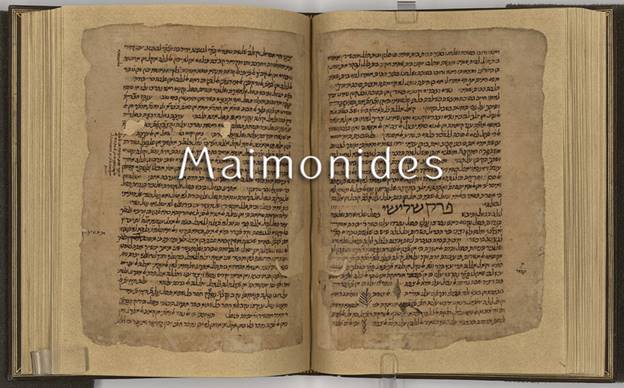
Maimonides describes God as “one simplex Being, without complexity or multiplicity, one from every standpoint and perspective.” God is the “ultimate Final Cause,” the “final Form of all that exists,” and the “Ultimate Form, the Form of all forms, on which the existence and persistence of every form in the world ultimately depends and by which all are sustained…That is why, in our tongue, He is called Hey ha-‘Olam” or “Life of the Universe.” If God did not exist, Maimonides argues, “there would be nothing,” and yet we are aware that “the universe exists.”
appear singular and disconnected from one another, they come together in the larger Unity—for Maimonides all things are interconnected. Maimonides believed that the world is one, which reflects the unity of God, writing, “the world’s unity bespeaks the unity of its Source.” As a doctor, he explained the nature of the world through a comparison with the human body: “Just as organs cannot be apart and remain real organs—liver, heart, or flesh by themselves—the world’s parts cannot exist without one another in the world as a whole…just as a human being has a certain capacity to order and coordinate his organs, giving each what it needs to protect it and keep it in health—the capacity acknowledged by physicians as the body’s ‘master faculty,’ or often just its nature—so does the world have a coordinating power that preserves species from extinction” and “protects their members over their general span of life.” “The whole world is just one being,” Maimonides affirms, “one living organism…This is how you should think of the entire globe: as one living, moving, ensouled being.”
Maimonides further describes God as “one simplex Being, without complexity or multiplicity, one from every standpoint and perspective.” God is the “ultimate Final Cause,” the “final Form of all that exists,” and the “Ultimate Form, the Form of all forms, on which the existence and persistence of every form in the world ultimately depends and by which all are sustained…That is why, in our tongue, He is called Hey ha-‘Olam” or “Life of the Universe.” If God did not exist, Maimonides argues, “there would be nothing,” and yet we are aware that “the universe exists.”
Not only is God One, but God is also good. The “prime intent” of God, Maimonides asserts, is “to give being to all that can be. For being, surely, is a good.” When we look at the world, we observe that that which “empowers or directs things takes nothing in return. All that it bestows it gives like one who acts out of sheer benevolence and grace, natural nobility, and inherent generosity.” “We are always in God’s presence,” Maimonides states, “walking in the aura of the Shekhinah” (Divine Presence).
Once Maimonides has established that God is One, the universe is One, and the world is One, he proceeds to affirm that humanity is also One. All human beings, Maimonides wrote, are created “equal,” “in the same womb,” and belong to the “tribe of Adam.” At the same time, humans are also different according to two main criteria, physical appearance and culture. Physically, Maimonides says, humans display “slight individual differences” such as the fact that “people vary in their hair and coloring.” Then, culturally, “there are propositions that have become known among one people and not among another.” Humans, Maimonides asserts, “grow attached to the familiar views they grow up with. They become partisans of those views.” Maimonides used the Islamic term ummahs for the different nations and peoples of the world in his discussion of cultural distinctions. Yet these differences among humans, Maimonides argued, are what Aristotle called “accidents,” variations that do not change the overall oneness of the species.
Maimonides on the “Other”
If, according to Maimonides, God is One and a perfect Unity, and all human beings are equal, it would follow that we should treat each other with kindness with the
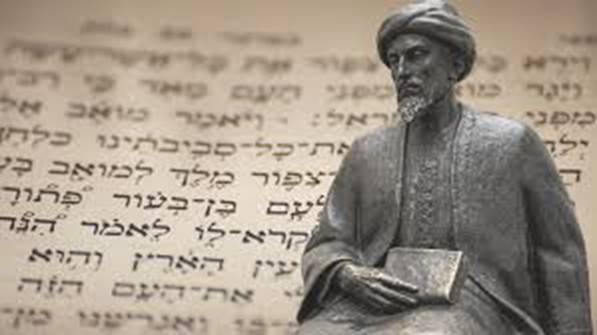
Maimonides lamented, “The grave ills that human beings inflict on one another, too, out of ambition, passion, opinions, and beliefs all reflect privations. For they all stem from ignorance, want of knowledge. Just as a blind man, sightless and unguided, always stumbles, harming himself and others, human sects perpetrate dreadful evils against their fellow humans and themselves, reflecting their ignorance. - Image British Muslim Magazine
He lamented, “The grave ills that human beings inflict on one another, too, out of ambition, passion, opinions, and beliefs all reflect privations. For they all stem from ignorance, want of knowledge. Just as a blind man, sightless and unguided, always stumbles, harming himself and others, human sects perpetrate dreadful evils against their fellow humans and themselves, reflecting their ignorance
objective of coexisting. Yet unfortunately this is often not the case in the world. Maimonides observed that the differences among peoples, the various “accidents” that should not affect unity, are seen to be far more substantiative by human beings than they actually are. Humans therefore lack sufficient knowledge of the Unity that brings them and all things together. Human differences such as varying ideologies, Maimonides explained, form the basis of a “rivalry for superiority” between groups. He lamented, “The grave ills that human beings inflict on one another, too, out of ambition, passion, opinions, and beliefs all reflect privations. For they all stem from ignorance, want of knowledge. Just as a blind man, sightless and unguided, always stumbles, harming himself and others, human sects perpetrate dreadful evils against their fellow humans and themselves, reflecting their ignorance. Had they the insight befitting our human form as vision befits the eye, all the harm they do to each other and themselves would end. For knowledge of the truth would dissolve hatred and spite and end the crimes of man against man.”
In his writings on Judaism such as the Mishneh Torah, Maimonides again and again stresses the importance of kindness and compassion with which Jews must treat each other, and also people who are not Jewish. “We bury the dead of the heathens, comfort their mourners, and visit their sick, in the interest of peace,” Maimonides affirms. Additionally, from a theological perspective, “In the case of heathens…the pious among them are assured of a portion in the world to come.” Maimonides stresses the importance of embracing the “Other,” asserting, “we are commanded to love the stranger,” and he states, “In most Midrashim [ancient Jewish scriptural commentaries] it is pointed out that the Lord has enjoined on us in respect of the stranger what He has enjoined in respect of Himself (exalted be He), by saying, Thou shalt love the Lord thy God, and Love ye therefore the stranger.” Maimonides argues, “we should treat resident aliens with the consideration and kindness due to a Jew; for we are bidden to sustain them, as it is said: Thou mayest give it unto the stranger that is within thy gates, that he may eat it (Deut. 14: 21).”
Jewish law puts the “stranger” or foreigner who may have a different religion, appearance, or culture from the majority population in the same category as the poor and other persons deserving of charity, compassion, and kindness. Maimonides affirms that “no joy is greater or more glorious than the joy of gladdening the hearts of the poor, the orphans, the widows, and the strangers. Indeed, he who causes the hearts of these unfortunates to rejoice emulates the Divine Presence.” And when giving charity to the poor, Maimonides states, “the poor of the heathens may not be excluded from these gifts; rather they may come together with the poor of Israel and take of them, for the sake of promoting ways of peace.”
Maimonides additionally maintains that non-Jewish scholars and rulers should be afforded great respect: “One who sees Gentile sages makes the blessing ‘Blessed are You, Lord our God, King of the Universe, Who gave his wisdom to human beings…One who sees Gentile kings makes the blessing ‘Blessed are You, Lord our God, King of the Universe, Who gave of His honor to human beings.”
Maimonides particularly emphasizes the importance of hospitality towards “strangers.” In interpreting Jewish law, he asserts that it goes even beyond welcoming them into one’s home, stressing the necessity to accompany them and help them more generally. Maimonides writes, “The reward for escorting strangers is greater than the reward for all the other commandments. It is a practice which Abraham, our father, instituted, and the act of kindness which he exercised. He gave wayfarers food to eat and water to drink and escorted them. Hospitality to wayfarers is greater than receiving the Divine Presence…But escorting guests is even greater than according them hospitality.”
Abraham is the key focal point for Maimonides’ discussions about God, the Unity of God, the oneness of humanity, the “Other,” and hospitality because, Maimonides asserts, Abraham reached an understanding of God on his own. It was not God who came to Abraham, but Abraham who discovered God through his faculty of reason (see below). God then rewarded Abraham and his descendants by forging a covenant with the Jewish people.
Maimonides’ definition of Jewish identity in this context is significant and is directly linked with his larger philosophy. Maimonides is aware of the Jews as constituting a distinct people, an ethnicity or ethnic nation solidified by ethnic bonds. Maimonides uses the Arabic term asabiyya, later utilized by Ibn Khaldun and meaning group feeling or solidarity, to describe these bonds among the Jews and other groups: “Ties of fellowship, affection, and mutual support reach their peak only among kin. So when a group shares an ancestor, even remotely, caring, mutual aid, and affection flourish among them.” Another crucial social bond, Maimonides explains, is friendship, which also forges “fellowship, affection, and mutual support,” albeit not quite to the degree that kinship does. Maimonides here is drawing from multiple cultural influences in discussing group solidarity—the Arabic asabiyya, the Judaic concept of reʿut or friendship, and the Greek concept of philia as developed by Aristotle which encompasses friendship and “all kinds of sociability.” Concerning the Jews, Maimonides writes, “To foster such fellowship is the Torah’s high aim.”
As contemporary Jewish scholars such as Menachem Kellner have argued, Maimonides’ identification of the Torah as that which binds the Jewish community together in fraternity is an indication of his definition of Jewish identity as lying not with descent and lineage but with a belief in the Torah and the unitary nature of God.
Maimonides’ views may be seen clearly in his advice to a Muslim who had converted to Judaism. The convert, Obadiah, explained to Maimonides that the rabbi in his new faith had told him not to recite Jewish prayers to the “God of our Fathers” on the rationale that as Obadiah was not Jewish by ethnic descent and had only just become Jewish, he could not possibly say that the God he was praying to was the God of his fathers. Maimonides reproached the rabbi, and said that Obadiah absolutely could use the phrase, “seeing that Abraham was the father of all those who believe in the Unity of God.”
While noting important differences between Judaism, Christianity, and Islam, Maimonides also acknowledged what he called “commonalities to all three communities” and where they overlapped. On Islam, for example, he stated that Muslims “properly regard God as a unity, a unity with no exception,” and he argued against the contention of a rabbi, again conveyed to him by Obadiah, that Muslim rituals concerning the Kaaba stone in Mecca indicate that Muslims are idolaters. When Muslims pray facing the Kaaba, Maimonides asserted, they are not praying to an idol because “Those who bow toward it today direct their thoughts to heaven” and thus the unity of God. Concerning Christianity, Maimonides uniquely authorized Jews to teach the Torah to Christians, because, he argued, for Christians the Torah is sacred. Abraham, who recognized the unity of God and the universe, is again of great importance in relations between the different religions, with Maimonides contending regarding Christians and Muslims, “it did result from his [Abraham’s] efforts that today we find such common reverence for him among most people on earth that even those not of his descent link themselves to him and think themselves blessed through his memory.”
In terms of theology, Maimonides believed that both Christianity and Islam were helping to bring about the coming of the Messiah, progressively spreading awareness of the Unity of God. He wrote in the Mishneh Torah, “it is beyond the human mind to fathom the designs of the Creator; for our ways are not His ways, neither are our thoughts His thoughts. All these matters relating to Jesus of Nazareth and the Ishmaelite (Mohammed) who came after him, only served to clear the way for King Messiah, to prepare the whole world to worship God with one accord.” Maimonides stresses that the coming of the Messiah in Judaism does not mean “that Israel might exercise dominion over the world, or rule over the heathens,” but that peace will come to the world and there will be “neither famine nor war, neither jealously nor strife. Blessings will be abundant, comforts within the reach of all.” The Jewish “Sages and Prophets,” Maimonides writes, longed for the Messiah with the aspiration that “Israel be free to devote itself to the Law and its wisdom,” to join “the whole world” in attaining “an understanding of their Creator to the utmost capacity of the human mind.” It is with these statements that Maimonides concludes his 14 volume Mishneh Torah.
Maimonides and Islam
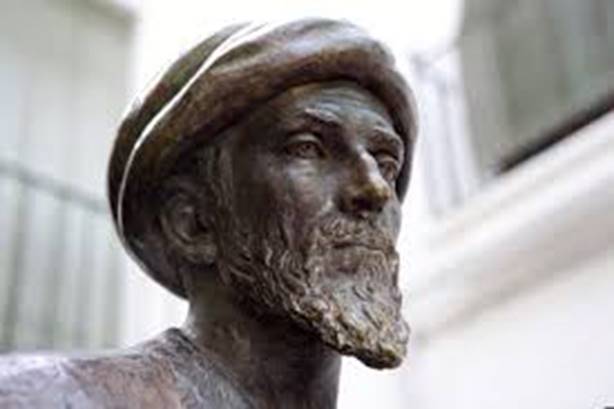
In outward form, language and culture, Maimonides absorbed Muslim civilization—he was like an Arab grandee, a man of influence in society and in court. He was immersed in an Islamic environment his entire life, beginning in Andalusia with its particular blend of cultural influences – Image HuffPost
Let us discuss and examine further the relationship between Maimonides and Islam. It is not an exaggeration to say that it would be difficult if not impossible to trace all of the connections to Muslim thought and culture in Maimonides’ life and thinking. In outward form, language and culture, Maimonides absorbed Muslim civilization—he was like an Arab grandee, a man of influence in society and in court. He was immersed in an Islamic environment his entire life, beginning in Andalusia with its particular blend of cultural influences. By the end of his life, he was in the heart of the Muslim world serving the most powerful political force in the Middle East, Saladin’s Ayyubid Sultanate. That he had direct access to Saladin’s innermost court speaks to the confidence Muslims had in him. Maimonides moved in elite Islamic circles in Cairo. He was, for example, part of a circle of friends who would meet to exchange ideas—Saladin’s vizier, Qadi al-Fadil, described the group as “lovers who love discussion.” There is a record of the group meeting for a theological discussion at which the participants were Maimonides, the Sunni Muslim poet and head judge of Cairo Ibn Sana al-Mulk, and the Shia Syrian scholar Sharif Abu al-Qasim al-Halabi.
Then there are the numerous Islamic influences and references in Maimonides’ writings. These include the genres he wrote in, for example Guide for the Perplexed is in the form of a risalah, a personal or public letter or essay in Arabic literature. He also utilizes many Muslim terms. We have already noted his use of the term ummah. Throughout his writings in Arabic, Maimonides uses the term salat for prayer and dua for individual prayers. He also used the term tawhid or the unity of God in association with God’s covenant with Abraham, writing that Abraham proclaimed the tawhid. In association with Moses, Maimonides used the phrase kalim Allah [God’s spokesman], which is how Moses is described in the Qur’an. He additionally referred to Jesus as Isa, using his Islamic name, rather than Yeshu, the name Jewish authors used. Another Islamic term Maimonides uses is jahiliyya or the time of ignorance before the coming of Islam. Maimonides applies this term to Judaism in his discussion of painful Jewish history. He argued that there was much Jewish knowledge and science that was lost when the Jewish people were subjected to “the nations” of “Jahiliyya.” The consequence was that Jews retained the Torah but lost methods of interpreting it, leaving, as he put it, “only faint hints and echoes…scattered kernels sheathed in many a husk that engrossed the attention of people who assumed there was no kernel within.” Maimonides saw himself as facilitating and encouraging the revival of Jewish learning to recover from this history.
We further note the extensive discussions about Islamic philosophical sources and ideas in Maimonides’ writings. He often refers to the different philosophical schools of thought and the debates that were going on in the Muslim world, for example involving the Muʿtazilites and the Ashʿarites. Even his statement about kernels and husks, scholars of Maimonides have noted, contains imagery also used by the great Islamic scholar Al-Ghazali, who, “Using the imagery of husks and core…finds the heart of monotheism in those who see God in all things.” Additionally, Maimonides was influenced by Shia Ismaili thought. It is also said that Maimonides and his students introduced to Egypt the mathematical work The Book of Perfection by al-Mu’taman, the Muslim scholar and ruler of Zaragoza in Spain.
In terms of individual scholars, the influence of the great Islamic philosopher Al-Farabi looms large in Maimonides’ thinking. An early Maimonides work was Treatise on Logic, which is indebted foremost to Al-Farabi. Maimonides told the Jewish philosopher Samuel ibn Tibbon of France that Al-Farabi was “exceedingly wise,” and counseled, “I would advise you to study only the works of logic composed by the scholar Abu Naṣr al-Farabi…for everything he has written…is like fine flour.” Maimonides was also influenced by the Islamic scholars Ibn Bajja and Avicenna, and he praised and recommended the writings of Averroes of Andalusia, whose career in many ways was similar to that of Maimonides. Like Maimonides, Averroes was dislocated by the Almohads and mastered both religious law—serving as the qadi or head judge of Cordoba—and philosophy in his commentaries on Aristotle. In terms of Maimonides’ own position in the philosophical debates ongoing in the Muslim world, he nailed his flag to the mast in identifying with the aforementioned Islamic Falsafa movement which sought to reconcile philosophy and revelation.
This task of balancing religion with reason, inspired by the debates in the Muslim world, was taken up with gusto by Maimonides and applied to his own Jewish tradition. Using these tools, he sought to invigorate Judaism. This can be seen in his Mishneh Torah, which included Maimonides’ “13 Principles of Faith,” a straightforward articulation of what Maimonides assessed to be the most essential components of the Jewish faith which are still used by Jews today. This mirrored the kind of doctrinal
When we interviewed Lord Jonathan Sacks, the former Chief Rabbi of the UK and a scholar deeply influenced by Maimonides, he confirmed that concerning Maimonides, “almost every aspect of his work was influenced by and stimulated by Islam. His creation of this magnificent legal code was inspired by sharia codes. His formulation of the principles of Jewish faith was inspired by the fact that Muslim thinkers had done this wonderful presentation of Islamic faith.”
simplicity and clarity with which Muslims spoke about their religion.
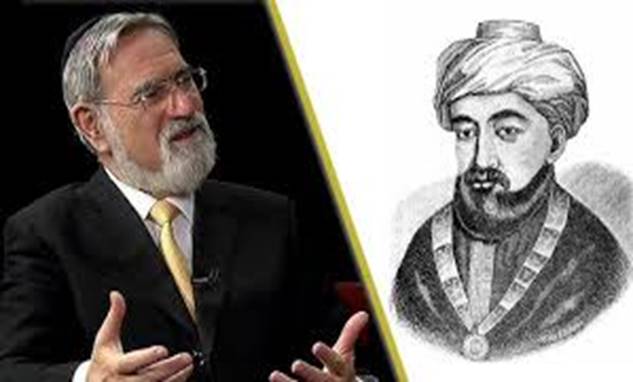
When we interviewed Lord Jonathan Sacks, the former Chief Rabbi of the UK and a scholar deeply influenced by Maimonides, he confirmed that concerning Maimonides, “almost every aspect of his work was influenced by and stimulated by Islam. His creation of this magnificent legal code was inspired by sharia codes. His formulation of the principles of Jewish faith was inspired by the fact that Muslim thinkers had done this wonderful presentation of Islamic faith.” Joel Kraemer, the distinguished scholar of Jewish and Islamic philosophy, further specifies of Maimonides’ 13 Principles that the first principle on the Creator echoes Avicenna, while the sixth on defining the nature of prophecy is derived from the thought of Al-Farabi, Avicenna, and Averroes. Kraemer also points out that in Commentary on the Mishnah, Maimonides states that “our law” divides speech into five categories (obligatory, prohibited, reprehensible, meritorious, and permissible), which are actually categories “from Islamic jurisprudence, which classified all human actions according to these very same five categories.”
There are even instances of Maimonides in Egypt issuing judicial rulings inspired by Islamic law. Professor Sarah Stroumsa has pointed to an example of a case of matrimonial discord in which Maimonides issued a ruling that has no precedence in Jewish law, but is found in Maliki Islamic law as practiced in Andalusia. According to the practice, a trusted third party was introduced who was tasked with determining the source of the marital difficulty and attempted to either reconcile the spouses or, in the case of divorce, make a determination on payments. Additionally, and perhaps surprisingly, Stroumsa further detects in Maimonides’ ideas the influence of the Almohads’ paradigm concerning the sources of law and doctrines of belief regarding monotheism.
In his interview with us, Sacks directly related Maimonides’ incorporation of Islamic influences to the Andalusian environment he grew up in, of “convivencia, living together.” Maimonides was educated from the time he was child in what was simultaneously a world center of Jewish learning and an illustrious center of Islamic scholarship, and ideas were freely shared across religious boundaries. These different influences on Maimonides made him the person he was. Like the great polymaths of Islam, he was as at home discussing the stipulations of religious law and the intricacies of theology as he was discussing the most advanced scientific, astronomical, and medical works.
Reconciling Reason and Revelation
As indicated above, when we examine Maimonides’ body of work, his interest in reconciling reason and revelation emerges as perhaps his most central task and theme. In this, he is very much in keeping with the other Andalusian philosophers, informed by the Islamic tradition of engaging with and interpreting the Greeks. Maimonides’ argument was that reason and religion necessarily cannot conflict. This is because while religion is derived from the word of God, reason acts on the basis of our human faculties which are given by God. Each should be seen in relation to the other. But they are also each conveyed in different ways.
Once again, Abraham is an essential figure in the discussion. It is Abraham, as mentioned above, who for Maimonides brings reason and revelation together. This is because Abraham first discerned God and the Unity of Creation on the basis of reason alone, and then subsequently proceeded to receive revelations. “Our Father Abraham,” Maimonides explained, “began to ponder, though but a child, and to meditate day and night, wondering: ‘How can the Sphere forever follow its course with none to conduct it? Who causes it to rotate? For it cannot possibly cause itself to rotate?’…he grasped the true way and understood the right course of his own sound reason: He realized that: there is a single God, He conducts the Sphere, He created the universe, and, in all that exists, there is no god but He.” In many ways Abraham is reflective of the human condition in being born into the world and trying to discern what life is all about. As Maimonides wrote, we are all seeking answers, whether a person believes in one god or many gods.
For Jews, the succession of divine laws, directives, and great sages and prophets following Abraham and later Moses in history provided guidance to the community about the just and correct ways to live one’s life and understand God. These directives and prophecies, Maimonides argues, contain truth in their own unique language—the language of revelation with its poetic phrasings, imagery, and stories. This language is often metaphorical. Maimonides states that this is necessary because human beings are limited by our language. The Torah, he notes, citing the Sages, “speaks in human language.” Thus religion seeks to convey certain truths in a manner that ordinary people can understand, and relate to their own experience—as Maimonides says, “what applies to God is whatever people in general can absorb and conceive of without reflection.” This means if one reads the text on a literal surface level, God is described as doing things people can conceive of like sitting on a throne in the heavens, speaking, seeing, moving up, moving down, shifting, or standing. Yet when such phrases are used, for Maimonides they are symbols and metaphors which convey an underlying divine message. It is even difficult for Maimonides to say what God is, because of the failings of our language in discussing the Unity of Being, so he argues that we are on firmer ground stating what God is not, or embracing a calming silence. On this subject, Maimonides quotes King Solomon from the Book of Ecclesiastes: “God is in Heaven; thou art on earth. So let thy words be few.”
Towards the beginning of Guide for the Perplexed, Maimonides compares religious texts to a golden apple which is encased in beautiful and intricate silver filigree: “At a glance or at a distance, it looks like a silver apple, but a keen observer who studies it closely will see inside and realize that it is gold. Just so the prophets’ poesy holds practical wisdom on the surface, including much that is wholesome socially, as the plain sense of Proverbs and similar sayings clearly do. But the inner sense bears a wisdom salubrious in another way, imparting truths about Reality.”
In addition to religion, humans have another way of understanding life, God, and how humans relate to the divine Unity: their own faculties of reason. Through reason, we may actualize our human potential; it is, Maimonides states, “our highest attainment.” In contrast to the often-poetic language of religion, reason speaks in a language of demonstration, empiricism, and logic. Reason takes as its starting point nature and our interaction with it. On the basis of our observation of nature, we can work our way towards understanding the Creator of all. As Maimonides puts it, “Only when we know the world and its nature by experience can we make inferences about what lies beyond it.”
In this pursuit, the best and most rigorous model is provided by the Greeks and scholars like Aristotle, who Maimonides described as “wonderfully perceptive, penetrating, and insightful.” Maimonides argued that aside from a prophet who has experienced God directly, Aristotle “reached the highest level of knowledge to which man can ascend,” and he should be taken seriously by all people who seek to know and understand the world.
Maimonides proceeds to provide a history of the development of philosophy following the ancient Greek period as it interacted with prophecy-based Abrahamic religions. When Christianity arrived in the Greek lands, philosophers worked to reconcile Christianity and reason, and Maimonides cites scholars engaged in this task such as the sixth century theologian John Philoponus of Alexandria. When Islam came, Maimonides continues, Muslim scholars attempted to similarly reconcile philosophy with religion and various schools of thought and methods emerged, drawing on lessons from Christian philosophers. Yet Maimonides believed that some of these approaches, while utilizing philosophical language, were not sufficiently rooted in demonstrable proof. He states his own approach thusly: “I say, as [the fourth century Greek philosopher and statesman] Themistius did, that reality does not conform to our beliefs; true beliefs must conform to reality.”
In other words, for Maimonides, the ultimate proof of the validity of any claim lay in logic, reason, and the scientific method of demonstration. In a case where there is a seeming conflict with the religious text, we must uphold the conclusion of reason. As Maimonides argues, “whenever Scripture, taken literally, contradicts what is proven, we must gloss, knowing that the sense of the text must be figurative.” Additionally, Maimonides asserts that there are usually rational reasons for religious laws in the context of specific cultures and time periods, even if we may not be able to discern them so long after they were recorded in holy texts.
Another point that Maimonides makes in the context of relating one belief system and culture to another, particularly concerning religion and philosophy, is that careful attention should be paid to language and the words being used. While two terms may appear distinct, they may in fact be getting at the same idea and the differences may conceal a common underlying meaning. For example, while on the surface a Biblical angelic figure may not have much to do with Aristotle, Maimonides detects a similar meaning being conveyed: “He says ‘incorporeal intellects’; we say angels.”
Maimonides is also adamant that what is proven scientifically be accepted, even if it originates in a nation, culture, or religion outside of one’s own. Regarding astronomy, Maimonides states that “our Sages…favor gentile scholars’ view to their own in these astronomical matters, as they freely admit: The sages of the nations of the world prevail…Quite right. For in intellectual matters, one must follow where the argument leads and believe what is soundly proven.” Pertaining to “the science of astronomy and mathematics,” Maimonides further argues, if proven logically, “we need not be concerned about the identity of their authors, whether they were Hebrew Prophets or gentile sages.” He attests that “sound thinkers” or muhaqiqun can be found in all nations.
Maimonides additionally believed that we can only truly move forward with intellectual pursuits by engaging in respectful scholarly debate. We should think clearly, rationally, and be openminded towards different ideas and arguments. Maimonides quotes Aristotle on the merits of presenting our own opponent’s views in addition to our own: “If we do, our arguments will be all the more welcome and acceptable to fair-minded thinkers who hear our adversaries first. For if we just stated our own belief and our arguments and not those of our adversaries, our position might seem less credible. One who wants to reach the truth should not be contentious with those who differ but treat them fairly and courteously and give their sound arguments as much leeway as his own.” Maimonides also counsels us to focus inward and attempt to check our biases, as a person “who favors one side, whether by upbringing or by interest, may be blinded to the truth.” However, “Where there is proof, even passion cannot quibble.” We should conduct scholarship with empathy, curiosity, rigor, and what Maimonides calls good “character.” Indeed, he explains that “the Torah seeks to foster a gentle, open character. One should be not rigid and harsh but amiable, agreeable, and receptive.”
In Guide for the Perplexed, Maimonides reminds us that debates about the nature of the world, the divine, and how to live one’s life have been going on for thousands of years. In the Bible’s Book of Job, for example, Maimonides discerns ancient debates about such questions which mirror philosophical debates taking place in the Muslim world of his own times in which Jews, Christians, and Muslims were all involved. Of Job and his interlocuters, Maimonides contends, “The view ascribed to Job corresponds to Aristotle’s; Eliphaz’s, to that of our Torah; Bildad’s, to that of the [Islamic rationalist] Muʿtazilite school; Zophar’s, to that of the Ashʿarites,” the orthodox theological school of thought which came to dominate Sunni Islam, exemplified by scholars like Al-Ghazali.
We see in Maimonides a fascination with and excitement at new scientific discoveries and perspectives from all corners of the world. While it is not possible for us as humans to completely understand God, creation, or the universe, our faculties of reason give us the ability to pursue this ideal. When we reach limits in our investigations, Maimonides counsels, we should “call a halt…and defer, when reasoning can take us no further.” Yet it is also possible, he notes, that “Someone else may have a proof that illuminates a truth still dark to me.” Hence the importance of dialogue and cooperation.
To restate our main point in this discussion, for Maimonides the human ability to reason does not contradict with religious texts, but only enhances and further clarifies them because both reason and religion are part of the same human process of knowledge. Both are here to help and guide us; they are ways in which we “beg God to remove the barriers between us and Him.”
The Importance of Love
There is one final core element of Maimonides’ thinking on knowledge, reason, and religion which we must emphasize: love. As noted above, Maimonides believed that the process of religious interpretation should be seen as occurring on different levels—recall his metaphor of the apple which was silver on the outside but gold on the inside. Concerning God and the worship of the believer, Maimonides stated that on the one hand, we fear God and are in awe of God, but on the other, we also love God. In one respect, at the level of religious law, fear and awe operate—we “fear of the Lord…the thou shalts and thou shalt nots.” “But,” he goes on to say, “the ideas imparted in the Torah—the knowledge that God exists and is one—imbue us with love.” Awe and love thus represent “two pathways: love though Torah’s ideas, which instill awareness of Him as He really is, and awe through all its practices.”
There is an essential and necessary connection, Maimonides argues, between reason and love. He believed that without love, we cannot know God, or at least approach knowing God: “No one loves the Holy One—blessed be He!—except by the experience of knowing Him.” Reason is linked to love for Maimonides, because, as he says, “love is proportionate to apprehension.” In other words, the more we know God, the more that we love God. Through studying nature, as we understand more, we feel a sense of wonder and love. We may contemplate the beauty around us and the harmony in the universe, or experience the starry sky, a stormy sea, or a hushing silence. “Love, as I have explained more than once,” Maimonides affirms, “depends on knowing, and it is from love that the worship springs that the Sages, following the Torah, call ‘the worship of the heart.’” Maimonides writes that “it is necessary for a man to dedicate himself to understand and discern, and by wisdom and insight to come to know his Master in so far as it is within man’s ability to understand and to attain that love.”
Abraham is again the model for Maimonides, as God called Abraham “‘His beloved one’ because he only served out of love.” A person who proceeds in this manner, Maimonides states, “follows the path of wisdom, not for worldly benefit or for fear of evil, or to inherit good but follows the Truth for its own sake, and in the end good comes.” Through using our intellect, we can strengthen our link to God, enhancing our “devotion to the love of Him, drawing ever nearer.”
Maimonides writes with passion and evident joy at the experience of loving God. He described the climax of the human love for God as the lover’s death “by a kiss.” The “love of the Holy One,” Maimonides writes, “is not bound to a man’s heart unless he feels it constantly and properly, and he deserts everything and leaves all else except the love of the Holy One.” Maimonides urges, “turn your mind to constant, passionate love of Him” and “love the Eternal with a great and exceeding love, so strong that one’s soul shall be knit up with the love of God, and one should be continually enraptured by it, like a love-sick individual.”
Some scholars have compared Maimonides’ language on the subject to Sufism, which his son Abraham, who succeeded Maimonides as head of the Egyptian Jewish community, openly embraced in his integration of Sufi practices into Jewish worship. Scholars have described Abraham’s pietist movement as “Jewish-Sufism” and assessed it to be “the foremost spiritual movement of medieval Egyptian Jewry.” Abraham also sought to integrate general Islamic practices into Jewish worship such as washing the feet and removing shoes when entering synagogues and prayer spaces. Maimonides had previously applied a Talmudic injunction to wash every morning to washing one’s face, hands, and feet before morning prayers specifically, which reflected the Islamic custom.
Conclusion
Eight centuries after he lived, Maimonides’ message of dialogue, knowledge, and love is desperately needed. His thinking is too important to be relegated to the Middle Ages. This is especially the case concerning the subject of harmonious relations between religions and embracing the “Other.” Today, we have a very gloomy picture indeed, particularly concerning Jews and Muslims—the very two communities which Maimonides bridges in his own life, career, achievements, and the esteem with which he is held by both. This is even more remarkable because Maimonides was living in a time of persecution. The Almohads who conquered Andalusia and assailed its pluralist culture could have turned Maimonides against Muslims. However, convivencia was resilient, both in Spain where it survived in pockets and remerged, and in Maimonides himself. In many ways we can see Maimonides as an embodiment of the survival and reemergence of convivencia—in his case, taking it far beyond Andalusia. Even late in life in Cairo, he identified first and foremost as Andalusian and was very proud of that.
We should also note that Maimonides’ approach to life, religious interpretation, and science was not appreciated by some members of his own community. In France, for example, Jewish leaders instigated Christian authorities to burn Maimonides’ work as heretical, and Guide for the Perplexed was banned. Yet we have seen that in the long run, many of Maimonides’ arguments concerning human plurality and a reconciliation of reason and religion were accepted, as his towering contemporary status among the Jewish community attests. He conducted his scholarship out of love for his community and for God.
Furthermore, Maimonides reminds us of the importance of remaining compassionate, kind, and optimistic even in difficult times. He did not allow his own challenging circumstances to affect his overall sensibilities and optimism. Instead, he tried to infuse his community and the world at large with this attitude. We “must not be frivolous and sarcastic, or sad and miserable, but cheerful,” he wrote, “The wise fathers said…that one…should greet every one with a friendly face.” As discussed above, he emphasized the path of love, stating that “love obliterates all iniquity,” and peace: “the purpose for which the whole of the Law was given is to bring peace upon the world.” An important element of peacebuilding is forgiveness, and Maimonides states that even if someone “has sinned all his life and repents on the day of his death and he dies penitent, all his sin is forgiven.” Maimonides specifically identified the letting go of grudges as the one principle which “makes civilized life and social intercourse possible.” He is adamant that “we are forbidden to hate one another and “we are forbidden to take vengeance on one another.” As he taught, “we should be prepared to show pity and mercy to all living creatures,” and he characterized the nature of his Jewish community as “merciful people who have mercy upon all” and practice “loving kindness.”
Then there is Maimonides’ contemporary relevance for the seeking of knowledge, an essential pursuit for all of us. It is, as we have seen, of the utmost importance to him. Maimonides speaks to us with a directness which instantly traverses the centuries: “Think it over now, dear inquirer. Would you not rather seek the truth and drop the dogma, wishful thinking, and awestruck deference to habit and cant?” Maimonides also counsels us that we should be humble and openminded. We cannot know everything, and our own cultures, religions, and traditions, as wonderful as they are, cannot provide us with complete knowledge. Hence we should use our own faculties of reason, and should be open to others, to other ways of thinking, and reach out to others as part of a dialogue to better understand the world in which we live and solve common problems together.
Maimonides stresses repeatedly the necessity of seeing the world as a single whole. He even expresses a political vision for the world’s nations or ummahs in what he called the “governance of the great nation [al-ummah al-kabira], or the nations [al-umam].” This, Maimonides writes, is the highest level of human political organization incorporating the world’s different ethnicities, religions, cultures, languages, and peoples. For Jews, as summarized by the scholar Haim Kreisel, Maimonides seeks to create a society in which leaders are steeped in their own traditions, and at the same time “possess a thorough knowledge of non-Jewish cultures and draw into Judaism the best of what these cultures have to offer. Rather than turn Jewish society into an insular one that erects walls in an attempt to ward off outside influences, the ideal leaders attempt to turn Jewish society into one committed to educational progress while upholding its traditional foundations.”
For Jonathan Sacks, Maimonides embodies the idea of “the dignity of difference.” Maimonides’ understanding of Judaism, Sacks says, “suggests that the proposition at the heart of monotheism is not what it has often been taken to be: one God, therefore one path to salvation. To the contrary, it is that unity is worshipped in diversity. The glory of the created world is its astonishing multiplicity: the thousands of different languages spoken by mankind, the proliferation of cultures, the sheer variety of the imaginative expressions of the human spirit, in most of which, if we listen carefully, we will hear the voice of wisdom telling us something we need to know. That is what I mean by the dignity of difference.”
Maimonides particularly emphasizes the importance of friendship, collaboration, and to always be respectful of others. For all the advances that science has made and continues to make, and we stand at the cusp of a potential technological revolution in AI, we cannot forget that we remain, as humans, perplexed as to the deeper mysteries of existence. We are still grappling with the big questions of life, and some reflection and thinking is required of us. Ultimately, Maimonides argues, we cannot go wrong if we approach these questions with love, empathy, and curiosity while always cherishing and preserving our humanity and that of others.
Maimonides’ life and work is an entry point for us, a gateway towards better and thriving relations between the world’s peoples through which we may pass—Jews, Muslims, and all of us. Let us conclude by citing one of the legends from Muslim culture about Maimonides. It is a compelling historical example of the mutual respect that can be attained between peoples of differing faiths, nations, and ethnicities and it speaks to the possibilities of kindness across cultural barriers. The story, which is part of folklore, goes like this: Following Maimonides’ death, his body was moved as part of a procession traveling from Egypt to Tiberias for burial. In the course of the journey, the procession was halted by Bedouin tribes who sought to extract payment. When they realized whose procession it was, however, they hung their heads in shame because of the reputation of the man who, without payment, treated them and other patients when they were ill.
It is time for us to discover—or rediscover—Maimonides. We can have no better guide to help us coexist with one another and resolve our perplexity, confusion, and anxieties for the future than the legendary Rambam.
Akbar Ahmed
Ambassador Akbar Ahmed is Distinguished Professor of International Relations and holds the Ibn Khaldun Chair of Islamic Studies at the American University, School of International Service. He is also a global fellow at the Wilson Center Washington DC. His academic career included appointments such as Nonresident Senior Fellow at the Brookings Institution; the First Distinguished Chair of Middle East and Islamic Studies at the US Naval Academy in Annapolis, MD; the Iqbal Fellow and Fellow of Selwyn College at the University of Cambridge; and teaching positions at Harvard and Princeton universities. Ahmed dedicated more than three decades to the Civil Service of Pakistan, where his posts included Commissioner in Balochistan, Political Agent in the Tribal Areas, and Pakistan High Commissioner to the UK and Ireland.
Frankie Martin
Frankie Martin is a doctoral candidate in anthropology at American University and a senior researcher for Akbar Ahmed’s quartet of Brookings Institution Press studies on Western-Islamic relations.
Amineh Hoti
Amineh Ahmed Hoti is Fellow-Commoner at Lucy Cavendish College, University of Cambridge. She was also a senior researcher for Akbar Ahmed’s quartet of Brookings Institution Press studies on Western-Islamic relations. Her most recent book is Gems and Jewels: The Religions of Pakistan (2021).