On Trump as Peacemaker?
By Frank F. Islam
Washington, DC
As President, Donald Trump has often presented himself as a pre-eminent peacemaker. In his inaugural address upon returning to office for his second term on January 20, 2025, Trump stated, “My proudest legacy will be that of a peacemaker and unifier. That’s what I want to be, a peacemaker and a unifier.”
On July 28, before a meeting with Prime Minister Keir Starmer of the United Kingdom at the Trump Turnberry Golf Club in Scotland, Trump asserted he had stopped six wars. He named the India-Pakistan and the Congo-Rwanda wars among them.
There is no question that President Trump wants to be recognized for his peacemaking. The central question remains, however: Does Trump's track record justify his being known as a “global peacemaker” capable of resolving intractable conflicts on the world stage?
That question is addressed in this article by examining: the Abraham Accords; and the wars between Iran and Israel; India and Pakistan; and Russia and Ukraine.
The Abraham Accords are perhaps Trump's most frequently cited diplomatic success. These normalization deals, initiated in 2020, saw Israel establish diplomatic relations with the United Arab Emirates, Bahrain, Sudan, and Morocco. These agreements marked a significant shift in Middle East diplomacy, bypassing the traditional focus on the Israeli-Palestinian conflict. The Accords formalized economic, diplomatic, and security cooperation, leading to increased trade and direct flights.
The US leveraged its diplomatic weight and offered incentives, such as the recognition of Moroccan sovereignty over Western Sahara in exchange for the normalization of relations with Israel. While critics argue that these Accords did not address the core Palestinian issue and were motivated by shared strategic concerns (primarily against Iran), they definitely represent a concrete shift in regional alliances.
The question of "how much credit" Trump deserves for this is complex; the groundwork for such shifts was arguably laid by evolving regional dynamics, but his administration's willingness to pursue a novel approach and exert direct pressure have been instrumental in bringing these deals to fruition.
In terms of the Iran-Israel twelve-day war in June of 2025, President Trump announced a ceasefire on June 24., expressing frustrations with both sides. The nature of this "ceasefire" was limited to an end of military hostilities rather than a broader resolution of underlying issues, and its long-term impact on the volatile relationship remains uncertain.
In addition, it is significant to note that the United States Air Force participated in the Iran-Israel war by bombing three nuclear facilities in Iran. It should also be noted that during Trump’s presidency in 2018 the US withdrew from the Joint Comprehensive Plan of Action (JCPOA) intended to limit Iran’s nuclear development and constrain the long-standing conflict between Israel and Iran.
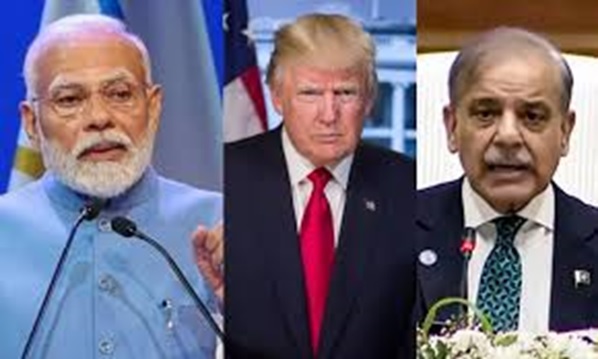
Shifting to the India-Pakistan conflict following the Pahalgam attack in April of this year, Donald Trump has frequently claimed to have played a decisive role in de-escalating this situation. His assertions often included the use of trade leverage, suggesting that the threat of disrupting trade deals compelled both nuclear-armed nations to step back from the conflict.
While India has consistently refuted any direct mediation by the US, emphasizing a bilateral resolution, evidence from US officials and international sources suggests that Washington did engage in significant behind-the-scenes facilitation. Acting US Representative Ambassador Dorothy Shea, for example, affirmed in July 2025 at a UN Security Council debate that "the US leadership has delivered de-escalations... between India and Pakistan."
Regarding the Russia-Ukraine conflict, Trump has frequently asserted that the war would not have taken place under his watch. He reiterated this claim upon returning to the presidency in 2025. He has also often suggested he could strike a deal between Moscow and Kyiv within a short timeframe.
On July 14, he gave Russia a 50-day deadline to resolve the Ukraine war or face severe economic sanctions, while also promising new infusions of weaponry for Kyiv through NATO. Then, just two weeks later, on July 28, Trump said he was “disappointed” with President Vladimir Putin’s failure to end the war and said he would only give Russia another 10 to 12 days to do so before imposing sanction
At this point, the Russia-Ukraine war continues, and the complexities of the conflict, deeply rooted in historical grievances and geopolitical ambitions, make a swift resolution challenging. While Trump's personal engagement and willingness to apply economic pressure are evident, the efficacy of his "deal-first, details later" approach in such a protracted and multifaceted conflict remains unproven.
In summary, Trump-style peacemaking possesses distinctive traits. It is highly personalized, often relying on direct relationships with foreign leaders rather than traditional diplomatic channels. Unpredictability is another hallmark, keeping adversaries and allies alike off-balance. Furthermore, his diplomacy is often media-driven, with pronouncements made via social media or rallies, shaping narratives and exerting public pressure.
Donald Trump’s efforts at peacemaking have not gone unrecognized. He has been nominated by friends and allies for the Nobel Peace Prize for his role in the Abraham Accords and, more recently, for his claims of de-escalating the Israel-Iran and India-Pakistan tensions. Republican Congressman Buddy Carter nominated him for the 2026 Nobel Peace Prize for the Israel-Iran ceasefire, crediting him with an "extraordinary and historic role."
Arguments for his nomination typically highlight the tangible steps towards normalization in the Middle East and his direct engagement in de-escalating regional conflicts. Arguments against awarding him the Prize point to his withdrawal from multilateral agreements like the JCPOA, and his rhetoric that often-inflamed tensions, and his administration's arms sales to conflict zones.
In conclusion, Donald Trump’s diplomatic legacy is undeniably mixed yet it is hard to ignore. He has demonstrated a willingness to directly engage with adversaries, challenge long-standing orthodoxies, and prioritize outcomes over process.
Ultimately, Trump may not have rewritten the fundamental rules of international relations, but his approach has certainly forced a re-evaluation of diplomatic norms. The true measure of his impact will be seen in the long-term stability or instability of the regions he engaged with, and whether his "deal-first" philosophy can foster lasting peace or merely temporary truces in a complex and ever-evolving global landscape.
(Frank F. Islam is an entrepreneur, civic leader, and thought leader based in Washington DC. The views expressed here are personal) |