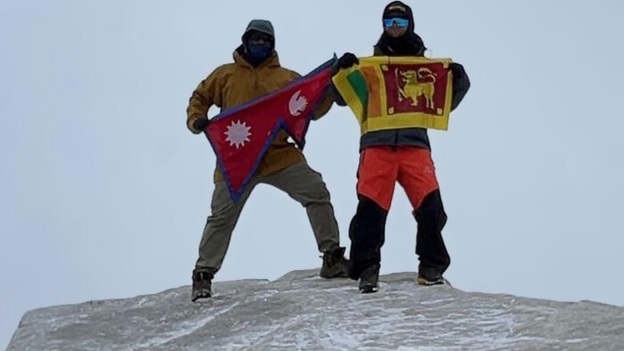
At Everest base camp, Dimantha D. Thenuwara (left) s een holding Nepal’s flag and Dawa Sherpa (right) the Sri Lankan flag
Climbing for Connection: One Mountaineer’s Quest for Regional Harmony
By Bidhi Adhikari / Sapan News
(A Nepali student interviews a Sri Lankan IT professional and adventurer who has made it his mission to climb South Asian mountains. His motivation: To inspire unity and spread a message of peace and collaboration throughout the region.)
When Sri Lankan IT professional Dimantha Thenuwara, an adventurer by passion, landed in Nepal for the first time on 10th April this year to climb Mount Ama Dablam, what he saw was not just one of the world's most challenging peaks, but human connections. Though he wasn't able to summit the mountain, he didn't consider the trip a failure.
Behind the expedition lay his urge to push boundaries stemming from a deeper desire to raise a voice for regional peace and harmony.
Ama Dablam, the ‘Matterhorn of the Himalayas’ and a majestic neighbor to Mount Everest, has a history of fatalities. Still, it holds a relatively higher success rate compared to other challenging mountains in the region.
In a Sapan Spotlight episode on Instagram, titled ‘Expeditions for Peace and Solidarity,’ we delved into how his passion for adventure led him from his home in tropical Sri Lanka to the intimidating peaks of Nepal. He shared how what started as his search for personal meaning evolved into a larger mission to demonstrate how journeys of exploration and adventure can be a tool to foster South Asian peace and beyond.
The adventure turned out to be a powerful means to building human connection, superseding cultural, regional, and language barriers. The immense kindness of his fellow travelers and others along the journey led to an experience that affirmed Dimantha Thenuwara’s belief in people-to-people relations as the ultimate peak to aspire to. South Asians have much in common. This includes the colossal ability to be kind, respectful, and hospitable. These shared values and cultural attributes contribute to an affinity and a sense of belongingness among South Asians who are able to travel in the region.
Dimantha Thenuwara's Ama Dablam expedition was a monumental test of physical and mental fortitude. From navigating treacherous icefalls to enduring the biting cold at high altitudes, every step was a challenge. These adversities also became the pathway for transformation and connection. What sets his journey apart was not merely the conquest of a peak but the intent to highlight how people across ethnic, religious or national divides come together in what he calls “a global hub of peace”.
The shared adversity and mutual reliance found in extreme environments like the Himalayas break down barriers. When lives depend on cooperation, differences fade, and genuine human understanding arises. This is precisely why he believed that these “journeys of exploration” could “foster peace.” They create a need for collaboration, empathy, and shared humanity, far removed from the complexities of diplomatic negotiations.
Beyond the grueling climbs and breathtaking vistas, Dimantha Thenuwara’s expedition unexpectedly forged bonds that transcended cultural divides. He never anticipated how deeply connected he would become with the Nepali community. This unexpected closeness was epitomized by Ngaa Tenji Sherpa and Miles Sherpa, the founders of Summit Force , the adventure company that accompanied him throughout his journey. Their relationship, built during the challenging expedition, blossomed into a friendship, culminating in their generous offer for the Sri Lankan visitor to stay at their guesthouse in Kathmandu.
This gesture, as he highlighted, went “beyond transactional” and stands as a testament to the deep respect and bond formed in the mountains. He vividly remembers the exceptional hospitality extended by everyone he met along the way.
“The collective kindness of the Nepali people touched me,” he said in our Sapan Spotlight interview. This overwhelming sense of “mutual respect” convinced him that Nepal was a country where he should “give back.”
This conviction quickly turned into action when Dimantha Thenuwara volunteered with a Nepali organization working in the Himalayan region to provide educational support for deprived children, SOS Himalaya Nepal in Kathmandu. His involvement demonstrated his dedication to the community that had embraced him.
It wasn’t a single, dramatic event that sparked his own commitment to this cause. Behind his expedition lies a series of incidents that collectively moved him. Dimantha Thenuwara’s journey has received overwhelmingly “warm and positive feedback” from both Sri Lankan and Nepali communities. Many have expressed a desire to participate in future expeditions inspired by his resilience and vision.
“You’re a man of resilience with a kind heart,” remarked a Sherpa, moved by Dimantha Thenuwara’s spirit.
After returning to Sri Lanka, he continued to spread his message through talks, emphasizing that the true “value of this expedition” lies in its ability to “connect countries and cultures.”
As for what comes next, Dimantha Thenuwara remains grounded, yet optimistic. “Let’s wait and see what expedition can be done. There are a few plans,” he shares, indicating that future adventures are on the horizon.
But for him, these will be about continuing to build upon the profound connections he discovered and fostered during his Ama Dablam ascent. His focus remains squarely on the human element, seeing each journey as an opportunity to reinforce bonds and demonstrate the power of collective effort.
This philosophy, shaped by experiences in the Himalayas, is steadfast: “Adventure is all about building connections and supporting one another…the success of any expedition relies on how we support each other.”
For him these mountains represent spaces where shared humanity can thrive, transcending borders and promoting global solidarity.
As South Asia faces various challenges, including climate change, economic development, and political tensions, this approach offers hope. It suggests that peace and understanding do not always require formal negotiations or official agreements. The path to regional unity and collaboration is rooted in human connection.
(Bidhi Adhikari is an economics student and a freelance researcher from Nepal who volunteers with the South Aasia Peace Action Network.) |