
Violating the Indus Water Treaty for a little more sediment flushing undermines New Delhi's credibility far more than it inconveniences Pakistan's canals
Pakistan Thwarted India’s Military Aggression. Here’s How It Can Win the Water War
By Hassaan F Khan
Tufts University
and Taimoor Akhtar
Cornell University, US

On the morning of May 31, flow gauges on the Chenab River recorded an alarming decrease in the river flow. The development made headlines in the aftermath of the conflict between India and Pakistan , which broke out on May 7. As with a similar episode at the end of April, it led some to wonder anxiously: Can New Delhi shut Pakistan’s water supply just like that?
The bulk of Pakistan’s water supplies originate from three rivers — Indus, Jhelum, and Chenab — which are allocated under the 1960 Indus Waters Treaty (IWT). Two of these western rivers are buffered by large dams on the Pakistani side: Tarbela on the Indus and Mangla on the Jhelum. Each can absorb changes in flow with little effect on irrigation deliveries. The Chenab, however, is different.
Pakistan does not have a Tarbela-size reservoir here, and upstream on the Chenab River, India operates three modest dams (Baglihar, Salal and Dulhasti). A closure at these structures can therefore look, at first glance, like the country’s tap has been turned off.
Here, we explain why and how the Chenab River flows can be disrupted (not blocked). Then we discuss what potential disruptions later in the year may look like. And, through this, we illustrate that while Pakistan must press its case against India’s illegal violations of the IWT, it also has room through smarter water management to blunt the impact of any Indian actions.
Pakistan’s vulnerability
Begin with the Indus River, which has an average annual flow of roughly 75 billion cubic meters (BCM) — enough to fill about 30 million Olympic-sized swimming pools. Two Indian run-of-river plants on the Indus River can together hold 0.02 BCM when their gates are closed — that is less than 0.03 per cent of the Indus’ annual flow, or only a few hours of discharge even in the low-water season. Once India’s small reservoirs fill, the water must spill onward, and the brief dent disappears inside normal reservoir operations downstream.
The situation on the Jhelum is similar. Mangla Dam on the Jhelum River sees about 27 BCM in an average year; Indian upstream infrastructure can store around 0.06 BCM, barely 0.2pc of the river’s flow. As things stand, and likely in the future, there is virtually no way India can cause any noticeable disruption to irrigation flows managed through the Indus and Jhelum rivers.
The Chenab, by contrast, reaches Marala with no Pakistani reservoir to cushion it. India’s infrastructure on the Chenab has a combined live storage — referred to as water that can be actively withheld or released — capacity of around 0.1 BCM.
This is where Pakistan’s water system is most vulnerable.
The Indian violations
Earlier in May, the Indus River System Authority (IRSA) reported an unusual change in average daily flows of Chenab as it entered Pakistan via Marala Barrage. As illustrated in the figure below, the seemingly normal daily average flows of around 50,000 cusecs recorded on May 27 and 28 abruptly increased over the next two days and then drastically decreased on May 31 and June 1, before returning to expected levels on June 2 and onwards.
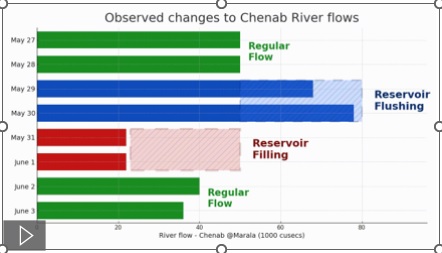
The average river flows of Chenab can vary significantly at this time of the year due to a combination of glacial melt, rainfall and water management practices. However, day-to-day changes in flows typically do not exceed 5,000 cusecs, and even if they do, they are typically linked to precipitation or snowmelt upstream in the basin and can therefore be predicted.
Here, though, the disruptions in Chenab’s daily average flows reported between May 28 and June 2 were induced via upstream reservoir operations, as confirmed by subsequent reports .
The abrupt rise in flows on May 29 and 30 was due to reservoir flushing (emptying) by India on the same days — a process where accumulated sediments are removed from a reservoir by releasing water at high flow rates, which helps restore the reservoir’s storage capacity and improve water quality. It can also help prevent flooding by managing water levels and mitigating the risk of sediment buildup.
The reported live capacity of India’s reservoirs on Chenab is 0.1 BCM, which equates to around 21,000 cusecs of surplus average daily flow across two days. This aptly explains most of the abrupt rise in the river flow on May 29 and 30.
The reservoir flushing was followed by reservoir filling — when water is gradually filled in the reservoir up to its intended operating level — on May 31 and June1, coinciding with the sharp fall in flows at Marala. Once India’s facilities reached their capacity, the flow returned to normal from June 2 onwards. The total water that reached Pakistan during these five days (May 28-June 2) did not change or decrease; only the timing of it was affected.
The disruption in the flow of the Chenab River always heavily depends on the time of the year and strategies used by India for the flushing and filling of its reservoirs. The IWT has predefined rules for flushing and filling and its abeyance, which means that India could i) flush or fill its reservoirs at will, and ii) choose any strategy to maximize impact on Pakistan.
The figure below illustrates what a hypothetical worst-case scenario may look like in dry winter months (November to January), when average daily flows in Chenab can reduce to 7,000 cusecs or lower. |