Muslims in the Subcontinent’s Freedom Struggle
By Zafar Iqbal, PhD
Washington, DC

Muslims played a vital and multifaceted role in the subcontinent’s struggle for independence from British colonial rule. Their contributions spanned political leadership, revolutionary movements, education, journalism, and grassroots mobilization. While opinions often differed—especially over partition—their sacrifices and leadership remain integral to India’s path to freedom.
Among the earliest organized revolutionary movements was the Ghadar Party, founded in 1913 in San Francisco by Indian immigrants, mainly Punjabis (predominantly Sikhs), with support from other communities, including Muslims. Key figures included Kartar Singh Sarabha, Lala Har Dayal, Maulana Muhammad Barkatullah, Rash Behari Bose, Sohan Singh Bhakna, Syed Haider Raza, and Syed Rahmat Ali. The party called for complete independence—years before the Indian National Congress adopted that goal—envisioning itself as the vanguard of an armed uprising against British rule.
Muslims in the Ghadar Party were active in reaching out to Indian Muslim soldiers in the British Army. In 1915, dozens returned to India to incite revolt, but the plan was betrayed. Many were executed or imprisoned in the Lahore Conspiracy Case. Although the rebellion failed, their courage inspired future revolutionaries, including Ashfaqullah Khan, Bhagat Singh, and Subhas Chandra Bose. It showcased the power of the Indian diaspora in the anti-colonial struggle.
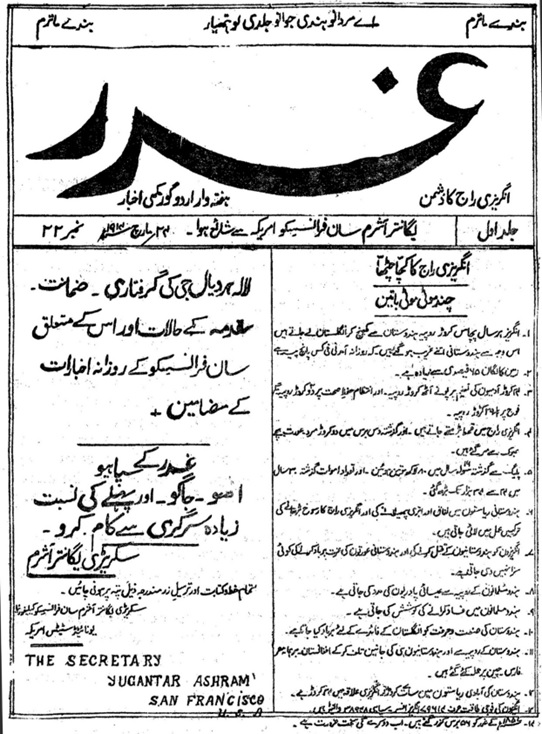
The party’s newspaper, Ghadar ( غدر ), was published in multiple languages, with the Urdu edition targeting Urdu-speaking migrants and soldiers. Its fiery articles and poems urged unity across religious lines, declaring: “We are all brothers—Hindu, Muslim, Sikh—one in the cause of India”
Beyond the Ghadar movement, Muslims were prominent in the Indian National Congress, the Khilafat Movement (1919–24), and other political platforms. Leaders such as Maulana Abul Kalam Azad, Khan Abdul Ghaffar Khan, Syed Ahmad Khan, Maulana Hasrat Mohani, Maulana Mohammad Ali, Maulana Shaukat Ali, Rafi Ahmad Kidwai, Husain Shaheed Suharwardi, Begum Rokeya, and Aruna Asaf Ali made lasting contributions.
A great deal has been written about these heroes, yet their sacrifices—whether for a united India or the creation of Pakistan—remain a shared legacy in the long journey to freedom.
Here is a front‑page scan of the Hindustan Ghadar Urdu edition ( غدر ), Vol. 1 No. 22 (March 28, 1914), showing the Urdu masthead at the top and densely packed Urdu text below. It offers a clear example of how the paper looked in Nastaliq script.
(Dr Zafar Iqbal, PhD, is a retired Senior Scientific Review Officer with the US Department of Veterans Health Administration and a distinguished neurochemist trained at the All-India Institute of Medical Sciences, New Delhi, with postdoctoral work at Indiana University. He has held faculty positions at Northwestern University, Indiana University, and the Chicago Medical School, authored over 35 research articles, contributed to more than 30 book chapters, and edited a book, Axoplasmic Transport.
A recipient of awards from the NIH, NSF, and VA, Dr Iqbal has presented globally, served on editorial boards, and participated in peer-review panels for leading journals. Beyond his scientific endeavors, he is an active leader in various cultural and community organizations, including the Aligarh Alumni Association of Washington, DC, GOPIO, and the Ameer Khusrau Society. His achievements are recognized in Who’s Who in America and American Men & Women of Science.)