Dr Akbar Ahmed’s solution is not isolation or more war, but dialogue—real, human-to-human engagement beyond the rigid formality of diplomacy
America at the Crossroads — and at Odds with Itself
By C. Naseer Ahmad
Washington, DC

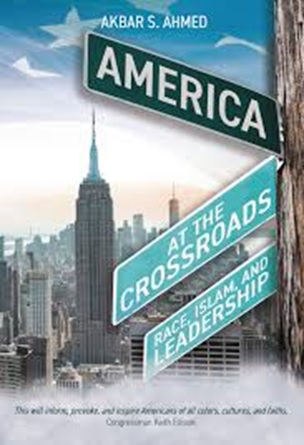
In America at the Crossroads, Professor Akbar Ahmed—former diplomat, anthropologist, and Ibn Khaldun Chair of Islamic Studies at American University—asks a question that should make Americans squirm: What happens when a country built on democracy starts behaving like an empire?
Written after the shock of 9/11, the book examines how the United States, in the name of security, began to trade away the very freedoms it claimed to defend. Ahmed zeroes in on the neoconservatives—Paul Wolfowitz, Donald Rumsfeld, and others—whose vision of America as global enforcer sought to remake nations like Iraq in democracy’s image, often leaving chaos behind.
The result, he argues, is a paradox: America wants to be seen as liberty’s champion, but much of the world sees an overextended empire. The damage to America’s reputation has been deepest in Muslim-majority countries, where mistrust widened after the wars in Afghanistan and Iraq.
Ahmed’s solution is not isolation or more war, but dialogue—real, human-to-human engagement beyond the rigid formality of diplomacy. Having watched him in lively discussions, I know he means it. His larger message—that American power without principle is hollow—resonates even more today, with new conflicts in Ukraine and Gaza and deepening polarization at home.
That polarization didn’t happen by accident. The seeds of inequality and division were sown decades ago, in the Reagan-Bush era, when racially charged campaign tropes like Reagan’s “welfare queens” and George H. W. Bush’s “Willie Horton” ad reframed political strategy. Many of the Supreme Court justices who later upheld Citizens United—which unleashed vast sums of corporate money into politics—were appointed by those presidents. That decision, along with Section 230’s shield for social media platforms, has helped create the toxic, conspiracy-rich environment we live in now.
It’s worth asking whether today’s distrust and division would be so intense had those decisions gone the other way. Would the internet still be a breeding ground for the likes of Alex Jones if platforms faced real liability for the damage caused by their content?
History offers another contrast. In 1964, Barry Goldwater declared that “extremism in the defense of liberty is no vice”—and suffered a historic defeat. Perhaps inequality wasn’t yet deep enough to make such rhetoric resonate. Today, anger toward “elites” makes similar language politically potent.
Ahmed briefly addresses the 2024 election and its corrosive rhetoric. I wish he had explored why so many Muslim Americans, including Arab Americans, voted Republican—and how they now view that choice in light of shifting policies and priorities. His book could serve as essential reading for such voters, offering a reminder that principle should outweigh opportunism or anger.
I first encountered Ahmed’s work while reading Journey into America during a cross-country trip with my son, a journey that inspired a review I published in The Washington Post. Later, while traveling across Europe, I reviewed his Journey into Europe. These books, like America at the Crossroads, weave together scholarship, travel, and dialogue—anchoring abstract debates in lived human experience.
That’s the value of America at the Crossroads: it’s not just a critique of policy, but a moral challenge. It forces us to ask whether America can lead without listening, whether it can project strength without sacrificing trust, and whether dialogue alone can overcome the divisions we have allowed to fester.
Two decades after 9/11, Ahmed’s warning still stands: A superpower that forgets its principles will eventually lose the very thing it is trying to protect. The choice between empire and democracy isn’t abstract anymore—it’s here, it’s now, and it’s ours to make.