|
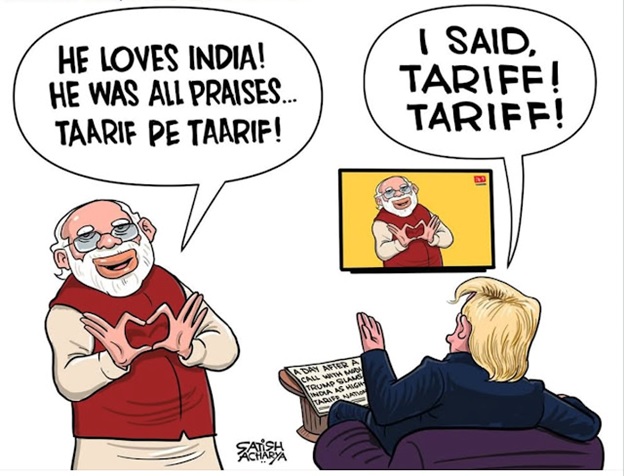
Indian Cartoonist Satish Acharya on Trump-Modi Dialog - Source Satish Acharya |
India Tariffs: Is Modi-Trump Bromance Over?
By Riaz Haq
CA
President Donald Trump has imposed 50% tariffs on India's exports to the United States. This is far higher than most countries facing US tariffs. Explaining the punitive India tariffs, US Treasury Secretary Scott Bessent said: "India came to the table early. They’ve been slow rolling things. So, I think that the president, the whole trade team has been frustrated with them. And also, you know, India, India has been a large buyer of sanctioned Russian oil that they then resell as refined products. So, you know, they have not been a great global actor".
Since taking office in January 2025, President Trump has been signaling his intent to apply tariffs on India's exports repeatedly. Trump has been singling out India as a country with the highest tariffs it applies on exports from the US.
Indian cartoonist Satish Acharya published a caricature of Modi-Trump conversation portraying Modi's ignorance or pretense of ignorance of what Trump said to him. The cartoon shows Modi thinking Trump was heaping "taarif" (praise) on him when in fact Trump was threatening to impose high tariffs on India. As an aside, tariff originates from the Arabic word "taʿrīf" (تعريف), which means "notification," "definition," or "announcement". This term probably entered the European lexicon through interactions between Arabic-speaking merchants and European traders in the medieval Mediterranean region.
Cartoons aside, it's clear that Mr Modi failed to take the Trump tariff threat seriously, and Indian negotiators dragged their feet hoping that Mr Trump would flinch. Meanwhile, India's supporters in Washington continued to argue for a US policy of "strategic altruism" toward India that has characterized US-India ties since the beginning of the 21st century.
In a 2019 piece titled "The India Dividend: New Delhi Remains Washington’s Best Hope in Asia" published in Foreign Affairs, authors Robert Blackwill and Ashley Tellis argued that the Trump Administration should continue this US policy of " strategic altruism " with India that began with US-India nuclear agreement. They asked President Trump to ignore the fact that the US companies and economy have only marginally benefited, if at all, from this policy. They saw India as a "superpower in waiting" and urged Washington to focus on the goal of having India as an ally to check China's rise. They see Chinese support for India's arch-rival Pakistan and China’s growing weight in South Asia and beyond as a threat to India.
At the same time, Mr Modi has suffered from delusions of personal rapport with Mr Trump, describing him as "my friend Dolund Trump" at mass rallies in India. Modi and his supporters in Washington should have heeded the advice of Ambassador Kishore Mahbubani. "One hard truth that Indians have to contend with is that America has also had difficulty treating India with respect ", wrote the Singaporean diplomat Kishore Mahbubani in his latest book "Has China Won?". "If America wants to develop a close long-term relationship with India over the long run, it needs to confront the deep roots of its relative lack of respect for India", adds Ambassador Mahbubani. It's not just Mahbubani who suspects the United States leadership does not respect India. Others, including former President Bill Clinton, current US President Donald Trump, former Secretary of State Hillary Clinton and CNN GPS host Fareed Zakaria have expressed similar sentiments.
President Trump has rejected all pleas from pro-India analysts for special treatment of New Delhi. Prior to his meeting with Prime Minister Narendra Modi at the White House in February this year, the US president described India as the "worst abuser of tariffs" and announced "reciprocal tariffs" on Indian imports to the United States.
At the same time, Mr Trump cracked down on both legal and illegal immigration from India. His administration is deporting thousands of illegal Indian immigrants in handcuffs and shackles on US military aircraft. Meanwhile, stringent new regulations on temporary work visas could significantly delay visa processing times and reduce the number of Indian workers employed in the United States on H1B visas.
(Riaz Haq is a Silicon Valley-based Pakistani-American analyst and writer. He blogs at www.riazhaq.com )