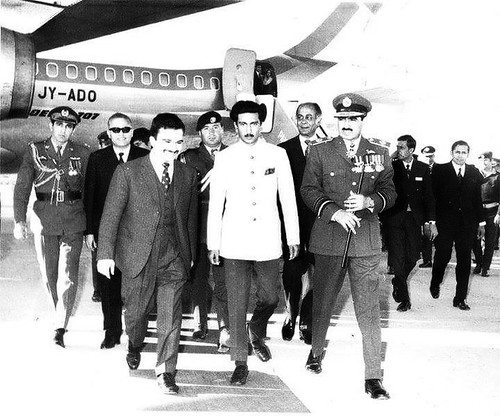
Khyber Pakhtunkhwa Governor Hayat Muhammad Khan Sherpao, PAF C in C Air Marshal Rahim Khan and Foreign Secretary Sultan Muhammad Khan receive Prince Hassan Bin Talal of Jordan, 1972
The Lion of the Frontier
By Dr Akbar Ahmed
American University
Washington, DC

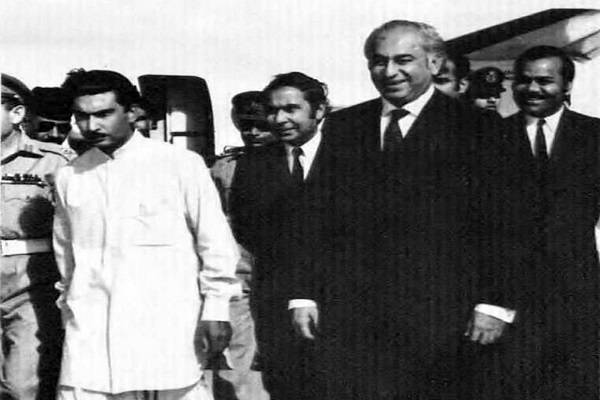
The old Frontier Province, now called KP, has produced many legendary figures. Among them was Hyat Khan Sherpao. There was a time when he was considered a potential successor to Zulfiqar Ali Bhutto himself in the heyday of Bhutto’s reign as prime minister. Sherpao embodied the finest qualities of the culture of the old Frontier Province – kindness, compassion, humor, and courage.
Sherpao was vice Chairman of Bhutto‘s Pakistan People‘s Party, and when he was appointed Governor of the Frontier Province, he was the youngest ever to hold that office. His charisma, dynamism, and socialist ideas earned him the love of ordinary people. He was popularly called the Lion of the Frontier. He was still in his 30s when he was assassinated in February 1975, ensuring a place in the hearts of millions of Pakistanis. Today there are many public parks, roads, bridges, and hospitals named in his honor, and his younger brother Aftab Sherpao leads a political party.
The senior Sherpao would often joke about me and my younger brother saying that both of them have direct access to me and I consider them highly as my best officers, but when I ask them what I can do for them, they say we don’t need anything. He would then point a finger in a circular motion next to his forehead, suggesting there was something wrong with the two brothers, saying everyone who comes to me wants something except these two. In the end, although I declined his generous offer to join his office as chief of staff, etc. he appointed my younger brother, a young police officer in the Pakistan Police cadre, as head of his security, which is why he was in the room with Sherpao at the University lecture when the bomb exploded that would take his life. Little did he know that before he passed away he had already helped me in one of the most important matters of my life: he had launched me in my PhD studies leading to a doctorate in Sociology and Anthropology.
My interest in a PhD and love of learning about the Pukhtun tribal societies was triggered when I was posted
There was a time when he was considered a potential successor to Zulfiqar Ali Bhutto himself in the heyday of Bhutto’s reign as prime minister. Sherpao embodied the finest qualities of the culture of the old Frontier Province – kindness, compassion, humor, and courage as Deputy Secretary, Home and Tribal Affairs Department in Peshawar. I was overseeing the Tribal Areas and the law-and-order situation in the Province. I was struck by the importance of understanding social structure and tribal values. I was very keen to learn more about the subject and frame it in an academic manner so that I could master the subject and thus contribute professionally.
My interest in tribal society continued to grow when I was appointed Registrar of the Cooperative Societies of the Province and the President of the Cooperative Bank. The Governor who had himself been Registrar many years ago had asked the Chief Secretary for a top notch CSP officer in this job to revive what had become a moribund institution. It did not take me long to realize that unless officers working in this field were able to relate to the social, cultural and tribal structures within which the societies operated their development projects would not be successful. They needed to fully understand the causes of success and failure of cooperative societies in the Province. They needed to have an understanding of the leadership, the relationship between communities, the position of women in the household and community, the importance given to education, etc. All these factors would have a bearing on development.
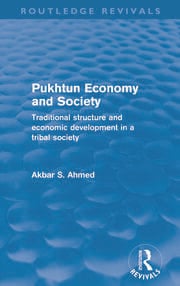
I decided to spend time studying this subject. I felt that an anthropological study of tribal society would be a good start. Once in London, I spent an academic year reading up on anthropological theory and then writing up my PhD, which was published by Routledge as Pukhtun Economy and Society. The volume is still in print.
But it was not an easy decision to leave Peshawar for a PhD in London. By then we had two small children to take care of and Sherpao, who was then senior minister of the provincial government, was keen for me to be posted as Political Agent, Khyber Agency. It was an area made famous by Raj novels and Hollywood movies. On the other hand, there would be the uncertainty of a long, exhausting slog working for the PhD. Besides, there was no guarantee that I would attain a doctorate. I knew I would face untold challenges. I was approaching it with my innate optimism, but I had heard stories of failed attempts, hints of racism and a depression setting in when hopes of the doctorate began to fade. There were even tales whispered of attempts at suicide. The pull of learning and knowledge, of Minerva, was great, but so was that of home and hearth.
Sherpao’s moment of grace for me, led me directly to register for and ultimately attain a PhD from the School of Oriental and African Studies, London University. As a mid-level civil servant in the early 1970s I had applied formally for study leave to pursue my studies abroad. It was a routine matter, but the bureaucracy then was more designed to create hurdles than to solve problems. It had taken some 30 movements of my file before it finally arrived on the desk of the Establishment Secretary in Rawalpindi. The Secretary was known to be notoriously antagonistic to the CSP cadre to which I belonged and he did not. Indeed, it was widely rumored that any case belonging to the CSP was turned down in routine. Although I had not met him, I was concerned that at this delicate stage if my file was turned down it could delay my PhD application for the year. I could not therefore take a risk. That is when I remembered Sherpao and his comment that I did not reach out to him as a friend. I decided to test his friendship, but the problem was to get to him. He was constantly traveling, and in any case, inundated with dozens of supplicants and hangers-on at any given moment. I finally traced him to Peshawar and arrived at his house in the suburb now named after him as
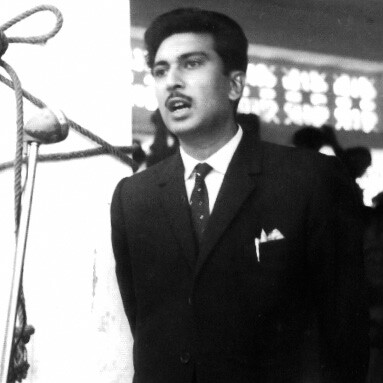
Sherpao’s moment of grace for me, led me directly to register for and ultimately attain a PhD from the School of Oriental and African Studies, London University
Hayatabad. It had become dark and was late in the evening. The courtyard outside his house was already chock-a-block with people trying to see him. I pushed my way inside through the crowd into the house itself where the drawing room was packed with visitors. I asked a bodyguard where Sherpao Khan was. He said he was in the bedroom and had just arrived from a helicopter visit to the Tribal Areas. I headed for his bedroom, but was blocked by two guards. They stood aside and I entered the bedroom. It was dark, but I saw a figure lying spreadeagled on his back on the bed. It was Sherpao. He looked unconscious and showed no sign of life. With some trepidation I said “Lala,” which means elder brother, “I hope you don’t mind, but I have a small favor.” He did not stir. I said I need you to talk to the Establishment Secretary, as my file for my PhD study leave was on his desk and unless you requested him my case would not make it for the start of the University year. I was not sure whether Sherpao even heard me. But then without hesitation and in one fluent movement, his body came to life, and he leant over to pick up the telephone by his bedside. Get me the Establishment Secretary, he murmured to the operator and then fell back to the prone position. A minute later the phone rang, and he picked up the phone and with a solemn voice spoke into it. I heard him say that he had sent a file which was on his table. He said, “I want you to sign it and return it immediately. It concerns a very important member of my team and my province. Please do not mess around with it. If any objections are made to it and it is blocked, I will personally take the file immediately to the Prime Minister.”
I quietly withdrew from the bedroom.
The next day I was told that I had been cleared to proceed to SOAS in London to do my PhD. Before I left, I called on Sherpao in his office and he seemed in a happy mood. I invited him to London, and he promised to visit me once there. Not long after in London I heard the devastating news that he had been assassinated while giving a lecture at Peshawar University. My brother who served with him on his personal staff and was a few feet from him had miraculously survived, but the close call affected all of us in the family.
The news left me shaken, and I had a foreboding for what was to come.
Not many years later, Bhutto himself would be toppled and sent to the gallows. Bilawal Bhutto his grandson would be born in 1988, just over a decade after Sherpao’s untimely death, and go on to head the People’s Party.
(Ambassador Akbar Ahmed is Distinguished Professor of International Relations and holds the Ibn Khaldun Chair of Islamic Studies at the American University, School of International Service. He is also a global fellow at the Wilson Center Washington DC. His academic career included appointments such as Nonresident Senior Fellow at the Brookings Institution; the First Distinguished Chair of Middle East and Islamic Studies at the US Naval Academy in Annapolis, MD; the Iqbal Fellow and Fellow of Selwyn College at the University of Cambridge; and teaching positions at Harvard and Princeton universities. Ahmed dedicated more than three decades to the Civil Service of Pakistan, where his posts included Commissioner in Balochistan, Political Agent in the Tribal Areas, and Pakistan High Commissioner to the UK and Ireland.)