
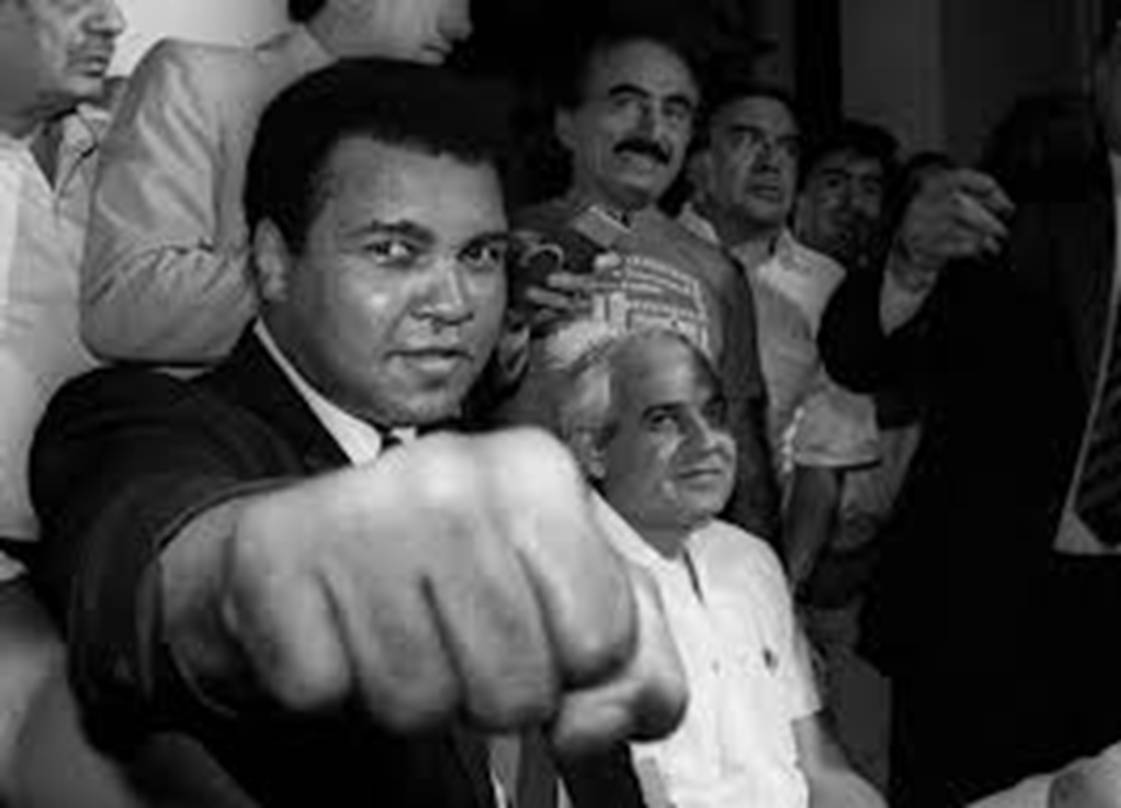
As the twentieth century concluded, Ali received more accolades—he was named “Sportsman of the Century” by Sports Illustrated and “Sports Personality of the Century” by the BBC. Ali’s life evidenced a dynamic combination of an elevated spirituality and a will, energy, power, and fortitude of steel: his soul was that of a Sufi saint in its purity and his strength was that of Thor’s hammer . - Photo PBS
Ali: Great American, Great Muslim
By Dr Akbar Ahmed, Frankie Martin, Dr Amineh Hoti



In 2010, my office received an urgent call. It was Laura Fattal of suburban Philadelphia, and she explained to Frankie Martin, who was working in the office, that the previous year, her son Josh Fattal, along with his American friends Shane Bauer and Sarah Shourd, were hiking in Iraqi Kurdistan in the mountains. During this hike, they were arrested by Iranian authorities and told they had crossed the border illegally into Iran.
Josh had been working at an international study abroad program, Shane was a journalist, and Sarah was teaching in Damascus—all had met up for this fateful Iraqi vacation. Iran, claiming the three were spies, incarcerated them in Tehran’s Evin Prison. Laura and the mothers of Shane and Sarah, Cindy Hickey and Nora Shourd, were leading a campaign to secure their release, but were finding themselves blocked at every turn and were in anguish. The hikers had become embroiled in the conflict between the US and Iran, two countries with no diplomatic relations. In this confrontation, the humanity of the hikers and the anguish of their families were being forgotten.
In reaching out to me, Laura explained, she was trying a new tactic. Laura, who is Jewish, decided to try to reach out to the Muslim community, to see if Muslim leaders could get through to the Iranian leadership. I was the first Islamic scholar they reached out to, and I agreed to do anything I could to free the hikers. [1] This included a special letter which I wrote to the Supreme Leader of Iran, Grand Ayatollah Ali Hosseini Khamenei, appealing to him to show Islamic compassion during the holy month of Ramadan and free the hikers. [2] I highlighted specifically the suffering of the families and the hikers themselves who were being held in solitary
confinement—Sarah, I noted, had already been diagnosed with a precancerous medical condition and was concerned she might have cancer, and was clinically depressed. Frankie and I visited the Iranian interest section in Washington, DC and delivered the letter to the highest-
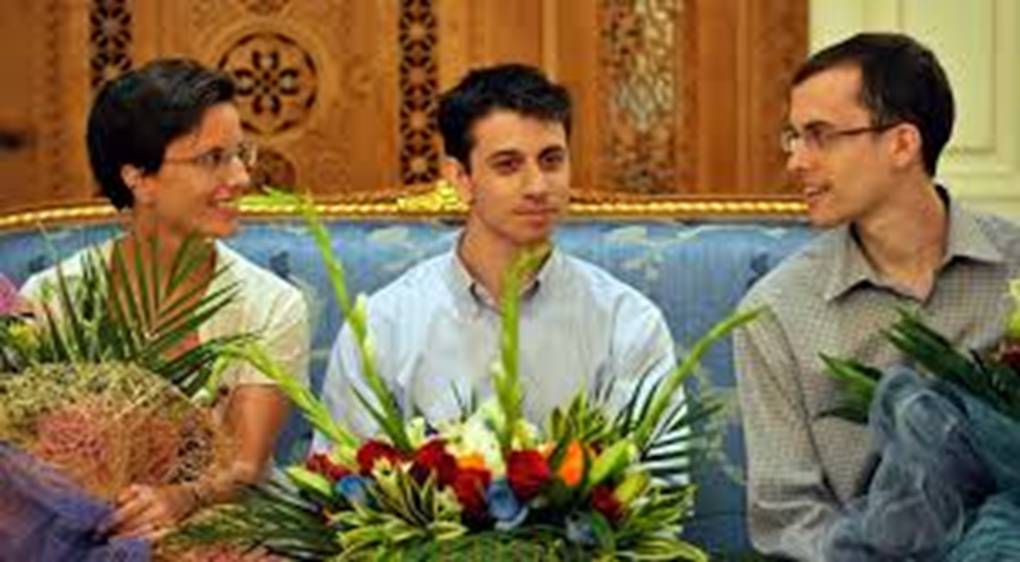
Hikers Sarah, Shane, and Josh
ranking Iranian diplomat, who told us it would be immediately translated into Persian and sent directly to the Supreme Leader. We met the hikers’ families, including Laura’s son Alex Fattal, and I along with Frankie became part of the “brain trust” working with the families to mobilize support and free the hikers. For over a year we focused intently on this important task, which included many ups and downs and twists and turns. On September 14, 2010, Iran released Sarah, citing medical reasons, Islam’s respect for women, and the end of Ramadan [3] —this was a wonderful development, but Shane and Josh still languished in prison. As Frankie said, “I felt that through our efforts, we helped the families keep their hope alive.”
The families had one very prominent person in their corner, who made all the difference—Muhammad Ali. Widely praised as the greatest boxer of all time, he was not only the most famous American Muslim, but also possibly the most famous person in the world. Indeed, when we discussed who might strengthen the appeal as a voice of the American Muslim leaders in this case, the biggest name I could think of was Ali. I involved my friend Dr Mohamed Elsanousi, who had a leadership role at the Islamic Society of North America, in the group meeting to discuss how to free the hikers. Ali invited us to visit him and his family to discuss the effort, and while I couldn’t make this trip due to other obligations, Elsanousi went and had a great visit with Ali.
Ali was in touch with the families, and he agreed to fully be part of the effort to free Sarah, Shane, and Josh. He wrote a letter to Ayatollah Khamenei, asking him to show Islamic compassion by freeing the hikers: “Please show the world the compassion I know you have in your heart.” [4] Ali also recalled his prior visits to Iran, and discussed his affliction of Parkinson’s disease which had transformed his life from the 1980s onwards, limiting his speech and movement: “You may or may not know, that even at the time of my visit [to Iran] I was and still am afflicted with Parkinson’s disease. It is a neurological disorder that affects mobility and causes other challenges involving motor movements in the body. My disease has worsened since my last visit to Iran to the point I don’t travel as much and find it hard to walk with balance and speak clearly. Sometimes I cannot speak at all. I am not discouraged because I know everything is part of Allah’s plan and am happy to do Allah’s bidding while I am here on earth. My life has been spent trying to help those who are in need all over the world. Allah blessed me with celebrity to help those who could not and cannot help themselves. I am not able to do as much as I used to but I still try to do what I can, where I can, to the extent I am able.” [5] Ali argued that the young Americans were only trying to experience the world, much as he had: “I was exactly the same way as a young adult. I wanted to get to know people everywhere.” [6]
Ali then went further. Eight months later, and following Sarah’s release, Ali and his wife Lonnie agreed that the time had come to try a more public approach to free Shane and Josh. Ali agreed to appear alongside American Muslim leaders and scholars, including myself, at a press conference at the National Press Club in Washington, DC. This was not an easy task, as Ali lived in Arizona, and no American airlines could accommodate his condition. Yet Alex Fattal was able to get through to the boxing magnate and promoter Bob Arum, who arranged for a private jet to fly Ali to and from DC.
Ali even offered to fly to Iran if he were able, if it would help free the hikers. There was a precedent for such an action. After Iranian students took over the US Embassy in Tehran in 1979 and held dozens of Americans hostage, Ali offered to fly to Iran to negotiate with the students and their leader, Ayatollah Khomeini, for their release. [7] He also volunteered to exchange himself for the hostages, but the offer was declined. [8] In 1990, Ali flew to Iraq where he successfully personally negotiated with Saddam Hussein who agreed to release 15 American hostages he had used at “strategic locations to deter international forces from bombing and risking civilian casualties.” [9]
On May 24, 2011, we held the press conference. It was amazing for me to meet Ali—as a young man, like millions of others, I watched rapt as he took on the world and reached the highest echelons of boxing, sports, and popular culture. While I was living in Cambridge, England in 1965, I stayed up all night to watch him defeat Sonny Liston for the second time to retain his title of
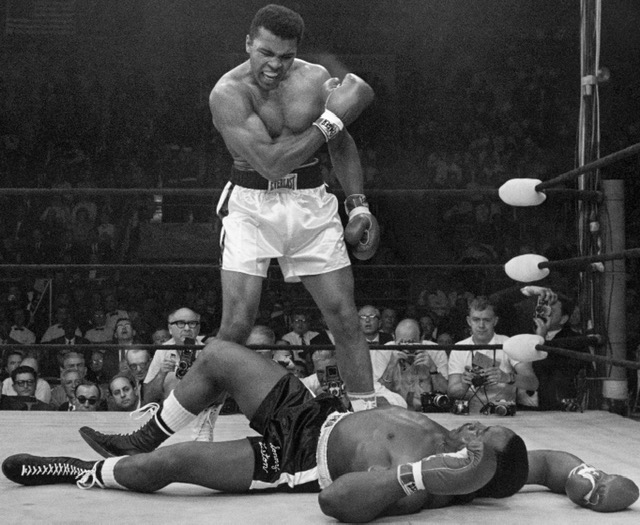
Ali knocks out Liston in 1965
World Heavyweight Champion. Ali was lightning fast and at the height of his powers. And yet now, as I entered the room directly behind Ali to face the cameras, I saw his difficulty lifting his foot onto the carpet. It was a poignant reminder of the fragility of life, that even the mightiest person must eventually face his own mortality. And Ali was, of course famously conscious of his own physical beauty, making statements like “I’m so pretty!”
At this moment, I truly understood the greatness of Ali. Dealing with a devastating illness, which most people would face in private, Ali was still living in the full glare of the media. He was not doing it for himself, however, but for others. The spirit of this great humanitarian was soaring to new heights. His physical strength had withered, but his moral and spiritual strength, nourished by his faith, was only increasing.
During the conference, Lonnie spoke for Ali from the podium, while Ali sat on a chair surrounded by our group. I also addressed the press at this gathering, appealing to the Iranian leadership to free the hikers on the basis of Islamic compassion. It would be a gesture of magnanimity to the hikers and their families who had endured so much anguish, I pointed out, and also to the nation of the United States.
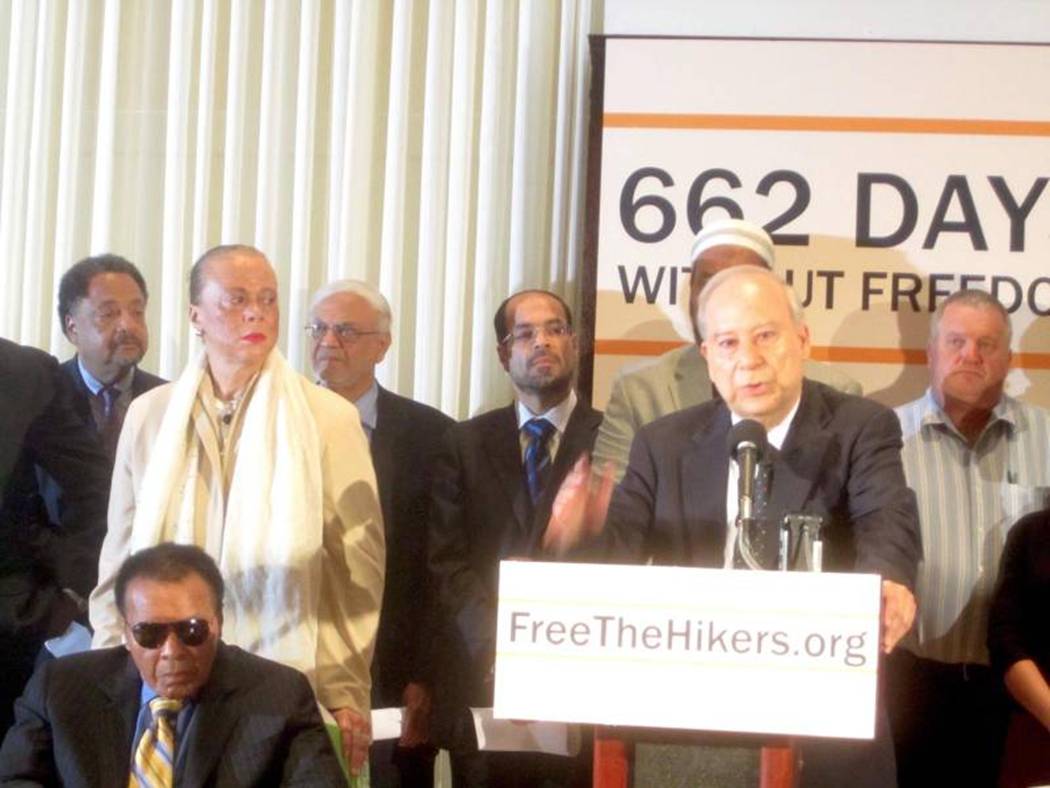
Dr Akbar Ahmed speaks at the press club in Washington DC with Muhammad Ali by his side
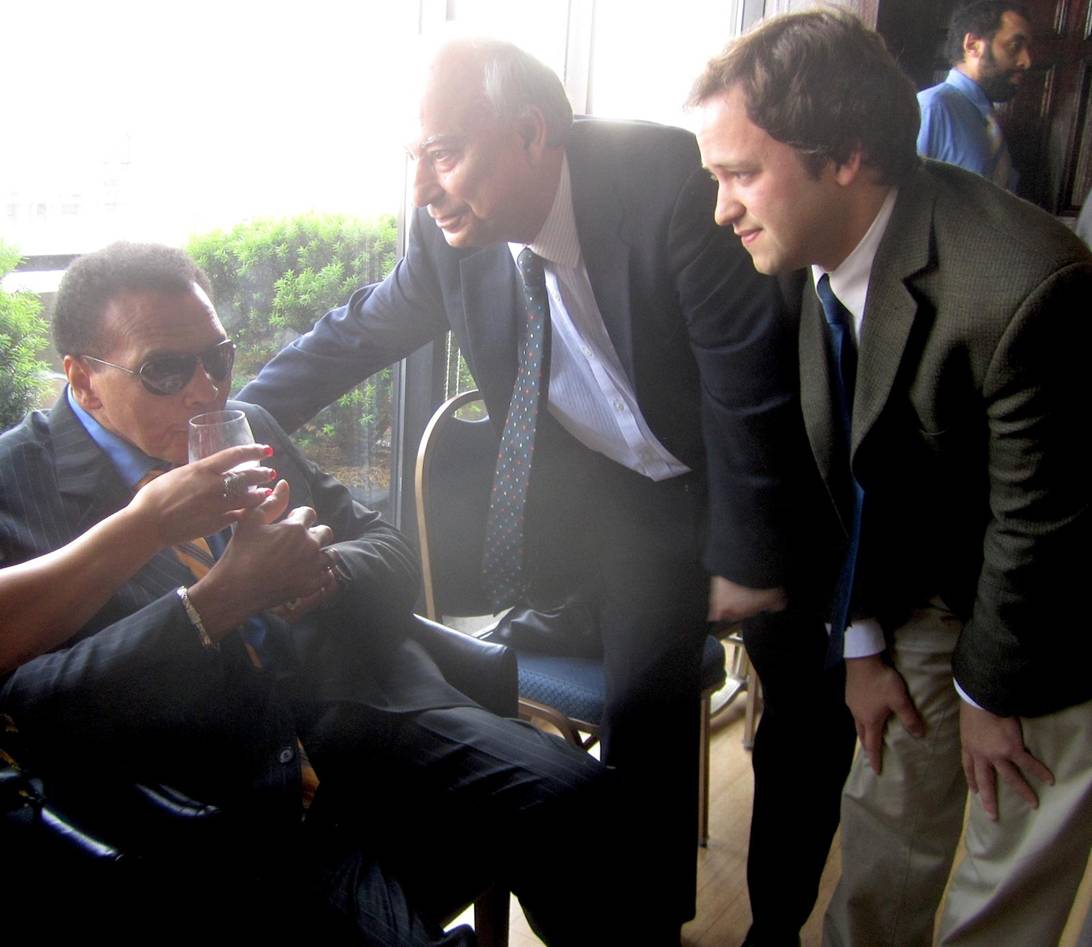
Authors Akbar Ahmed and Frankie Martin with Ali
Before the event, Frankie and I met and spoke with Ali backstage. It was difficult for him to speak, but he listened as we described our work to improve relations between Islam and the West, including our “Journey into America” project on Islam in America. Interestingly, I had earlier been told by the actor Christopher Lee, when I first met with him in London about playing the title role in my film Jinnah about the founder of Pakistan, that he was already aware of my work because Ali had showed him my book Living Islam.
And I had another connection to Ali. When Ali was in the UK training in the 1960s, my brother Tariq, then an undergrad studying in Birmingham, turned up alone unannounced at Ali’s training site in London. Tariq was initially refused entry, but when he told Ali’s security detail to inform him that a young Pakistani and representative of the Muslim students of Birmingham had arrived to meet him, Ali immediately let him in. The two took photos of themselves clowning around and, suffice to say, Tariq became an Ali superfan. Many people who met Ali had similar anecdotes, all demonstrating Ali’s kindheartedness, grace, good humor, and effusive embrace of people across the world. Much later in Pakistan, Amineh Hoti met Khalilah Camacho Ali, Ali’s former wife, who remembered her husband as warm and funny, attesting, “He had the ability to make everyone feel happy and he was kind to everyone.” [10]
Ali’s entrance in such a public fashion was a game changer for the families of the hikers held in Iran. After the press conference, as Alex Fattel recounted, the families began to hear rumors that Khamenei had issued a pardon to the hikers, and the diplomatic process accelerated, with Ali helping to create the public conditions for secret talks between the US and Iran, facilitated by Oman. [11] On September 21, 2011, Iran released Shane and Josh. The talks were historic beyond the case of the hikers, however, as they were also the starting point for the nuclear agreement signed by the US and Iran. [12] The case of the hikers, and Ali’s involvement, had led to the two countries speaking directly with each other. It was very much in keeping with Ali’s life and mission to bring the people of the world closer together in an embrace of love and brotherhood.
In order to reach his towering stature, however, Ali had to endure many trials. First, as he ascended into the stratosphere of American celebrity in the 1960s on the strength of his superior boxing skills and charisma, he became a Muslim—initially through the Nation of Islam—and immediately alarmed many Americans, particularly among the white population. Then, when he was drafted to fight in the Vietnam War, he refused on religious grounds, stating that he had no quarrel with the Vietnamese with whom the US was fighting. This resulted in more controversy. Ali was convicted in court for refusing conscription, faced years in prison, and his world heavyweight title was stripped from him. By the time the US Supreme Court reversed the conviction in 1971, Ali had lost over three years of prime boxing time.
In the 1970s, though older and slower, he mounted a comeback through sheer willpower and recovered his title. America was transfixed by Ali, with the writer Norman Mailer describing him as the most prominent person in the nation following the president and “the very spirit of the 20th Century.” [13] His status as a global icon was solidified and assured. Particularly in the Muslim world and in Africa Ali was embraced as a native son. In the 1980s, his Parkinson’s condition forced him to give up boxing, but he began the next phase of his life as a humanitarian. He traveled the globe on goodwill missions, and raised millions for various philanthropic causes, sometimes without anyone knowing he was involved. [14] By the time he appeared at the 1996 Olympics in Atlanta and held aloft the Olympic torch, the US and the world were in love with him. He was greeted by adoring crowds wherever he went. As the twentieth century concluded, Ali received still more accolades—he was named “Sportsman of the Century” by Sports Illustrated and “Sports Personality of the Century” by the BBC. Ali’s life evidenced a dynamic combination of an elevated spirituality and a will, energy, power, and
fortitude of steel: his soul was that of a Sufi saint in its purity and his strength was that of Thor’s hammer.
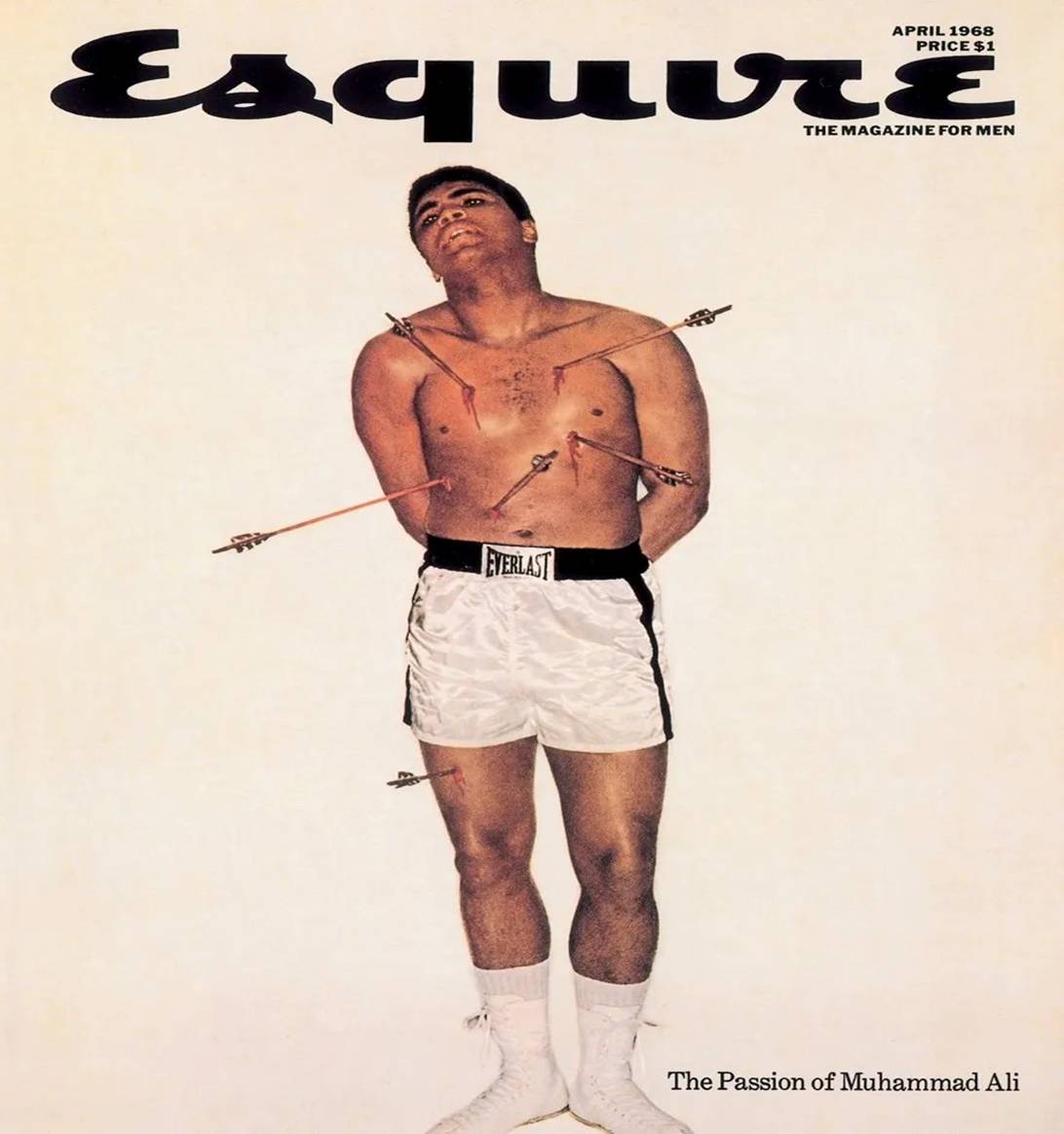
In all the great religions and traditions there is the notion of the prophetic figure who goes through fire, only to emerge on a higher spiritual plane. Nothing illustrated this better for Ali than his 1968 photo on the cover of Esquire magazine. In it, Ali is shown in his boxing trunks, tied to a stake, with arrows which drew blood sticking out of his body. The editors were equating him with a Christian saint and martyr, Saint Sebastian, and making the point that this was how America was treating him. If America was not yet feeling that it had mistreated its great hero, who would not break or yield to the relentless pressure, it eventually came around to this realization. When Ali died in 2016, he was mourned as a national and international icon, with his funeral in his hometown of Louisville, Kentucky attended by US presidents and foreign heads of state alike.
Dealing with a devastating illness, which most people would face in private, Ali was still living in the full glare of the media. He was not doing it for himself, however, but for others
Indeed, the greatness of Ali was also the greatness of America, which produced and, finally, fully embraced and loved him. It was a country striving to live up to the hopeful vision Ali said he had while experiencing prejudice in the 1960s: “I just wanted America to be America.” [15] At his best, Ali symbolized his nation as the gentle giant. In his courage and character, we can see the American icons John F. Kennedy, Martin Luther King, Jr, Malcolm X, and Jimmy Carter—Kennedy in his determination to land a man on the moon, King and Malcolm X fighting for social justice, and Carter embracing all with his compassion. And in Ali’s commitment to his faith, his humility, his generosity, and his expression of love for his fellow Muslims, he reflected his religion of Islam. He was Muslim in his refusing to acquiesce before what he saw as tyranny and his belief in an outcome in which the universe promised him justice and compassion. In his facing persecution and loss of his titles and livelihood and yet refusing to bow before what he perceived as unjust and prejudicial authority, he echoed the inspiring example of Hussain, the grandson of the Prophet and son of Ali, at Karbala. Ali was truly a great American, and a great Muslim.
For us, the authors, Ali is also a great “Mingler,” a person who embraces and loves all of humanity regardless of race, religion, ethnicity, or nation. Indeed, as Lonnie said at our press conference for the hikers, Ali was “A citizen of the world. There were no boundaries, there were no different cultures, wherever he went, he melded into the environment, into the culture, into the society that he visited.” Regardless of how others treated him—from his childhood in the segregated South to his life in the glare of the media and politics—his great love of humanity could not be extinguished.
In this piece, we would like to pay tribute to Ali and highlight those aspects of his life, thinking, and teaching which may promote human coexistence. At a very difficult moment in world history characterized by increasing national, religious, racial, and ethnic conflict, Ali’s message is needed more than ever.
The Early Life and Rise of Ali
Muhammad Ali was born Cassius Marcellus Clay Jr in Louisville in 1942. His father was a painter and his mother worked as a housekeeper when Ali was young. He was raised in his mother’s Baptist church, while his father was a Methodist. [16] Growing up, Ali had dyslexia, and consequently struggled in school. As he got older, he was increasingly aware of social hierarchies and the prejudice towards Blacks in the segregated Jim Crow South. Once, on a hot day when Ali was a young child, Ali’s mother walked up to a small diner and asked for a cup of water she could give her thirsty son, but the door was shut in their faces: “I’m sorry, but we don’t serve Negros. I could lose my job,” the clerk told them. [17] While Ali said he didn’t run into too much trouble with white kids in Louisville growing up, he noted, “there were times when we were called ‘nigger’ and asked to leave certain neighborhoods.” [18] “At that early age,” he affirmed, “I could see that something was very wrong.” [19]
Ali found role models in his parents concerning dealing with and standing up to injustice. They instilled in him both a pride in his identity and a compassion for others.
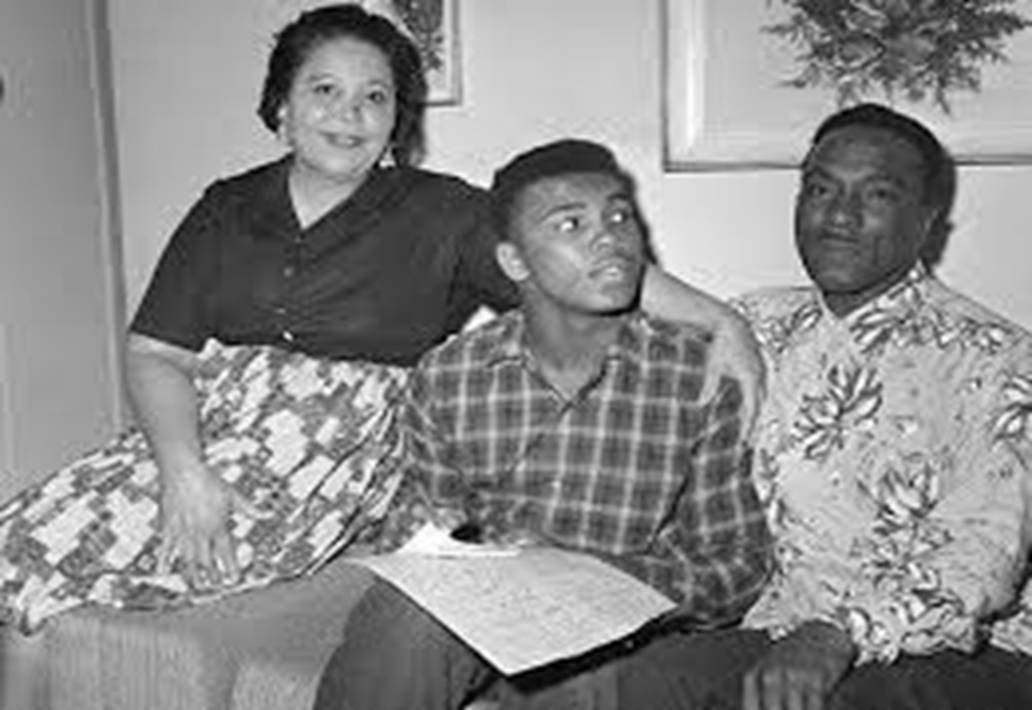
His father, Ali attested, “taught us to always confront the things we feared, and to try to be the best at whatever we did,” and he described his mother as never saying “a bad thing about anyone…She taught us that prejudice was wrong, and to always treat people with love and respect”-
Facebook
Of his parents, Ali stated, “I noticed how they remained dignified in the face of injustice. I saw how they responded to the people around them; I witnessed how my mother would forgive, not hate. And how Cash [his father] always held his head high and he worked hard.” [20] His father, Ali attested, “taught us to always confront the things we feared, and to try to be the best at whatever we did,” and he described his mother as never saying “a bad thing about anyone…She taught us that prejudice was wrong, and to always treat people with love and respect.” [21] Her message was that “Hating is wrong, no matter who does the hating.” [22] Thus, with his parents’ encouragement, and contrary to the common views of the majority society, as a child, Ali said, “I thought that my skin was beautiful, I was proud of the color of my complexion.” [23]
In 1955, Emmett Till, a 14-year-old Black boy, was lynched in Mississippi, blamed for purportedly whistling or flirting with a white woman. Ali was deeply affected by this case. “I cried for months just thinking about it,” [24] Ali said, “He was a black boy about the same age as me…A picture of him in his coffin was in the newspapers, with a gruesome description of what had been done to him. It made me sick, and it scared me. I was full of sadness and confusion. I didn’t realize how hateful some people could be until that day. Although I didn’t know Emmett Till personally, from that day on I could see him in every black boy and girl. I imagined him playing and laughing. As I looked at his picture in the paper, I realized that this could just as easily have been a story about me or my brother.” [25]
Despite this horrible murder, Ali decided he would not give into hate: “I knew that my heart could harden in a world with so much pain, confusion, and injustice. Somehow, I knew that if I were going to survive, I could not become bitter. I would have to love even those who could not give it in return. I would have to learn to forgive even those who would not—or my soul would wither away.” [26]
By this point, Ali had met a man who would become instrumental in his life—Joe Martin, a white policeman who was teaching boys to box in his spare time. While Ali had initially sought him out to report a stolen bike, he soon joined Martin’s gym and started boxing. He threw himself into the sport, training constantly. When the young Ali heard a boxing announcer on the radio discuss Rocky Marciano, “the Heavyweight Champion of the World,” Ali reported that he “never heard anything that affected me like those words: ‘Heavyweight Champion of the World.’ All the world?” [27] From that day forth, he wanted to hear those words said about him, and “I was determined to be the best boxer.” [28] There was another motivation, as Ali said, in that he wanted to be “that public Black role model who was missing while I was growing up.” [29]
Ali began fighting in amateur contests, and by the time he was 18 he had already fought over 100 such bouts, winning 100 and losing 8. [30] At this time, he met his boxing hero, Sugar Ray Robinson, and when Sugar Ray brushed him off, saying he was busy, Ali’s feelings were hurt. He consequently vowed, “I was going to be different when I became a great boxer. I would be the kind of champion that fans could walk up to and talk to. I would shake their hands and sign every autograph…I was going to go out of my way to show my fans how important they were, and how much I appreciated them.” [31]
This would be a characteristic of Ali’s moving forward. An additional characteristic also formed: his showmanship. This he learned from the wrestler Gorgeous George. On a radio program in which Ali appeared after Gorgeous George, Ali heard George say about his upcoming fight, “I’ll kill him; I’ll tear his arm off. If this bum beats me, I’ll crawl across the ring and cut off my hair, but it’s not gonna happen because I’m the greatest wrestler in the world!” [32] “That really made an impression on me,” Ali said, “because I couldn’t wait to see that match. I didn’t care if he won or lost. I just wanted to be there to see what happened…So that’s when I really started shouting, ‘I am beautiful. I am the greatest. I can’t be beat, I’m the fastest thing on two feet, and I float like a butterfly and sting like a bee.’” [33]
Thus, the distinctive Ali style of self-promotion was born. He referred to his promotions before fights as “campaigning,” similar to presidential candidates. Ali traveled around in buses, for example, reciting poetry lines like “The name of this Champion, I might as well say,/ No other one than the greatest, Cassius Clay, [34] and referred to opponents as ugly bears amid other taunts.
Ali also set out to challenge the image of boxers, to “change the image of the fighter in the eyes of the world.” [35] He stated, “I’d known fighters to be the most human of humans and among the most talented people to be found anywhere,” but they were seen as “Just brutes that exist to entertain…animals to tear each other’s skin, break each other’s nose, and bleed and bleed, then get out of sight while the managers and the lawyers and the promoters announced it all, judged it all and profited most from it all.” [36] Ali’s strategy in the ring was not savagery, but, as he put it, “to be as scientific as I could when I fought. I didn’t want to be seriously hurt, and I didn’t want to do that to anybody else either. My plan was to dance, stay out of my opponent’s reach, and use my wits as much as my fists. I tried to get into the mind of my opponent and psyche him out.” [37]
In 1960, Ali competed for the United States at the Summer Olympics in Rome, winning a gold medal. This made him a hero both in Louisville and nationally. With his star on the rise, a group of Louisville millionaires united to represent him, thus keeping him out
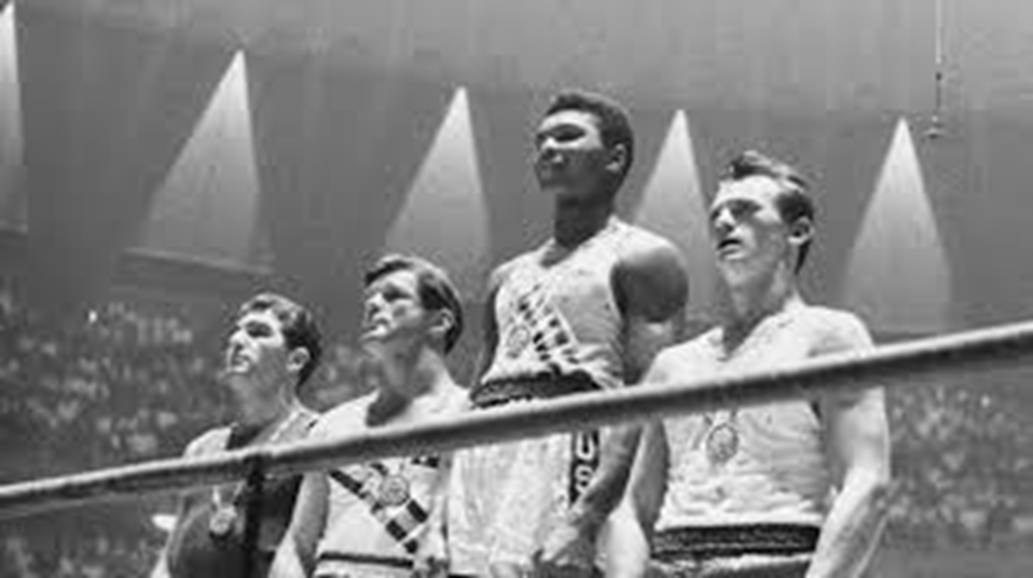
In 1960, Ali competed for the United States at the Summer Olympics in Rome, winning a gold medal – Olympics.com
of the often seedy world of boxing which was frequently associated with gangsters. Ali’s rise was meteoric as he moved from amateur to professional boxing and won fight after fight, including upsets against established boxing superstars such as Sonny Liston. All the while, he kept the media enthralled with his dynamic personality and promotional strategy.
And yet, in Louisville and in the USA, Ali was still Black. This was brought home to him when he attempted to order a cheeseburger and a milkshake at a Louisville restaurant shortly following his Olympics triumph. Despite the fact that he was wearing his gold medal around his neck, the waitress told him, “We don’t serve Negroes.” [38] Ali was crestfallen, recounting later, “I had won the gold medal for America, but I still couldn’t eat in this restaurant in my hometown, the town where they all knew my name, where I was born in General Hospital only a few blocks away. I couldn’t eat in the town where I was raised, where I went to church and led a Christian life. I still couldn’t eat in a restaurant in the town where I went to school and helped the nuns clean the school…I didn’t have the right color skin.” [39] Ali proceeded to get into a fight with a local motorcycle gang which was in the restaurant, and the evening culminated, the story goes, with Ali throwing his gold medal into the river and exclaiming, “This medal ain’t worth a damn thing.” [40]
Ali and the Nation of Islam
Ali had embarked on his personal journey of racial and spiritual awareness, as he weighed how to respond to the social injustices around him. He began to realize that he was unknowingly reflecting some of the attitudes and prejudices of white America, for example a stereotyped view of Africa and Africans. While in Rome for the Olympics, he told reporters that America was the best country in the world and he was better off there than in Africa, because in Africa he would be fighting off snakes and alligators and living in mud huts. [41] When a young Nigerian asked him if he had been quoted correctly, Ali said he had, and the disappointed Nigerian replied, “I thought we were brothers. You don’t understand.” [42] Ali was then aware of how limited his knowledge was—what he knew about Africa he learned from Tarzan movies. [43] Ali then made the decision that he did not wish to be a “White Hope” catering to and reflecting the attitudes of the white majority. In doing so, “I felt a new, secret strength.” [44]
In cities such as Chicago and New York, Ali had already come across Black Muslims belonging to the Nation of Islam. As we discussed in our study Journey into America, [45] the Nation of Islam was part of a long tradition in Black America of recovering and reviving Islam, the religion of a great number of enslaved peoples brought to the Americas. The Nation of Islam had emerged from the Moorish Science Temple, an organization founded in New Jersey in 1913, which featured members praying facing the east and dressing in “Turkish” attire including fezzes, turbans, curved swords, and silk robes. By Ali’s time, the Nation of Islam was led by Elijah Muhammad, who had taken over the organization in 1934 after its founder, Wallace Fard Muhammad, had disappeared. Elijah Muhammad had fled the US South, where he witnessed lynchings of Blacks, and found work in a factory in Detroit before joining the Moorish Science Temple and then the Nation of Islam. During the Second World War, Elijah Muhammad was arrested several times and imprisoned for refusing to serve in the military.
The Nation of Islam movement gathered momentum after the war, stressing pride, empowerment, self-reliance, responsibility, and clean living within the Black community. The Black American writer James Baldwin captured the significance of Elijah Muhammad’s accomplishments concerning the Black community: to “heal and redeem drunkards and junkies, to convert people who have come out of prison and to keep them out, to make men chaste and women virtuous, and to invest both the male and female with pride and a serenity that hang about them like an unfailing light.” [46] Theologically, however, the Nation of Islam differed substantially from the religion of Islam. In the case of the Nation of Islam, Wallace Fard Muhammad was seen as Allah, and Elijah Muhammad considered the Messenger of Allah. Elijah Muhammad also taught that the white race was evil and associated with the devil. Politically, the Nation of Islam sought to secure its own state or territory within the United States in which it could live separately from whites.
Ali initially encountered the Nation of Islam through its newspaper, Muhammad Speaks! which he bought from a man selling it in the street. An illustration drew his instant attention. As Ali described, it was a cartoon of a Muslim slave who “is praying with his hands open in the Muslim manner: ‘Oh Allah! Oh, Allah!’ A white slave master comes up behind him with an upraised whip: ‘Boy, who are you praying to?’ The slave quickly hides his Islamic guise, bows his head and says, ‘Boss, I was praying to Jesus. Jesus Christ, our Lord and Savior, Jesus Christ.’ The slave master lowers his whip and walks away, satisfied, saying, ‘All right, you keep praying to Jesus!’” [47] For Ali, “The cartoon aroused my curiosity in a way no religious statement had ever done before. Why didn’t the slave master want the slave to pray to Allah? Why to Jesus?” [48]
In this cartoon, Ali glimpsed the essence of the message of the Nation of Islam. This was that the “original” identity of American Blacks was rooted in the religion of Islam, which had been artificially stripped away from them by the cruel slave system and a society ruled by white Christian supremacy. By recovering Islam, Blacks could also recover their authentic Black identity. They would then recover their inner morality, strength, and pride in being who they are, not who the whites want them to be or believe them to be.
Ali first attended a Nation of Islam mosque in Miami in 1961, and increasingly found himself drawn to the religion. As he recounted, “What I had heard matched my own feelings, my desires and ambitions for the achievement of freedom and equality for my people, a driving force that had been inside me all my life.” [49] He said, “I thought about my father back in Louisville, Kentucky, painting murals of a White Jesus in Baptist churches all over town. Who said Jesus was White? What painter ever saw Jesus? I remembered that all the pictures on the walls of public places were always of White people. There was nothing about us Black folk.” [50]
It was around this time when Ali first met Khalilah Camacho Ali, who he would later marry. She told a private audience including Amineh of her first meeting with Ali when she was ten years old. Khalilah, whose father was a top lieutenant to Elijah Muhammad, [51] recalled that Ali said, “I’m going to be the heavyweight champion of the world before I hit 21 so get your autograph!” and gave his name. However, “When he signed his name ‘Cassius Marcellus Clay,’ I tore up the paper and threw it on the floor. This is a Roman name! And do you know what the Romans did to us? They enslaved us. You need to change your name! Until you have a name of honor.’ In fact, I was really into Islam and admired the Prophet Muhammad as my main role model—he had the most gentle, simple and compassionate character—so I said to Cassius, ‘Go and get a Muslim name.’” “He was upset,” she said, “But he couldn’t wait. ‘I want to be a Muslim like her.’ So he went to Elijah Muhammad.” [52]
When he decided to formerly join the Nation of Islam, Elijah Muhammad gave him the name Muhammad Ali—Muhammad after the Prophet of Islam and Ali after the son-in-law and cousin of the Prophet. From then on, Ali would refuse to be known as Cassius Clay, which he referred to as his “slave name.” Ali explained, “Muhammad means ‘worthy of all praises,’ and Ali means ‘most high,’” and “Changing my name was one of the most important things that happened to me in my life.” [53] He captured the experience in these verses:
“The day I met Islam,
I found a power within myself that no
man could destroy or take away.
When I first walked into the mosque,
I didn’t find Islam; it found me.” [54]
While Ali was becoming more involved with the Nation of Islam in private, he did not reveal this publicly. This changed after his 1964 victory over Sonny Liston, in which he became the World Heavyweight Champion. He now announced that he was not to be called Cassius Clay anymore, and would only go by Muhammad Ali. His new identity was leading him into another arena outside boxing, as he explained, “When I became a Muslim, I was on my way to entering what I called ‘The Real Fight Ring,’ the one where freedom and justice for Black people in America took place.” [55] Ali felt he had to succeed at boxing “in order to get people to listen to the things I had to say.” [56] “I hoped, he said, “to inspire others to take control of their lives and to live with pride and self-determination.” [57]
According to Ali, the attitude of the Nation of Islam was, “The White Establishment, whether in slavery days or modern days, had taught us to hate ourselves.” [58] So, “Why not clean up our own neighborhoods and schools instead of trying to move out of them and into White people’s neighborhoods?” [59] “I’d like to see peace on earth,” he said, “and if integrating would bring it, I’d say let’s integrate. But let’s just not stand still where one man holds another in bondage and deprives him of freedom, justice, and equality, neither giving him freedom or letting him go to his own.” [60] On this basis, Ali made statements like “integration is wrong. White people don’t want it, the Muslims don’t want it.” [61]
Ali’s announcement that he was a Muslim caused a media firestorm. As Ali described, “The outrage against my becoming a Muslim touched off a public upheaval that went far beyond the ranks of athletes and boxing promoters.” [62] Many whites perceived the Nation of Islam to be a hate group known for talking of the “white devil,” and Ali instantly became controversial for associating with them. Ali explained, “to be a Muslim was equivalent to being an outlaw more dangerous than a Jesse James,” [63] and “a criminal offense.” [64] Ironically, Ali noted, this was the case “in a nation that boasted about its ‘religious freedom.’” [65] Distance also grew with his Louisville millionaire sponsors, resulting in the end of his contract in 1966. From then on, he was managed by Elijah Muhammad’s son Herbert Muhammad. The ire of Ali’s opponents in white America only drove him further to succeed.
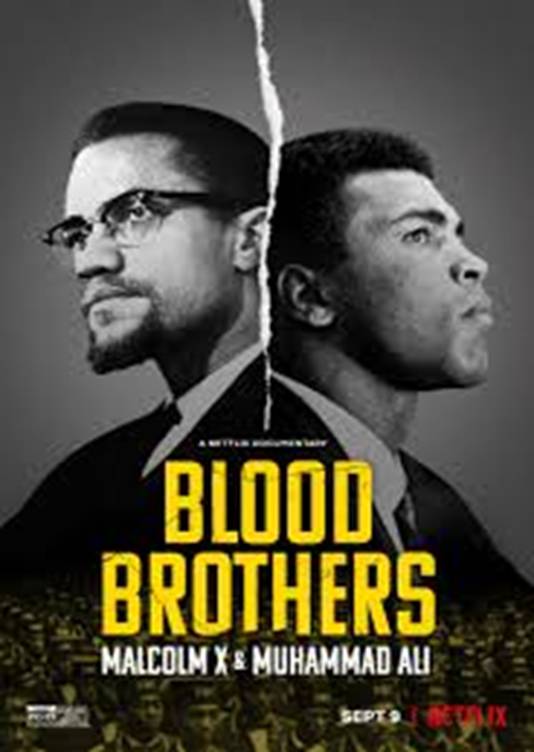
An important influence in Ali’s life in the early 1960s was Malcolm X, who started calling Ali his younger brother. Ali described him as his spiritual advisor and Malcolm X stood next to Ali when he announced to the world he had become a Muslim. Yet the two fell out after Malcolm X split from Elijah Muhammad following his pilgrimage to Mecca and embrace of mainstream Sunni Islam. Malcolm X beckoned Ali to come with him, but Ali remained a dedicated follower of Elijah Muhammad and the Nation of Islam. (Continued next week)
[1] References to “I” refer to me, Akbar Ahmed, and “we” to all three authors.
[2] Akbar Ahmed, “An Appeal by an Islamic scholar to Grand Ayatollah Khamene’i of Iran,” HuffPost, September 3, 2010.
[3] Robert F. Worth and Alan Cowell, “Iran Orders Release of American Hiker,” The New York Times, September 14, 2010.
[4] “Muhammad Ali asks Iran to free U.S. hikers,” Associated Press, February 7, 2011.
[5] Alex Fattal, “When Muhammad Ali Was in My Corner,” The Atlantic, June 11, 2016.
[6] Alex Fattal, “When Muhammad Ali Was in My Corner,” The Atlantic, June 11, 2016.
[7] Hana Ali, At Home with Muhammad Ali: A Memoir of Love, Loss, and Forgiveness (New York: Amistad, 2019), pp. 256, 262.
[8] Melani McAlister, “Iran, Islam, and the Terrorist Threat, 1979-1989.” In J. David Slocum, ed., Terrorism, Media, Liberation (New Brunswick: Rutgers University Press, 2005), p. 146.
[9] Aaron Randle, “Muhammad Ali’s Little-Known Role as a Hostage Negotiator,” History, April 30, 2025: https://www.history.com/articles/muhammad-ali-iraq-hostages
[10] Amineh Hoti, “How Muhammad Ali, ‘The Greatest’ Boxing Champion Got His Name,” HuffPost, October 21, 2017.
[11] Alex Fattal, “When Muhammad Ali Was in My Corner,” The Atlantic, June 11, 2016.
[12] “Secret US-Iran talks cleared way for historic nuclear deal,” Associated Press, November 24, 2013.
[13] Norman Mailer, “Ego,” Life, vol. 70, no. 10, March 19, 1971, p. 18F.
[14] Margueritte Shelton, Muhammad Ali: A Humanitarian Life (Lanham, MD: Rowman & Littlefield, 2023), p. 112.
[15] Muhammad Ali and Hana Ali, The Soul of a Butterfly: Reflections on Life’s Journey (New York: Simon & Schuster, 2004), p. 40.
[16] Ali and Ali, The Soul of a Butterfly, p. 7.
[17] Ali and Ali, The Soul of a Butterfly, p. 10; Ali, At Home with Muhammad Ali, p. 328.
[18] Ali and Ali, The Soul of a Butterfly, p. 10.
[19] Ali and Ali, The Soul of a Butterfly, p. 13.
[20] Ali and Ali, The Soul of a Butterfly, p. 6.
[21] Ali and Ali, The Soul of a Butterfly, p. 6.
[22] Ali and Ali, The Soul of a Butterfly, p. 10.
[23] Ali and Ali, The Soul of a Butterfly, p. 13.
[24] Ali, At Home with Muhammad Ali, p. 328.
[25] Ali and Ali, The Soul of a Butterfly, p. 11.
[26] Ali and Ali, The Soul of a Butterfly, p. 11.
[27] Muhammad Ali and Richard Durham, The Greatest: My Own Story (New York: Random House, 1975), p. 50.
[28] Ali and Ali, The Soul of a Butterfly, p. 19.
[29] Ali and Ali, The Soul of a Butterfly, p. 15.
[30] “Muhammad Ali,” History, December 16, 2009: https://www.history.com/articles/muhammad-ali
[31] Ali and Ali, The Soul of a Butterfly, p. 32.
[32] Ali and Ali, The Soul of a Butterfly, p. 71.
[33] Ali and Ali, The Soul of a Butterfly, pp. 71-72.
[34] Ali and Durham, The Greatest, p. 101.
[35] Ali and Durham, The Greatest, p. 130.
[36] Ali and Durham, The Greatest, p. 130.
[37] Ali and Ali, The Soul of a Butterfly, pp. 116-117.
[38] Ali and Ali, The Soul of a Butterfly, p. 39.
[39] Ali and Ali, The Soul of a Butterfly, pp. 40-41.
[40] “Muhammad Ali discusses his book ‘The Greatest: My Own Story,’” Studs Terkel Radio Archive, November 26, 1975: https://studsterkel.wfmt.com/programs/muhammad-ali-discusses-his-book-greatest-my-own-story?t=NaN%2CNaN&a=MuhaAliDisc%2CMyOwnStor ; Leo Bertucci, “Just Askin’: Did Muhammad Ali really throw an Olympic gold medal into the Ohio River?” Louisville Courier Journal, August 9, 2024.
[41] Ali and Durham, The Greatest, p. 63.
[42] Ali and Durham, The Greatest, p. 63.
[43] Ali and Durham, The Greatest, p. 63.
[44] Ali and Durham, The Greatest, p. 78.
[45] See Akbar Ahmed, Journey into America: The Challenge of Islam (Washington, DC: Brookings Institution Press, 2010), Chapter 4.
[46] James Baldwin, The Fire Next Time (New York: Random House, 1993), pp. 50–51.
[47] Ali and Durham, The Greatest, p. 204.
[48] Ali and Durham, The Greatest, p. 204.
[49] Ali and Durham, The Greatest, p. 205.
[50] Ali and Ali, The Soul of a Butterfly, p. 65.
[51] Ula Yvette Taylor, The Promise of Patriarchy: Women and the Nation of Islam (Chapel Hill: The University of North Carolina Press, 2017), p. 108.
[52] Amineh Hoti, “How Muhammad Ali, ‘The Greatest’ Boxing Champion Got His Name,” HuffPost, October 21, 2017.
[53] Ali and Ali, The Soul of a Butterfly, pp. 61, 65.
[54] Ali and Ali, The Soul of a Butterfly, p. 65.
[55] Ali and Ali, The Soul of a Butterfly, p. 67.
[56] Ali and Ali, The Soul of a Butterfly, p. 69.
[57] Ali and Ali, The Soul of a Butterfly, p. 69.
[58] Ali and Durham, The Greatest, p. 203.
[59] Ali and Ali, The Soul of a Butterfly, p. 66.
[60] Thomas Hauser, Muhammad Ali: His Life and Times (New York: Simon & Schuster, 1991), p. 188.
[61] Barbara L. Tischler, Muhammad Ali: A Man of Many Voices (New York: Routledge, 2016), p. 80.
[62] Ali and Durham, The Greatest, p. 201.
[63] Ali and Durham, The Greatest, p. 212.
[64] Ali and Durham, The Greatest, p. 213.
[65] Ali and Durham, The Greatest, p. 213.
Ambassador Akbar Ahmed is Distinguished Professor of International Relations and holds the Ibn Khaldun Chair of Islamic Studies at the American University, School of International Service. He is also a global fellow at the Wilson Center Washington DC. His academic career included appointments such as Nonresident Senior Fellow at the Brookings Institution; the First Distinguished Chair of Middle East and Islamic Studies at the U.S. Naval Academy in Annapolis, MD; the Iqbal Fellow and Fellow of Selwyn College at the University of Cambridge; and teaching positions at Harvard and Princeton universities. Ahmed dedicated more than three decades to the Civil Service of Pakistan, where his posts included Commissioner in Balochistan, Political Agent in the Tribal Areas, and Pakistan High Commissioner to the UK and Ireland.
Frankie Martin is a doctoral candidate in anthropology at American University and a senior researcher for Akbar Ahmed’s quartet of Brookings Institution Press studies on Western-Islamic relations.
Amineh Ahmed Hoti is Fellow-Commoner at Lucy Cavendish College, University of Cambridge. She was also a senior researcher for Akbar Ahmed’s quartet of Brookings Institution Press studies on Western-Islamic relations. Her most recent book is Gems and Jewels: The Religions of Pakistan (2021).
