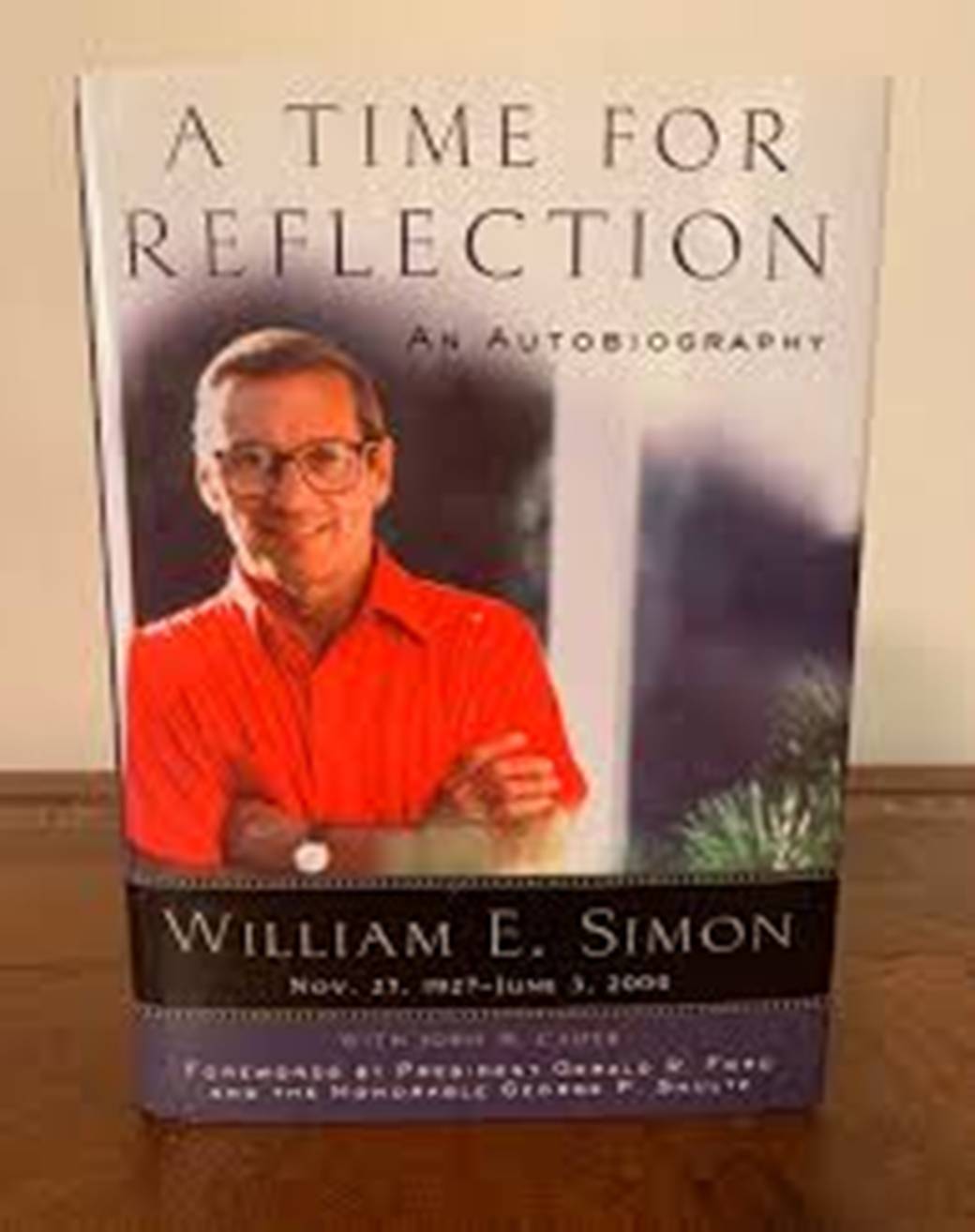
Simon — financier, public servant, philanthropist, and influential conservative thinker — intended his autobiography to be more than a chronological retelling of events. What emerges instead is a hybrid of memoir, policy meditation, and ethical manifesto: a final statement of principles from a man deeply concerned about the direction of American institutions and the erosion of civic character - Photo AbeBooks
A Time for Reflection: Lessons in Leadership and Character from William E. Simon
By C. Naseer Ahmad
Washington, DC

Black Friday in America, arriving on the heels of Thanksgiving, reliably turns people’s minds toward gift-giving and year-end reflection. In Pakistan, the commemorative season approaches Quaid-i-Azam Day, followed soon after by the new year. It is a moment when we take stock of our fortunes, our families, the national trajectory, and the year that has raced by. It is also a time when many of us look for books that offer more than entertainment — works that encourage reflection on responsibility, leadership, and the moral standards shaping public life. A Time for Reflection, the posthumously published autobiography of former US Treasury Secretary William E. Simon, is one such volume.
Simon — financier, public servant, philanthropist, and influential conservative thinker — intended his autobiography to be more than a chronological retelling of events. What emerges instead is a hybrid of memoir, policy meditation, and ethical manifesto: a final statement of principles from a man deeply concerned about the direction of American institutions and the erosion of civic character.
Life expectancy markers give his reflections added weight. Most Americans, according to actuarial tables, never reach 70. In Pakistan, the percentage who do is even smaller—often quoted at under 10 percent. Simon not only surpassed that milestone but filled his decades with an unusually varied and consequential public life. His narrative begins with an unexpectedly candid assessment of his upbringing. Though he was raised in relative comfort, he writes critically of his father, who inherited wealth only to see it dissipate through poor stewardship. Rather than breeding resentment, this instability fueled Simon’s ambition. From an early age he resolved not merely to restore lost prosperity, but to exceed it through discipline, ingenuity, and sheer drive.
The reader sees early evidence of this determination when Simon recounts how he creatively circumvented a failed eye exam to secure admission into the US Army. This mixture of resourcefulness and relentlessness defined his years on Wall Street as well, where he rose to prominence as a formidable bond trader. Wealth and reputation came quickly, but the book makes clear that financial success is not its focus. Instead, these chapters serve to illustrate the ethical tensions he observed in business and the values he believed should guide economic life.
Simon’s governmental service — particularly his tenure as Treasury Secretary under Presidents Richard Nixon and Gerald Ford — provides some of A Time for Reflection’s most absorbing material. His treatment of Nixon is strikingly sympathetic, especially considering the Watergate scandals that still dominate historical memory. Simon does not ignore the ethical failures of the administration, yet he avoids the easy condemnatory narrative. He highlights instead Nixon’s intellect, strategic sense, and moments of genuine statesmanship. Simon even devotes substantial attention to his own later involvement in creating the privately funded Nixon Presidential Library in California, a project he believed essential to preserving a more nuanced view of the former president.
His observations on Gerald Ford stand in contrast: steadiness, decency, and civic responsibility are the qualities he emphasizes. Reading these passages today —when political environments in both the US and Pakistan often feel polarized and personality-driven — one can sense Simon’s yearning for leaders anchored in character rather than charisma alone.
Pakistani readers with an interest in economic policy will find Simon’s ideological reflections particularly relevant. A committed advocate of free-market principles, he warns consistently against government overreach, excessive regulation, and chronic deficit spending. These arguments are rooted in the debates of the 1970s and 1980s, but they echo contemporary fiscal challenges — including those besetting Pakistan now. Today, anyone can look up historical deficit data through even the simplest AI tools and see that the battles Simon fought have hardly been resolved. In this sense, his policy reflections feel less like relics of a bygone era and more like continuing challenges confronting modern economies.
The memoir also charts Simon’s post-government ventures, most notably his pioneering role in leveraged buyouts (LBOs). He clearly takes pride in the strategic creativity involved, though he avoids dwelling on the long-term consequences of corporate restructurings. Contemporary readers — aware of later corporate scandals such as WorldCom or of the 2008 financial crisis — may wonder how Simon would have interpreted the vulnerabilities that emerged long after his era. These gaps are understandable in a posthumous work, yet they lend the book a certain poignancy: Simon did not live to witness the full moral and economic implications of the innovations he championed.
What ultimately distinguishes A Time for Reflection from typical political memoirs is the profound turn it takes in its final chapters. Here, Simon steps away from the arenas of finance and government to recount the humanitarian and philanthropic commitments that shaped his later life. One of the most compelling episodes involves his leadership of the US Olympic Committee, particularly his successful effort to restore a medal unjustly stripped from a Native American athlete decades earlier. His friendships with sports legends such as Jesse Owens are narrated with warmth, situating athletic achievement within a broader moral landscape of dignity and national identity.
Equally moving are Simon’s reflections on his Roman Catholic faith and his volunteer work caring for terminally ill patients. The contrast between the high-powered Wall Street strategist and the humble bedside caregiver is striking. In one memorable moment, he describes asking a dying patient to “put in a good word for a sinner like Simon” in heaven — a line that reveals a capacity for humility not often associated with powerful public figures.
For Pakistani readers — especially those engaged in policy, governance, or public service — A Time for Reflection offers more than the life story of an American statesman. It illuminates how personal character shapes public leadership. It also invites a quiet comparison: how might Pakistan’s own finance ministers, technocrats, and political leaders measure up when judged not only by their policies but by the moral compass guiding their decisions?
As the year draws to a close and the holiday season encourages contemplation, Simon’s autobiography offers exactly what its title promises: a reminder to pause and consider the values we hope to embody—both as individuals and as a nation. Whether placed on a shelf as a prompt toward humility or read as a meditation on the intersection of public duty and private conscience, A Time for Reflection stands as a timely companion for readers seeking meaning beyond the marketplace.