
Ali: Great American, Great Muslim - II
By Akbar Ahmed , Amineh Hoti , Frankie Martin



Ali Versus The United States
In 1966, at the height of his boxing powers, Ali received word that the US government had made him eligible for the draft to serve in the Vietnam War. He immediately refused, stating, “I ain’t got no quarrel with the Viet Cong” [1] and “All I want is peace.” [2] Ali framed his decision with this question: “Why should they ask me to put on a uniform and go ten thousand miles from home and drop bombs and bullets on brown people in Vietnam while so-called Negro people in Louisville are treated like dogs and denied simple human rights? No, I’m not going.” [3] Ali is apparently not on record delivering the famous quote, “No Viet Cong Ever Called Me Nigger” [4] which has long been associated with him, but he delivers the line in the 1977 biographical film The Greatest in which he plays himself.
Ali was against fighting in a war not sanctioned by his own religious leadership and he objected to killing people in war generally, filing for a draft exemption as a conscientious objector. “God told Abraham to kill his son and Abraham was willing to do it,” Ali said, “so why shouldn’t I follow what I believed? Standing up for my religion made me happy; it wasn’t a sacrifice.” [5] Ali also objected on the grounds that he felt the Vietnamese were being dehumanized in the United States. Ali recounted, “I had seen a series of pictures in a magazine showing mangled bodies of dead Viet Cong laid out along a highway like rows of logs and a white American officer walking down the aisle of the dead taking the ‘body count.’ The only enemy alive was a little naked girl, searching among the bodies, her eyes wide, frightened. I clipped out that picture; and the face has never quite left my mind.” [6]
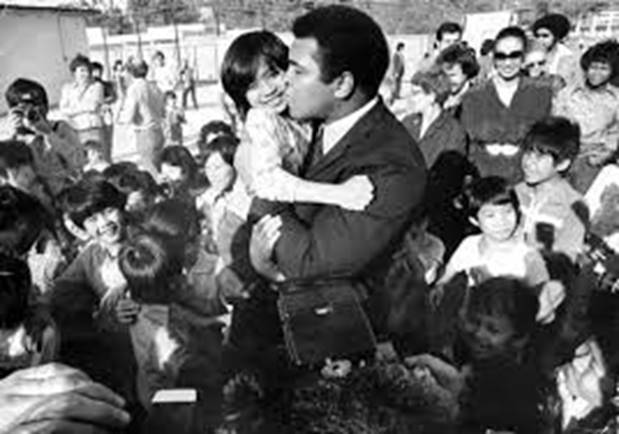
In Miami, Ali had seen a group of children attacking another group of frightened children, pelting them with stones and sticks. When Ali asked the children who were attacking the others what was going on, a child explained, “They Viet Cong. We Americans.” [7] Ali immediately went over to one of the “Viet Cong,” an especially scared young girl, and lifted her onto his shoulders. When the children protested, exclaiming, “She on the Viet Cong side. We against them, ain’t we, Champ?” Ali replied, “No…We ain’t…They just like you and me.’” [8] When Ali looked at the “Viet Cong” girl, he stated, “I saw a strong resemblance between her and the little Vietnamese girl in the magazine.” [9]
In 1967, Ali, who had been summoned to a recruiting center to report for duty, officially rejected conscription. He was consequently sentenced to five years in prison and fined $10,000. The reaction was swift and ferocious for the World Heavyweight Champion. Many Americans were already outraged at Ali for associating with the Nation of Islam which was accused of “race-hate” and communism, and the anti-Ali feeling now grew precipitously. Ali became reviled in mainstream America and seen as a traitor to the country—he was described, for example, as “a black Benedict Arnold” (Los Angeles Times). [10]
Ali was stripped of his heavyweight championship title, boxing commissions around the US refused to grant him a license to fight in their states, and his passport was seized. Even the Nation of Islam asked him to reconsider his decision, but he refused. The Nation of Islam consequently stripped him of membership and barred its members from associating with him. [11] While the US government assured him that if he served in the military, he would never hold a gun and could stage boxing exhibitions, he refused to change his mind. “They wanted to use me to lead other young American men into the war,” Ali explained, “They didn’t seem to realize that to take their ‘deal,’ I would have had to denounce my religion, my faith, my beliefs...So they took my title, my financial security, and they tried to take my freedom. But they could not take my dignity, my pride, or my faith, because those were solid, real, and constant in my life.” [12] “The more we master the challenges,” he asserted, “the deeper our faith becomes.” [13]
As a consequence of this decision, Ali’s boxing career came to a grinding halt for over three years. During this period, he went on tour to speak, for example in universities. In a 1967 address to nearly 1,000 people at Howard University in Washington, DC, a historically Black institution, Ali said, “See, we have been brainwashed. Everything good and of authority was made white. We look at Jesus, we see a white man with blond hair and blue eyes. We look at all the angels, we see white with blond hair and blue eyes. Now, I’m sure if there’s a heaven in the sky and the colored folks die and go to Heaven, where are the colored angels? They must be in the kitchen preparing the milk and honey. We look at Miss America, we see white. We look at Miss World, we see white. We look at Miss Universe, we see white. Even Tarzan, the king of the jungle in black Africa, he’s white!” [14]
Ali’s battle with the US government was a catalyst in American opposition to the Vietnam War and also in the cause of the movements of Black pride and Black Power. Socially, it was a period of tumult and violence in
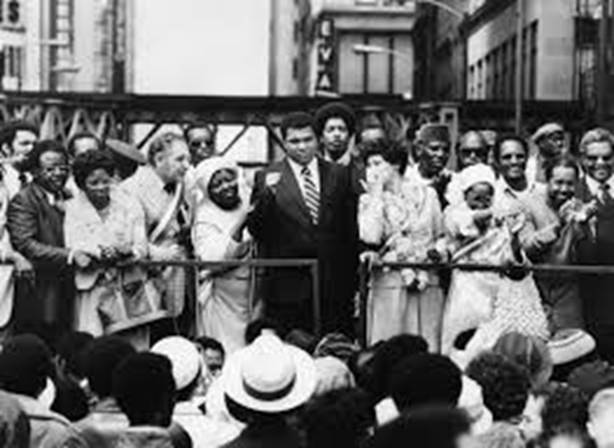
In 1967, for example, Ali privately met with Chicago gang members and convinced them to end plans to spark a riot against police, warning “about the dire repercussions for the ghetto community and their families” and persuading them “to abandon the violent rebellion idea.” – Chicago Tribune
America’s urban areas, and Ali did what he could to restore and promote peace amid the nation’s boiling social and racial tensions. In 1967, for example, he privately met with Chicago gang members and convinced them to end
plans to spark a riot against police, warning “about the dire repercussions for the ghetto community and their families” and persuading them “to abandon the violent rebellion idea.” [15]
Ali had now broken into the world of culture and society far beyond boxing, and was in touch with global figures encouraging him such as Robert F. Kennedy and Bertrand Russell. [16] Martin Luther King, Jr said, “No matter what you think of Mr Muhammad Ali’s religion, you certainly have to admire his courage.” [17] In 1970, Ali observed that it seemed popular culture was catching up to his positions: “When I didn’t go to Vietnam, I was by myself almost. Now everybody is against it. Right? I wasn’t wrong then. I used to always say: ‘I’m pretty.’ ‘I’m beautiful.’ And now the black folk have signs saying ‘black is beautiful.’ They’re just now getting around to seeing it.” [18]
In 1971, the Supreme Court overturned Ali’s conviction, fully clearing his return to boxing and removing the specter of prison. Ali set out to regain his title which had been stripped from him, and he triumphed. After a loss to Joe Frazier, his first, in 1971, he successfully regained his
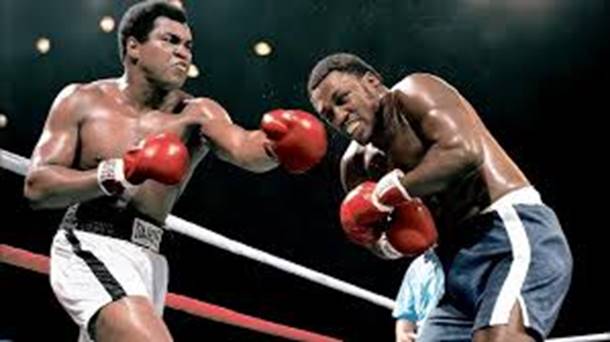
After a loss to Joe Frazier, his first, in 1971, Ali successfully regained his World Heavyweight Champion title and fought in such celebrated bouts as the “Rumble in the Jungle” in Zaire against George Foreman and the “Thrilla in Manilla” against Joe Frazier in the Philippines
World Heavyweight Champion title and fought in such celebrated bouts as the “Rumble in the Jungle” in Zaire against George Foreman and the “Thrilla in Manilla” against Joe Frazier in the Philippines. These fights endeared Ali to audiences across the globe. In Zaire, for example, he said, “I’ve never received such an outpouring of love and support as I got from them. People lined up on the streets to see me, and I loved interacting with them and learning about their lives.” [19] Crowds yelled, “Ali, bomaye!” which means “Ali, kill him!” referring to Foreman. After Ali won the fight, he made the journey from Kinshasa to the presidential compound in N’Sele where he was staying as throngs of adoring people lined the streets. When he arrived at the compound, he encountered a group of local children and, though exhausted, he sat with them doing magic tricks well into the morning.” [20] Such sights were repeated throughout Ali’s travels, especially in Africa and Asia.
In the United States, Ali’s social and political stances continued to follow him in the ring. For example, before a fight with Ali, Floyd Patterson announced that with his victory he would “bring the title back to America,” ignoring the fact that Ali was American, and stated he would only call him by Cassius Clay, thus ignoring his Muslim identity. This was common practice among many Americans, including in the media, who refused to use his Muslim name. Ali responded, “I’m gonna give you a whipping until you call me Muhammad Ali.” [21] Ali’s position concerning such sentiments was, “I am America. Only, I’m the part you won’t recognize.” [22]
Ali, the Great Humanitarian
In 1975, following the death of Elijah Muhammad, his son and successor Imam W. D. Muhammad moved the Nation of Islam into mainstream Sunni Islam, and Ali moved with him. In doing so, Imam W. D. followed a path which Malcolm X had embarked on a decade earlier. Malcolm X, Ali said, “was a visionary—ahead of us all…Malcolm was the first to discover the truth, that color doesn’t make a man a devil. It is the heart, soul, and mind that define a person.” [23] W. D. Muhammad now led the community in this direction, with Ali explaining that Imam W. D. “taught us the true meaning of the Qur’an. He showed that color don’t matter. He taught that we’re responsible for our own lives and it’s no good to blame our problems on other people.” [24] While Ali had long believed in human equality despite the Nation of Islam’s ideology, he was now, following the leadership of Imam W. D., spiritually positioned to make his mark on the globe as a great Mingler uniting all of humanity.
This broadening of Ali’s spiritual life also coincided with the decline of his boxing career. In 1978, the year of his final boxing win, Ali embarked on a flurry of activity for social causes. He “addressed the United Nations Special Committee against Apartheid to boldly impart his message of peace with a powerful spirit of hope. He traveled to the struggling country Bangladesh as a hero who was granted honorary citizenship, before he returned home to support the ‘Longest Walk,’ a Native American protest march across the nation to fight government attempts to end treaty rights. He was invited to Russia by
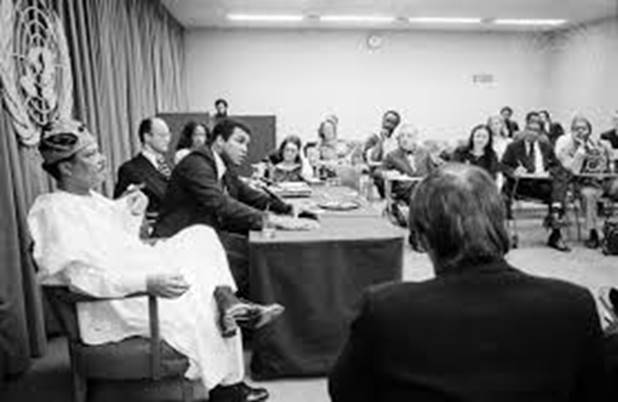
Ali “addressed the United Nations Special Committee against Apartheid to boldly impart his message of peace with a powerful spirit of hope. He traveled to the struggling country Bangladesh as a hero who was granted honorary citizenship
Leonid Brezhnev, where he prayed at a local mosque and spread his positive influence throughout the goodwill mission during the Cold War.” [25] Brezhnev requested Ali to do all he could to improve relations between the Soviet Union and the US, and made Ali an “unofficial ambassador for peace to the United States.” [26] The following year, Ali became the first foreign athlete to visit China, where he was personally received by Deng Xioping. [27] In China, Ali “joined prayer gatherings at the Great Mosque of Xi’an, met with students, and went to a local gym to teach expert workout routines.” [28] Deng told Ali, “You have deep feelings toward China” and stated, “Boxing can…be a bridge which enhances mutual understanding and friendship between Chinese and American people.” [29]
Following a loss in 1981, Ali retired from boxing for good. His final record was 56 wins and 5 losses. Later, he would discover that at this point he already had Parkinson’s disease, which was subsequently diagnosed. “As a man who spent most of my life developing his
Ali became the first foreign athlete to visit China, where he was personally received by Deng Xioping. “Boxing can…be a bridge which enhances mutual understanding and friendship between Chinese and American people,” Deng told Ali
physical fitness and athleticism,” Ali said, “this diagnosis was difficult to accept. At first there were times when I could push all thoughts of the disease out of my mind. Later, when the physical symptoms could not be ignored, there were periods of frustration and depression, which I had to fight as vigorously as any opponent I ever faced in the ring. The only way I could deal with this challenge was through my faith. It was faith that restored my sense of purpose and self-confidence. My faith gave me back my joy and enthusiasm for life. I think maybe my Parkinson’s is God’s way of reminding me of what is important: for example, how we treat each other. It slowed me down and caused me to listen rather than talk. Actually people pay more attention to me now because I don’t talk so much.” [30]
Ali at this stage of his life also came to regret some of the boasting insults that he had hurled against opponents such as Joe Frazier to promote his fights and psychologically affect his opponents and give himself an edge. In his book The Soul of a Butterfly (2004), Ali published a poem in honor of Frazier entitled “The Silent Warrior” in which he refers to Frazier as “a great man” and “a great champion”: “His pride no man could take down./ His dignity rose with his crown.” [31] And he refers to himself: “Now Ali could feel Joe’s pain,/ And Ali’s sorrow could not be relieved.” [32]
Ali realized that God had a special path for him, a door which opened to him following his retirement from boxing and health affliction. “Each time I thought I had achieved my life’s purpose,” he explained, looking back
at his life, “I discovered it was only another step in my journey. I thought boxing would help me be that public Black role model who was missing while I was growing up. I thought my purpose was to be that hero who showed children that Black is beautiful. I thought my purpose was to be that champion who showed White people they couldn’t treat Blacks like second-class citizens. I learned that all of these accomplishments were important, but even more important, I gained a platform that allowed me to carry out my real mission, which has been to encourage all people to respect each other and to live in peace.” [33]
Ali attested, “During my boxing career, you did not see the real Muhammad Ali. You just saw a little boxing and a little showmanship. It was after I retired from boxing that my true work began.” [34] As he wrote in the early 2000s, “I’m not as physically healthy as I once was, but in many ways I’m a lot stronger now.” [35] He also stated, “I’m working harder now than I ever worked in boxing. When I was in boxing, I used to get up at six o’clock in the morning to run. Now I’m up at five o’clock, praying, signing pamphlets, and reading the Qur’an.” [36]
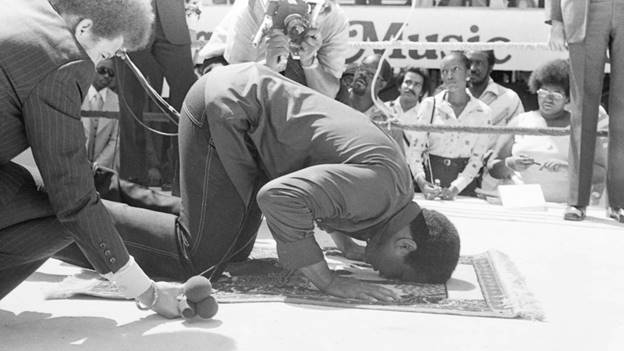
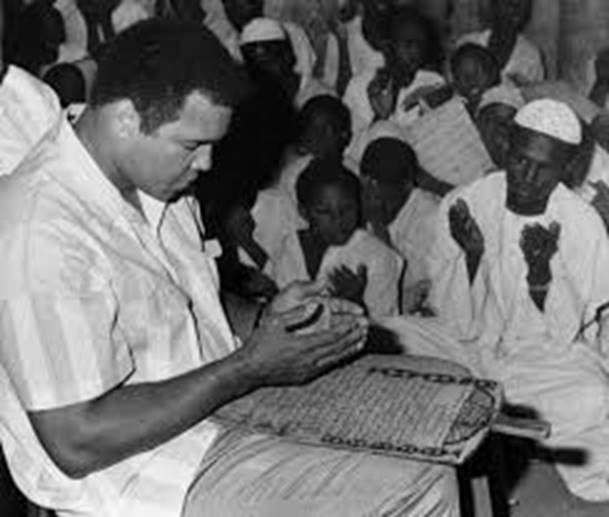
“During my boxing career, you did not see the real Muhammad Ali. You just saw a little boxing and a little showmanship. It was after I retired from boxing that my true work began.” [34] As he wrote in the early 2000s, “I’m not as physically healthy as I once was, but in many ways I’m a lot stronger now.” [35] He also stated, “I’m working harder now than I ever worked in boxing. When I was in boxing, I used to get up at six o’clock in the morning to run. Now I’m up at five o’clock, praying, signing pamphlets, and reading the Qur’an.” – WBUR, Al Jazeera
Ali was traveling more than ever on humanitarian visits—in a single year, 1989, for example, Ali traveled within the US 67 times, flew twice to Saudi Arabia, and visited Yugoslavia, Senegal, Pakistan, India, Switzerland, and England. [37] In 1997, after a nun in Ivory Coast who was caring for 400 Liberian child refugees dislocated by civil war appealed to Ali for assistance raising supplies, Ali himself flew to Ivory Coast: “To the nun’s surprise, Ali arrived with toys, food, and gifts for the children. Although his voice was muted, he shook hands and spoke quietly with the children.” [38]
Ali thus became one of the world’s great humanitarian icons, a tireless and dedicated fighter for love and peace. In 1998, he was named the United Nations Messenger of Peace. Ali was deeply influenced by Sufi Islam and its message of love and peace with all, and Sufism suffuses The Soul of a Butterfly. Ali’s statements evidenced Sufi wisdom, for example, “The heart accommodates the heavens and the earth, all the seas and all the land.” [39] After 9/11, Ali was a leading and high-profile spokesman for Islam as he sought to challenge prejudice against Muslims and build bridges. Ali pointed out that “the Prophet Muhammad, peace be upon him…respected and interacted with peoples of other faiths in his time” and “The Holy Qur’an encourages Muslims to have meetings and exchanges of ideas with people from other religious traditions.” [40] Ali was also increasingly being recognized for his seminal influence on American culture, for example he was referred to as “the first rapper,” influencing the art form through his rhyming performances. [41]
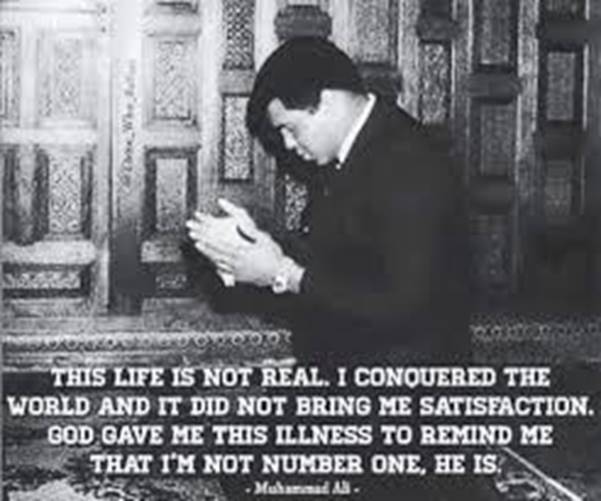
Ali was perhaps the most famous living example of someone who was unapologetically both Muslim and American and saw no contradiction between the two. The writer Thomas Hauser, who collaborated on book projects with Ali after his retirement from boxing, captured Ali’s spiritual significance for people across the globe in this statement: “Muhammad Ali is the most loved person in the world. Everywhere he goes, wherever he goes, people of all colors and religions crowd around, hoping to get close to him. I’ve seen it happen so many times. And each time, I ask myself, ‘If we can all get together and have a meeting of the minds on Ali, why can’t we all get together, period?’ I look at this man and I say to myself, ‘God is trying to tell us something. ’” - The Muslim Vibe
Ali was perhaps the most famous living example of someone who was unapologetically both Muslim and American and saw no contradiction between the two. When Ali was given the honor of having a star on the Hollywood Walk of Fame in 2002, for example, he objected to people stepping on the name of the Prophet of Islam. This was not an impediment, however, as an accommodation was found which symbolically speaks to the compatibility of Islam and America: his star was unveiled on an easel instead of on the ground, and then displayed permanently on a wall.
The imposing fighter had become a saintly figure. He was now fighting a different battle, as he said, “I’m fighting for human dignity” and “for peace and understanding.” [42] Ali’s goal, he stated, was to “unite all humankind through faith and love.” [43] Towards the end of his life, Ali was still making public appearances, such as at charity events, and bringing joy, comfort, and hope to others, despite his own struggles and great difficulty speaking. In 2014, he met Jill Conley, a young woman dying of cancer, and the two tearfully embraced. She recounted, “Even without saying anything, looking in my eyes he said everything…He jumped right in my heart and my soul.” [44]
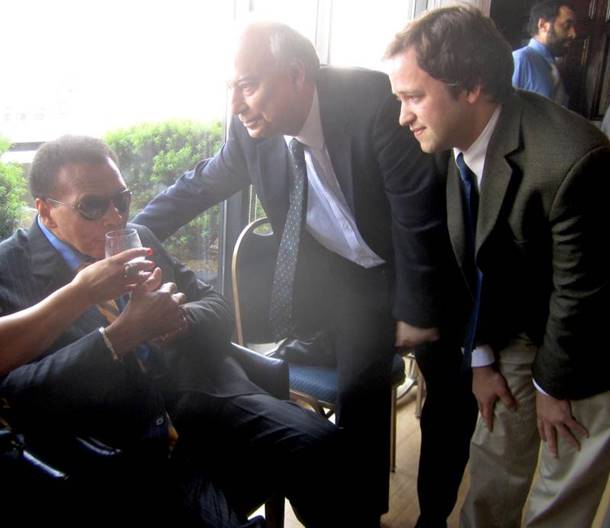
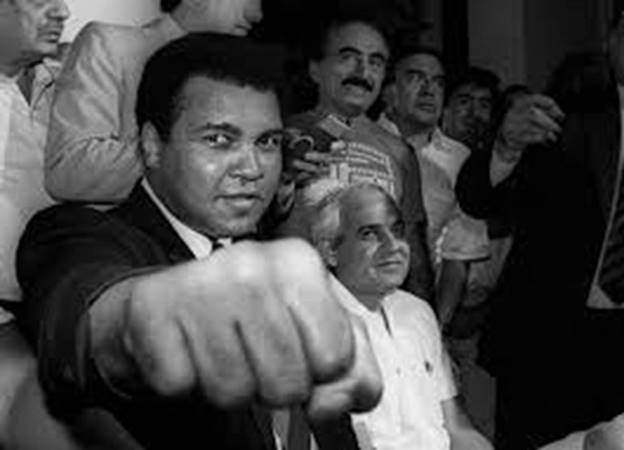
Authors Akbar Ahmed and Frankie Martin with Muhammad Ali during the campaign for the release of US citizens from Iranian custody
The writer Thomas Hauser, who collaborated on book projects with Ali after his retirement from boxing, captured Ali’s spiritual significance for people across the globe in this statement: “Muhammad Ali is the most loved person in the world. Everywhere he goes, wherever he goes, people of all colors and religions crowd around, hoping to get close to him. I’ve seen it happen so many times. And each time, I ask myself, ‘If we can all get together and have a meeting of the minds on Ali, why can’t we all get together, period?’ I look at this man and I say to myself, ‘God is trying to tell us something.’” [45]
Ali and the Divine
Let us turn here to a discussion of Ali’s philosophical ideas and spiritual teachings which are valuable and instructive for us to consider. We will begin with his understanding of God. For Ali, God is the supreme unitary and inclusive force, accessible to all people of all religions. All of us share what Ali called “our original spiritual state of oneness,” [46] which we can reach once again by coming together with one another. Ali spoke of the need to recognize “the divine light that is within us all” [47] and of his respect for “the great power that has been responsible for the universe.” [48] God, Ali said, “is One and the only One, who is similar to nothing, and nothing is comparable to Him.” [49]
While humans may call God different names, Ali taught that these names reflect an underlying unity. As he affirmed in one of his favorite sayings, “Rivers, lakes, ponds, streams, oceans, all have different names, but they all contain water. So do religions have different names, and they all contain truth, expressed in different ways, forms, and times. It doesn’t matter whether you’re a Muslim, a Christian, or a Jew. When you believe in God, you should believe that all people are part of one family. If you love God, you can’t love only some of his children.” [50]
Thus, Ali states, “We all have the same God, we just serve him differently.” [51] These are the “many paths to God,” [52] Ali believed, with different religions being “different roads converging to the same point.” [53] Just as God has different names which point to the same unity, different religions “have different ways of worshipping God,” but, Ali stated, “we’re all trying to get to the same place.” [54] He elaborated, “My mother was a Baptist. She believed Jesus was the son of God, and I don’t believe that. But even though my mother had a religion different from me, I believe that on Judgment Day my mother will be in heaven. There are Jewish people who lead good lives; and when they die, I believe they’re going to heaven. If you’re a good Muslim, if you’re a good Christian, if you’re a good Jew; it doesn’t matter what religion you are, if you’re a good person you’ll receive God’s blessing.” [55] While, he attested, “I believe Islam is the correct path for me…I respect people of different religious beliefs.” [56] “I may have changed my religion,” he explained, “but the God my mother taught me about is still God; I just call him by another name.” [57]
Ali also believed that God is accessible through nature. As he said, “When I am at home in Michigan, I like to take walks around my farm and observe the beauty of nature. One morning, while I was walking, I came across a trail of ants. As I took a closer look, I noticed that the ants were heading somewhere. They were all traveling in the same direction, following the ant in front of the line. I watched as they came across obstacles. There were rocks in their paths, puddles in their way, and the wind was blowing small branches and leaves around. But the ants continued forward. They went over the rocks and around the puddles. It took them close to an hour to reach their destination, which seemed to be a small tree on the other side of our driveway. Along their journey, I noticed how some of them had trailed off on their own and others had stopped. But the majority of them were still following the ant at the head of the line. As I watched them, I was reminded of how great God is. There are signs all around us, most of which go unnoticed, but when we do pay attention to the little things, we witness how even the smallest of creatures have challenges and obstacles to overcome, and then our own don’t seem so insurmountable.” [58]
Ali found lessons in the rhythms and cycles of nature: “When it rains we sometimes see a rainbow. Moisture and light cooperate to create a stairway to heaven. We witness the seasons come and go in perfect timing. We watch as summer fades into fall, and fall into winter. Then we watch as the snow melts away and spring appears. Just as we trust that the seasons will change, we must trust that we can weather the storms of life. When God is present, nothing can prevail against us.” [59] “Everything in nature is in perfect order except man,” Ali believed, pointing to the tendency of humans to be consumed by prejudice and injustice: “Man is suffering because he has adopted a way of life that’s against nature and the laws of God.” [60]
Another way to gain an appreciation of God for Ali is to ascend to great heights and view the world from a different perspective. It is a version of what is known as the “Overview Effect” observed in astronauts, the feeling of global and human unity that one gets from seeing the world from space. As Ali says, “We are all so small in the scheme of God’s grand universe. When I am traveling in an airplane, I like to watch the ground as the plane takes off. I notice how the houses and cars become smaller the higher we rise, until everything appears to be the size of the ants. We feel big and important here on the surface of the earth, but every so often, when we get the chance to view the world from a different angle, we can see things as they really are.” [61]
Ali and the “Other”
For Ali, the underlying unity of the people of the world means that we should all treat each other with kindness. The “Other,” the person who is different from us, is in truth just like us, as “in God’s eyes we are all equal” [62] despite our differences. Indeed, Ali argued, “God beautified the planet by spreading everyone out and making us different,” [63] and “We should appreciate the beauty in the diversity. It would be a boring world, if every flower were the same shape, color, and size.” [64] “There are billions of people in the world, and every one of them is special,” he enthused with wonder, “No one else in the world is like you. No one else looks the same…Ain’t that amazing?” [65] The process of meeting, learning, and knowing about each other is wonderful, and Ali explained of his many travels, “Most of my knowledge comes from traveling, talking to people. We don’t realize how much gold and how much wisdom is in places where you don’t think it is.” [66]
We should cherish human differences, Ali said, and reach out to each other, as “each of us has to accept differences in others, and all of us should look for qualities in others that we can embrace. We must recognize that often there are different ways to be right.” [67] “The goal of our nations,” he believed, “should be to work on understanding, respecting our differences, and celebrating our similarities.” [68] Ali attested that “the world becomes a better place to live each time someone embraces a 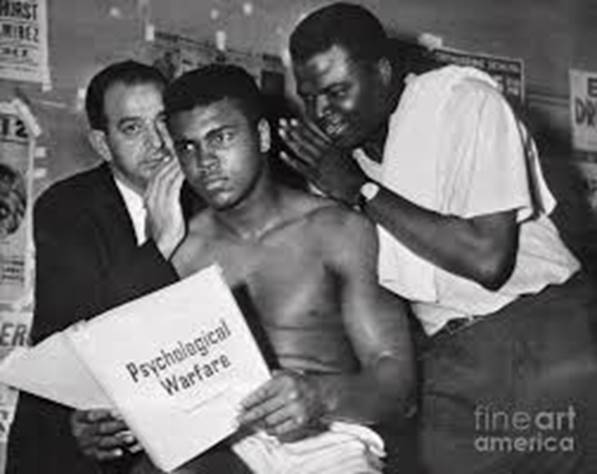
Throughout his life, however, including in the Nation of Islam, Ali was always reaching out to the “Other.” As he explained, “Through it all, I had people of different faiths and nationalities all around me. My trainer, Angelo Dundee, was Italian. Bundini Brown, my assistant trainer, was a Black man, but he was Jewish. Gene Kilroy, my camp manager, was White. Ferdie Pacheco, my ring doctor, was Cuban. And Howard Bingham, one of my closest friends, is Black and Christian. I loved them all and considered them my family.” – Fine Art America
philosophy of caring for all people, not just ‘one’s own.’” [69] And concerning our “enemies,” Ali stressed unity: “What a change there would be in the world if we all recognized God in our fellow man. We may see him in ourselves and in our friends, but how much better if we could also recognize him in our so-called enemies?” [70]
Even when he was in the Nation of Islam, with its ideology of “white devils,” Ali stated, “We didn’t hate anybody; we just wanted to be with our own. Black people were in trouble; we needed to help ourselves first.” [71] He explained, “I never really believed that White men were devils. But when I was young, I had seen and heard so many horrible stories about the White man that this made me stop and listen.” [72] He later stated, “I was wrong” to follow a teaching which “disrespected other people and said that white people were ‘devils’…Color doesn’t make a man a devil. It’s the heart and soul and mind that counts.” [73]
Throughout his life, however, including in the Nation of Islam, Ali was always reaching out to the “Other.” As he explained, “Through it all, I had people of different faiths and nationalities all around me. My trainer, Angelo Dundee, was Italian. Bundini Brown, my assistant trainer, was a Black man, but he was Jewish. Gene Kilroy, my camp manager, was White. Ferdie Pacheco, my ring doctor, was Cuban. And Howard Bingham, one of my closest friends, is Black and Christian. I loved them all and considered them my family.” [74]
Peace: The Way Forward
In order to promote peace in a world beset by conflict, Ali’s life lessons will stand us in good stead. He is adamant, first of all, that “God, Allah, is not for war. I know God, Allah, is not for violence, and I know he is for peace.” [75] In his teachings, Ali focuses particularly on the problem of prejudice and hatred and presents his ideas on how to ameliorate the difficult situation. His book Healing (1996) is dedicated to this topic. Ali states the problem starkly: “The world is adrift in a sea of hate.” [76]
Globally, Ali states, “In Bosnia, Rwanda, and many other parts of the world, the hate and conflict that come with prejudice have burgeoned out of control” while in the US, “prejudice has created an increasingly large underclass.” [77] Our world, Ali believed, is “intoxicated by power and wealth. We have countries struggling against each other, nations taking advantage of weaker nations, men and women being killed, wounded, and uprooted by war. With all that we’ve accomplished through history,” and he points to technological achievements involving everything from genetic engineering to space exploration, “we have yet to master peace. It is easier for most people to fight fire with fire, hatred with hatred, and injustice with vengeance.” [78]
Part of the problem lies with what Ali calls “labels,” which, he notes, are given by humans to one another, not by God. As Ali explains, “God never named anything Catholic. He never named anything Baptist, Jehovah’s Witness, Muslim, or Judaism. Man gave the title, and that’s what separates and divides people.” [79] Politically, he pointed out, “the common Russian doesn’t hate Americans, and the common American doesn’t hate Russians. It’s just the politics of leaders that cause the titles and the labels, which cause the prejudice or hate.” [80] Ali dreamed of starting an organization he called WORLD, or the World Organization for Rights, Liberty, and Dignity, in which, he said, there would be “no title involved. All people, all races, all religions fighting for one cause—the human cause.” [81]
Ali reminds us that the prejudices humans have for one another are not innate. Instead, prejudice “is learned. It’s not a self-winding watch.” [82] Often, hatred is the result of fear. [83] It also frequently stems from an awareness among members of a group of suffering injustice in the past, and they blame an entire other group for past injustices in a stereotyped manner. Ali calls this “revengocide.” [84] Hatred is a cycle, as he says, “inevitably, being on the receiving end of prejudice spawns more prejudice.” [85]
Ali is insistent on the need to challenge prejudice in favor of human unity—“All people, all colors, got to work to get along,” he urged. [86] His counsel on how to move past prejudice and hatred in our lives and in the world is as follows. First, it is, as Ali says, “to recognize the hopes and needs of others.” [87] This involves empathy. He explains, “Too often, people from different backgrounds can’t imagine each other’s suffering, fear, and anger. And the best way to bridge that gap is to get to know each other. People have to sit down and talk. We have to reach out to those who are different from us, and judge them as individuals rather than on the basis of group stereotypes.” [88]
Once outreach, dialogue, and communication are established, Ali states, “the next step is for all of us to find common ground.” [89] Concerning Muslims and Jews, for example, Ali recommends that common ground which can be built on includes the fact that for centuries “Jews and Muslims lived in harmony” and “the prophet Muhammad referred to Jews as ‘People of the Book.’” [90] Interdependent situations such as being on sports teams also help, when different people are able to “cooperate in pursuit of a common goal.” [91]
Like other Minglers, Ali stresses education as a way to improve relations between people, as “teaching can bring us beyond prejudice, and the best way to teach is by example. That means doing some basic things, like following ‘The Golden Rule.’” [92] He notes, “Prejudice comes from being in the dark; sunlight disinfects it.” [93] This includes holding “‘our own kind’ to the same standards that we hold others.” [94] Forgiveness is also important, as Ali affirms, “Some people hold on to hatred, revenge, and prejudice. But there comes a time in every person’s life when he has no choice but to forgive or he will be consumed by bitterness.” [95]
Ali counsels that we challenge bigotry in our everyday interactions, which is often when we encounter such harmful ideas, including “from family members, business associates, and friends.” [96] For example, Ali says, “if a ‘religious’ person voices a message of hate, ask ‘Does your religion teach you to love people? Who does it teach you to love? Where in your holy scriptures does it teach bigotry and hate?…if today’s world is to be truly healed, that healing must be achieved one person at a time. The tolerance and understanding necessary to heal must come from each and every one of us, arising out of our everyday conduct, until decency reaches a flood tide.” [97]
We have above discussed Ali’s exhortations to treat the “Other” with kindness as being part of the same unity as ourselves. Ali, the great competitor, did not believe we should compete for our own human group over others. He argued that this is an ultimately harmful mentality: “If we continue to think and live as if we belong only to different cultures and different religions, with separate missions and goals, we will always be in self-defeating competition with each other.” [98]

Ali affirms, while “There’s truth in Hinduism[,] Christianity, Islam, all religions…The only religion that matters is the real religion—love.” [99] Indeed, he said, “There is only one religion, and that’s the religion of the heart.” [100] Rather than us seeking “victory” for our own group over others, Ali called for a “competition of love” in which we attempt “to gain victory for all humanity.” – Twitter
In order for our societies to be healed, Ali discusses repeatedly the importance of love. As Ali affirms, while “There’s truth in Hinduism[,] Christianity, Islam, all religions…The only religion that matters is the real religion—love.” [99] Indeed, he said, “There is only one religion, and that’s the religion of the heart.” [100] Rather than us seeking “victory” for our own group over others, Ali called for a “competition of love” in which we attempt “to gain victory for all humanity.” [101] Ali taught, “If I am a faster runner than you, you may feel bad seeing me pass you in the race, but if you know that we are both racing to make our world better, you will feel good knowing that we are all racing toward a common goal, a mutual reward. In a competition of love we’ll all share in the victory, no matter who comes in first. A heart enlightened by love is more precious than all of the diamonds and gold in the world.” [102] In one well-publicized episode in 1981, Ali rushed to the scene after hearing a man was threatening to jump from a building and commit suicide in Los Angeles, and he saved his life after talking to him from a nearby window. When asked how he did this after police negotiators had failed for two hours, Ali stated, “He said his mother and father don’t love him, that nobody loves him. He asked, ‘Why do you worry about me? I’m nobody.’” [103] “I told him I loved him,” Ali said, “I told him he wasn’t a ‘nobody.’ He saw me weeping and he couldn’t believe I was crying, that I cared that much about him.” [104]
In truth, according to Ali, treating the “Other” well is the only way to ensure the safety and serenity of the “Self.” As he put it, “When we are decent to others and share ourselves through kindness and compassion, the door to the heart is open. The greatest truth in life is that the happiness and peace of each can be reached only through the happiness and peace of all.” [105] “We have to make an effort to be kind to others,” he stated, “even toward those we don’t know. It is through selfless acts that we inspire change.” [106] We should appreciate the dignity and worth of every person, of ordinary people of any background, no matter who they are, Ali believed. As his daughter Hana Ali recounted, Ali quoted a Bible verse (1 Thessalonians 5:2) “telling all who’d listen, ‘When God comes, he will come as a thief in the night.’ Meaning we wouldn’t recognize him.” [107] Ali was confident that “everyone has the capacity for love, kindness, and compassion” and reminds all of us “how fragile and precious life is. We must always be mindful that each day is a gift from God that can be lost at any moment.” [108]
Kindness is also about challenging the ego—the self ego and the group ego. When we show kindness for another person, we reach out beyond ourselves and our own selfish concerns. This is the recipe for peace which demonstrates our responsibility for others. While it may seem like this serves the “Other” instead of “myself” or “us,” Ali reminds us that we are all on the same team—it is a victory for humanity, for all of us. At a time “when nations are against nations, races against races, one community against the other, one religious group bombing the other,” Ali said, “now is the time when friendship is most needed.” [109] “When stronger nations begin to care for weaker nations,” Ali is adamant, “we will see unity. When people lend a helping hand without having to receive something in return, we will see humanity. And the reward will be peace among nations and brotherhood among men.” [110]
Ali calls on us to “Think well of all, be patient with all, and try to find the good in all.” [111] He says, “We can never pray enough, or give enough, or share enough, or care about the world enough, and we could never love enough to repay God for his gifts to us. Being kind to all of his creatures, showing respect for ourselves and others, treating all people with kindness and showing compassion for the less fortunate, ill, and deprived, is what we should do.” [112] He stated, “You can’t serve God, because he doesn’t need you. You serve Him by serving people.” [113]
Ali also tells us to stay positive, given the fact that “We create our own realities according to our thoughts and beliefs.” [114] “Only God and love are real,” [115] he contends, and “Life would be unbearable if we couldn’t dream; Your happiness, your health, and your success depends on the way you think.” [116] “If you keep a positive mind and an optimistic outlook on life,” he says, “negativity loses its power to make you unhappy. God’s love is universal. He is with us always. Let Him guide you and you will never be lost.” [117]
In Ali, we have an inspiring model and guide to help us navigate and improve a world in crisis and challenge the forces of hatred and division which are ripping us apart. Ali’s prayer for interfaith and universal coexistence between the world’s peoples is a beautiful one: “It is my prayer that Muslims and all people who seek peace come together and work to make our world a better place for ourselves and our children.” [118] Throughout his own remarkable time on earth, he said, “my greatest privilege in life was becoming a messenger of peace and love.” [119] The more we are able to adopt Ali’s stance, and become ourselves messengers spreading this wonderful and desperately needed message, the better off we, our nations, and the world we all call home will be.
[1] Ali and Durham, The Greatest, p. 124.
[2] Ali and Durham, The Greatest, p. 138.
[3] Shelton, Muhammad Ali, p. 57.
[4] Stefan Fatsis, “No Viet Cong Ever Called Me Nigger,” Slate, June 8, 2016.
[5] Hauser, Muhammad Ali, p. 171.
[6] Ali and Durham, The Greatest, p. 135.
[7] Ali and Durham, The Greatest, p. 137.
[8] Ali and Durham, The Greatest, p. 137.
[9] Ali and Durham, The Greatest, p. 137.
[10] Ali and Durham, The Greatest, p. 144.
[11] Ali and Ali, The Soul of a Butterfly, p. 89.
[12] Ali and Ali, The Soul of a Butterfly, p. 162.
[13] Ali and Ali, The Soul of a Butterfly, p. 97.
[14] Tischler, Muhammad Ali, p. 117.
[15] Shelton, Muhammad Ali, p. 60.
[16] Ali and Durham, The Greatest, pp. 126, 136.
[17] Shelton, Muhammad Ali, p. 57.
[18] Tischler, Muhammad Ali, p. 183.
[19] Ali and Ali, The Soul of a Butterfly, p. 126.
[20] Ali and Ali, The Soul of a Butterfly, p. 127.
[21] Ali and Durham, The Greatest, p. 218.
[22] Ali and Durham, The Greatest, p. 219.
[23] Ali and Ali, The Soul of a Butterfly, p. 85.
[24] Hauser, Muhammad Ali, p. 294.
[25] Shelton, Muhammad Ali, pp. 111-112.
[26] Hauser, Muhammad Ali, p. 395.
[27] Mike Ives, “How Muhammad Ali helped revive boxing in China,” Al Jazeera, June 9, 2016; Jun Mai, “How Muhammad Ali helped land knockout blow to end China’s 20-year ban on boxing,” South China Morning Post, June 4, 2016.
[28] Shelton, Muhammad Ali, p. 112.
[29] “China pays rich tributes to Muhammad Ali,” The Economic Times, June 4, 2016.
[30] Ali and Ali, The Soul of a Butterfly, pp. 146-147.
[31] Ali and Ali, The Soul of a Butterfly, pp. 112-113.
[32] Ali and Ali, The Soul of a Butterfly, p. 113.
[33] Ali and Ali, The Soul of a Butterfly, p. 15.
[34] Ali and Ali, The Soul of a Butterfly, p. xv.
[35] Ali and Ali, The Soul of a Butterfly, p. 209.
[36] Hauser, Muhammad Ali, p. 515.
[37] Shelton, Muhammad Ali, p. 157.
[38] Tischler, Muhammad Ali, p. 181.
[39] Ali, At Home with Muhammad Ali, p. 213. The saying is attributed to the Nizam of Hyderabad in Hazrat Inayat Khan, Sufi Teachings (Delhi: Motilal Banarsidass Publishers, 1990), p. 261.
[40] Ali and Ali, The Soul of a Butterfly, p. 189.
[41] Angus Batey, “Muhammad Ali’s influence ran deep through rap’s golden age,” The Guardian, June 6, 2016.
[42] Ali and Ali, The Soul of a Butterfly, p. 173.
[43] Ali and Ali, The Soul of a Butterfly, p. 205.
[44] Tischler, Muhammad Ali, p. 182.
[45] Thomas Hauser, back cover of Ali and Hauser, Healing.
[46] Ali and Ali, The Soul of a Butterfly, p. 178.
[47] Shelton, Muhammad Ali, p. 142.
[48] Ali, At Home with Muhammad Ali, p. 52.
[49] Hauser, Muhammad Ali, p. 501.
[50] Ali and Ali, The Soul of a Butterfly, p. xviii; Hana Ali in Muhammad Ali, Episode 4, “Round Four: The Spell Remains (1974-2016), Documentary film, PBS, 2021.
[51] Ali and Ali, The Soul of a Butterfly, p. xviii.
[52] Ali and Ali, The Soul of a Butterfly, p. 198.
[53] Shelton, Muhammad Ali, p. 142.
[54] Muhammad Ali and Thomas Hauser, Healing: A Journal of Tolerance and Understanding (San Francisco: Collins Publishers San Francisco, 1996), p. 9.
[55] Ali and Hauser, Healing, p. 3.
[56] Ali and Ali, The Soul of a Butterfly, p. 198.
[57] Ali, At Home with Muhammad Ali, p. 329.
[58] Ali and Ali, The Soul of a Butterfly, p. 152.
[59] Ali and Ali, The Soul of a Butterfly, p. 158.
[60] Hauser, Muhammad Ali, p. 515.
[61] Ali and Ali, The Soul of a Butterfly, p. 152.
[62] Ali and Ali, The Soul of a Butterfly, p. xvi.
[63] Ali and Ali, The Soul of a Butterfly, p. xviii.
[64] Ali and Ali, The Soul of a Butterfly, p. xviii.
[65] Hauser, Muhammad Ali, p. 481.
[66] What’s My Name: Muhammad Ali, Part 1, Documentary film, HBO, 2019.
[67] Ali and Hauser, Healing, p. 10.
[68] Ali and Ali, The Soul of a Butterfly, p. xviii.
[69] Ali and Hauser, Healing, p. 11.
[70] Ali and Ali, The Soul of a Butterfly, p. 96.
[71] Ali and Ali, The Soul of a Butterfly, p. 66.
[72] Ali and Ali, The Soul of a Butterfly, p. 59.
[73] Ali and Hauser, Healing, p. 6.
[74] Ali and Ali, The Soul of a Butterfly, p. 60.
[75] Ali, At Home with Muhammad Ali, p. 195.
[76] Ali and Hauser, Healing, p. 4.
[77] Ali and Hauser, Healing, p. 8.
[78] Ali and Ali, The Soul of a Butterfly, p. 200.
[79] Ali, At Home with Muhammad Ali, p. 70.
[80] Ali, At Home with Muhammad Ali, p. 70.
[81] Ali, At Home with Muhammad Ali, p. 70.
[82] Ali and Hauser, Healing, p. 5.
[83] Ali and Hauser, Healing, p. 6.
[84] Ali and Hauser, Healing, p. 6.
[85] Ali and Hauser, Healing, p. 8.
[86] Hauser, Muhammad Ali, p. 515.
[87] Ali and Hauser, Healing, p. 8.
[88] Ali and Hauser, Healing, p. 8.
[89] Ali and Hauser, Healing, p. 9.
[90] Ali and Hauser, Healing, p. 11.
[91] Ali and Hauser, Healing, p. 9.
[92] Ali and Hauser, Healing, p. 10.
[93] Ali and Hauser, Healing, pp. 8-9.
[94] Ali and Hauser, Healing, p. 10.
[95] Ali and Ali, The Soul of a Butterfly, p. 160.
[96] Ali and Hauser, Healing, p. 10.
[97] Ali and Hauser, Healing, pp. 10-11.
[98] Ali and Ali, The Soul of a Butterfly, p. xxiii.
[99] Shelton, Muhammad Ali, p. 144.
[100] Ali, At Home with Muhammad Ali, p. 75.
[101] Ali and Ali, The Soul of a Butterfly, p. xxiv.
[102] Ali and Ali, The Soul of a Butterfly, p. xxiii.
[103] Ali, At Home with Muhammad Ali, p. 73.
[104] Ali, At Home with Muhammad Ali, p. 73.
[105] Ali and Ali, The Soul of a Butterfly, p. 101.
[106] Ali and Ali, The Soul of a Butterfly, p. 200.
[107] Ali, At Home with Muhammad Ali, p. 212.
[108] Ali and Ali, The Soul of a Butterfly, pp. 101, 123
[109] Ali, At Home with Muhammad Ali, p. 74.
[110] Ali and Ali, The Soul of a Butterfly, p. 178.
[111] Ali and Ali, The Soul of a Butterfly, p. 8.
[112] Ali and Ali, The Soul of a Butterfly, p. 207.
[113] Ali, At Home with Muhammad Ali, p. 75.
[114] Ali and Ali, The Soul of a Butterfly, p. 129.
[115] Ali and Ali, The Soul of a Butterfly, p. 161.
[116] Ali, At Home with Muhammad Ali, p. 42.
[117] Ali and Ali, The Soul of a Butterfly, p. 161.
[118] Ali and Ali, The Soul of a Butterfly, p. 189.
[119] Ali and Ali, The Soul of a Butterfly, p. 209.
Akbar Ahmed
Ambassador Akbar Ahmed is Distinguished Professor of International Relations and holds the Ibn Khaldun Chair of Islamic Studies at the American University, School of International Service. He is also a global fellow at the Wilson Center Washington DC. His academic career included appointments such as Nonresident Senior Fellow at the Brookings Institution; the First Distinguished Chair of Middle East and Islamic Studies at the U.S. Naval Academy in Annapolis, MD; the Iqbal Fellow and Fellow of Selwyn College at the University of Cambridge; and teaching positions at Harvard and Princeton universities. Ahmed dedicated more than three decades to the Civil Service of Pakistan, where his posts included Commissioner in Balochistan, Political Agent in the Tribal Areas, and Pakistan High Commissioner to the UK and Ireland
Amineh Hoti
Amineh Ahmed Hoti is Fellow-Commoner at Lucy Cavendish College, University of Cambridge and Governor, St Mary’s School, Cambridge. She was also a senior researcher for Akbar Ahmed’s quartet of Brookings Institution Press studies on Western-Islamic relations. Her most recent book is Gems and Jewels: The Religions of Pakistan (2021)
Frankie Martin
Frankie Martin is a doctoral candidate in anthropology at American University and a senior researcher for Akbar Ahmed’s quartet of Brookings Institution Press studies on Western-Islamic relations.
