
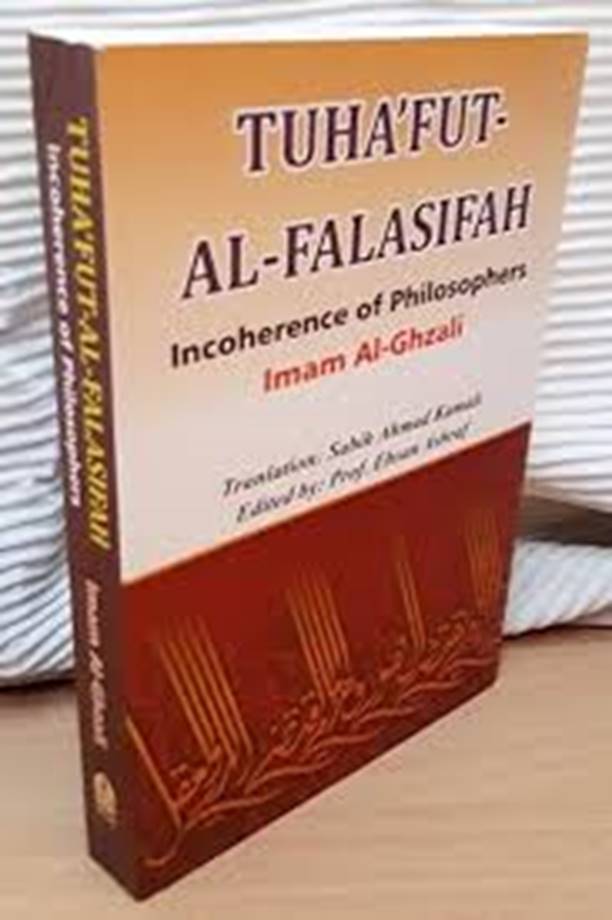
Natural science must be given back the honored place in the Islamic epistemology that it once occupied side by side with theology, philosophy, mathematics, medicine, engineering and ethics. It should not be labeled as “dunawi ta’leem” and denigrated as compared to “deeni ta’leem”. Knowledge is one, that is the essence of Tawhid. It is only our understanding that is limited Image Amazon.com
A Grand Misunderstanding that Held back a Civilization: Al-Ghazzali’s Tahaffuz al Falasafa
By Dr Nazeer Ahmed
Concord, CA
Summary: Al Ghazzali did NOT repudiate cause and effect. What he did repudiate was the mechanistic and deterministic interpretation of cause and effect. Al Gazzali’s views are consistent with the statistical theories of classical mechanics as well as modern quantum mechanics. Natural science must be given back the honored place in the Islamic epistemology that it once occupied.
In 1095 CE, al Ghazzali, in his well-known treatise Tahafud al Falasafa (Incoherence of the Philosophers) wrote: “The connection between what is habitually believed to be a cause and what is believed to be an effect is not necessary.”
It was a stressful time in history. The Islamic world was divided between the Fatimids in Cairo and the Abbasids in Baghdad. The Shia Fatimids controlled North Africa, Egypt and Palestine. The Sunni Abbasids, backed by the powerful Seljuk Turks, controlled vast regions in Central and West Asia extending from Amu Darya to Damascus. The division was not just political; it was also ideological. Fatimid doctrines challenged Sunni orthodoxy for the soul of Islam and their daees (proselytizers) were active in regions as far away as Samarqand in Central Asia and Multan, in today’s Pakistan. The Assassins, a renegade offshoot of the Fatimids, were playing havoc in Sunni domains, assassinating Sultan Malik Shah and Nizamul Mulk of the mighty Seljuks in 1092. Europe was seething with resentment against the Islamic world and Pope Urban was soon to declare the First Crusade (1095).
The fissures in the Islamic world were deep indeed. In addition to ideology and politics, the fault lines extended to philosophy. The explosive philosophical controversies let loose by the Mutazilites in Baghdad (760-846 CE) had not died out, leading in succession to the atomistic views of the Asharites (9 th-10 th centuries CE) and their refinement in the Maturdi doctrines (10 th century CE). The Mu’tazalites upheld the primacy of reason whereas the Asharites emphasized the primacy of divine intervention. The Maturdi positions were somewhere in-between.
The ideological disputes between the Fatimids and the Sunnis, and the speculative philosophical discourses of the philosophers were causing turmoil and tumult in the Islamic body politic. Intellectual and doctrinal stability was needed.
Imam Al Gazzali, perhaps the greatest champion of Sunni orthodoxy in Islamic history, waged a two-front war, one against the esoteric doctrines of the Fatimids and the second against the speculative ideas of the philosophers. His voluminous writings reflect this two-front intellectual struggle. The Tahaffuz al Falasafa was a philosophical critique of the Greek influence in Islamic philosophy.
Al Ghazzali challenged the medieval mechanistic and deterministic understanding of cause and effect which precluded the possibility of divine intervention in the outcome of events and left no room for miracles. In other words, if one were to accept the deterministic theory of cause and effect, how would you explain the staff of Moses turning into a serpent and swallowing up the false serpents of the Egyptian magicians in the Pharoah’s court? What would be the explanation for the hand of Jesus curing the Lepers?
Al Ghazzali was a Professor at the Nizamiya college in Baghdad, appointed to that position by Nisam ul Mulk the Seljuk grand visier. His works were widely distributed in the madrasas of the far-flung Seljuk empire, from Samarqand and Bokhara to Baghdad and Damascus. Some found their way to Cordoba in the Omayyad Emirate of al Andalus.
On the face of it, Al Gazzali seems to question the validity of cause and effect. Certainly, this was the way his position was understood in his times. It was the age of philosophical discourse, heavily weighted in favor of deductive (top down) reasoning rather than inductive (bottoms up) discourse based on empirical measurements.
No less a person than the eminent Spanish sage Ibn Rushd (d 1211) took up the defense of cause and effect and wrote a treatise (Tahaffuz al Tahaffuz- The Incoherence of the Incoherence) to refute Al Ghazzali’s position.
For centuries since the great debate between Al Ghazzali and Ibn Rushd, it has been axiomatic among students of Islamic history that one of the major factors for the decay of scientific endeavor in Islam was Al Ghazzali’s position on cause and effect. Western writers have largely concurred with this misunderstanding.
And a misunderstanding it was. Al Ghazzali did NOT refute cause and effect; he refuted that cause and effect were mechanistic and deterministic. It was a misunderstanding that slowed down the development of natural sciences in the Islamic world after the thirteen century.
Modern statistical theories support the position of Al Ghazzali. The outcome of an event depends on the aggregate of the statistical outcome of a large number of dependent events. It is like you shuffle a billion, billion, billion cards from a mega deck of cards. The outcome is the aggregate statistical outcome of all the cards. Similarly, in nature, zillions upon zillions of events happen at any moment. What we perceive as the end result is the gross sum or average of all the events.
The statistical outcome of an event can be more clearly understood if we consider them in the light of Quantum Mechanics. In Quantum Mechanics, the outcome of an event is inherently probabilistic rather than predetermined. Whereas in classical mechanics uncertainty is the result of missing information, in Quantum Mechanics, uncertainty is built into nature.
The Quantum theory, as well as the statistical classical mechanics theory accommodates miracles. One can safely state: We apply a force on a body, it will deform, inshallah.
Cause and effect, as in Newtonian mechanics, is the result of averaging. Newtonian physics gives a picture of the physical world that is sufficient and adequate for building a technological civilization. Correctly understood in the framework of statistical mechanics, it does not refute the premise that the classical laws of physics are averages and approximation to reality. They are based on “habit” - to use a term used by al Ghazzali.
Natural science must be given back the honored place in the Islamic epistemology that it once occupied side by side with theology, philosophy, mathematics, medicine, engineering and ethics. It should not be labeled as “dunawi ta’leem” and denigrated as compared to “deeni ta’leem”. Knowledge is one, that is the essence of Tawhid. It is only our understanding that is limited. The Islamic approach to nature gets mired in medieval philosophical disputes. Philosophy has its place and its limits. Newtonian physics is valid within its assumptions and its limits; so is Quantum Mechanics. They are both tools bestowed by the Creator upon human reason to know His creation so that the human can discharge his responsibility as the khalifa on earth and serve Him with knowledge and conviction. Ma Khalaqtul Jinna wal Ins Illa Le Yabidoon. (I created not beings of fire and beings of clay except to serve Me).
(The author is Director, World Organization for Resource Development and Education, Washington, DC; Director, American Institute of Islamic History and Culture, CA; Member, State Knowledge Commission, Bangalore; and Chairman, Delixus Group.)
