The report documents how the global financial system reinforces inequality - Physics Wallah
WIR 2026: Income and Wealth Inequality in India, Pakistan and the World
By Riaz Haq
CA
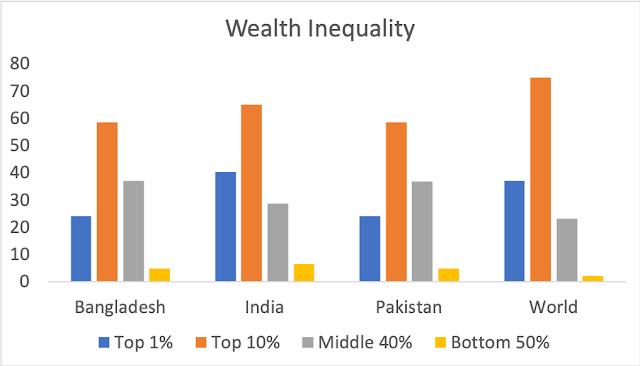
The top 1% of Indians own 40.1% of the nation's wealth, higher than the 37% global average. This makes India one of the world's most unequal countries, according to the World Inequality Report. By contrast, the top 1% own 24% of the country's wealth in Pakistan, and 23.9% in Bangladesh. Tiny groups of wealthy elites (top 1%) are using their money to buy mass media to manipulate public opinion for their own benefit. They are paying politicians for highly favorable laws and policies to further consolidate their power. It is a phenomenon known as " elite capture ".
|
Wealth Inequality - Source World Inequality Report 2026 |
"Extreme wealth inequality is persistent and increasing" in all parts of the world, says the report published by World Inequality Lab of the Paris School of Economics. This has serious economic, political and social implications. It is undermining democracies and empowering billionaires at the expense of the common
people, including the middle class (middle 40%) and the poor (bottom 50%).
|
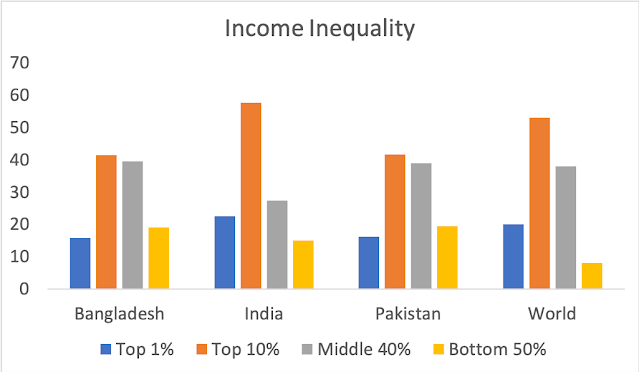
Income Inequality - Source World Inequality Report 2026 |
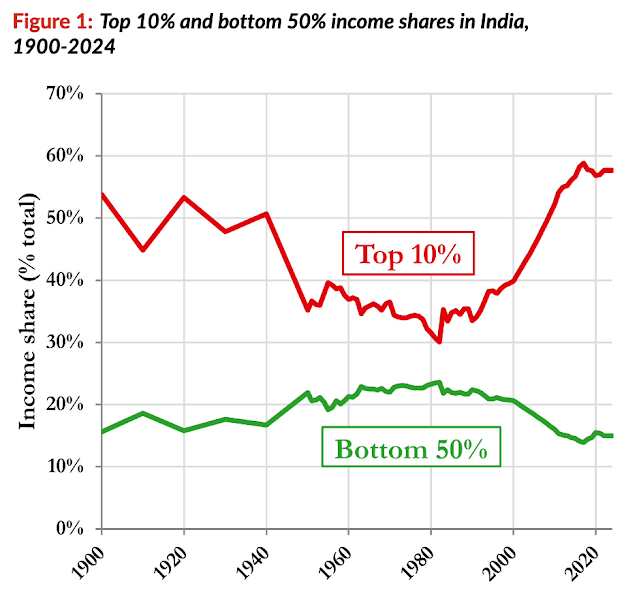
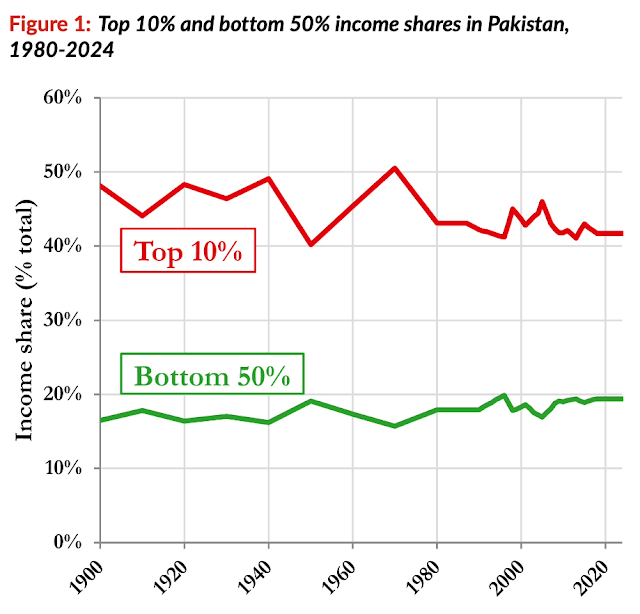
Income inequality is trending in the same way as wealth inequality. The income of the top 1% of Indians stands at 22.6% of the national income. The income of the top 1% of Pakistanis is 16.2% of the country's income, significantly lower than the 20% global average. The income and wealth distribution in Bangladesh is similar to Pakistan's.
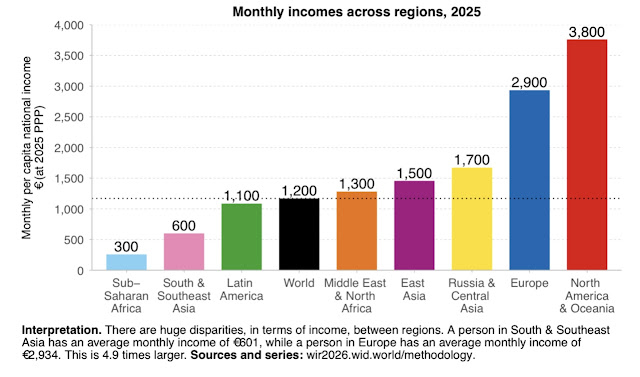
The global average monthly income is 1200 Euros but there are huge differences among various regions of the world. The South and South East Asia region remains among the poorest, but its average monthly income of 600 Euros is twice that of sub-Saharan Africa. North
America's monthly income of 3,800 Euros is the highest while sub-Saharan Africa's 300 Euros is the lowest in the world.
|
Regional Income Disparities - Source WIR2026 |
The report documents how the global financial system reinforces inequality. Wealthy economies continue to benefit from an “exorbitant privilege”: each year, around 1% of global GDP (approximately three times as much as development aid) flows from poorer to richer nations through net foreign income transfers associated with persistent excess yields and lower interest payments on rich-country liabilities. Reversing this dynamic is central to any credible strategy for global equity.
(Riaz Haq is a Silicon Valley-based Pakistani American analyst and writer. He blogs at www.riazhaq.com)