 |
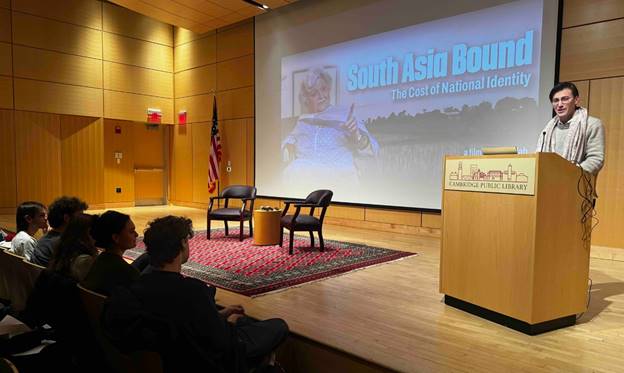
Filmmaker Zac Colah introducing his documentary 'South Asia Bound: The Cost of National Identity' at Cambridge Public Library last Monday. The documentary draws attention to several forms of internal fragmentation not only in Pakistan but also in India, underscoring a region-wide struggle between centralized authority and marginalized populations and complicating claims to a singular national identity. - Photo Beena Sarwar
Examining Identity, Division, and Postcolonial Legacy – And Building Community
By Tamanna Syed / Sapan News in collaboration with Cambridge Day
Cambridge, MA

A recently premiered documentary, South Asia Bound: The Cost of National Identity filmed in Pakistan over the summer, traces how India and Pakistan emerged from Partition into states still shaped by contested identities and uneven political power, reflecting regional patterns across South Asia.
Screened last Monday, 8 December, at the Cambridge Public Library’s main branch, the documentary examines how state narratives built on a myth of unity often overshadow the region’s vast cultural, ethnic, linguistic, and religious diversity.
The event, organised by the filmmaker Zac Colah, a senior at Tufts University, and hosted by the South Asia Peace Action Network or Sapan, with Sapan News as a media partner — brought together a diverse audience from around the Boston area.
The film revolves around four prominent South Asian scholars and cultural figures: Salima Hashmi, an artist and former dean at the National College of Arts in Lahore; Aasim Sajjad Akhtar, political economist and professor; Taimur Rahman, musician and political activist; Furrukh Khan, academic and anthropologist; and Colah himself, who appears in the film as a narrator connecting various strands of the ideas being shared.
The screening was followed by a fireside chat between Colah and journalist Beena Sarwar of Sapan, and an engaged Q&A session.
Core inquiry
Their insights frame the documentary’s core inquiry into how national identities in India and Pakistan are built through exclusionary narratives inherited from 1947.
“To define a ‘them’ is also to create an ‘us,’” Colah told Sapan News after the event. “And that process, especially when done by the state, is responsible for so
much suffering across South Asia, from Balochistan to Nagaland.”
The documentary outlines several forms of internal fragmentation. In Pakistan, ethnic groups such as the Baloch, Pashtun, and Sindhi continue to demand autonomy, language rights, and relief from state repression. The post-screening conversation also
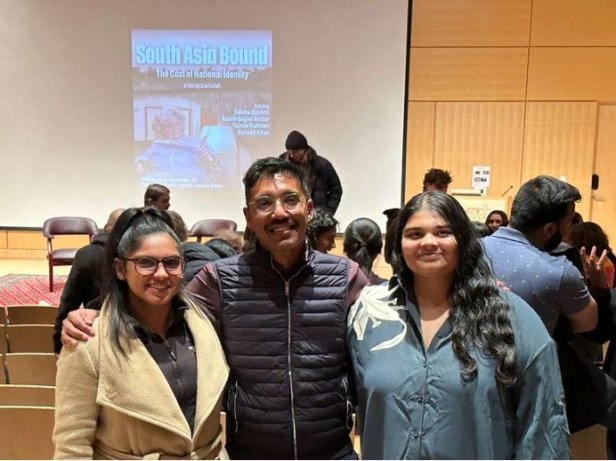
Muslims for Progressive Values Nausheen Suj, Sami Safiullah, and Tamanna Syed after the screening
highlighted structural and social challenges faced by Shia communities.
The film’s commentary also draws attention to the experiences of Kashmiri, Assamese, and Naga communities in India, whose histories complicate any claim to a singular national identity. These examples underscore a region-wide struggle between centralized authority and marginalized populations.
A major theme raised in both the film and discussion was the lasting influence of British colonial frameworks. Attendees and speakers noted how centralized administration, extractive economic systems, and entrenched caste and class hierarchies remained embedded long after independence. Audience members pointed specifically to Narendra Modi’s right-wing, Hindutva-oriented Bharatiya Janata Party as an example of how postcolonial governments can reinforce these colonial logics to consolidate power.
The film itself briefly highlights how Pakistan economically and politically disenfranchised what was then East Pakistan. Colah framed this as part of a broader regional pattern in which postcolonial governments reproduce inherited colonial tools to marginalize their own populations. Artist and educator Salima Hashmi drew a laugh with her comment in the film referring to
military hardware as “boys’ toys” while noting the gendered dynamics of war.
As an American of Bangladeshi origin, this resonated strongly with me. The post-screening discussion also brought up the enduring human toll of the Bangladesh Liberation War of 1971, particularly the widespread sexual violence against women and the fragmentation of countless families.
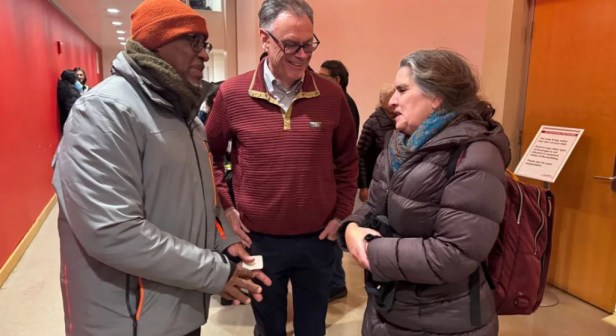
Journalists Phil Martin, James McManus and Rachel Layne after the event. Photo by Beena Sarwar / Sapan News
‘Outside-in perspective’
Audience member Sami Safiullah, a Planning Committee Member for Muslims for Progressive Values (of which I am also a member), said the film raised issues rarely addressed in mainstream regional discourse. He appreciated how the documentary highlighted Pakistan’s ethnolinguistic diversity – contrasting with what he calls a “state-sanctioned monolingual, monoreligious, Urdu-Sunni-Muslim identity.”
He hoped that continued public examination of these tensions could help dismantle neocolonial state structures across Pakistan, India, Bangladesh, and the region more broadly.
Events like this carry special significance for diaspora communities, he told Sapan News.
As Colah noted, “When we are outside of South Asia, we can unite in our collective criticisms and hopes for the region”.
Such unity is far harder to achieve within South Asia itself, where state narratives shape education, media, and public spaces, agreed Safiullah.
South Asia might have seen a European Union-like regional integration had ethno-religious discrimination not entrenched such deep political divisions, remarked Rajiv Tandon, a retired psychiatrist who recently moved to Cambridge from Michigan.
The diaspora’s “outside-in perspective” is a privilege that should not be taken lightly, added Safiullah.
Cultural complexities
Several attendees echoed similar sentiments, describing the event as a rare space for South Asians to reflect collectively on identity, heritage, and the political histories often absent from mainstream discourse.
Prominent journalists Phillip W. D. Martin, Rachel Layne, James McManus, Antara Dev Sen, and Pratik Kanjilal were among the audience.
“The entire presentation was stellar, and it raised important questions about Pakistan's role in the world and identity in the region,” Martin told Sapan News later.
Fellow MPV Planning Committee Member, Nausheen Suj, commented that watching the film “from the heart of empire” sharpened her awareness of the diaspora’s distance and privilege, and emphasized the grounding power of gathering in community. Being in a room full of people committed to imagining peace, she told Sapan News, made her feel “less alone” and more connected to a global South Asian community.
Colah emphasized that this collective space is part of the work.
“There’s something special about being in the same room and exploring an idea together,” he said, talking to Sapan News. “You could feel the power of the collective—and it spans across borders and continents.”
He added that one of the greatest threats young people in South Asia face today is “a lack of access to more critical ways of thinking about the world around us” and he hopes his films can help counter that.
A concise film with wide implications, the South Asia Bound screening sparked extensive discussion about minority rights, statelessness, colonial and neocolonial governance, and cross-border solidarities. The documentary invites viewers to reconsider how national identities have been constructed and contested, emphasizing the long reach of colonialism and the pressures of contemporary statecraft.
Colah told Sapan News he plans to expand this work by “focusing future films on the struggles faced by ethnic minorities across South Asia.”
For many attendees, the Cambridge premiere underscored the power of public dialogue and storytelling in grappling with the political and cultural complexities of the region – and beyond.
( Tamanna Syed is a Bangladeshi American poet, writer, artist, and filmmaker whose work centers on cultural identity and social justice. Her poetry collection The Falcon and the Dove is an Amazon international #1 bestseller, her documentary No Budget for Bullets has been widely recognized, and her screenplay Marigolds was a finalist at the Women Deliver International Film Festival, honoured by figures such as Malala Yousafzai and Michelle Obama.
This is a Sapan News syndicated feature published in collaboration with Cambridge Day .)