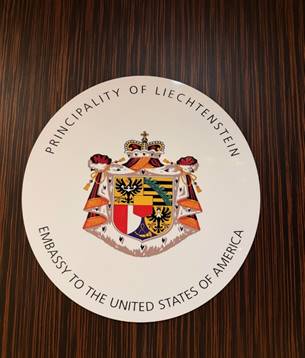

Within the residence of His Excellency Georg Sparber, the Ambassador of Liechtenstein, the International Correspondents Committee of the National Press Club gathered for "Embassy Night."Liechtenstein teaches us that greatness is not found in the number of people you rule, but in the longevity of the peace you provide them. It is a sliver of the Alps that fits inside a single district of Lahore or Karachi, yet it carries the weight of a history that never broke
The Alpine Sentinel: A Meditation on the Principality of Liechtenstein
By C. Naseer Ahmad
Washington, DC

On the evening of December 16, 2025, the air over the Potomac River held a crisp, expectant stillness. Within the residence of His Excellency Georg Sparber, the Ambassador of Liechtenstein, the International Correspondents Committee of the National Press Club gathered for "Embassy Night." Outside, the iconic landmarks of Washington, DC, stood silhouetted against the winter sky; inside, guests were transported to a world defined by a very different kind of permanence.
To the uninitiated, Liechtenstein is a whisper in the ear of Europe—a landlocked principality of roughly 160 square kilometers, cradled in the rugged Alpine embrace between Switzerland and Austria. It is a place where the Rhine flows with the secrets of centuries and the mountains stand as silent sentinels over a population of just 40,000. Yet, to measure Liechtenstein merely by its footprint is to mistake the size of a diamond for its value.
A Mirror of Scale: From the Alps to the Indus
To truly grasp the physical scale of this "micro-state," one must look through the lens of the global south. Liechtenstein’s entire sovereign territory—its forests, its factories, its castles—spans an area roughly equivalent to the urban core of Islamabad or the Rawalpindi Cantonment.
When we place this Alpine geography atop the map of Karachi, the contrast becomes a poetic study in density. The Karachi South District, the historic and bustling heart of the Pakistani megacity, is slightly smaller than the entire Principality. However, where Liechtenstein hosts 40,000 souls, a comparable slice of Karachi—such as the East District—teems with nearly 3 million.
Imagine, for a moment, the landscape of Lahore. If you were to draw a circle encompassing Gulberg, Model Town, the Cavalry Ground, and parts of the DHA, you would have captured the physical dimensions of an entire European nation. In Lahore, that space is a vibrant, crowded tapestry of millions; in Liechtenstein, it is a serene kingdom of alpine meadows and precision engineering. It is a reminder that sovereignty is not always about the vastness of the horizon, but the integrity of the borders.
The Alchemy of Longevity
While the world around it has been carved, re-carved, and scarred by the blades of history, Liechtenstein’s borders have remained unchanged since 1719. To appreciate this, one must look back three centuries to the world as it was when the House of Liechtenstein first established its principality.
In 1719, the British Empire was an emerging maritime force, its navy beginning to weave a web of influence across the oceans. In the East, the Mughal Empire was beginning its long, slow fracture. Had the stewards of the Mughal throne—or the Nawabs and Maharajahs of the subcontinent—looked toward the tiny courts of the Alps, they might have found a different blueprint for survival.
Liechtenstein’s history is a masterclass in the "intangible considerations" of diplomacy. While the great capitals of Europe—Paris, Berlin, Dresden—have all felt the scorching breath of fire and war, this tiny enclave remained intact. By weaving a garment of neutrality and forging unbreakable ties with Switzerland, Liechtenstein bypassed the calamities of two World Wars.
The Prince of Liechtenstein, currently H.E. Hans-Adam II, still holds significant constitutional power, a rare continuity in an age of shifting political sands. It makes one wonder: if the dynastic rulers of the Indian Subcontinent had stepped out from the "clouds of their courtiers" to share a cup of tea and a strategy with the Princes of Vaduz, would the sun have set so definitively on their own empires?
The Wealth of Quietude
Today, the Principality "punches far above its weight." It is one of the wealthiest nations on Earth, a global leader in precision manufacturing and dental products, and a financial center that has transitioned from historic secrecy to modern transparency.
It is a "doubly landlocked" country—a geographical rarity shared only with Uzbekistan—meaning one must cross at least two international borders to reach a coastline. This isolation has not bred insularity, but rather a fierce commitment to quality and community. From the Swiss franc in their pockets to the national football team that must often play "away" games due to the sheer lack of stadium space, the people of Liechtenstein live a life of curated excellence.
A Lesson in the Potomac Night
As the night at Ambassador Sparber’s residence concluded, the view of the Potomac served as a poignant reminder of the ebb and flow of power. The British Empire, once a colossus upon which the sun never set, now sees a sun that "barely rises" over its diminished reach. Meanwhile, the tiny Principality of Liechtenstein remains exactly what it was 300 years ago: a stable, prosperous, and sovereign testament to the power of neutrality and the wisdom of staying small but significant.
In the end, Liechtenstein teaches us that greatness is not found in the number of people you rule, but in the longevity of the peace you provide them. It is a sliver of the Alps that fits inside a single district of Lahore or Karachi, yet it carries the weight of a history that never broke.