|
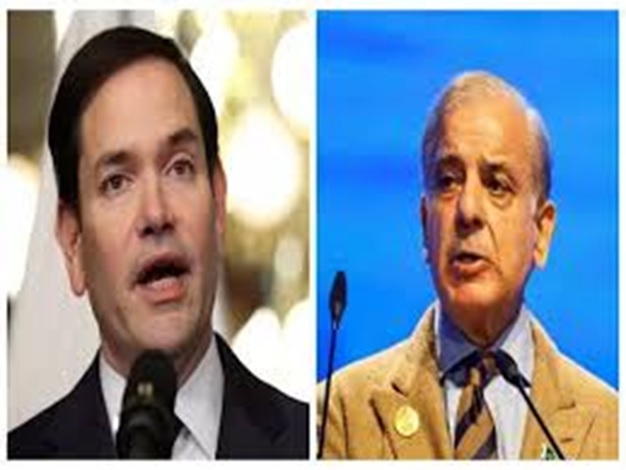
Pakistani Prime Minister Shehbaz Sharif and US Secretary of State Marco Rubio – The Economic Times |
Trump Administration Seeks Pakistan's Help for Promoting “Durable Peace between Israel and Iran”
By Riaz Haq
CA

US Secretary of State Marco Rubio called Pakistan Prime Minister Shehbaz Sharif to discuss promoting “a durable peace between Israel and Iran,” the State Department said in a statement, according to Reuters . Both leaders "agreed to continue working together to strengthen Pakistan-US relations, particularly to increase trade", said a statement released by the Pakistan government.
The call came after Iran and Israel agreed to a ceasefire to end what President Donald Trump described as a "12-day war". It is yet another indication of Pakistan's close ties with both Tehran and Washington. Pakistan strongly condemned Israel's "unprovoked attack" and the US bombing of Iran's nuclear facilities. This also shows Washington’s growing engagement with Islamabad at a time when the Trump administration is exploring a new diplomatic initiative with Tehran, possibly “as early as next week”. President Trump met Pakistan’s army chief Field Marshal Asim Munir at the White House last week when they discussed Iran, which Trump said Pakistan knew better than most other countries.
Earlier in May this year, President Trump, Vice President JD Vance and Secretary Rubio arranged India-Pakistan ceasefire after four days of fighting between the two South Asian neighbors. Testifying before the US Congress earlier this month, the US Central Command Chief General Michael Kurilla described Pakistan as a “phenomenal partner in the counterterrorism world”. His statement coincided with the Washington visit of the Indian parliamentary delegation led by Shashi Tharoor. Tharoor's delegation's aim was to "isolate Pakistan" after the Pahalgam militant attack in Kashmir which India blamed on Pakistan without presenting any evidence.
Pakistan also enjoys close ties with China and Russia. China-Pakistan friendship has meant significant diplomatic support and massive investment in infrastructure, as well as the state-of-the-art military hardware for the country's armed forces. Russia, too, has drawn closer to Pakistan. It has recently agreed to invest in a modern steel plant in Karachi where an abandoned Soviet-era steel mill stands today.
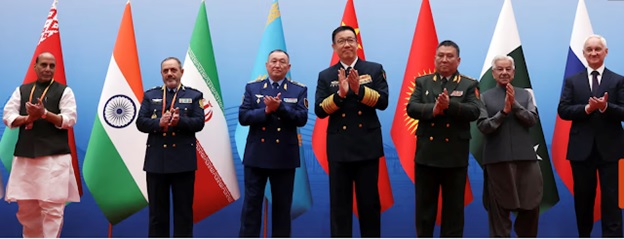
Shanghai Cooperation Organization (SCO) Defense Ministers
At a recent Shanghai Cooperation Organization (SCO) Defense Ministers meeting in China, nine member countries(China, Kazakhstan, Kyrgyzstan, Russia, Tajikistan, Uzbekistan, Pakistan, Iran and Belarus) rejected India's attempt to insert a reference to Pahalgam in the joint statement. Earlier, India distanced itself from SCO's joint condemnation of Israel’s attacks on Iran. India also abstained from voting on a UN resolution regarding the Israel-Palestine conflict, specifically related to the humanitarian situation in Gaza. This decision continues India's pattern of abstaining on resolutions criticizing Israel.
While India claims the mantle of the "Global South" leadership, its actions do not align with its ambition. On the other hand, Pakistan's policies and actions are much more aligned with those of the BRICS nations. Pakistan is not currently a member of BRICS yet, but both China and Russia have publicly expressed support for its inclusion as a full member.
(Riaz Haq is a Silicon Valley-based Pakistani-American analyst and writer. He blogs at www.riazhaq.com)