
What Does It Mean to Be American?
By Dr Akbar Ahmed
American University
Washington, DC

Since the publication of my “Journey into America: The Challenge of Islam” over a decade ago, much has changed in the United States, yet much remains the same.
The book is based on a year’s fieldwork with my team of young American scholars. Crisscrossing the length and breadth of the vast country, we focused on understanding the Muslim community in the context of American identity, visiting over seventy-five cities and one hundred mosques.
The fieldwork resulted in a book published by Brookings Institution Press and a documentary film with the same title.
Prompted by the tenth anniversary of the project in 2020 amid the devastating coronavirus epidemic, we began to assess the state of American society in the intervening years and where it would be headed in the future—particularly concerning the central focus of Journey into America, the relationship between Islam and America.
I expressed my reasons for launching the project: “For me, it was a journey of discovery. It was also my tribute to the land which had welcomed me and my family so I would like to express my warmest gratitude to Frankie Martin, great friend, scholar, colleague, and the senior researcher of the Journey into America project, who was central to the writing of this book and helped shape and form it.
It was a journey of discovery for my young team too. Of their own country. Of themselves. As we traveled, I was again struck by the beauty and grandeur of America. And the hospitality and generosity of its people. The new version of the film was shown early in 2020 at the American University in Washington, DC, and at the Church of Jesus Christ of Latter-Day Saints Temple, the grand house of worship situated by the Washington, DC beltway. Our plan was to show the film at other venues, but the arrival of the malign virus stopped us in our tracks.
While commentators were talking with anxiety about a new kind of authoritarian America emerging, accelerating after the arrival of the coronavirus, it is also clear that the love of freedom, democracy, pluralism, and strong ideas of human compassion are still valued in the land.
Examining the study anew, we were struck by its rich ethnography. There are detailed descriptions based on fieldwork of the major ethnic contours of society backed by finely drawn case studies. The core idea of Journey into America still holds the key to understanding American society and its relationship with its minorities like Muslims can best be explained by appreciating what I defined broadly as the three American identities, which have been in play since the English settlers first arrived in the New World: primordial identity, pluralist identity, and predator identity. Rarely in the social sciences do we note the geometrically neat and schematic matchup between theoretical models and actual communities on the ground and the durability and resilience of these models.
At the risk of gross simplification, one by one, in sequence, we saw the three models in play since the fateful events that followed 9/11—under George W. Bush, Barack Hussein Obama Joseph R. Biden and Donald J. Trump.
Indeed, individuals may shift from one to another over time, as we note they seemed to do. But they give us a rough and ready image and idea of a certain distinct type of American society. The presidents thus become emblematic of a particular model of American identity. This method can help us make sense of American society since 9/11.
More than a decade has passed since the publication of Journey into America: The Challenge of Islam, a work that sought to explore the relationship between Islam and American identity.
As we revisit the project in light of recent events, it is also a fitting moment to reflect on the impact the book has had—across the political spectrum and in public discourse.
A decade later, when my team and I went back to the Journey into America project, both the book and the film, we felt that it had Introduction Retrospective—Journey into America Revisited held up well. It is not an outdated and irrelevant study but one of current importance and, with its rich ethnography, a significant tool for understanding contemporary America. The time is right to return to the earlier project and apply its lessons to what is occurring in the US today.
This new work also incorporates ethnographic fieldwork conducted in the United States since the publication of Journey into America. Frankie Martin, as the senior researcher for both projects, had never lost faith in them and vigorously argued to return to the themes of Journey into America and push them forward. Strongly patriotic, he believed fellow Americans would benefit from such an exercise. “As I looked back at Journey into America,” Frankie noted.
I appreciated again the mammoth scale of the project and the contribution it has made and will continue to make. While working on Journey into America, I discovered my own country, and the project continues to embody and reflect the hopes and challenges of the US.
I am proud that more than a decade on, Journey into America is still making an impact and has much to teach us. It helps us understand who we are as Americans and where we are going. I am thrilled that the research will be preserved and expanded in the context of contemporary American society in this small book.”
Journey into America proved to be part of a more extensive journey we were on—a journey to understand the relationship between the Muslim world and the West after 9/11. The study followed one that my team and I had conducted in the Muslim world, Journey into Islam (2007). It was succeeded by the study The Thistle and the Drone (2013), about the global impact of the “war on terror,” and Journey into Europe (2018) which examined Islam in Europe and the place of Islam in European history, culture, and civilization.
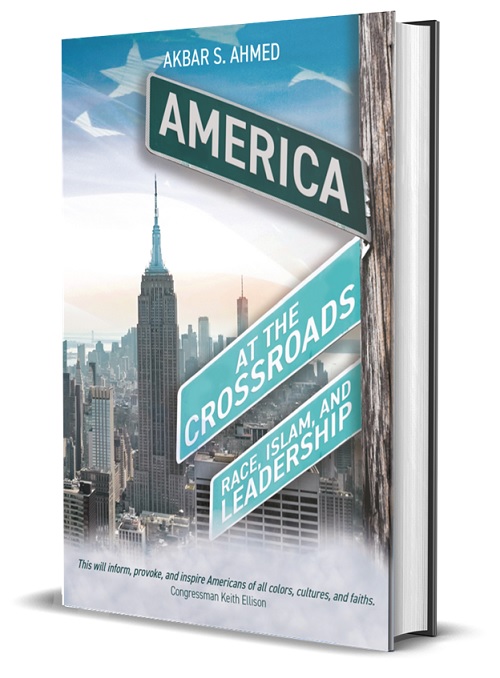
America at the Crossroads projects, all published by Brookings Institution Press, constitute a quartet of studies on the same topic from different perspectives. They are based on anthropology and ethnographic fieldwork and, taken together, provide a unique view of Western-Islamic relations that can aid us in the crucial task of promoting better understanding and relations between peoples. Our current study in preparation, The Mingling of the Oceans: How Civilizations Can Live Together, continues these themes in investigating the best ways to promote coexistence from our shared human history.
The strength and relevance of Journey into America remain not just due to the thorough examination of Muslims in America, their history, and the accompanying detailed ethnography but its exploration of American identity and how Muslims and other minorities relate to it. Indeed, heated disputes and debates over identity divide society.
Issues of race, ethnicity, and religion remain at the heart of the polarized state that America finds itself in today. Indeed, the killing of George Floyd by Minneapolis police in May 2020, yet another in a sequence of unarmed African Americans killed by often white police officers, proved to be a flashpoint in a racial reckoning that marked the mainstream ascendency of the Black Lives Matter movement. The movement and the widespread protests that followed shook the nation to its core, leading to counterreactions and debates over such matters as “Diversity, Equity, and Inclusion” (DEI) programs and “critical race theory.” Additionally, developments such as the coronavirus pandemic with its politicization of vaccines, masking, and social distancing, the contentious debates over immigration, and the Hamas October 7 attacks in Israel and Israel’s retaliatory devastation of Gaza have all profoundly influenced American society and their effects will continue to reverberate.
The main question we had set out to explore when we started fieldwork, “What does it mean to be American?” which lay at the heart of the ethnography in our study, remains as pertinent as when we first approached the subject. This book, America at the Crossroads, thus serves as a companion to Journey into America. Our ethnography, in the meantime, has not aged but remains a valuable source of information about American society, culture, and history. It also helps us understand the US today: there is cause and effect at work here, and it sets the stage for the coming time.
(Dr Akbar Ahmed is a known authority on contemporary Islamic cultures and history, He is currently Distinguished Professor and Ibn Khaldun Chair of Islamic Studies at the School of International Service, American University. Dr Ahmed has authored several books including Journey into America and Journey into Europe. Dr Ahmed is also a Wilson Center Global Fellow.)
