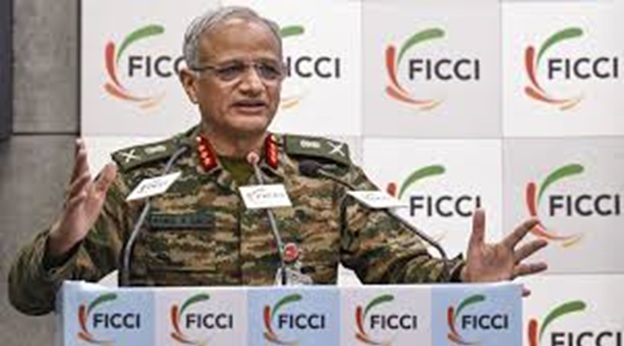
Deputy chief of army staff Lieutenant General Rahul R. Singh speaks during a conference-cum-exhibition in Delhi on July 4, 2025 - Photo PTI
Indian Military Begins Accepting Its Losses in "Operation Sindoor"
By Riaz Haq
CA

The Indian military leadership is finally beginning to accept its losses in its unprovoked attack on Pakistan that it called "Operation Sindoor". It began with the May 31 Bloomberg interview of the Indian Chief of Defense Staff General Anil Chauhan in Singapore where he admitted losing Indian fighter aircraft to Pakistan in an aerial battle on May 7, 2025. General Chauhan revealed that the Indian Air Force was grounded for two days after this loss.
General Chauhan was followed by Navy Captain Shiv Kumar, the Indian Defense Attache in Jakarta, Indonesia, who explained last month that the Indian Air Force losses occurred due to "constraint by (the Indian) political leadership" imposed on the Indian Air Force. He said the Indian forces had been directed not to target Pakistan’s military infrastructure or air defenses. “Only because of the constraint given by the political leadership to not attack the military establishment or their air defenses,” he explained why the IAF suffered the loss of fighter jets.
Yesterday, Lieutenant General Rahul Singh, India's Deputy Chief of the Army, blamed the losses on Chinese help for Pakistan. He said India faced three enemies: Pakistan, China and Turkey based on the equipment used by Pakistan in the latest round. By this logic, Pakistan faced four or more enemies: India and its arms suppliers France, Israel and Russia whose equipment was used by the Indian military in Operation Sindoor against Pakistan.
General Singh said the Pakistanis were closely watching the Indian military's moves in real time. “When the DGMO-level talks were going on, Pakistan actually was mentioning that ‘we know that your such and such important vector is primed and ready for action. I would request you to perhaps pull it back’. So, he was getting live inputs … from China,” he claimed.
Using a homegrown datalink ( Link-17 ) communication system, Pakistan has integrated its ground radars and satellite links with a variety of fighter jets and airborne early warning aircraft (Swedish Erieye AWACS) to achieve high level of situational awareness in the battlefield, according to experts familiar with the technology developed and deployed by the Pakistan Air Force. Such integration allows quick execution of a " kill chain " to target and destroy enemy assets, according to experts. This capability was demonstrated recently in the India-Pakistan aerial battle of May 7-8 that resulted in the downing of several Indian fighter jets, including the French-made Rafale.
In an earlier statement, Indian Foreign Minister Subrahmanyam Jaishankar told Newsweek: “I was in the room when the US vice president spoke to Prime Minister Modi on the night of May 9, warning that the Pakistanis would launch a very massive assault on India if we did not accept certain things". “That night, Pakistan did launch a large-scale attack,” Jaishankar said. India sought and accepted the ceasefire immediately after the "large-scale attack" launched by Pakistan.
These statements by the Indian military brass lead to only one conclusion: Not only is there an implicit admission of India's failed "Operation Sindoor", but also a litany of lame excuses for the losses incurred by the Indian military. The fact is that the Indian leadership clearly underestimated Pakistan's capacity for a strong military and diplomatic response to the Indian provocation labeled "Operation Sindoor". New Delhi was caught unprepared for it.
(Riaz Haq is a Silicon Valley-based Pakistani-American analyst and writer. He blogs at www.riazhaq.com)