The Quiet Lesson of Service
By C. Naseer Ahmad
Washington, DC
Each evening of my childhood, my father would ask me the same question: “What did you do for humanity today?” It was never about grades, accolades, or the usual milestones that so often define success. For him, the true measure of a day lay not in achievements, but in whether it had made someone else’s life, however slightly, better. Only now, looking back, do I fully grasp the quiet weight of that question and the lesson it carried.
Service, in its many forms, has long been the thread running through my family’s story. My father-in-law Dr Zia-ud-Din, a physician by training and a servant at heart, spent most of his career in Nigeria, Africa, caring for the sick in communities far from his own. He died not in comfort, but in the modest quarters above the hospital he had built in Kano, Nigeria—a building that still stands as a living testament to a life given wholly to others. His two sons later followed in his footsteps, taking leave from their own medical practices in US to treat patients in underserved corners of the world.
Yet not all service is so dramatic. Its essence is universal, found in acts both great and small. Volunteering—humble though it may appear—is among the most profound ways we express gratitude for the communities we belong to. It is not a duty, but a connection, a quiet response to something larger than ourselves. I am continually inspired by those who not only hear that call, but also pause their own lives, however briefly, to answer it.
Community gatherings, especially, are fertile ground for this spirit to flourish. While many tasks could easily be outsourced, leaders often reserve certain roles for community members—not merely for practical reasons, though cost savings matter, but for philosophical ones. When a community serves itself, bonds of belonging deepen, transforming an event into a shared act of stewardship.
I felt the truth of this two summers ago, at my community’s annual gathering in Harrisburg, Pennsylvania. Standing in line for lunch, I noticed Dr Nadeem Khan, one of the region’s most respected gastroenterologists, ladle in hand, serving meals with quiet cheer. Moving down the line, I recognized more familiar faces from our Northern Virginia Chapter, each offering plates of food with warmth and humility. The food nourished, but it was the gesture that lingered, whispering a reminder I could not ignore: “It is more blessed to give than to receive.”
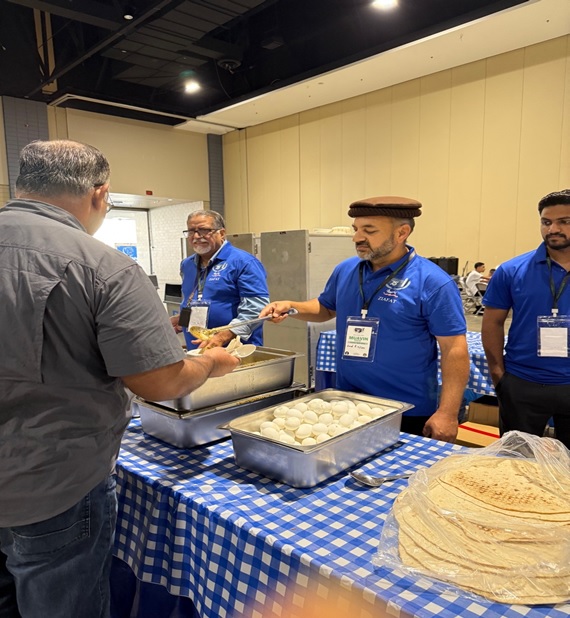
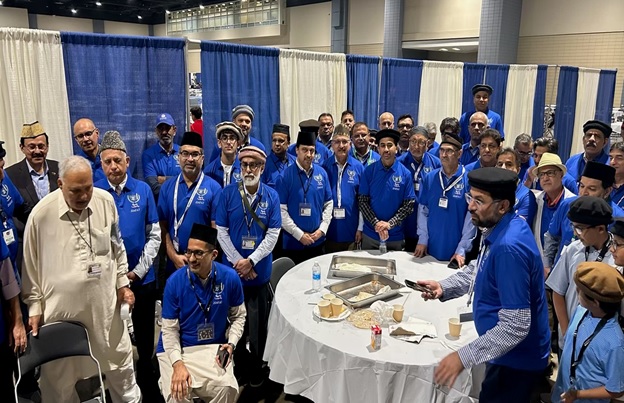
This year, I resolved to stand on the other side of the table. On July 5, 2025, at the Greater Richmond Convention Center—host to our 75th Annual Convention—I reported for duty in a dining hall stretching nearly half a city block. Nearly ten thousand people had gathered for the weekend, united in a spirit of fellowship. The irony was not lost on me: this act of communal unity unfolding in Richmond, once the capital of the Confederacy, a city historically marked by division. And yet, throughout the holiday weekend, there were no arguments, no unrest—only shared purpose.
As we prepared to serve, our team leader, Asif Mahmood, spoke into a loudspeaker: “Some people may be impatient. Some may speak harshly. Do not reply. Today, your only task is to serve.” His words transformed the moment, turning a simple chore into an exercise in humility.
Stationed at Table 8, the first point of contact for the endless line of attendees, I was assigned to serve rice, followed by meat, potatoes, and pasta from my teammates. Our station leader, Haroon Shukoor, offered one last instruction: “One portion at a time. Hold the second unless it’s truly requested—not to deny, but to keep the line moving.”
Looking up at the line—stretching almost the length of the hall—I felt a flicker of doubt. But with each scoop, Asif’s words echoed in my mind. The feared impatience never came. A few asked for second helpings, some even third or fourth, but by following Haroon Shukoor’s guidance, we kept the line flowing until the final plate was filled. What had seemed a daunting task became unexpectedly simple—and deeply fulfilling. More than words of thanks, it was the unspoken gratitude in people’s eyes that made serving feel less like a duty and more like a privilege.
In those hours, I realized my father’s question had finally found its answer—not as an abstract ideal, but as a lived truth. With each meal I handed across the table, meeting each person’s gaze, I understood what he had always known: in serving others, we do not merely give—we receive something greater. In the most ordinary acts, we rediscover the extraordinary ties that bind us together as human beings.