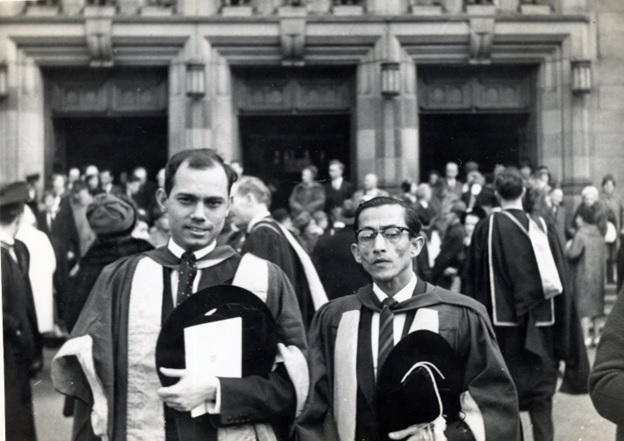
Syed Amir and Ayub Bukhari (right) receiving their doctoral degrees, 1963
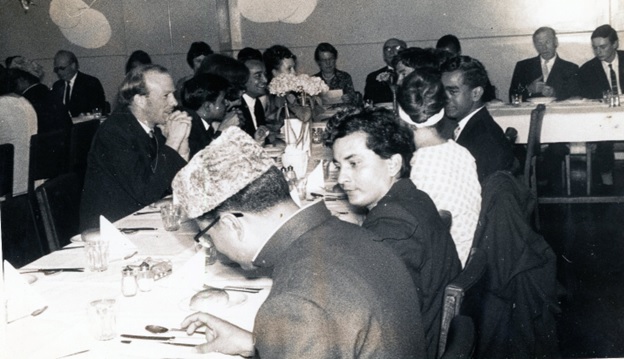
The annual Pakistan students dinner, 1962
Life at an English University Six Decades Ago
By Dr Syed Amir
Bethesda, MD

The year was 1958, and I had recently joined the Pakistan Council of Scientific and Industrial Research (PCSIR), Karachi, as a junior scientist, having arrived from India after completing my MSc at Aligarh Muslim University. Soon thereafter, General Ayub Khan abolished the constitution and promulgated martial law. However, remarkably, life in Pakistan remained peaceful, with no visible signs of martial law; there were no soldiers or tanks on the streets.
The PCSIR was, at the time, located in barracks behind the Navy Hospital, where, despite the limited facilities, some important research was being carried out. The main impetus was the founding director, Dr Salimuzzaman Siddiqui. He was a renowned scientist who had migrated from India to create a scientific infrastructure in Pakistan. His mornings were spent on administrative tasks, and afternoons were dedicated to working in the laboratory. Coming from an aristocratic family of Lucknow, Dr Siddiqui studied Urdu literature and poetry at Mohammedan Anglo Oriental College (MAO), Aligarh, but later switched to medicine and science when he went to study in Germany. Thus, besides being an acclaimed scientist, he was a well-recognized poet, musician, and artist. With his long grey hair and modest, intense demeanor, he evoked the memories of philosophers from the Middle Ages.
In those pioneering days, Pakistan had a shortage of highly trained scientists. The government offered grants and scholarships to young investigators to attend a foreign university and pursue higher education, with the expectation that they would return and serve Pakistan. Additionally, foreign governments offered scholarships, including those under the Colombo and the Commonwealth Scholarship and Fellowship Plans. I was fortunate to secure a grant in 1960 to pursue a PhD at the University of Birmingham in England.
One of my senior colleagues from PCSIR, Dr Ayub Bukhari (now deceased), was also ready to travel to England with me on a similar scholarship. We often went together to complete the paperwork. The public transport system in Karachi was a nightmare. The fact that he owned a motorcycle made it very convenient to move around. In the early sixties, travel to Europe or America was not as commonplace as it is today. Furthermore, at the time, English society observed great discipline and formality in daily life, a legacy of the imperial colonial past. The British Council had a well-stocked library in Karachi at that time, along with an officer dedicated to assisting students planning to study in the United Kingdom. They offered some helpful advice to us on the English weather, dining, and etiquette.
Coincidentally, the day we left for England was the first day of PIA’s inaugural flight of its Boeing jet service to Europe. It is hard to believe, but PIA was regarded as one of the world's best airlines. The flight to London took nearly twenty hours, with stopovers in Tehran, Beirut, and Geneva.
As we emerged from the Heathrow Airport, it seemed like a strange, unfamiliar world. The city was shrouded in mysterious early October fog. We had no idea where we would go from the airport and were desperately looking for the British Council representative to find an inexpensive place. It was late, and finding a hotel room in London proved challenging. He made numerous attempts before finding a bed and breakfast place that would accept us. We were concerned that he would charge a lot of money for all of his services, and we had no money. We were relieved when, after setting us up, he shook hands, said goodnight, and left. In Pakistan, this kind of free service would be unimaginable,
At the University of Birmingham, I soon became accustomed to the new environment. In those days, there was only one university in the town, and it had limited seats, with admission highly competitive. Once admitted, however, all expenses were covered by the government. The public held the University students in high regard, thus it was much easier for us to find lodgings, as the landladies took pride in having a student lodger.
During my stay at the University of Birmingham, it had been less than fifteen years since the British Raj had ended, and many Englishmen who had served in the military or civil service in India were living retired lives. We encountered them in buses, railway platforms, and other public places. Occasionally, they would startle us by letting us know that they understood what we were talking about. University life mirrored English society. It would have been very unusual to see any students or faculty members without ties and proper attire. Women students rarely wore trousers. Of course, it is very different in today’s England, and blue jeans, as in the US, are the most popular clothes for both men and women.
Birmingham is the second-largest city in the UK after London, but in those days, it had the look of a provincial town. The downtown area went dead after 5 pm, and shops closed in the early afternoon on Saturdays. Sundays were desolate, since life came to a standstill. As students, our social life was centered on the students' union that had its own lounge, coffee house, and dining facilities. The University Chaplain extended to us the facility to hold our Juma prayers in the small chapel.
The Pakistan Students Association was active, and students from East Pakistan participated in its activities. I recall that Ms Razia Khan, daughter of the renowned East Pakistani Speaker of the National Assembly, Moulvi Tameez Uddin Khan, was once the president of Pakistan Society. The annual Pakistan Day dinner was a celebrated event. Once we had the Pakistani High Commissioner, Agha Hilaly, as the chief guest. Another time, Sir Zafar Ullah Khan from the Hague was invited as the chief guest.
The 1960s were the high noon of Ayub's presidency. We all looked forward to his annual appearance on Panorama, the BBC’s acclaimed weekly program, when he came to attend the Commonwealth Prime Ministers' Meeting in London. Shared cultural heritage is a strong bond, and students drawn from India and Pakistan interacted seamlessly. Similarly, those from Bangladesh and West Bengal socialized frequently. Their common language transcended all other differences. Winter is usually a bleak time in England. Days are short, and the weather is unbearably cold. Most English students went home at Christmas time. The foreign students had nowhere to go. Staying warm was a challenge. We had old-fashioned electric heaters in our rooms, which required coins to operate.
To save money, we would spend a lot of time at the university, which did have central heating. The problem was especially acute during Christmas time, as the university and its dining facilities were all closed for a week. Some of us, however, found an escape route. The Pakistan High Commission in London maintained a student hostel which was heated and had a cafeteria offering Pakistani cuisine. Notably, the charges were low and affordable. A kind old English lady managed it. The management was chaotic. Occasionally arguments broke out when some students showed up without prior reservations and insisted on being accommodated. Occasionally, we could find a few students sleeping on the floor in the corridors.
My old friend from my days at Aligarh University, Khurshid Alam Khan, and I spent several Christmases at the hostel. Despite its rudimentary facilities, it was a pleasure to be in centrally heated accommodation. At different times, we met many interesting people staying there, as Pakistani students from England and around the world were drawn to it. Once we even saw Sir Zaffar Ullah Khan lounging alone on a couch in the basement of the hostel.
Christmas Day itself presented special problems in London. The hostel cafeteria was closed, and London looked like a ghost town. It was a struggle to find a place to eat, and I recall both Khurshid and I once wandering around Piccadilly Circus in search of food. Only an odd wimpy bar would be open, and that was a lifesaver.
London and, by extension, England, have undergone extensive changes since my days, both culturally and demographically. The student hostel, which held so many cherished memories, no longer exists. Few today can guess what life in England was like in the sixties.