|
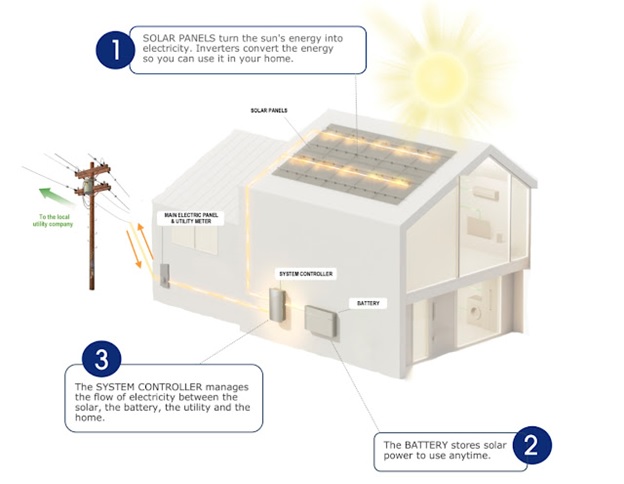
Home with rooftop solar panels and battery storage |
Clean Energy Revolution: Soaring Solar Energy Battery Storage in Pakistan
By Riaz Haq
CA

Pakistan imported an estimated 1.25 gigawatt-hours (GWh) of lithium-ion battery packs in 2024 and another 400 megawatt-hours (MWh) in the first two months of 2025, according to a research report by the Institute of Energy Economics and Financial Analysis (IEEFA).
increased production efficiency. Lithium iron phosphate (LFP) batteries have become the most affordable packs, with prices at $75 per kilowatt-hour as of last year, according to Statista .
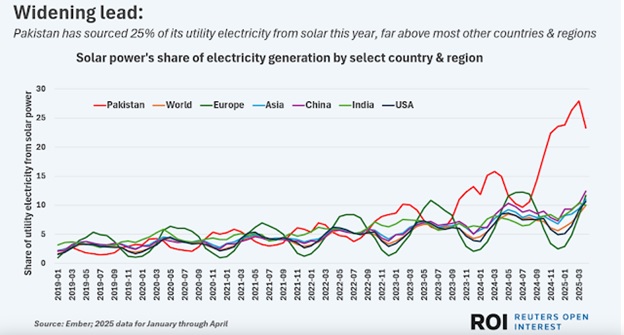
Pakistan leads in solar generation mix – Source Reuters |
Pakistan is investing in battery storage projects to improve grid stability, integrate renewable energy sources, and reduce reliance on traditional power sources. These projects are being developed by both public and private entities, with significant funding from international organizations like the Asian Development Bank (ADB).
|
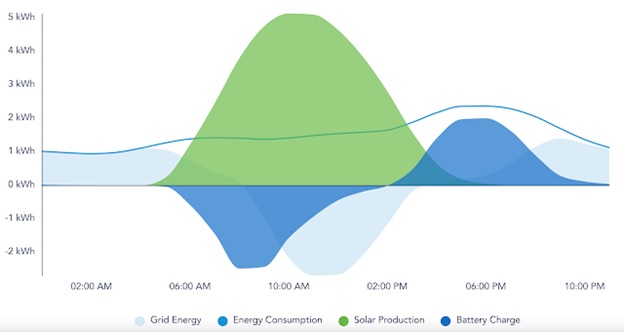
Daily charge-discharge cycle for a home with solar panels and battery storage |
While negatively impacting demand for grid electricity in the short-term, the increasing use of battery storage solutions by rooftop solar consumers will likely improve grid stability, integrate renewable energy sources, and reduce reliance on fossil fuels. Here's how the IEEFA report explains it:
"The grid should adapt to changing consumer dynamics and increasing adoption of alternative energy sources. BESS (Battery Energy Storage Solutions) has inherent peak shaving abilities, which could work to the grid’s advantage and result in cost savings by reducing centralized generation. As more distributed solar systems operate, the grid is already experiencing peak-demand shifting. Consumers with solar PV installations defect from the grid during the day but reappear during the night, leading to declining minimum demand during the day but a rising peak demand during the evening (known as the duck curve). Daytime demand is expected to decrease even further if rapid solarization continues, which may jeopardize system stability. Instances of extremely low demand, such as during holidays, may cause utilities to trip, leading to the risk of grid failure. Conversely, the surge in evening peak requires a quick rampup of fossil fuel-based power generation".
Battery packs are the most expensive components of electric vehicles today. Lower battery pack prices will make electric vehicles more affordable, leading to wider adoption and lower transport emissions. As a signatory to the Paris Agreement, Pakistan is pushing to grow electric vehicle adoption. The country’s New Energy Vehicle (NEV) policy for 2025–2030 targets 30% of all new vehicles to be electric by 2030, rising to 90% by 2040.
Pakistan has contributed only 0.28% of the CO2 emissions but it is among the biggest victims of climate change. The US, Europe, India, China and Japan, the world's biggest polluters, must accept responsibility for the catastrophic floods in Pakistan and climate disasters elsewhere. A direct link of the disaster in Pakistan to climate change has been confirmed by a team of 26 scientists affiliated with World Weather Attribution, a research initiative that specializes in rapid studies of extreme events, according to the New York Times .
(Riaz Haq is a Silicon Valley-based Pakistani-American analyst and writer. He blogs at www.riazhaq.com)