
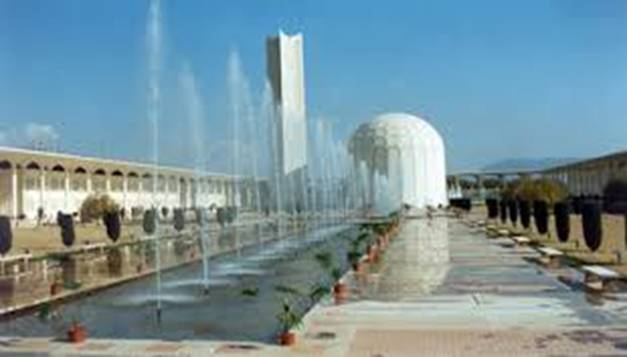
Pakistan Institute of Nuclear Science and Technology (PINSTECH), Nilore, Pakistan
Reconstruction of a Technological Culture in Islam -3
By Prof Dr Nazeer Ahmed
Concord, CA
Ibn Rushd and his defense of the philosophers
Al Ghazzali’s position did not go unchallenged. The Spanish jurist and philosopher Ibn Rushd (d 1198) rose to the defense of the philosophers.
Ibn Rushd was born into a prominent family of jurists in Cordoba, Spain in 1126. His grandfather was an influential scholar at the Almoravid courts. Ibn Rushd received his early education in Cordoba and Seville and mastered the fields of jurisprudence, philosophy, theology, mathematics and astronomy. The Almohads (1147-1214) seized North Africa and Andalus (southern Spain) from the Almoravids and established their own Caliphate. Ibn Rushd found favor with the Almohad courts and worked for them in various capacities in Marrakesh, Seville and Cordoba. In 1171 he was appointed the chief Kazi of Cordoba, the most prestigious judiciary position in the kingdom. Encouraged by the second Almohad Caliph Abu Yaqub Yusuf (1163-84), Ibn Rushd wrote his celebrated commentaries on Aristotle, which had a profound impact on the development of philosophy and science in Europe.
We would like to point out here that Ibn Rushd was a contemporary of the well-known physician-philosopher Ibn Tufayl (1105-1185) and the Sufi master (honorably referred to as Shaikh al Akbar – the great shaikh), Ibn al Arabi (1165-1240). Ibn Rushd had a collegial relationship with Ibn Tufayl and worked with him while there are only anecdotal descriptions of his meetings with Ibn al Arabi.
Ibn Rushd wrote more than 100 books covering theology, jurisprudence, philosophy and mathematics. However, it is for his book, Tahaffuz al Tahaffuz, a critique of Al Ghazzali’s Tahaffuz al Falasafa that Ibn Rushd is best known in the Islamic world. His defense of the philosophers was forceful and comprehensive. We will focus here only on two issues from his Tahaffuz al Tahaffuz that are relevant to modern science, namely, his views on the nature of time and cause and effect.
Al Ghazzali questioned the necessity of cause and effect in nature. He held that only God was the efficient cause and that events happened one after the other according to their taqdeer (Divine decree). This was the Ash’arite position based on a discontinuous, atomistic view of time. This assumption about time was introduced by al Ash’ari to explain the possibility of miracles, namely, phenomenon that do not follow the accepted norms of cause and effect. Al Ghazzali wrote: “On the negation (of natural causality) depends the possibility of affirming the existence of miracles which interrupt the usual course of nature . . . and those who consider the ordinary course of nature a logical necessity regard all this as impossible.”
Ibn Rushd took issues with this position as contrary to reason. He wrote: ““……. Intelligence is nothing but the perception of things with their causes, and in this it distinguishes itself from all the other faculties of apprehension, and he who denies causes must deny the intellect. Logic implies the existence of causes and effects, and knowledge of these effects can only be rendered perfect through knowledge of their causes. Denial of cause implies the denial of knowledge, and denial of knowledge implies that nothing in this world can be really known, and that what is supposed to be known is nothing but opinion, that neither proof nor definition exist, and that the essential attributes which compose definitions are void. The man who denies the necessity of any item of knowledge must admit that even this, his own affirmation, is not necessary knowledge.”
Ibn Rushd was sensitive to the criticism of the theologians and took pains to explain that the philosophers were staunch believers: “The learned among the philosophers do not permit discussion or disputation about the principles of religion, and he who does such a thing, according to them, needs a severe lesson … Of religious principles it must be said that they are divine things which surpass human understanding, but must be acknowledged although their causes are unknown.”. On creation, he wrote: “Creation is an act of God. He created the world providentially, not by chance. The world is well ordered and is in a state of the most perfect regularity, which proves the existence of a wise Creator. Causality is presupposed.”
Both Al Ghazzali the theologian, and Ibn Rushd the Jurist-Philosopher, supported their positions with quotes from the Qur’an. To al Ghazzali, the omnipotence of God was paramount. Like al Ash’ari, he postulated a discrete time so that he could conceptually accommodate the intervention of divine will in every action. However, in the process he relegated the truth of observation to “habit” and went on to propose, without evidence, his own theory of cause and effect as events that happened “side by side”.
To Ibn Rushd, time was continuous and eternal. To the theologian’s objection that this would make time co-extent with God, Ibn Rushd would reposit that the infinity of time collapses before the infinity of God, thereby preserving the sanctity of God’s primal creation of nature including time itself. To Ibn Rushd, cause and effect were confirmed by observation. Without a causal relationship, reason itself made no sense, and the world would become unintelligible.
Ibn Sina, Necessary Agent and Contingent Agent
Ibn Sina (d 1037), one of the most distinguished scientists in the Islamic golden age, understood the futility of deciphering time and described physical phenomenon in terms of change rather than time. In his cosmology, time becomes a tool for measurement of change, much as it does in the cosmology of modern science. Regarding the issue of cause and effect, Ibn Sina differentiated between a “necessary” agent of change and a “contingent” agent of change. God was the “necessary” agent of change. It was He who is primal origin of all causes. The contingent agents are intermediate or apparent agents. For instance, if a house is destroyed in an earthquake, the earthquake is the “contingent” agent, God is the “necessary” agent. Ibn Sina was thus able to retain the causality in nature while safeguarding the tenet that God is the ultimate cause of all causes.
TheMaturidi (d 944) Compromise
Shaikh al Maturidi, in his book Kitab al Tauhid, advanced a position that was a compromise between the Ash’ari and Mu’tazila positions. The Mutazilites had maintained that man had both a free will (Iqtiar) and freedom to choose (iktisab). It was their view that cause and effect were deterministic and necessarily followed one from the other. Shaikh al Ash’ari had taken the opposite view. Postulating that time was discrete, he maintained that only God had the free will and freedom to choose and that events happened at every moment in accordance with His predetermined will, either through angels or through direct intervention.
Shaikh al Maturidi took issues with both the Asharites and the Mu’tazalites. He maintained that a merciful God, in His wisdom and justice, created alternate outcomes for every event. He provided guidance through His revealed books and His messengers as to which of the alternate outcomes were “good” and which were “evil”. The human was endowed with reason (aql) to discern and choose between the alternative courses of action created by God and presented to man. Thus, al Maturdi accepted the free will and choice of the human while maintaining that the creator of those choices and of alternate courses of action was God. In al Maturdi’s cosmology both the free will and choice of the human and the omniscience and omnipotence were preserved.
Similarly, in a natural phenomenon, each event has an infinite number of outcomes, each of which is prescribed by the Will of God. That an event repeats and is predictable is the Sunnah of Allah. As the Qur’an states: “Allah creates and repeats His creation”. This repetition and the predictable patterns they create make it possible to capture natural phenomenon through equations, algorithms, mathematical representations and geometry and build the tree of scientific and technological knowledge.
Al Maturidi’s position is remarkably similar to some of the modern views of space-time. In this view, there is no one single pre-determined future but an infinite number of possible “futures”. The choice of any one course of action in space-time determines “the future” that we experience. The arrow of time is not just “forward” and “backward” as most philosophers argue, but it vectors in infinite number of directions, all of them within the “mansha” or conception of God. This cosmology opens up the possibility of an infinite number of possible futures depending on a choice that one makes at a given moment. Each further choice, in turn, takes us in a different direction. The creator of all choices is God; The human is the medium that exercises his choice using his limited free will. His omnipotence is thus preserved. The possibilities are illustrated in the diagram above.
In the diagram, action A leads to choices B,C,D,E,F,G all of which are within the “mansha” (will, plan, conception) of God. You choose outcome F. That is your “fate”. The choice of action F leads to further possibilities of which you choose action J. Once again, that is your “fate”. Then onto K,L,M,N,O,P and so on. Thus, “a human is the architect of his own fortune” but this fortune is within the mansha of God. A profound insight indeed that preserves the omnipotence of God and the choice of the human.
Al Maturidi’s compromise cosmology was popular in the eastern Islamic world. The Sunni, Hanafi Ottomans and the great Moguls of India adopted it as court dogma. In the recent past, Allama Iqbal (d 1938) used it in his articulation of human free will.
The Maturidi school was overshadowed by the more fatalistic Ash’ari cosmology in the eighteenth and nineteenth centuries as the Ottoman and Mughal empires vaned and Europe increasingly dominated the world putting the Muslims on the defensive.
A Sufi perspective on time
In the spiritual Sufi perspectives, supported by the Qur’an, there are layers of reality separating human perception from the Ultimate Reality. In this perspective, the assumed “eternity” of time in philosophy is only figurative in as much as physical time collapses to nothingness before the eternity of God.
I asked a venerated Sufi Shaikh from Turkey to throw some light on this question. He said: “I heard from my Shaikh that time is like a fish in an ocean”. The Shaikh made a sinewy motion with his right hand to show the movement of a fish.
Time is like the fish that was lost by the companion of Moses at the junction of the two seas. Al Ghazzali, the theologian, stood at the shores of the sea and saw time as an atom. Ibn Rushd, the jurist and philosopher, rode on the back of the fish and saw time as movement in an endless ocean. The perspectives were different.
In the cosmology of Shihabuddin Suhrawardy (d 1191), there are heavenly domains that separate the human from the earthly domains. There are four identified heavenly domians: Ahad, Wahed, Wahdaniyet, Arwah. These domains are independent of space-time (la-makan in the Urdu language). The created world (alam e khalq) is separated from the heavenly domains and is the domain of apparent space-time. In this world, reason, logic, mathematics, language, cause and effect apply. The interface between the created world and the heavenly realms defines the limit of human reason. Continued next week.
(The author is Director, World Organization for Resource Development and Education, Washington, DC; Director, American Institute of Islamic History and Culture, CA; Member, State Knowledge Commission, Bangalore; and Chairman, Delixus Group)
