
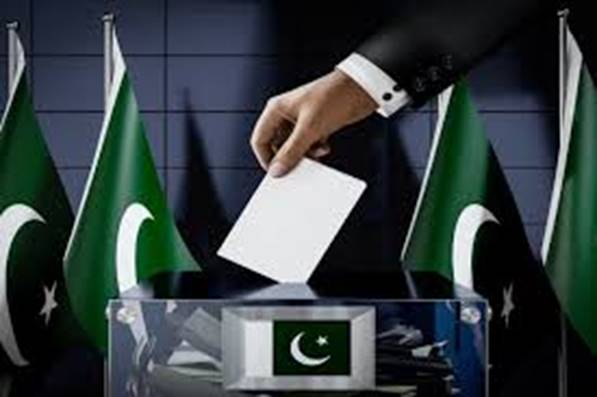
Across the oceans, many in Pakistan watched this victory with admiration. Television channels ran stories on the “first Muslim mayor of New York,” and social media overflowed with pride. Yet beyond the celebration lies a question worth pondering: could someone like Zohran Mamdani, liberal, outspoken, and belonging to a minority faith, win a similar election in Pakistan? Could a non-Muslim Pakistani ever hope to become the country’s Prime Minister or President? – Photo Daily The Spokesman
The Power of the Vote
By John Bosco
London, UK

There are rare moments when Indians and Pakistanis, divided by borders and politics, experience a shared sense of celebration and emotional unity. Usually, they cheer for rival teams on the cricket field, one celebrating while the other mourns. But when both communities rejoice together, it signifies something deeper. That moment arrived with the election of Zohran Kwame Mamdani as Mayor of New York City: a victory celebrated not only by people of his faith but by South Asians of every background. For many Pakistanis, it was a proud moment; for many Indians, it felt personal, as Mamdani’s father hails from Gujarat, India.
Born in Kampala, Uganda, in 1991, Mamdani moved to New York as a child. He attended the Bronx High School of Science and later studied Africana Studies at Bowdoin College. Before running for mayor, he served in the New York State Assembly, earning a reputation as a grassroots organizer and advocate for economic justice. His background (African-born, South Asian by heritage, and New Yorker by spirit) made him a symbol of a global, inclusive generation.
Mamdani’s story mirrors that of countless immigrants who came to America seeking opportunity. Like Barack Obama’s Kenyan roots or Sadiq Khan’s Pakistani background, his identity resonated with diverse communities. For Black voters, his African origins struck a chord. For South Asians, he represented belonging in spaces once thought unreachable.
Yet his rise was not built on identity politics alone. Mamdani ran an unapologetically progressive campaign centered on “Bread, Cloth, and House,” a universal promise of dignity. His platform pledged affordable housing, fare-free public transport, childcare for all families, and a thirty-dollar minimum wage by 2030. He called for city-owned grocery stores to reduce food costs and proposed a plan to make New York greener through clean energy and improved public transport. His message was simple but powerful: good governance begins with empathy.
In a city shaped by billionaires and burdened by inequality, Mamdani spoke directly to renters, bus drivers, and working families struggling to survive. His campaign drew more than two million voters, the highest turnout in fifty years. He won four of the city’s five boroughs, losing only Staten Island. His success was driven by young, diverse, renter-heavy neighborhoods that had long felt excluded from the city’s prosperity.
Observers noted that the contest was not about religion, but about class and opportunity. The divide was between the rich and the poor, homeowners and renters, the old and the young. One of the most remarkable aspects of Mamdani’s victory was his ability to gain support from a significant portion of New York’s Jewish community. Nearly one-third backed him despite his outspoken stance on Palestine. Prominent Jewish politicians such as Brad Lander and Jerrold Nadler endorsed him, and progressive Jewish organizations campaigned for his platform. His success showed that political discourse in New York could transcend old boundaries and embrace shared values, even on sensitive issues.
Mamdani’s triumph stemmed from his ability to connect across lines of faith, race, and class. His campaign focused on affordability, public transport, housing, and livelihood—issues that united people regardless of background. While his opponents relied on experience and establishment politics, Mamdani represented renewal. His message was not about creed, but about fairness. In a city of contrasts, he gave voice to those whom the elite had long ignored.
Across the oceans, many in Pakistan watched this victory with admiration. Television channels ran stories on the “first Muslim mayor of New York,” and social media overflowed with pride. Yet beyond the celebration lies a question worth pondering: could someone like Zohran Mamdani, liberal, outspoken, and belonging to a minority faith, win a similar election in Pakistan? Could a non-Muslim Pakistani ever hope to become the country’s Prime Minister or President?
Under Pakistan’s Constitution, Article 41(2) limits the presidency to Muslims, while Article 91(3) reserves the office of Prime Minister for the same. Non-Muslims can contest elections, but remain ineligible for these top positions. Their representation is mostly symbolic, confined to reserved seats rather than open competition.
This reality stands in contrast to countries where religion does not define one’s right to serve. In the United States, Mamdani’s campaign was judged by his ideas, empathy, and policies. His faith neither limited his candidacy nor defined his credibility. That is the essence of democracy: leadership measured by commitment to justice, not by identity.
But this comparison should not lead to despair. It should inspire hope. Pakistan’s democracy is still evolving, and there is growing recognition that true progress depends on inclusion. If faith can inspire compassion abroad, it can also nurture equality at home.
When Sadiq Khan became Mayor of London and Mamdani triumphed in New York, South Asians everywhere celebrated with pride. For Pakistan, these moments can serve as inspiration rather than comparison. They remind us that democratic maturity is a journey, not a destination. Pakistan too can build a society where every citizen is valued equally.
The real strength of democracy lies in giving all people, regardless of belief, the chance to lead and to serve. The celebration of Mamdani’s victory by Pakistanis across the world is a beautiful reminder of shared humanity. It also challenges us to look inward and imagine what inclusion could look like in our own country.
If we take pride when someone from our community rises to power in London or New York through fair elections, we should also be willing to create the same opportunity for those of different faiths at home. Only then can Pakistan truly claim to stand for justice and equality—not merely in words, but in practice.
That vision is not beyond reach. It is entirely possible if we choose fairness, openness, and merit. Pakistan can build an inclusive democracy where all citizens—whether Christian, Muslim, Parsi, Sikh, Hindu, or Ahmadi—can aspire to the highest offices. Mamdani’s story is not just about one man’s political success. It is a story about the promise of democracy itself, the power of the vote, and the belief that leadership grounded in empathy can transcend barriers and unite people around common hopes.
Optimism is the first step toward change. If Pakistan believes in equality and works for it with sincerity, the day will come when every citizen, regardless of faith, can dream without restriction. That will be the moment when our pride in others’ inclusion becomes a reflection of our own progress, and when Pakistan fulfills the democratic promise envisioned at its birth.
(John Bosco is a free-lance writer based in London. - bosco_jj@yahoo.com )
