
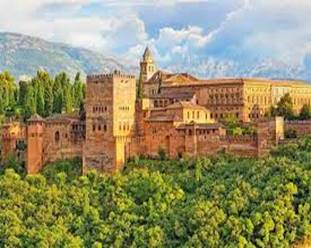
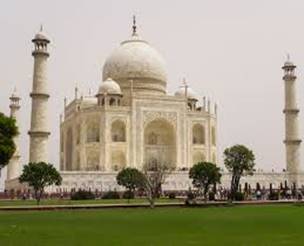
Today, both the Alhambra and the Taj Mahal are counted among the world’s most beautiful and admired buildings
The Shared Histories of Alhambra and the Taj Mahal
By Dr Syed Amir
Bethesda, MD

Two of the world’s most famous architectural marvels, the Taj Mahal in India and the Alhambra Palace in Granada, Spain, have traversed similar life paths. However, they had very different beginnings. The Alhambra was built when Islamic power in Spain had largely dissipated, while the Taj Mahal was built when the Mughal Empire was at its peak and India was the wealthiest country in the world.
The Muslim rule in Cordoba was extinguished by the forces of the Christian King, Alfonso VIII, following his victory at Las Navas, near Cordoba, in 1212. What was once a magnificent empire ultimately disintegrated into small autonomous Taifa kingdoms. By 1230, most of Andalusia had come under Christian rule. There was one exception, however. One of the Taifa Emirs, Muhammad ibn Yūsuf ibn Naṣr (reigned 1238–1273), carved out an autonomous principality of Granada and founded the Nasrid dynasty. It lasted for about two centuries as a Muslim enclave. The last Moorish King, Mohammed XII (Abu Abdullah), in 1492 surrendered the Alhambra to the Catholic monarchs, Ferdinand and Isabella. It ended the Muslim rule in Spain.
Paradoxically, Granada witnessed a remarkable flowering of art, architecture, and poetry during the waning days of Islamic rule. According to the eminent anthropologist, Ibn Khaldun, who lived in Granada during the reign of Muhammad V, around 1364, the Emirate emerged as the center of culture and learning, though concurrently riven by political instability and acrimony.
The architectural pinnacle of Granada is the Alhambra. Construction began in 1238 under Emir Muhammad Ibn al-Ahmar, who was nicknamed Muhammad al-Ghalib (the victorious). Humbling himself, he responded that “Wala Ghalib al Allah” (God is the only conqueror). This phrase became his signature and appeared everywhere in the Alhambra, as well as on his coins and metal objects. The construction of the Alhambra was completed during the reign of Amir Muhammad V (1354–1359 and 1362–1391), the eighth Nasrid ruler.
Granada’s history, however, is filled with sorrow. Authors Dana Facaros and Michael Pauls, in their book, Granada, Seville, have noted that “Granada’s gift was the Alhambra, by common consent the loveliest palace in the world, in the loveliest setting, underneath the snowcapped Sierra Nevada. Such a past, combined with the somewhat gloomy history that followed, makes Granada the most wistful and melancholy of these cities.”
After Granada fell in 1492, the Alhambra briefly served as the residence of King Ferdinand and Queen Isabella. It is said that Columbus presented plans requesting support for his voyage to the Catholic monarchs in the Alhambra’s Hall of Ambassadors. The Alhambra’s last royal residents were King Philip V and his queen in 1526. However, they soon abandoned the palace, which marked the start of its downfall.
The Alhambra suffered significant damage during its occupation in 1810-1812 by the French army, which nearly blew up the whole edifice. The American author, diplomat, and storyteller, Washington Irving, visited the palace in 1828 and again in 1829. He was so enchanted by its intrinsic, melancholic beauty that he decided to take up residence there for a few weeks. His books, The Tales of Alhambra and The Treasures of Alhambra, a mix of facts, myths, and fiction, have become classics and remain popular today.
Irving noted “that the desertion of the royal court was a fatal blow to Alhambra. Its beautiful halls became desolate, and some of them fell into ruin. The beautiful fountains went dry, and the dwelling became filled with a loose and lawless population, rogues and thieves who made this their place of refuge.” The writings of Irving and other intellectuals heightened Europeans' awareness of the value of preserving Islamic monuments in Southern Spain. The Spanish Government launched a project to restore the Alhambra.
The Alhambra and its gardens, Generalife, have now been refurbished to their original beauty, making them among the most popular tourist attractions worldwide. In 1984, UNESCO added the Alhambra to the World Heritage List.
Unlike the Alhambra, the Taj Mahal was built when the Mughal Empire was at its peak, and India was the wealthiest country in the world. Emperor Shah Jahan built the mausoleum to immortalize his beloved wife, Mumtaz Mahal. She died in 1631 in Burhanpur, Deccan (present-day Madhya Pradesh), while giving birth to their 14th child in the arms of her teenage daughter, Jahan Ara Begum. Dana and Michael Preston, in their book, Taj Mahal, remark that Mumtaz’s death quickly marked the end of Shah Jahan’s youth. His beard, which previously had only a few grey hairs, turned mostly grey within a few days. For a whole week, he made no customary appearance at the Jharuka or attended the Darbar.
Mumtaz Mahal was temporarily buried in a garden in Burhanpur. Construction of her permanent resting place started in 1632 in Agra. An estimated 20,000 artisans, craftsmen, and laborers were involved in the project. The building process took twenty years to complete.
The Taj Mahal's stunning look comes from its extensive use of white marble on the exterior. Shah Jahan was highly interested in and knowledgeable about precious gems, and he used some of them to embellish the Taj Mahal. The Prestons, in their book, quoted historians who said, “Taj Mahal looks like a white marble jewel set in a sandstone casket formed by the rest of the complex.” Francis Bernier visited the Taj Mahal in 1663 and is quoted by the Prestons as commenting, “everywhere are seen jasper and jade as well as other stone similar to those that enrich the walls of grand dukes’ chapel in Florence”.
Shah Jahan moved his capital to Delhi in 1648 and shifted his interest to building his new capital city, Shahjahanabad. Meanwhile, the Taj Mahal was already showing some disrepair. Aurangzeb, in 1652, returning from a military campaign, visited his mother’s mausoleum to recite the Fatiha and was distressed to find that the building was showing signs of water damage. He wrote to his father about the water damage and begged him to address it.
The Taj Mahal fell on hard times as Mughal power declined and chaotic conditions prevailed in Agra. In the eighteenth and nineteenth centuries, it suffered many acts of vandalism at the hands of unruly bands of Jats and Marathas. Its precious and semi-precious floral inlays were chiseled away, lavish carpets and wall hangings, and an ornate silver door were removed and carted away.
As the British General Lord Lake took control of Agra in 1803, the mausoleum became a playground for soldiers and employees of the East India Company. They used its pristine marble floors and terraces for late-night dance parties as the brass band played. The mosques and the Tasbih Khana were rented to newlyweds as honeymoon cottages. For decades, the Taj Mahal remained neglected and in disrepair. Its lush gardens, luxuriant flower beds, and fountains withered away.
The Taj Mahal saw a reversal of its fortunes with the arrival, at the turn of the century, of Lord Curzon as the viceroy of India (1898-1905). Appointed to the powerful office at the young age of 39, Curzon was a highly cultivated man with a deep interest in preserving India’s national heritage. Soon after his arrival, he initiated a major project to restore and renovate the monument, which he loved. He was so proud of the restoration work he ordered that, in his farewell speech at the Taj Mahal, he commented, “If I’d never done anything else in India, I have written my name here and the letters are a living joy.”
Today, both the Alhambra and the Taj Mahal are counted among the world’s most beautiful and admired buildings.
(Dr Syed Amir is a former Assistant Professor, Harvard Medical School, and a health science administrator, US National Institutes of Health)
