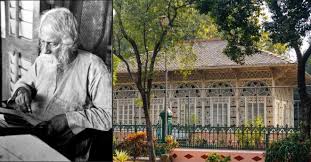
Today, Tagore’s songs are the national anthems of not one but two nations, India and Bangladesh, while his work inspired the writing of the national anthem of a third, Sri Lanka. We should note that in the case of Bangladesh, a Muslim nation had selected a national anthem written by a Hindu. Amar Sonar Bangla was written by Tagore in 1905 but adopted by the new nation in 1971. For Bengalis, Tagore remains a very special figure and part and parcel of their very identity. Among Bengalis, Tagore’s songs, for example, “are sung, hummed, or played…in every possible situation.” In Bengali the word Rabindrik refers to those things with characteristics associated with Tagore – Image DailyEducation.in
Gurudev Tagore: The Bard of Bengal
By Akbar Ahmed, Frankie Martin, Dr Amineh Hoti
In late 1961, when I joined Birmingham University in the UK as an undergraduate, I was selected as part of the cast of students performing the play The Post Office by Rabindranath Tagore. Tagore was the Indian Bengali Hindu literary icon known as Gurudev or blessed or divine teacher. With this play we represented our university in competition with other Universities such as Oxford and Cambridge at a week-long theater festival held in Bristol. Speakers during the exhilarating week included figures such as Harold Pinter. An announcement mentioned an actor making a film about Lawrence of Arabia. He was unknown, a Peter O’ Toole. I planned to attend the session but in the end the item was cancelled due to the speaker’s filming commitments in the Arab world.
While the other Universities performed plays by great Western playwrights including Tennessee Williams, ours was unique in that it was by an Eastern playwright. This was unusual for the time. I was the only South Asian member of the cast, which itself was a cross-cultural gesture, in the spirit of Tagore. It was a tiny role, especially for someone fresh from his triumph as Mortimer Brewster in the annual school play Arsenic and Old Lace at Burn Hall in Pakistan, a role made famous by Cary Grant in the movie; but I hastily set aside any artist’s ego as it gave me an introduction to Tagore. It was a portal to a veritable Aladdin’s cave of delights—of stories, plays, images, verses and led to noble thoughts of world peace and universal love.
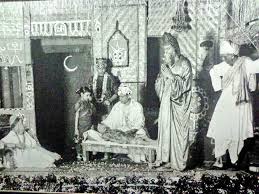
Tagore’s play The Post Office had been endorsed by the Irish poet and playwright William Butler Yeats, which facilitated its publication and fame in the West
Tagore’s play The Post Office had been endorsed by the Irish poet and playwright William Butler Yeats, which facilitated its publication and fame in the West. Around the same time, Tagore was awarded the Nobel Prize in Literature, which gave more prominence to The Post Office. The play, widely hailed as a masterpiece, is suffused with Tagore’s philosophic and religious worldview. It reflects Hindu philosophy and mysticism, which in a sense Tagore represents. It touches the mysticism we are familiar with through the Abrahamic religions, but in some senses is even deeper. It was staged in Dublin, London, and Berlin, and it was broadcast on the radio in Paris the night before the Nazis took the city in 1940. In 1942, despite the Nazis banning the play, it was staged by Janusz Korczak, head of a Jewish orphanage in the Warsaw Ghetto, in order to give hope to the children and avert their depression. Tragically, three days after the performance, Korczak and the children were sent to the Treblinka concentration camp where they were killed.
Alam and Chakravarty, The Essential Tagore, p. 313.
References to “I” refer to me, Akbar Ahmed, and “we” to all three authors.
Ragini Mohite, “Reading Tagore’s ‘The Post Office’ During the Pandemic: Reflections on the Nature of Education,” Liverpool University Press Blog, May 4, 2021: https://liverpooluniversitypress.blog/2021/05/04/reading-tagores-the-post-office-during-the-pandemic-reflections-on-the-nature-of-education/
Jai Chakrabarti, “‘The Post Office’: A Play from India to Wartime Poland,” Jewish Book Council, September 15, 2021: https://www.jewishbookcouncil.org/pb-daily/the-post-office-a-play-from-india-to-wartime-poland
Discussing The Post Office during the coronavirus pandemic in 2021, the scholar Ragini Mohite noted that it “has been a resilient part of the public consciousness in times of generation-defining crises.”
The play is about a young boy who has a terminal illness and for his own protection is sealed up in his house. He is only able to experience the world by looking out of his window. Positive and cheerful despite his illness, he longs to experience the world and speaks to passersby about it. They are from diverse backgrounds and social positions, and the boy is fascinated by all of them. One character, for example, Gaffer, who dresses as a fakir or Sufi Muslim holy man, indicates an Islamic and Afghan background.
The boy describes with excitement the many things he will do when he is well. When he asks about a building he observes with a flag, he is informed that it is the king’s post office—and he is facetiously told that one day there might be a letter for him from the king. The boy takes this seriously, however, and loves the idea. He finds hope that one day he will receive a letter from the king. The king represents the divine, and towards the end of the play the boy is clearly connected with the spiritual world. In his moment of death, he will experience a moment of release where he will become one with the Divine Being.
It is this sense of Oneness, of a unity that encompasses diversity, that Tagore embodies throughout his work, which ranges across poetry, plays, novels, academic writings and essays, music including opera, and painting. He dominated Bengal’s already rich and complex literary world, writing over 1,000 poems, some 200 books, over 40 plays, and more than 2,000 songs. In 1913, he made history by becoming the first Indian and non-Westerner to be awarded the Nobel Prize. He is known as a crucial figure in the literary, political, and cultural movement known as the Bengal Renaissance, which balanced tradition and modernity, religion and science, and East and West. It transformed Bengal and deeply influenced South Asia as a whole—for example it was a key influence on the movement led by Gandhi which achieved independence from British rule in 1947. Tagore, one of Gandhi’s earliest admirers, was the first to call him Mahatma or Great Soul, while Gandhi called Tagore Gurudev and “‘The Great Sentinel,’ the conscience of the sub-continent.” Jawaharlal Nehru, who thought of Tagore as his intellectual guru, described both Tagore and Gandhi as “in the long line of India’s great men” and “supreme as human beings.”
Today, Tagore’s songs are the national anthems of not one but two nations, India and Bangladesh, while his work inspired the writing of the national anthem of a third, Sri Lanka. We should note that in the case of Bangladesh, a Muslim nation had selected a national anthem written by a Hindu. Amar Sonar Bangla was written by Tagore in 1905 but adopted by the new nation in 1971. For Bengalis, Tagore remains a very special figure and part and parcel of their very identity. Among Bengalis, Tagore’s songs, for example, “are sung, hummed, or played…in every possible situation.” In Bengali the word Rabindrik refers to those things with characteristics associated with Tagore.
Tagore was a perpetual artistic innovator, “creating new forms and styles in his poetry; working fundamental changes in Bengali vocal music; introducing novel kinds of drama, opera and ballet; exploring subjects from nursery-rhymes to science in his essays; evolving a unique style in the paintings and drawings that he produced in large quantities from 1928 on; above all, enormously expanding and altering the resources of the Bengali language” and “inventing a range of lyric meters and verse-forms that no writer before him in any modern Indian language had dreamed of.” Influences on Tagore’s literary, dance, and musical compositions ranged from European literary traditions to Balinese dance-drama to north and south Indian classical music. Tagore was also an educator, having established Visva-Bharati University in West Bengal, one of the major universities of India.
For us, the authors, Tagore is a great “Mingler,” someone who embraces the “Other” regardless of religion, race, ethnicity, or nation. Indeed, Tagore himself said, “When the streams of ideals that flow from the East and from the West mingle their murmur in some profound harmony of meaning it delights my soul.” Through his artistic works and the sheer force of his personality and dedication, Tagore reached out to the “Other” in love on a global level. While Tagore’s popularity as a literary figure has declined in the West over the decades, he remains an iconic figure in the East, particularly South Asia. While in the West he has primarily been seen as a literary figure, his importance for the West and the world is greater than that. It is his philosophy and the big ideas he presented across the different mediums in which he worked that are most important for us to consider.
Today we live in a sharply polarized world of continuing technological advancements, for example the rise of AI. For Tagore, the modern world contained both great potential and poison. The potential was for humans to increasingly meet and know one another, to gain an appreciation for the unity of humanity within our distinctive identities and traditions. The poison was alienating organizational mechanization, technological advancements in killing and destruction, economic greed, and nationalism, all which came in a kind of Western package of modernity which, Tagore was greatly concerned, would be adopted and mimicked by the nations struggling for their independence from European powers such as those in Asia, thus leading to global disaster. He lived through the horrors of the First World War, and his final writings in 1941 were of alarm as the planet entered the Second World War.
At a time of rising ethnonationalism and conflicts across the world, with numerous commentators and spiritual leaders like Pope Francis having declared we are either entering or about to enter a Third World War, we argue that it is important to review and revive Tagore’s rich legacy. We hope that this piece helps accomplish the important task. Tagore’s vision of humanism and hope for an inclusive India and an inclusive world can lead us on the path of love and unity and away from the poisons of hatred and intolerance.
The Life of Tagore
Rabindranath Tagore was a tall tree in an Indian forest of tall trees, a forest thick with towering names like Gandhi, Jinnah, Iqbal, Nehru, and Azad. He was perhaps the first to be internationally recognized— as stated above, winning the Nobel Prize, then a Knighthood. He returned the knighthood after the brutal British massacre at Jallianwala Bagh.
Tagore was born in Jorasanko Thakur Bari, near Calcutta in India in 1861. His Brahmin family was highly accomplished and affluent with a long history. With Calcutta then serving as the British capital of India, the Tagore family, which had close links with the British, was situated at the center of colonial administration. The family was full of “firsts.” Rabindranath’s grandfather, Dwarkanath, for example, was the first Indian bank director, was among the first Indian industrialists, involved in shipping and mining and trading in indigo, silk, sugar, tea, and coffee, and was the first Indian to partner with a European businessman as an equal in the creation of Carr, Tagore and Company in 1834. Rabindranath’s brother,
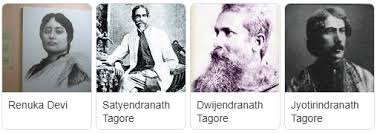
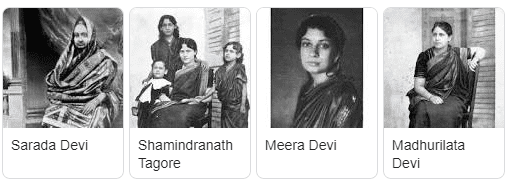
While the Tagores were wealthy businessmen and landowners, possessing large estate holdings, they had more than wealth—they had a vision of destiny in the uplift of Bengal and India and the reconciliation of tradition and modernity
Satyendranath, was the first Indian to join the British Civil Service, and his sister Swarnakumari Devi was the first Indian woman novelist and the first woman to edit a journal in India.
While the Tagores were wealthy businessmen and landowners, possessing large estate holdings, they had more than wealth—they had a vision of destiny in the uplift of Bengal and India and the reconciliation of tradition and modernity. They wished to adopt the best of the British while retaining the best of their own culture and use their wealth and influence for cultural enrichment and the good of the society. They did this across different areas of life including newspapers, literature, and the arts, and became leaders in what was known as the Bengal Renaissance. In yet another “first,” for example, Dwarkanath was the first “bi-musical Indian,” meaning he was the first Indian with “the practical ability to play/perform both Indian and Western music.”
Ragini Mohite, “Reading Tagore’s ‘The Post Office’ During the Pandemic: Reflections on the Nature of Education,” Liverpool University Press Blog, May 4, 2021: https://liverpooluniversitypress.blog/2021/05/04/reading-tagores-the-post-office-during-the-pandemic-reflections-on-the-nature-of-education/
Fakrul Alam and Radha Chakravarty, eds. The Essential Tagore (Cambridge: The Belknap Press of Harvard University Press, 2011), pp. 313, 373; Amartya Sen, “Tagore and his India,” The Nobel Prize, August 28, 2001: https://www.nobelprize.org/prizes/literature/1913/tagore/article/
Nikhil Bhattacharya, “Rabindranath Tagore and Mohandas Karamchand Gandhi,” MK Gandhi.org, May 5, 2011: https://www.mkgandhi.org/articles/tagoreG.php#:~:text=Tagore%20first%20called%20Gandhi%20a,the%20Great%20Sentinel%20or%20Gurudev%22
William Radice, “Introduction.” In Rabindranath Tagore, Selected Poems (London: Penguin, 2005), p. 29.
Sunil Khilnani, Incarnations: A History of India in Fifty Lives (New York: Farrar, Straus and Giroux, 2016), p. 244.
Amartya Sen, “Tagore and his India,” The Nobel Prize, August 28, 2001: https://www.nobelprize.org/prizes/literature/1913/tagore/article/
Alam and Chakravarty, The Essential Tagore, p. 313.
Radice, “Introduction,” pp. 20-21.
Fakrul Alam and Radha Chakravarty, “Introduction.” In Fakrul Alam and Radha Chakravarty, eds. The Essential Tagore (Cambridge: The Belknap Press of Harvard University Press, 2011), p. 14.
Rabindranath Tagore, The Religion of Man (London: George Allen & Unwin Ltd, 1922), p. 88.
Stanley Wolpert, A New History of India (New York: Oxford University Press, 2009), p. 221.
Radice, “Introduction,” p. 19.
Sharmadip Basu, “The bi-musical subject: Dwarkanath Tagore and European music in early-nineteenth century Calcutta,” South Asian History and Culture, vol. 15, no. 4, 2004, p. 375.
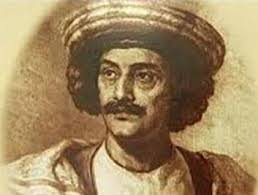
. In 1828, Roy founded the Brahmo Samaj movement, which was the “most influential reform organization of nineteenth-century Hinduism” and “the lead organization in the emergence of a broader modern Hinduism.” The movement promoted a Hinduism that was large in scope, intellectual, philosophical, humanistic, inclusive—for example, embracing other religions such as Islam—and emphatically modern, all while being based in the ancient Upanishads
The key figure in providing this direction to the Tagores was the Hindu reformer Raja Rammohun Roy, of whom Dwarkanath was a dedicated follower. In 1828, Roy founded the Brahmo Samaj movement, which was the “most influential reform organization of nineteenth-century Hinduism” and “the lead organization in the emergence of a broader modern Hinduism.” The movement promoted a Hinduism that was large in scope, intellectual, philosophical, humanistic, inclusive—for example, embracing other religions such as Islam—and emphatically modern, all while being based in the ancient Upanishads. Thus Roy, in the words of the historian Stanley Wolpert, could “train himself to become an Englishman while remaining a Bengali brahman.” Dwarkanath could on the one hand lead the Brahmo Samaj while at the same time meeting and moving in the circles of Queen Victoria, Charles Dickens, and William Thackeray.
Rabindranath was born into this dynamic and exciting environment. His parents’ fourteenth child, he grew up surrounded by the arts such as literature, theater, and music, in which his siblings excelled. He began writing poetry as a child, and his first book of verse came out when he was 13 years old, followed by his publishing of essays on poets such as Dante at the age of 16. There were repeated efforts to send Rabindranath for formalized schooling, both in India and in England, but he always resisted such structures. He was instead taught by his father, his siblings, and tutors in his home—one of whom, for example, guided Tagore’s translation of Macbeth into Bengali when he was 12.
Tagore was steeped in the interfaith ideas of Roy, stating of Roy, “It was he who first felt and declared that for us Buddha, Christ and Mohammed have spent their lives; that for each one of us has been stored up the fruits of the discipline of our Rishis.” While his father led Brahmo Samaj, which featured and furthered Roy’s intellectual and philosophical approach to religion, however, Rabindranath’s notable religious experiences which shaped his life were felt viscerally and emotionally. In 1882, for example, while staying at his brother’s house in Calcutta, he had a profound emotional and religious experience which gave him a life altering insight into what he called “spiritual reality.” He explained it thusly: “One morning I happened to be standing on the verandah…The sun was just rising through the leafy tops of those trees. As I continued to gaze, all of a sudden, a covering seemed to fall away from my eyes, and I found the world bathed in a wonderful radiance, with waves of beauty and joy swelling on every side. This radiance pierced in a moment through the folds of sadness and despondency which had accumulated over my heart, and flooded it with this universal light.” He was now aware of “the joy aspect of the Universe. And it came to be so that no person or thing in the world seemed to me trivial or unpleasing.”
“From infancy I had seen only with my eyes,” he explained, discussing the significance of the experience, but “I now began to see with the whole of my consciousness,” which had been expanded. “I had never before marked the play of limbs and lineaments which always accompanies even the least of man’s actions,” he said, but “now I was spell-bound by their variety, which I came across on all sides, at every moment. Yet I saw them not as being apart by themselves, but as parts of that amazingly beautiful greater dance which goes on at this very moment throughout the world of men, in each of their homes, in their multifarious wants and activities.” He put down his experience in verse, writing, “I know not how of a sudden my heart flung open its doors,/ And let the crowd of worlds rush in, greeting each other.” The experience had “illuminated for me the whole universe, which then no longer appeared like heaps of things and happenings, but was disclosed to my sight as one whole.”
Another significant event in his life followed—his father’s decision to send Tagore to rural Bengal to look after the family estates there. Tagore described this period as the “most productive” in his life in which he produced some of his best work. Perhaps for the first time, Tagore was in close contact with rural people, and a new world opened up to him. The result of this interaction was the appearance of ordinary people as protagonists for the first time in Bengali
David J. Neumann, Finding God Through Yoga: Paramahansa Yogananda and Modern American Religion in a Global Age (Chapel Hill: University of North Carolina Press, 2019), p. 52.
David J. Neumann, Finding God Through Yoga: Paramahansa Yogananda and Modern American Religion in a Global Age (Chapel Hill: University of North Carolina Press, 2019), p. 52.
Wolpert, A New History of India, p. 218.
Radice, “Introduction,” p. 33.
Rabindranath Tagore, Greater India (Triplicane, Madras: S. Ganesan, 1921), p. 87.
Tagore, The Religion of Man, p. 94.
Rabindranath Tagore, My Reminiscences (New York: The Macmillan Company, 1917), p. 216.
Tagore, My Reminiscences, p. 216.
Tagore, My Reminiscences, p. 218; Tagore, The Religion of Man, p. 94.
Tagore, My Reminiscences, p. 218.
Tagore, My Reminiscences, p. 219.
Tagore, My Reminiscences, p. 222.
Mohammad A. Quayum, “Rabindranath Tagore: A Sectarian or a Cosmopolitan Writer?,” Asian StudiesReview, vol. 49, no. 2, 2025, p. 393.
Bengali
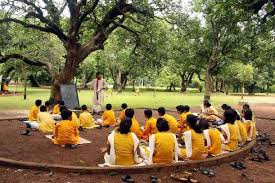
The school was inspired by the model of the forest hermitage ashram of ancient India and utilized an experimental method of teaching. Learning was “unstructured” and “ classes were held under the trees, where observation of nature was encouraged through study and excursions.” Tagore hoped to cultivate “ love of nature and sympathy with all living creatures” among the students.The school would be a major focus for the remainder of his life
literature. Tagore was now involved in management and in economic and political affairs affecting people’s lives. He saw how ordinary people lived, and tried to improve their lives. Most of his tenants were Muslims, and he described them with affection: “I love them from my heart.” Observing relations between Muslims and Hindus, he noted how they were able to live together in a seamless and organic way. He was especially fascinated by mystic Muslim and Hindu folk music which further shaped his religious outlook and accorded with his own views on the unity of the divine.
In 1901, Tagore, then in his early forties, established a school on family land near Bolpur, West Bengal which he called Santiniketan, meaning abode of peace. The school was inspired by the model of the forest hermitage ashram of ancient India and utilized an experimental method of teaching. Learning was “unstructured” and “ classes were held under the trees, where observation of nature was encouraged through study and excursions.” Tagore hoped to cultivate “ love of nature and sympathy with all living creatures” among the students.The school would be a major focus for the remainder of his life. Notably, it was established entirely independently of British control or funding, a considerable undertaking at the time.
Tagore accomplished such achievements despite experiencing great tragedies in his life. His wife died at the age of 29, followed nine months later by the death of his daughter, and four years after that his youngest son died of cholera at the age of 13. He also lost his sister-in-law, with whom he was very close, to suicide. Dealing with death shaped Tagore’s spiritual views and approach to life. As he wrote, “When a seedling is fenced into a dark space, its sole effort is to somehow escape that darkness, to emerge into the light, stretching upwards as if on tiptoe, as far up as possible. Likewise, when death suddenly imprisoned my heart inside a dark nothingness, my entire being struggled desperately, day and night, to penetrate that darkness and come out into the light of existence. But when the darkness conceals the way out of darkness, can there be any sorrow greater than that? And yet, through this unbearable grief, from time to time, I felt the touch of a sudden joyous breeze. I was surprised at it…I had been forced to give up the one I had clung to for support. Seeing this as a loss, I suffered agony; but simultaneously, perceiving it as a sort of liberation, I experienced a vast sense of peace…Death had created the distance that is required for one to see the world whole, and to see it in all its beauty.”
In 1903, Lord Curzon, the Viceroy of India, announced that Bengal would be partitioned between Hindu and Muslim administrative areas. This announcement supercharged Bengali and Indian nationalism and patriotism against the British. Huge protests broke out, and Tagore was front and center in the movement, writing patriotic songs that were sung across the country. The movement was known as Swadeshi, meaning of one’s own country, and promoted indigenous industry and crafts and boycotts of foreign goods. The movement could not stop the partition which occurred in 1905, however, although the partition was revoked six years later.
Yet Tagore soon began to grow disillusioned with the tactics and vision of the nationalist activists, which included terrorist attacks, riots, and murders. Muslims, Tagore noted, were particularly affected because many were poor and were faced with economic destruction if they were forced to boycott foreign goods, for example, and were seen as disloyal by many Hindu nationalists. “I will never allow patriotism to triumph over humanity as long as I live,” he said in 1908. Tagore could not condone violence, believing that India should not pursue the path of violence and that good could come only from constructive work pursued in a tolerant spirit. He threw himself into this task, publishing copious writings and focusing on the uplift of rural people.
With Tagore’s fame in India growing, in 1912 he departed for England to study its educational methods. Along with him he carried a collection of his poems, Gitanjali, which he had translated into English. The collection originally written in Bengali contains 157 poems on the themes of
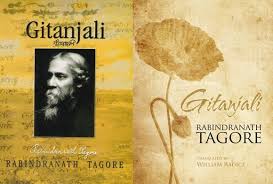
With Tagore’s fame in India growing, in 1912 he departed for England to study its educational methods. Along with him he carried a collection of his poems, Gitanjali, which he had translated into English. The collection originally written in Bengali contains 157 poems on the themes of love, devotion and spiritual longing. This collection would change Tagore’s life. He circulated the translation in England, and a copy was sent to William Butler Yeats, who was amazed at what he read. Yeats attested, “I know of no man in my time who has done anything in the English language to equal these lyrics. Even as I read them in this literal prose translation they are exquisite in style as in thought.” Tagore now shot into global fame, a rise that is as remarkable as it was unlikely as an Indian subject at the high noon of the British Empire
love, devotion and spiritual longing. This collection would change Tagore’s life. He circulated the translation in England, and a copy was sent to William Butler Yeats, who was amazed at what he read. Yeats attested, “I know of no man in my time who has done anything in the English language to equal these lyrics. Even as I read them in this literal prose translation they are exquisite in style as in thought.” Tagore now shot into global fame, a rise that is as remarkable as it was unlikely as an Indian subject at the high noon of the British Empire. Gitanjali was published in 1912 and was an instant sensation. The Times Literary Supplement declared the work to be “the psalms of a David in our time.” The following year, he was awarded the Nobel Prize, the first Asian and first non-European to receive the honor. Two years after that he was knighted. Tagore has been described as the world’s “first international literary celebrity.”
Tagore was greatly disturbed by the advent of the First World War, and began to speak more loudly and openly about the dangers of nationalism, which he was familiar with in India in the aftermath of the partition of Bengal. He promoted spiritual human unity, and he redoubled his efforts building up his school in Santiniketan which reflected his vision—the motto of the school was “where the world becomes a single nest.” In 1918, he upgraded and expanded his school to become Visva-Bharati University, meaning the communion of the world with India. The mission of the school, Tagore said, was “to seek to establish a living relationship between the East and the West, to promote inter-racial amity and intercultural understanding and fulfill the highest mission of the present age—the unification of mankind.” The school’s constitution specifically mentions that “the study of the religion, literature, history, science, and art of Hindu, Buddhist, Jain, Zoroastrian, Islamic, Sikh, Christian, and civilizations may be pursued along with the culture of the West…in amity, good-fellowship, and co-operation between the thinkers and scholars of both Eastern and Western countries, free from all antagonisms of race, nationality, creed, or caste and in the name of the One Supreme Being.”
Kathleen M. O’Connell, “Foreword to the Second Edition.” In H. B. Mukherjee, A Study of the Educational Thought and Experiment of Rabindranath Tagore (Abingdon, Oxon: Routledge, 2021), p. x.
H. B. Mukherjee, A Study of the Educational Thought and Experiment of Rabindranath Tagore (Abingdon, Oxon: Routledge, 2021), p. 69.
Alam and Chakravarty, The Essential Tagore, p. 491.
Quayum, “Rabindranath Tagore,” pp. 393-394.
Kathleen M. O’Connell, “Foreword to the Second Edition.” In H. B. Mukherjee, A Study of the Educational Thought and Experiment of Rabindranath Tagore (Abingdon, Oxon: Routledge, 2021), p. x.
H. B. Mukherjee, A Study of the Educational Thought and Experiment of Rabindranath Tagore (Abingdon, Oxon: Routledge, 2021), p. 69.
Radice, “Introduction,” p. 20.
Alam and Chakravarty, The Essential Tagore, pp. 47-48.
Amartya Sen, “Tagore and his India,” The Nobel Prize, August 28, 2001: https://www.nobelprize.org/prizes/literature/1913/tagore/article/
Satyajit Ray, “Portrait of a Man.” In The UNESCO Courier: 60 Years of Friendship with India, November 2009, p. 16.
Kaylan Kundu, “Rabindranath Tagore: A Renewed Interest in the West.” In Rama Datta and Clinton Seely, eds., Celebrating Tagore: A Collection of Essays (New Delhi: Allied Publishers Private Limited, 2009), p. 286.
Kaylan Kundu, “Rabindranath Tagore: A Renewed Interest in the West.” In Rama Datta and Clinton Seely, eds., Celebrating Tagore: A Collection of Essays (New Delhi: Allied Publishers Private Limited, 2009), p. 286.
Alam and Chakravarty, “Introduction,” p. 10
Amit Chaudhuri, “Foreword: Poetry as Polemic.” In Fakrul Alam and Radha Chakravarty, eds. The Essential Tagore (Cambridge: The Belknap Press of Harvard University Press, 2011), p. xx.
Mukherjee, A Study of the Educational Thought and Experiment of Rabindranath Tagore, p. 221.
Quayum, “Rabindranath Tagore,” p. 398. Prominent European academics helped Tagore develop the school, and students arrived from across India and beyond, including China, Japan, and the West. Tagore spoke of his intent to invite “students from the West to study the different systems of Indian philosophy, literature, art and music in their proper environment, encouraging them to carry on research work in collaboration with the scholars already engaged in this task.” Over time Tagore continued to develop the school by adding departments focusing on different world traditions. In 1927, for example, a department of Islamic studies was established, with a chair of Persian studies following in 1932, and a department of Chinese studies in 1937. One of the earliest graduating students of Visva-Bharati was the distinguished Muslim Bengali writer Syed Mujtaba Ali.
During this period, the Indian independence movement under the leadership of Gandhi gained strength. When rumors circulated that Gandhi had been arrested, violence broke out among Indians, and the British launched a harsh crackdown including the imposition of martial law. In Amritsar, British troops fired into crowds killing hundreds of people. In response to this, Tagore returned his Knighthood given what he described as the “degradation not fit for human beings” with which the British were treating Indians.
In terms of Tagore’s relationship with Gandhi, the two great men were close but had a complex relationship. While Tagore embraced Gandhi and accepted him as the leader of the Indian independence movement based in nonviolence, the two sometimes disagreed on tactics, for example the strategy of boycotting foreign goods—Tagore
Mukherjee, A Study of the Educational Thought and Experiment of Rabindranath Tagore, pp. 229-233.
Rabindranath Tagore, Creative Unity (London: Macmillan, 1922), p. 173.
Quayum, “Rabindranath Tagore,” p. 386.
Quayum, “Rabindranath Tagore,” p. 392.
“Tagore renounced his Knighthood in protest for Jalianwalla Bagh mass killing,” The Times of India, April 13, 2011.
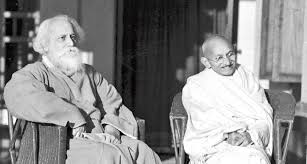
While Tagore embraced Gandhi and accepted him as the leader of the Indian independence movement based in nonviolence, the two sometimes disagreed on tactics, for example the strategy of boycotting foreign goods—Tagore
felt this could stoke exclusionary nationalism by associating what is foreign with what is impure
felt this could stoke exclusionary nationalism by associating what is foreign with what is impure.
The rest of Tagore’s life was spent in constant activity in India and abroad, speaking to audiences across the world about his message of peace and promoting intellectual and artistic cooperation and dialogue between nations. He gained disciples from the West and around the world who moved to India to learn from him and were devoted to him. He continued to receive accolades, for example in 1931 on the occasion of Tagore’s 70 th birthday, The Golden Book of Tagore was published, co-sponsored by Gandhi, Albert Einstein, the French writer Romain Rolland, Kostis Palamas of Greece, and the Indian scientist Jagadish Chandra Bose, Tagore’s close friend. Tagore died in 1941 at the age of 80 in Jorasanko Thakur Bari, his family estate where he was born.
Tagore on the Unity of Reality
As a quintessential Mingler, Tagore celebrated human diversity and argued that it constituted a single entity. Humanity is, he said, “a divine harp of many strings.” For Tagore, humanity was fundamentally at one with the world, nature, and cosmos itself—this was part of his understanding of “unity,” the ultimate reality or God: “humanity is composed of individuals, yet they have their interconnection of human relationship, which gives living solidarity to man’s world. The entire universe is linked up with us in a similar manner.” To illustrate his view, Tagore quoted from an ancient Hindu text, the Shvetashvatara Upanishad, stating, “He who is one, above all colors, and who with his manifold power supplies the inherent needs of men of all colors, who is in the beginning and in the end of the world, is divine, and may he unite us in a relationship of good will.”
Key to Tagore’s life outlook was the consciousness of the world and universe as a unitary whole. He referred to this unitary whole as God, or Brahma in Hinduism, and with names including “the One,” “the Creator,” the “Infinite,” “the supreme Lover,” “the universal Unity,” “the divine Reality,” and “Being, the ultimate reality.”
While things in the world may appear to us to be distinct and different, they are in fact all interrelated and interdependent. Thus, the diversity we observe in the world is necessarily so and derives from the same unity. Tagore argued that “the One appears as many” and “the nature of Reality is the variedness of its unity”— it is a “unity which comprehends multiplicity.”
When we search for the points in which apparently distinct facts or elements come together, an entity or wholeness appears in which we gain deeper and more authentic insight into what we are perceiving. As Tagore explained, “What is the truth of this world? It is not in the masses of substance, not in the number of things, but in their relatedness…It is not in the materials which are many, but in the expression which is one.” As he also put it, “truth consists, not in facts, but in harmony of facts.” If one is only looking very closely at the smaller components of something, like roots of a tree or leaves, they may not appreciate the wider unity or whole of the tree. To further expound on the tree example, Tagore notes that even when we perceive something in its larger unity, there are still larger levels—there is no tree without its environment, without the sun, soil, and the seasons, and if any part of this inter-relation is checked, the tree will not survive.
Tagore sought to aid us in appreciating that larger reality, where a person experiences “an illumination of his consciousness” in realizing “the spiritual unity reigning supreme over all differences.” The barrier to such a consciousness is the ego, because the ego is “all about me.” This inwardness means the ego is not focused on what is outside one’s self, what they are a part of. Our own “feelings and events,” Tagore wrote, in their “vehement self-assertion they ignore their unity with the All.”
The good news for Tagore is that he believed that human beings, in addition to the ego, also have an instinctual urge to reach out beyond themselves—there is a “mysterious spirit of unity” or pull towards unity. We have within us, he argued, a “longing for magnitude…The truth that is infinite dwells in the ideal of unity which we find in the deeper relatedness.” It is part of being human.
In fact, Tagore believed that the different human religions came from this tendency to seek unity: “when, at first, any large body of people in their history became aware of their unity, they expressed it in some popular symbol of divinity.” In the human history of different groups, he contended, it was a “moral spirit of combination which was the true basis of their greatness,” fostering “their art, science and religion.” Human progress and true civilization itself has to do with this process, what he called a “widening of the range of feeling…to extend the scope of our consciousness towards higher and larger spheres.” The ultimate truth for man, Tagore affirmed, is “in his extension of sympathy across all barriers of caste and color.” “It is an impulse for union,” he further argued, “which drives our mind across our little home and neighborhood to its love tryst abroad. It must unite with the great mind of humanity to find its fulfilment.”
The Importance of Love
If Tagore’s body of work could be said to have one overarching theme, it would be love. Love is crucial for Tagore because it is through love that we transcend ourselves in order to embrace the larger Unity. In love, we shun our ego in favor of the “Other” and Unity, and when we do this we do not feel “emptiness” but “fulfillment.” When we embrace the larger unity of how things fit together through love, we experience “the joy that is at the root of all creation,” as “love is the ultimate meaning of everything around us.” Whereas knowledge of God must necessarily be partial for humans, Tagore argued, “he can be known by joy, by love.” Love is actually necessary to understand humanity itself, as “we never can have a true view of man unless we have a love for him.”
In order to be truly happy, Tagore says a person must “establish harmonious relationship with all things with which he has dealings.” He affirmed that “joy is everywhere; it is in the earth’s green covering of grass; in the blue serenity of the sky; in the reckless exuberance of spring; in the severe abstinence of grey winter; in the living flesh that animates our bodily frame; in the perfect poise of the human figure, noble and upright; in living; in the exercise of all our powers; in the acquisition of knowledge…Joy is the realization of the truth of oneness, the oneness of our soul with the world and of the world-soul with the supreme lover.”
In love, Tagore further asserted, “all the contradictions of existence merge themselves and are lost. Only in love are duality and unity not at variance. Love must be one and two at the same time.” “It is only in the light of love,” he said, “that all limits are merged in the limitless” and all “sense of difference is obliterated.” Love is thus essentially the meaning of life, and “We live in this world when we love it.” For Tagore, “our love of life is really our wish to continue our relation with this great world. We are glad that we are in it; we are attached to it with numberless threads, which extend from this earth to the stars.” “The facts that cause despondence and gloom are mere mist,” Tagore declared with confidence, “and when through the mist beauty breaks out in momentary gleams, we realise that Peace is true and not conflict. Love is true and not hatred; and Truth is the One, not the disjointed multitude.”
Tagore and the “Other”
For Tagore, the distinctions between different peoples and religions, the differences between “Self” and “Other” were not negative. He believed that the Self shapes the Other and the Other shapes the Self. Tagore argued, “At every step we have to take into account others than ourselves.” When we are by ourselves, we are like an eye without light and an object to gaze upon—and “our eye loses the meaning of its function if it can only see itself.” But when we relate to what is other than us, we widen “the limit of our self” and realize “our own selves…through expansion of sympathy.” This process is a joyful one, as “we have our greatest delight when we realize ourselves in others, and this is the definition of love.” Tagore explained the idea by invoking Hindu teachings, stating, “In our religious literature, opposition is reckoned as one of the means of union.”
Tagore understood the different religions similarly as on one level distinct but on another to be reflecting the larger Unity. Tagore believed that the messengers of all great religions sought “the welfare of men” and the “the spiritual emancipation of all races.” “Whatever might be their doctrines of God,” he argued, “their life and teaching had the deeper implication of a Being who is the infinite in Man, the Father, the Friend, the Lover, whose service must be realized through serving all mankind.” He expressed this vision in verse in poems like “Question,” writing,
“God, again and again through the ages you have sent messengers
To this pitiless world:
They have said, ‘Forgive everyone,’ they have said, ‘Love one another.”
At his school at Santiniketan, Tagore commemorated the birth and death anniversaries of the founding prophets of different religions such as Jesus, the Prophet of Islam, and Buddha.Tagore cited Jesus and Buddha as great spiritual leaders who reflected important teachings of the Upanishads, stressed the importance of love, and inspired us with their reaching towards the ideal. Tagore wrote, “When Buddha said to men: ‘Spread thy thoughts of love beyond limits,’ when Christ said ‘Love thine enemies,’ their words transcended the average standard of ideals belonging to the ordinary world. But they ever remind us that our true life is not the life of the ordinary world, and we have a fund of resources in us which is inexhaustible.”
In his writings and advocacy, Tagore argued against rigid sectarianism in religion, explaining that because “The self-expression of God is in the endless variedness of creation…our attitude towards the Infinite Being must also in its expression have a variedness of individuality ceaseless and unending.” Thus, he explained, there will be different understandings of God represented in different religions because “God is generous in his distribution of love, and his means of communication with men have not been restricted to a blind lane abruptly stopping at one historical point of time and place.” In a poem, Tagore writes, “The Sectarian thinks/ That he has the sea/ Ladled into his private pond.”
While religiously Tagore was rooted in the intellectual universality of the Upanishads, as we have seen in his discussion of love the expression of his devotion was of the heart as much, if not more so, than the head. An important reason for this was that Tagore’s religious beliefs were shaped by his interactions with the folk culture of rural Bengal which cut across religious boundaries. Tagore, who had been steeped in the “high culture” of Calcutta and England before being dispatched by his father to oversee the family estates, was taken by expressions for the divine among poor and rural people. It is a conciseness of the unity of God expressed through love which, Tagore wrote, “transcends the limitations of race and gathers together all human beings within one spiritual circle of union.
In the expressions of love among the rural people, Tagore came to appreciate, social hierarchies and religious distinctions were absent. While the “educated classes” of India often think in terms of Hindu and Muslim, he observed, they often miss the connections among the common people of both religions “going on beneath the surface” at a village level. The love and unity being expressed also cut across social distinctions in a society where, he stated of Hindus, “our higher castes think nothing of looking down on the lowest castes as worse than beasts.”
Tagore was particularly fascinated by the Baul of Bengal, a mystic sect including Sufi Muslims and Hindus popular among the poor who offer the same invocations of love for the divine in their devotional songs. The Baul, Tagore explained, seek “from a direct source, the enlightenment which the soul longs for, the eternal light of love.” In doing so, they provide “us a clue to the inner meaning of all religions.” In his description of the Baul, Tagore uses Sufi imagery, stating, “The pride of the Baül beggar is not in his worldly distinction, but in the distinction that God himself has given to him. He feels himself like a flute through which God’s own breath of love has been breathed: ‘My heart is like a flute he has played on.’”
In terms of Islamic influences on Tagore, Tagore stated that the code of life of his own family was “a confluence of three cultures, the Hindu, Mohammedan and British.” In his thinking, Tagore was profoundly influenced by Muslims including the Persian poets Saadi and Hafiz, whose poetry Tagore readily quoted in his letters and conversations.
In Tagore’s literary works, he portrays Muslim characters with sympathy and empathy, such as the short stories “Kabuliwala” (1892) and “The Tale of a Muslim Woman” (1941). In “Kabuliwala,” Rahmat, an Afghan Pashtun in Calcutta, strikes up a friendship with a five-year-old Hindu Brahmin girl, Mini, who reminds him of his own daughter in Afghanistan. The character of Rahmat has been described as “one of the most lovable characters in Bengali fiction.” “The Tale of a Muslim Woman,” dictated by Tagore shortly before his death at a time of increasing Hindu-Muslim tension, similarly concerns the relationship between a female Brahmin and a Muslim. In this case an esteemed Muslim, Habir Khan, saves Kamala, the Brahmin woman, from bandits, but when he takes her back to her family, she is disowned because they believe she is contaminated by contact with Muslims. Khan allows her to live with his family in safety and security and permits her to freely practice her religion, telling her, “A true Mussalman will also respect a devout Brahmin.” Experiencing more love at her new house than her old, she and Khan’s son fall in love and her religious vision
Erving E. Beauregard, “Tagore and Gandhi: The Complementary Nature of Indian Genius,” University of Dayton Review, vol. 1, no. 1, 1964, pp. 22-23.
Tagore, Creative Unity, p. 202.
Tagore, The Religion of Man, p. 222.
Tagore, The Religion of Man, p. 50.
Tagore, The Religion of Man, p. 188.
Rabindranath Tagore, Personality (New York: The Macmillan Company, 1917), p. 189.
Rabindranath Tagore, Sādhanā: The Realisation of Life (New York: The Macmillan Company, 1915), p. 91.
Tagore, The Religion of Man, p. 105.
Tagore, The Religion of Man, p. 227.
Tagore, The Religion of Man, p. 205.
Tagore, The Religion of Man, p. 192.
Tagore, Sādhanā, p. 97.
Tagore, Personality, p. 72.
Tagore, Sādhanā, p. 26.
Tagore, Creative Unity, pp. 5-6.
Tagore, Creative Unity, p. 32.
Tagore, Personality, p. 100.
Tagore, The Religion of Man, p. 108.
Tagore, Creative Unity, p. 39.
Tagore, The Religion of Man, p. 66.
Tagore, Creative Unity, p. 124.
Rabindranath Tagore, Nationalism (San Francisco: The Book Club of California, 1917), p. 120.
Tagore, Sādhanā, pp. 18-19.
Tagore, Creative Unity, p. 27.
Rabindranath Tagore, Thought Relics (New York: The Macmillan Company, 1921), p. 90.
Tagore, Creative Unity, p. 75.
Tagore, Sādhanā, p. 107.
Tagore, Sādhanā, p. 107.
Tagore, Sādhanā, p. 159.
Tagore, Sādhanā, p. 111.
Tagore, The Religion of Man, p. 133.
Tagore, Sādhanā, p. 116.
Tagore, Sādhanā, p. 114.
Tagore, My Reminiscences, p. 239.
Tagore, Sādhanā, p. 29.
Rabindranath Tagore, Stray Birds (New York: The Macmillan Company, 1916), p. 78.
Tagore, Sādhanā, p. 112.
Tagore, Creative Unity, p. 15.
Tagore, Sādhanā, p. 60.
Tagore, Sādhanā, p. 59.
Tagore, Sādhanā, p. 60.
Tagore, Creative Unity, p. 49.
Tagore, The Religion of Man, p. 49.
Tagore, Greater India, p. 92.
Tagore, The Religion of Man, p. 71.
Tagore, The Religion of Man, pp. 71-72.
Rabindranath Tagore, Selected Poems. Translated by William Radice. (London: Penguin Books, 2005), p. 96.
Ashim Dutta, Mystic Modernity: Tagore and Yeats (Abingdon, Oxon: Routledge, 2022), p. 10.
Tagore, Sādhanā, pp. 15-17.
Tagore, Sādhanā, pp. 58, 77.
Tagore, Thought Relics, p. 59.
Tagore, Thought Relics, p. 74.
Tagore, Thought Relics, p. 75.
Quayum, “Rabindranath Tagore,” p. 397.
Tagore, The Religion of Man, pp. 79-80.
Tagore, Greater India, p. 27.
Tagore, Greater India, p. 101.
Tagore, Greater India, p. 76.
Tagore, The Religion of Man, p. 19.
Tagore, Creative Unity, p. 87.
Tagore, The Religion of Man, p. 170.
Quayum, “Rabindranath Tagore,” p. 390.
Quayum, “Rabindranath Tagore,” p. 395.
Alam and Chakravarty, The Essential Tagore, p. 647. expands—she even becomes a Muslim while stating of God, “He is neither a Hindu nor a Muslim.” It is believed that Tagore’s story was inspired by Jodhabai, the Hindu Rajput princess who married the sixteenth century Muslim
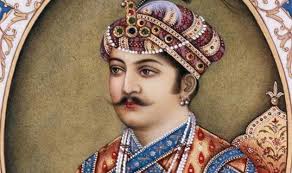
Tagore particularly lauded Akbar the Great, a ruler who embraced all religions, writing “the meeting of the Mussulman and the Hindu produced Akbar, the object of whose dream was the unification of hearts and ideals.”
Mughal Emperor Akbar the Great. Additionally, in Tagore’s poem “Shah Jahan,” about the Mughal emperor who was also Akbar’s grandson, Tagore provides a striking and now well-known description of the Taj Mahal, built by Shah Jahan, as “a teardrop on the cheek of eternity,” speaking as it does to universal emotions of grief and love.
Tagore particularly lauded Akbar the Great, a ruler who embraced all religions, writing “the meeting of the Mussulman and the Hindu produced Akbar, the object of whose dream was the unification of hearts and ideals.” In his praise of Akbar, Tagore joined Indian luminaries such as Nehru, who discusses Akbar at length as a symbol of Indian unity in his book The Discovery of India. But for Tagore, Akbar was not just an emperor and a political leader. Like the ancient Indian emperor Ashoka, Akbar was also a guru, Tagore wrote, “the greatest honor that India confers her children.” And as befitting a guru with a consciousness of the divine, Tagore believed, Akbar’s rule was about love. As he explained, “Akbar’s attempt at resolving all the religious differences by forging a bond of love was a unifying gesture. He had realized an ideal of unity, and with his liberality and sense of respect he had accessed the innermost recesses of all religions. He used to attend diligently the religious discourses of the Hindu, the Moslem, the Christian and the Parsee preachers. He had given important positions to Hindu women in the inner domain of the palace, the Hindu officers in the ministry and the brave Hindu warriors in the military rank. It is by love and not by politics that he had tried to unify the whole of India, —its King and subjects.”
Tagore was also deeply influenced by the fifteenth century poet Kabir, who was born into a Muslim family, studied under a great Hindu guru, and is revered by Hindus, Muslims, and Sikhs alike. The only major work of translation Tagore published aside from his own work was a collection of Kabir’s poetry. Another central influence was Lalon Shah Fakir, the Bengali nineteenth century mystic poet with a similar background, but in reverse—Lalon came from a Hindu family but became a devotee of a great Muslim holy man. Tagore himself collected many of Lalon’s songs from his disciples and archived them in a library at his Visva-Bharati University. An additional inspiration for Tagore was Guru Nanak, the founder of Sikhism who also brought Hindus and Muslims together. Tagore’s affection for Guru Nanak and Sikhism dated to when he was a child, when he would accompany his father to pray in the Golden Temple of Sikhism in Amritsar.
Prominent Muslims frequently showed their affection and identification with Tagore. Kazi Nazrul Islam, the national poet of Bangladesh, dedicated his Sanchita (Collection) poetic anthology to the “Poet-Emperor, Rabindranath Tagore,” and Tagore dedicated Bosonto (Spring), his dance-drama, to Nazrul. The Bengali Muslim poet Golam Mostafa even claimed Tagore for Islam, stating, “there is so much of Islamic content and ideals in his writings that he can be called a Muslim without hesitation.” Tagore himself encouraged such a connection, affirming, “I am like one of those Sufi saints, poets, and artists.” He also wrote in a poem, “O that I were an Arab Bedouin!” and while meeting with Bedouin in Iraq, a chief told him that the Prophet of Islam “has said that the person whose words and actions do not threaten anyone is a true Muslim.” Tagore concluded from the experience, “I am a son of Bengal…in front of me sits a being of a completely different order. However, the language of humanity’s deepest utterances is one that we both recognize.”
In terms of Europeans, Tagore also embraced them, stating, “I have been fortunate in coming into close touch with individual men and women of the Western countries, and have felt with them their sorrows and shared their aspirations. I have known that they seek the same God, who is my God—even those who deny Him.” He said that he realized from the time when he lived with a British family, the Scotts, while studying in London as a young man, that “human nature is everywhere the same.” He cites in his work several extraordinary Europeans who made a profound personal impact on him, including a Swede named Karl Hammargren who came to Bengal after being inspired by the work of Raja Rammohun Roy and served the people there.
In India, Tagore said, the presence of the Europeans was “a human fact” on the ground. He argued against retribution for colonization, stating, “There is always the natural temptation in us of wishing to pay back Europe in her own coin, and return contempt for contempt and evil for evil,” but this “would be to imitate Europe in one of her worst
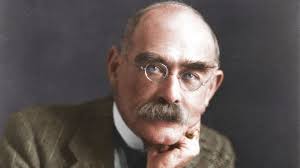
Tagore contested Rudyard Kipling’s statement concerning East and West, “Never the twain shall meet,” by replying, “It is true that they are not yet showing any real sign of meeting. But the reason is because the West has not sent out its humanity to meet the man in the East, but only its machine”
Alam and Chakravarty, The Essential Tagore, p. 649.
Alam and Chakravarty, The Essential Tagore, p. 493.
Tagore, Creative Unity, p. 104.
Alam and Chakravarty, The Essential Tagore, p. 103.
Sanyal, “The Englishmen and the Indians,” p. 116.
Quayum, “Rabindranath Tagore,” p. 391.
Alam and Chakravarty, The Essential Tagore, p. 124.
Quayum, “Rabindranath Tagore,” p. 392.
Quayum, “Rabindranath Tagore,” p. 392.
Quayum, “Rabindranath Tagore,” p. 390.
Alam and Chakravarty, The Essential Tagore, p. 782.
Alam and Chakravarty, The Essential Tagore, p. 782.
Tagore, Creative Unity, p. 98.
Tagore, My Reminiscences, p. 165.
See Tagore, Creative Unity, pp. 100-103.
Tagore, Creative Unity, p. 109. features which comes out in her behavior to people whom she describes as yellow or red, brown or black.”
For Tagore, the benefit of the European presence was that it enabled Bengal and India to link with the wider world and come into their own at the same time. The West could thus bring out the best in Bengal and India. Tagore lamented that due to the asymmetrical colonial power dynamics, when Indians met the English, the English were seen as “merely a merchant, or a military man, or a bureaucrat” rather than a human being. It was this human connection that Tagore craved, which could benefit both peoples. From the perspective of the English, Tagore said, “it has become quite possible for him to rule the subjugated race without loving them…we are complete strangers.” The media was also a problem, with Tagore arguing, “The English newspapers are making it almost impossible for the English to carry on with their administration of India by constantly criticizing the Indians and expressing their contempt for them.” The English were not interacting with Indians as they actually were, but as they imagined them. Only when India could meet the Englishman “as his equal, will all reason for antagonism, and with it all conflict, disappear. Then will East and West unite in India, country with country, race with race, knowledge with knowledge, endeavor with endeavor.”
It is on this basis that Tagore contested Rudyard Kipling’s statement concerning East and West, “Never the twain shall meet,” by replying, “It is true that they are not yet showing any real sign of meeting. But the reason is because the West has not sent out its humanity to meet the man in the East, but only its machine.”
(Continued next week)
(Ambassador Akbar Ahmed is Distinguished Professor of International Relations and holds the Ibn Khaldun Chair of Islamic Studies at the American University, School of International Service. He is also a global fellow at the Wilson Center Washington DC. His academic career included appointments such as Nonresident Senior Fellow at the Brookings Institution; the First Distinguished Chair of Middle East and Islamic Studies at the US Naval Academy in Annapolis, MD; the Iqbal Fellow and Fellow of Selwyn College at the University of Cambridge; and teaching positions at Harvard and Princeton universities. Ahmed dedicated more than three decades to the Civil Service of Pakistan, where his posts included Commissioner in Balochistan, Political Agent in the Tribal Areas, and Pakistan High Commissioner to the UK and Ireland.
Frankie Martin is a doctoral candidate in anthropology at American University and a senior researcher for Akbar Ahmed’s quartet of Brookings Institution Press studies on Western-Islamic relations.
Amineh Ahmed Hoti is Fellow-Commoner at Lucy Cavendish College, University of Cambridge. She was also a senior researcher for Akbar Ahmed’s quartet of Brookings Institution Press studies on Western-Islamic relations. Her most recent book is Gems and Jewels: The Religions of Pakistan (2021).
Tagore, Nationalism, p. 107.
Tagore, Greater India, p. 95.
Tagore, Greater India, p. 95.
Jharna Sanyal, “The Englishmen and the Indians,” South Asian Review, vol. 25, no. 1, 2004, p. 111.
Sanyal, “The Englishmen and the Indians,” p. 113.
Tagore, Greater India, p. 101.
Tagore, Creative Unity, p. 109.