
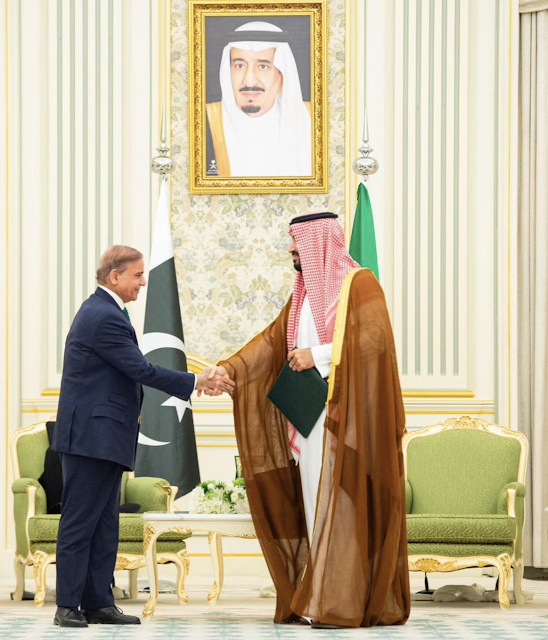
Pakistan PM Shahbaz Sharif(L) with Saudi Crown Prince MBS
Pak-Saudi Joint Defense: Is Pakistan a Major Power or a “Bit Player” in the Middle East?
By Riaz Haq
CA

The recently signed “Strategic Mutual Defense Agreement” between Saudi Arabia and Pakistan states that “any aggression against either country will be considered an aggression against both”. It is being seen by some geopolitical analysts as the beginning of an "Islamic NATO". Others, such as Indian-American analyst Shadanand Dhume , have dismissed Pakistan as no more than a "bit player" in the Middle East. Where does the truth lie?
Is Pakistan really capable of defending Saudi Arabia and other Arab Gulf nations against external aggression such as the recent Israeli attack on Qatar? Can Pakistan provide a nuclear umbrella to deter aggression against its friends in the Middle East? Or is it too weak economically and unstable politically to provide security guarantees to the GCC (Gulf Cooperation Council) nations like Qatar, Saudi Arabia and the United Arab Emirates? Let's try and understand the context which has brought about this bilateral security arrangement between Pakistan and Saudi Arabia.
The oil-rich Gulf Arab nations have long relied on the West for their security. But, on September 9, 2025, when Israel launched an airstrike on a residential compound in Doha, Qatar, the US and its Western allies did nothing to defend the Qataris. It’s notable that this attack occurred on a US ally which hosts the largest American military base in the region. The fact that the United States did nothing to stop this Israeli aggression has shaken the confidence of the GCC nations in the willingness of the United States to defend them, particularly from any Israeli attacks.
Israel has attacked almost every country in the Middle East, including Iran, Lebanon, Syria and Yemen in the last 12 months. It is being aided and abetted by the West in its excesses against humanity. It appears to have the license from the United States to do so.
Given these realities, who can the Gulf Arabs turn to for security? Which country with nuclear weapons is most likely to deter attacks on the Saudis from nuclear-armed adversaries? Who else but nuclear-armed Pakistan!
In recent years, Pakistan has emerged as a credible military power in terms of both conventional and nuclear capabilities. The Pakistani military's strong performance was recognized in May this year as it responded to what India called its " Operation Sindoor ". The country has developed a range of short and medium-range missiles capable of carrying both conventional and nuclear warheads. Its longest range missile Shaheen 3 can hit deep inside India and Israel. Last year, the Biden administration imposed sanctions against Pakistan after accusing it of developing intercontinental ballistic missiles ( ICBMs ) capable of reaching the US mainland.
In January this year at an Islamabad event, Ambassador Munir Akram articulated potential rationales for developing a missile of increased range, according to the US Congressional Research Service . A missile exceeding the Shaheen-III range may be necessary to reach Indian missiles deployed on bases in the Indian Ocean located "well beyond" the Shaheen-III range, he said, adding that India has sought to establish access to such bases. Akram also posited that Pakistan may need to develop an indigenous space launch vehicle or an anti-satellite weapon; ballistic missile programs can aid the development of such platforms.
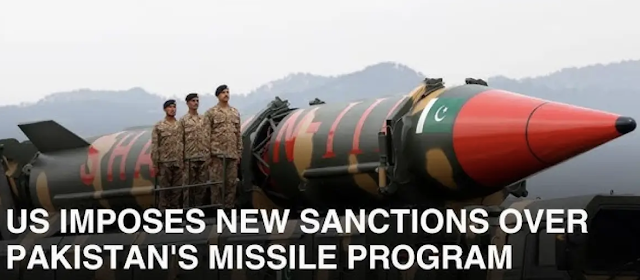
The Biden administration accused Pakistan of developing intercontinental ballistic missiles
Yes, Pakistan does have a weak economy. But that is primarily because of significant underinvestment over decades. That’s where the oil-rich Gulf Arab nations can help. They have been investing trillions of dollars in the West in the hope of getting security from them. They have huge sovereign investment funds which can invest in Pakistan. Even if they invest a fraction of what they have invested in the US, the positive effects on Pakistan’s economy will be immense.
As for Pakistan’s political instability, it can be managed by a hybrid system of government where the politicians and the generals reach an understanding to benefit both as well as the country. It will also serve Saudi interests to use its considerable influence in Pakistan to bring political and economic stability to the country.
Given today's geopolitical realities, Pakistan is the best choice for Saudi Arabia and other Gulf nations to deter aggression. Gulf Arab nations have generally welcomed the Strategic Mutual Defense Agreement (SMDA) between Saudi Arabia and Pakistan, viewing it as a move that strengthens regional security amid concerns about US commitments. Iran's President Masoud Pezeshkian has also welcomed it, describing it as "a beginning for a comprehensive regional security system". In a speech to the United Nations General Assembly, he said: “Iran welcomes the defensive pact between the two brotherly Muslim countries, the Kingdom of Saudi Arabia and the Islamic Republic of Pakistan, as a beginning for a comprehensive regional security system with the cooperation of the Muslim states of West Asia in the political security and defense domains”.
(Riaz Haq is a Silicon Valley-based Pakistani American analyst and writer. He blogs at www.riazhaq.com)
