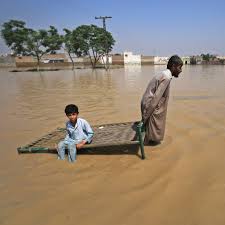
Personal experience has taught me that philanthropy is both a duty and a privilege. It is a duty to use our resources to alleviate suffering, and a privilege to be in a position to do so. The act of giving is not just about writing a check; it is about extending a hand, showing empathy, and demonstrating a shared sense of responsibility for our fellow human beings – Photo The New York Times
Pakistan Floods and the Need for the Spirit of Philanthropy
By Frank F. Islam
Washington, DC

The year 2025 will be etched in Pakistan's history as a period of significant devastation. Monsoon rains, cloudbursts, and glacial lake outbursts triggered catastrophic floods that submerged vast swathes of the country, from its mountainous regions to the urban centers along its river belts.
As someone dedicated to civic engagement and global philanthropy, I see this tragedy not as just another headline, but as a powerful call for compassion and action. Disasters anywhere demand compassion everywhere. This is a principle that lies at the heart of effective philanthropy.
While geopolitical divides may exist, a natural disaster of this magnitude underscores our shared humanity. The suffering of the Pakistani people should be a shared global sorrow.
The statistics emerging from the floods paint a harrowing picture of suffering and loss. As of mid-September 2025, over 1,000 people have lost their lives, with nearly 1,100 injured. The human toll is magnified by the widespread displacement of families; with over 2.9 million people forced from their homes and over 6.9 million people affected.
The impact on vulnerable groups is particularly heartbreaking. Women, children, and the poor in rural areas bear the brunt of the crisis. Relief Web reports indicate that the floods in Khyber Pakhtunkhwa alone affected over 1.57 million people, with hundreds of deaths and injuries, including a disproportionate number of children. In Punjab, a UNICEF update from September 2025 highlighted that the worst flooding in decades had affected 5.1 million people and evacuated 1.9 million, leaving 5,000 children at risk of malnutrition due to the disruption of nutrition centers.
Beyond the immediate devastation, the long-term risks are substantial. The destruction of sanitation systems and the contamination of water sources pose a serious threat of waterborne diseases like cholera and dengue, which are already seeing a rise in affected areas. Over 2.2 million hectares of cropland have been submerged, a significant blow to a nation already facing food inflation. The loss of crops and livestock, with over 6,500 animals perished, threatens long-term food insecurity. The disruption of education, with thousands of schools either destroyed or being used as temporary shelters, puts a generation of children at risk of dropping out, potentially leading to results such as increased child labor and early marriage.
Despite the enormous scale of the tragedy, Pakistan's history is a testament to its resilience in the face of natural disasters. The devastating 2005 Kashmir earthquake, which claimed over 70,000 lives, and the catastrophic 2010 monsoon floods, which displaced over 20 million people, showcased the country's capacity to rebuild and recover. So too did the response to the 2022 floods which resulted in the deaths of more than 1,700 individuals and affected approximately 33 million people across nearly one-third of the country’s territory
These historical examples highlight the crucial role of communities in helping one another. In the immediate aftermath of these disasters, local volunteers and community organizations were often the first responders, providing essential relief and support long before international aid could reach the affected areas.
This inherent resilience, powered by hope and solidarity, is the foundation upon which the country can rebuild. The 2025 floods have once again demonstrated this communal strength, as individuals and local groups have mobilized to provide food, shelter, and comfort to their neighbors. This internal resolve is a vital asset in the long and arduous journey toward recovery.
Another vital asset should be philanthropy. When state resources are stretched thin and the logistical challenges of delivering aid are immense, philanthropy becomes a crucial pillar of the relief effort. The agility and flexibility of philanthropic organizations and individual donors can often provide swift and direct support to those most in need.
The response to the 2010 Haiti earthquake, where private donations played a significant role in providing aid and the rapid response to the tsunami in the Indian Ocean, provide powerful examples of the ability of philanthropy to support and transform recovery efforts.
Personal experience has taught me that philanthropy is both a duty and a privilege. It is a duty to use our resources to alleviate suffering, and a privilege to be in a position to do so. The act of giving is not just about writing a check; it is about extending a hand, showing empathy, and demonstrating a shared sense of responsibility for our fellow human beings.
The power of philanthropy lies in its multiplier effect. One act of giving can inspire many, creating a ripple effect of generosity that can transform lives. A donation to a reputable organization, for instance, can not only provide immediate relief but also contribute to long-term projects like rebuilding schools, restoring livelihoods, and implementing disaster preparedness measures.
A concerted call to the international community, especially the Pakistani diaspora, is essential in order to realize the full multiplier effect. The Pakistani diaspora has a proven track record of mobilizing swiftly in times of crisis. The 2022 floods saw them raise significant funds and provide aid directly to communities in need, often bypassing bureaucratic hurdles. Their deep cultural understanding and strong ties to their home country make them an invaluable resource in the recovery process.
Three actions that can be taken to maximize the impact of global philanthropic assistance are: First, facilitate the flow of international aid and private philanthropy by ensuring transparency and accountability in the distribution of funds. Second, invest in long-term disaster risk reduction strategies, including early warning systems, climate-resilient infrastructure, and sustainable agricultural practices. Finally, empower local communities and the diaspora to play a central role in both the relief and rebuilding phases.
The floodwaters in Pakistan may have receded, but the need for compassion and action remains. By working together, this moment of profound loss can be transformed into an opportunity to build a more resilient and equitable future for the people of Pakistan, demonstrating that in the face of shared tragedy, the spirit of humanity and philanthropy can triumph.
(Frank F. Islam is an entrepreneur, civic leader., and thought leader based in Washington DC. The views expressed here are personal)