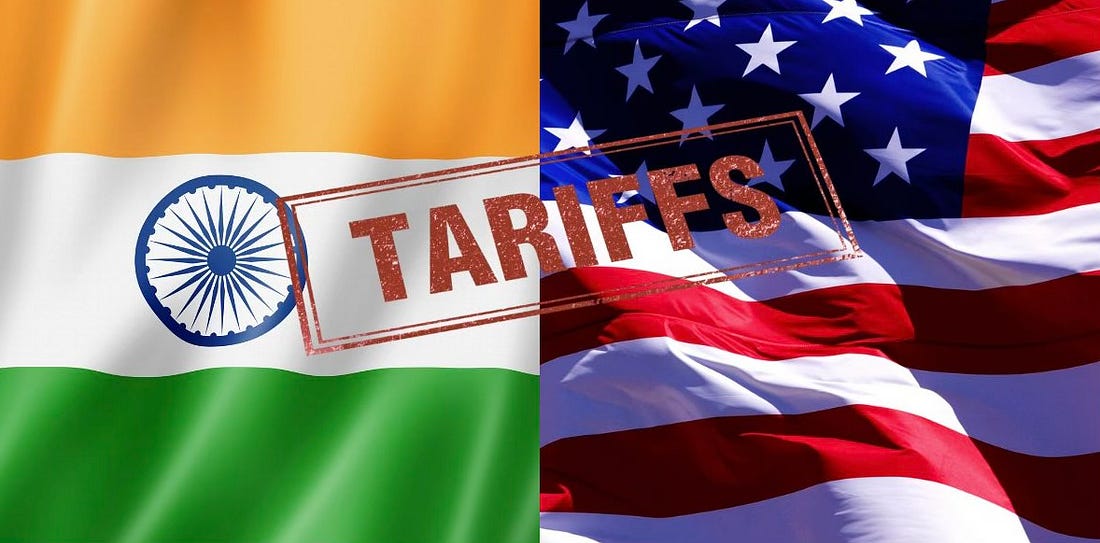
Strategic Partners or Economic Rivals? Tariffs Test India-America’s Relationship
By Regina Johnson / Sapan News
A wave of tariffs from Washington aimed at protecting America’s domestic industries and addressing trade imbalances has strained relations with India, testing the resilience of their bilateral ties.
The growing controversy over trade policy has led to a series of court cases challenging the legality of the Trump administration’s tariffs.
The tariff issue has been festering since April, when President Trump announced “reciprocal” or Liberation Day” tariffs on over 180 trading partners, including India and other South Asian countries, under the International Emergency Economic Powers Act.
In May, a three-judge panel in the US Court of International Trade in New York struck down the tariffs, including reciprocal tariffs. The court ruled that he couldn’t use the Act to reset the tariffs.
The Trump administration filed an appeal to that decision in the US Court of Appeals for the Federal Circuit, only to be thwarted again. In a 7-4 decision on 29 August the court ruled that the IEEPA does not grant the President authority to impose tariffs; that power lies with the US Congress.
The administration filed another brief to the Supreme Court on 19 September against the ruling, “Invalidating the tariffs “would have catastrophic consequences for our national security, foreign policy, and economy,” argued Solicitor General D. John Sauer– the tariffs could bring in $15 trillion in revenue to the US.
The Supreme Court will hear arguments on 5 November.
Meanwhile, India’s Prime Minister Narendra Modi met China’s President Xi Jinping at the Shanghai Cooperation Organization (SCO) summit in Tianjin, China, at the end of August where they agreed they were partners, not rivals.
An alliance between India and China leads to a combined population of nearly 3 billion and a GDP of nearly USD 23 trillion, estimates the World Bank Group.
Relationship at risk
In all of this, the US tariffs imposed on India have impacted Indian and Indian American business communities and business owners not only economically but these same communities, which historically viewed the US as a strategic partner, now feel disappointed, frustrated, and let down.
The varied, far reaching tariffs came as a shock to the Indian business leaders.
The community is puzzled about why the leadership has not devised some workaround to these problems. After all, India is a security partner in the Quadrilateral Security Dialogue alongside Australia, Japan, and the US collaborating on climate change, critical technology, health, and maritime security. Additionally, India is not alone in buying crude oil from Russia . In August 2025, China bought 47% of Russia’s crude exports, India (38%), according to data from the Center for Research on Energy and Clean Air.
“I think the concern is more about the relationship between the US and India,” says Dr Shankar Rachakonda, chairman, and treasurer of the Indian American International Chamber of Commerce . The Washington, DC-based IAICC promotes trade, investment, and business relations between India and the US.
“The key question is what broke down between the two countries that they could not come to an agreement? That India got hit with a 25% tariff and countries like Vietnam and Pakistan ended up with 19%,” Dr Rachakonda told Sapan News. “What you thought was a highly respectful relationship is not exactly in great shape because of these tariffs.”
The tariffs hit just as the America-India relationship had reached a comfortable place, transitioning over decades from their initial mutual mistrust particularly during the Cold War era, when India was close to the then Soviet Union. Since the 2000s, the US and India had developed a strategic partnership shaped by shared democratic values, economic interests, and growing geopolitical alignment.
It was then President George W. Bush “who really worked towards improving the relationship with India,” including by lifting the sanctions the US imposed on India and Pakistan after their 1998 nuclear tests, reminisced Dr Rachakonda.
Today, however, “there is a belief in India, whether right or wrong, that the relationship with the US is all transactional,” he added.
Robert Koopman, a senior lecturer at American University, DC, agrees with this view. He describes the relationship under former President Obama as “strong” and filled with more “tension or unpredictability” under President Trump.
Koopman, a former chief economist at the World Trade Organization, describes the US approach to trade under Trump as “mercantilistic, extractive” and unilateral – taking benefits rather than building cooperative, win-win relationships.
The shift
The US wants access to India’s agricultural and dairy markets, which India cannot accept,” said Dr Rachakonda. “I think India clarified that’s a big no because no Indian government can alienate the Indian farm sector.”
India’s agricultural sector is a politically sensitive area, with the government seeking to maintain high tariffs and policy flexibility to support farmers and rural development, even as global trade negotiations push for more openness. Indian farmers held massive and long drawn out protests to changes to agricultural laws in 2021 and in 2024 called for minimum crop prices .
Highlighting the shifting alliances and economic tensions, US Secretary of Commerce Howard Lutnik has said that India needs to open its markets. He criticized India’s decision to buy Russian oil, stating that before the Russian conflict, India bought less than 2% of its oil from Russia, but now it’s up to 40%.
Talking to Bloomberg, Secretary Lutnick claimed India was taking advantage of the cheap, sanctioned oil to “make money” calling this “just plain wrong” and “ridiculous.” India, he said, needs to decide which side it wants to be on – either support the US and the American consumer, and stop aligning with BRICS, a multinational alliance bringing together Brazil, Russia, India, China and South Africa.
He went on to say that he thinks India will return to trade negotiations and try to make a deal with President Trump.
Impact and uncertainty
The announced tariffs most severely affect industries such as textiles, pharmaceuticals, and jewelry, making Indian exports to the US uncompetitive. The uncertainty is discouraging investment and could cause some businesses in India or America to shut down or consider moving to other countries with lower tariffs, said Dr Rachakonda.
The garment industry will be particularly hit hard as many stores rely on fabric from India. Many businesses may shut down and “It’s mostly because of the uptick in price due to the tariffs”, he said.
India’s textile industry employs more than 100 million, with the US as its single-largest market – almost 28% of Indian textile and apparel exports go to America, says the New Delhi-based Confederation of Indian Textile Industry. In the financial year 2024-25, India exported close to USD 11 billion [₹ 966.7 billion] worth of products to the US.
WATCH VIDEO:
Amid the growing frustration over tariff-related challenges, the uncertainty is affecting planning, investment and long-term decision making.
“India has depended significantly on foreign direct investment, and US companies have invested a lot in India,” Dr Rachakonda said. He wondered if the tariffs would cut investments in India and if companies would continue to manufacture items made costlier by tariffs.
US investments in India in 2024 were valued at about USD 58.5 billion. India investments in the US were valued at USD 5.01 billion in the same year, according to the US Bureau of Economic Analysis.
Experts agree that the tariffs are forcing India and the US to reexamine their relationship with each other, and with other countries.
The BRICS alliance has always opposed a post-World War II world led by the US but now, “Trump is providing them with even more political and economic reasons to try to find ways to cooperate,” commented Mr Koopman.
America’s reduced investment in infrastructure, education, and research and development could also handicap its long-term growth, regardless of trade policy, he added.
Supporting businesses
In the midst of this chaos, IAICC is actively supporting businesses affected by the tariffs by collaborating and sharing information with media outlets and other organizations. The aim is to share expertise and provide information to the business community. Their virtual meetings and discussions also bring together stakeholders and provide a platform for support. The organization is guiding companies as they explore alternative markets and adapt new business strategies amid the shifting global trade landscape.
Dr Rachakonda who heads the organization is optimistic that the situation is temporary despite the challenges, and that the latest tariff hikes are about geopolitical strategy concerning Russia rather than India itself. He sees the tariffs as a serious but potentially resolvable issue.
There is significant short-term pain at the moment but hope for a negotiated solution in the future.
The significant short-term pain being caused by the tariffs is offset by the stakeholders’ hope - and work they are putting in -- for a negotiated solution going forward. Whether or not that happens, only time will tell.
(Regina Johnson is coordinating editor, Sapan News. She has extensively reported on America’s energy policy at S&P Global, Washington, DC. She has written articles for LATINA Style Magazine, Advisors Magazine, Inkstick Media, and Thrive Magazine. Sapan News)