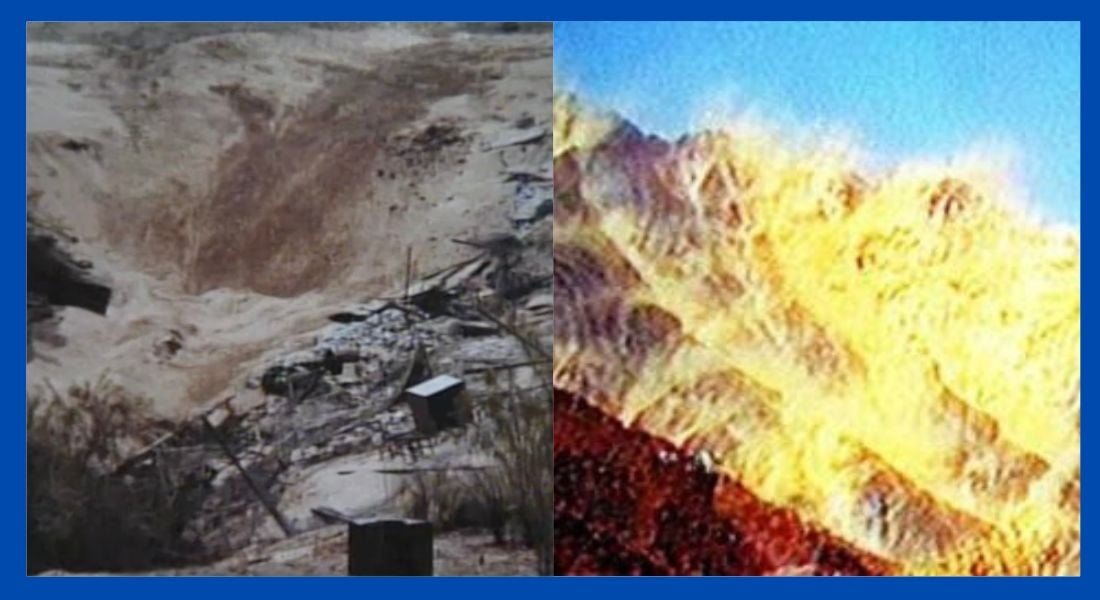
Nuclear tests conducted in India and Pakistan, May 1998 - Photos Open access. There is virtually no location in India or Pakistan where a nuclear strike would not trigger catastrophic consequences for South Asia. Their nuclear arsenal and rivalry underscores the constant threat of escalation and reminds us why global disarmament is urgent
No Joking Matter: India-Pakistan’s Nuclear Threats Make the Region Unsafe
By Ammara Ahmad
Lahore, Pakistan
The latest conflict between India and Pakistan earlier this year unfolded against a backdrop of nuclear threat and deterrence. Unlike India, which maintains a no-first-use policy, Pakistan maintains ambiguity, justifying this stance on the basis of its comparatively smaller military and arsenal.
Shehbaz Sharif, Pakistan’s Prime Minister called a meeting with the National Command Authority on 10 May, three days after the Indian airstrikes on Pakistani territory.
This highly publicized meeting with the country’s top body of officials that oversees Pakistan’s nuclear stockpile was widely seen as a signal to India that Pakistan would not hesitate to push the nuclear button if the conflict escalated.
Pakistan’s Army Chief, Field Marshal Asim Munir, then visited the United States in August – another highly publicized event. The media later quoted his address at a gathering in Tampa, Florida, in which he reportedly warned New Delhi of a potential nuclear strike.
India’s Ministry of External Affairs condemned the remarks as “saber-rattling,” accusing Pakistan of making provocative displays of military power and issuing threats. Pakistan’s Foreign Office clarified that the comments had been taken out of context and called the response “immature”.
Dangerous
Why is this endless tough talk so dangerous? There is virtually no acknowledgment of the risks or even a trace of caution when India and Pakistan challenge each other.
The reality is that a large-scale conflict, especially one that escalates to the nuclear level, would be catastrophic for both countries.
Firstly, India and Pakistan collectively house one-fifth of the global population. So, a nuclear Armageddon will lead to mass casualties even if the strikes hit remote areas.
Secondly, radiation or a potential nuclear winter will pollute the region’s waterways, soil and air to the extent that vast swaths of land become unlivable. Large populations could be displaced, suffer famines or never regain their livelihoods.
Both India and Pakistan rely on agriculture for employment and to feed their huge populations.
Nearly 18% of India’s GDP depends on agriculture and employs 45.5% of India’s workforce, according to the 2021-22 Periodic Labor Force Survey.
In Pakistan, where most of the country is at risk of floods and drought, roughly 24% of the economy depends on agriculture, which employed over 37% of its population in 2023, according to the Pakistan Economic Survey 2024-2025.
Even today, there are pockets in both countries that are food insecure. Additionally, many depend on agriculture for the export of raw materials like cotton, rice and spices.
In fact, the Integrated Food Security Phase Classification, an international initiative for enhancing food security and nutrition analysis, reported that last year roughly 24% of Pakistan's districts had some degree of food insecurity , with more than 1.5 million people facing a severe hunger crisis.
India, now the world’s most populous country, has experienced steady economic growth and achieved self-sufficiency in grain production. However, widespread poverty, food insecurity, and malnutrition still continue. Anemia affects 57%of women and 67% of India’s children, reports the World Food Program.
The National Family Health Survey -5 (2019–21), produced by the Ministry of Health and Family Welfare of the Government of India, further highlights alarming trends in child nutrition, providing district-level estimates for crucial indicators. Nearly 35.5% of children under five are stunted (indicating chronic malnutrition), over 19% are wasted (low weight for height), and more than 32% are underweight, according to the report.
The disruption caused by nuclear explosions to food systems could affect up to two billion people.
If a nuclear war contaminates even a small percentage of the soil or water, food insecurity will intensify multifold given that a few agricultural areas feed most of the population.
Carrier’s warning
The nuclear winter caused by explosions would transform the region i nto a bleak and hostile environment, as the late Harvard University professor George F. Carrier, one of the world’s leading applied mathematicians, explains in his research paper “ Nuclear Winter: The State of Science ,” published by the National Institute of Health, 1986.
The detonation of even a fraction of our combined nuclear arsenals over cities would create massive firestorms, sending five to seven million tons of black carbon soot into the stratosphere, according to Carrier.
While this soot would spread globally, it would most immediately and intensely impact the Indian subcontinent, where sunlight could be reduced by 20–30%, plunging the region into prolonged darkness. Temperatures across India, Pakistan, and neighboring countries could drop by 2–5°C, devastating a region dependent on monsoon cycles and year-round agriculture.
The South Asian monsoon, which sustains over a billion people, would likely weaken or end, explains Carrier, causing crop failures. Rainfall could decline by up to 80%, leading to drought-like conditions in both rural and urban areas. Fields would wither and rivers would dry. The skies would remain hazy and dim, and the psychological toll of living in a cold, darkened, irradiated landscape would be immense, with long-lasting effects for generations to come.
“Even modern nuclear weapons with lower yields and precision targeting, still pose devastating radiation risks and retain the potential to trigger nuclear winter scenarios,” Dr Rabia Akhtar, a professor of international relations, currently a Visiting Scholar at Managing the Atom, Belfer Center at the Harvard Kennedy School.
South Asian societies are still largely agrarian, this would lead to widespread agricultural collapse – “beyond our region, and intensify global food insecurity, affecting not just those nations that used nuclear weapons but the entire planet,” she told Sapan News.
Cities struck by nuclear blasts would become radioactive wastelands, displacing tens of millions and overwhelming already strained infrastructure. The urban centers in both countries could become cancer hubs.
The impact on biodiversity will be equally devastating, with both immediate and long-term consequences. The initial blasts and firestorms could burn forests, wetlands, and grasslands, destroying habitats for thousands of species. These include important fragile ecosystems, uniquely adapted to harsh and varied climates ranging from the Western Ghats and, the Sundarbans, Thar Desert, and Himalayan foothills, to the Karakoram and Hindu Kush mountains to the Indus River Delta, and coastal mangroves.
Threatened ecosystems
All these ecosystems could face radiation fallout, toxic air, and acid rain, leading to mass die-offs of plants, animals, and microorganisms. This would also of course affect monsoon-dependent biodiversity like amphibians, reptiles, and migratory birds. Agricultural collapse could push humans to overexploit forests and wildlife, worsening deforestation, poaching, and species extinction. The Indus River, a lifeline for both agriculture and biodiversity, would be at high risk from nuclear fallout, industrial fires, and infrastructure collapse, severely affecting aquatic species like the endangered Indus River dolphin, freshwater turtles, and native fish. Pakistan’s wildlife in protected areas, such as the Chiltan Hazarganji National Park, Hingol National Park, and Khunjerab National Park could suffer mass mortality. Migratory species using Pakistan as a corridor or breeding ground like cranes, raptors, and shorebirds would see their routes disrupted.
Biodiversity conservation is already underfunded in this region; a post-war collapse of governance and ecological oversight could lead to unregulated exploitation and ecosystem breakdowns that could push many native species toward extinction.
“It is not just biodiversity loss but entire planetary health will be at stake,” Zofeen T. Ebrahim, the former Pakistan editor of The Third Pole network , told Sapan News. “What happens in Pakistan or India will not remain within the geographic boundaries of the two. Waters don’t respect boundaries neither does air.”
There is a new hypothesis that modern nuclear bombs don’t have a radiation problem like those that destroyed Hiroshima and Nagasaki. This theory was floated by Niel de Grass Tyson and later picked up on social media.
Certainly, the new bombs are more sophisticated and may be 'better' at killing instantly and 'cleaner' per kiloton, says Dr Rabia Akhtar. “But the scale of devastation is incomparably larger, and radiation would still be widespread enough to cause long-term environmental and human catastrophe.”
“In the India-Pakistan case, there is no difference between targeting military targets like nuclear assets and civilian targets like urban centers,” she adds. “Any large-scale nuclear war would involve hundreds or thousands of detonations, and even if individual bombs are smaller, or ‘cleaner’ as the pro-nuke lobby puts it, the cumulative radioactive and environmental effects would still be catastrophic.” Besides India and Pakistan, the world’s nuclear-armed countries are China, France, Israel, North Korea, Russia, and the United States, according to the United Nations. However, the seriousness of the issue is largely ignored or misunderstood. During the conflict in May, people joked that they wanted to see the A-bomb exploding before they went to sleep. Well, not funny.
“To me, it’s a suicide mission which I have certainly not signed up for, nor have the people in both the countries!” says Zofeen T. Ebrahim.
Listening to media pundits and politicians on both sides, it seems each believes they can emerge from the conflict unscathed. We need more responsible political and media narratives in India and Pakistan. We must acknowledge the grave risks of a confrontation between nuclear-armed states and prioritize the urgent need to begin a peace process.
(Ammara Ahmad is a journalist and writer from Lahore. Website: www.ammaraahmad.com .
A Sapan News syndicated feature for September 26, International Day for the Total Elimination of Nuclear Weapons.)