
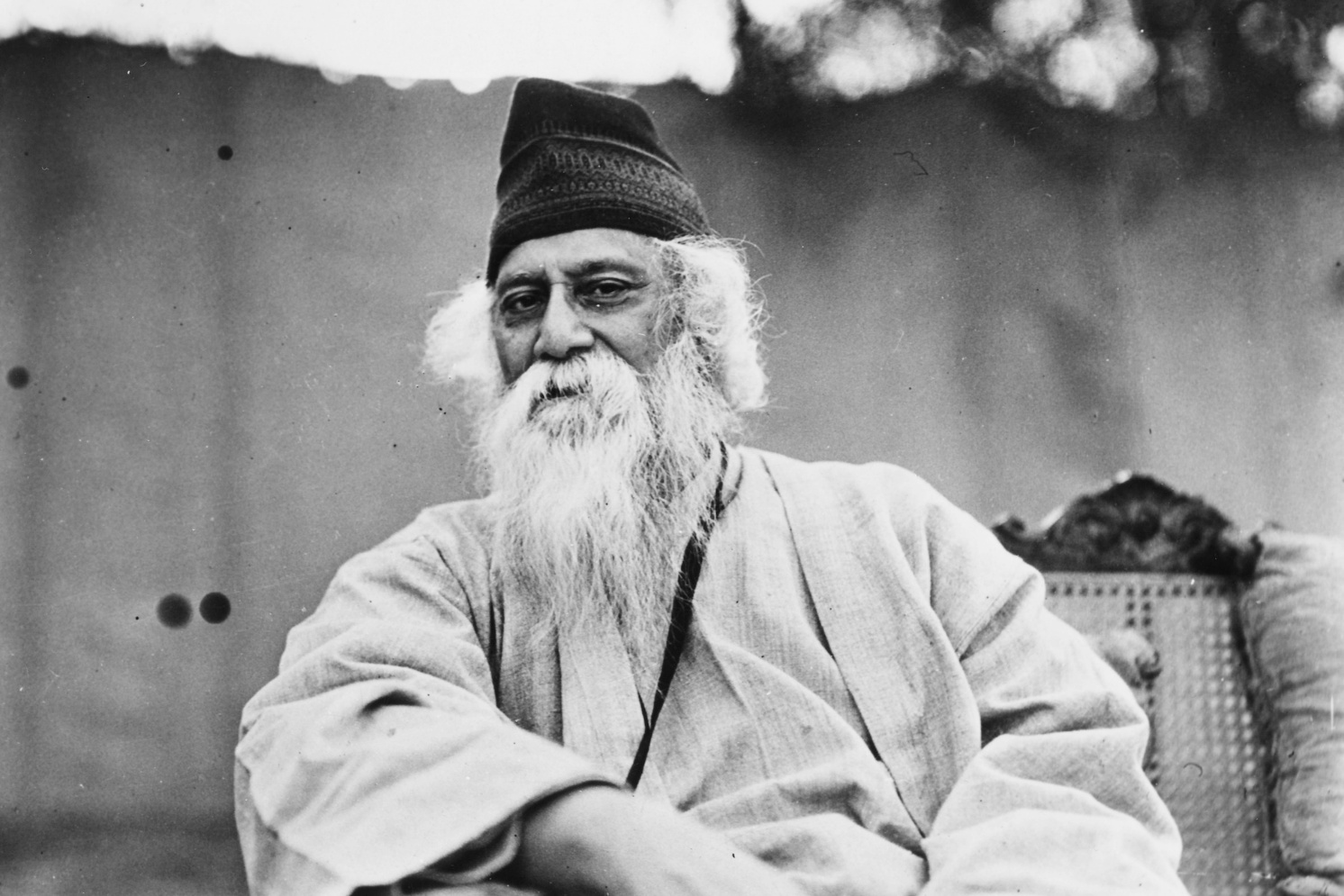
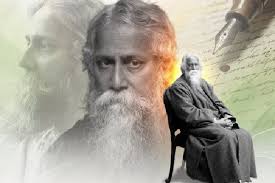
Photo Poetry Foundation
Gurudev Tagore: The Bard of Bengal - 2
By Akbar Ahmed, Frankie Martin, Dr Amineh Hoti
There is no better way to enter a discussion of Tagore’s views of nationalism, one of the central themes in his thought and writing, than through one of his most acclaimed novels, The Home and the World (1916). In the book, which was later adapted into a film by the renowned Indian filmmaker Satyajit Ray, two Begali Hindu friends, Nikhil and Sandip, compete for the affection of Nikhil’s wife Bimala. Bimala is a Hindu woman who Nikhil, a wealthy landlord, has encouraged to come out of traditional gender seclusion, or purdah. Nikhil, who is firmly modern in his sensibilities and has drawn his universalist philosophical religious views concerning the unity of all from the Upanishads, ensured that Bimala has been exposed to the culture of both India and the West. Sandip, on the other hand, is a firebrand activist of the Swadeshi nationalist movement who sees Bengal and India as a divine goddess which must be purified of foreign influence. While Nikhil embraces Muslims as a “necessary” part of India, Sandip is anti-Muslim, vowing, “they must be suppressed altogether and made to understand that we are the masters.” The humanist Nikhil is very similar in outlook and social position to Tagore himself, Sandip voices the Hindu nationalist perspective, and Bimala represents Bengal and India. Like Bimala, India is a developing traditional society that is faced with two models of modernity—all-embracing universalism or the exclusivist nationalism of the Western nation-state model. Bimala is torn between both men, and the tale ends in tragedy.
An Urgent Warning on Nationalism
While Tagore did all he could to stem the tide of nationalism, the tragic fate of the characters of The Home and the World reflect what Tagore was seeing around him and his fears for the future of India and humanity in general. On the final day of the nineteenth century, he had prophesied the horrors of the twentieth, writing,
“The last sun of the century sets amidst the blood-
red clouds of the West and the whirlwind of hatred.
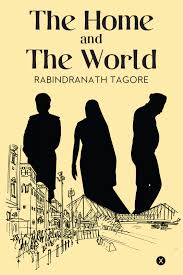
While Tagore did all he could to stem the tide of nationalism, the tragic fate of the characters of The Home and the World reflect what Tagore was seeing around him and his fears for the future of India and humanity in general
The naked passion of self-love of Nations, in its
drunken delirium of greed, is dancing to the
clash of steel and the howling verses of
vengeance.”
During the First World War, Tagore saw Western nations tear each other apart, and he died during the Second World War, when it was all happening again. Nehru, writing from prison during the worst of the Second World War, expressed some relief that Tagore had not lived to see it, stating, “Perhaps it is as well that [Tagore] died now and did not see the many horrors that are likely to descend in increasing measure on the world and on India.”
Tagore was clear that what he saw as the problem was not “Europe” per se, but a model of identity and political organization developed in Europe. Tagore lamented what nationalism was doing to Europeans, who he argued had great legacies of humanism, spirituality, and rule of law. Tagore contended that Europe’s virtues included stressing “the higher obligations of public good above those of the family and the clan,” “liberty of conscience,” the continent’s “Christian culture of centuries” which inspired those who “stood up for the rights of man irrespective of color and creed,” and its medical advances and achievement in “alleviating those miseries of man which up till now we were contented to accept in a spirit of hopeless resignation.”
And yet, Tagore believed that the ideology of the nation was emerging supreme, which was challenging all of this and driving the Western nations to “suicide.” Nationalism, Tagore asserted, is “a cruel epidemic of evil” that has humanity in its “iron grip.”
Tagore defined nationalism as “the aspect of a whole people as an organized power.” For him nationalism was a product of modernity and has both a social identity and a technological and economic component. It is about power and the self-preservation of the “people” or “race.” Nationalism posits how a modern people is to be organized and how they are to relate to others. Tagore saw the nation as connected intimately with the scientific advances and mechanics that bring it into being, building up a vast structure that disconnects people from one another. Nationalism is a “poison” contained within modernity which he believed would bring humanity to ruin. It is based on “exclusiveness,” and, concerning the “Other,” it “is always watchful to keep at bay the aliens or to exterminate them.”
Tagore argued that nationalism is inculcated through state policy, particularly in the field of education. Under nationalism, Tagore stated, “the whole people is being taught from boyhood to foster hatreds and ambitions by all kinds of means, by the manufacture of half-truths and untruths in history, by persistent misrepresentation of other races and the culture of unfavorable sentiments towards them, by setting up memorials of events, very often false, which for the sake of humanity should be speedily forgotten, thus continually brewing evil menace towards neighbors and nations other than their own. This is poisoning the very fountainhead of humanity.
Tagore also felt that nationalism on the Western model was challenging and overturning millennia of moral and spiritual teachings. Spirituality was now being diverted away from the Unity of all inwards towards the “Self” and one’s own group, people, religion, or race. Spirituality was thus being distorted to the extent that people were not even aware of what was being altered and what was being lost.
For Tagore, nationalism was about the ego which, the great religions teach us, prevents us from encountering the “Other”—he described nationalism as “organized selfishness.” The nation with its “pure” people becomes a god to be worshipped, as Sandip does in The Home and the World, part of what Tagore calls “The Cult of the Nation.” Nationalism is the ego run amuck. There is additionally a strong element of a desire for economic gain and greed in nationalism, to make the nation rich at the expense of others. The people of the world, Tagore observed, witness “successful” nations prospering in “commercial adventures or in foreign possessions, or in both” and conclude that “for a nation, selfishness is a necessity and therefore a virtue.”
Whereas relationships between countries have the potential to be amicable and embracing, Tagore believed that nationalism was harming international relations. Nationalism fostered “suspicion” and “distrust” between countries, with relations determined on the question of national self-interest. Under nationalism, Tagore argued, “Nation can only trust Nation where their interests coalesce, orat least do not conflict.” Each country is perpetually “casting its net of espionage into the slimy bottom of the others, fishing for their secrets, the treacherous secrets brewing in the oozy depths of diplomacy.”
Tagore was particularly concerned that non-Europeans—the subjects of the European empires and those of rapidly “developing” countries, would turn their backs on their own histories of inclusion to unthinkingly embrace Western-style nationalism. As Tagore put it, nationalism “is ready to send its poisonous fluid into the vitals of the other living peoples, who, not being nations, are harmless.” In Tagore’s visits to Asian countries like Japan and China he implored his audiences not to adopt the model of Western nationalism lest they lead themselves to ruin. He exhorted the Japanese, for example, to “never to follow the West in its acceptance of the organized selfishness of Nationalism as its religion, never to gloat upon the feebleness of its neighbors, never to be unscrupulous in its behavior to the weak, where it can be gloriously mean with impunity, while turning its right cheek of brighter humanity for the kiss of admiration to those who have the power to deal it a blow.” Instead, Japan “must infuse the sap of a fuller humanity into the heart of the modern civilization” by taking and contributing its own unique humanistic culture to the world.
Tagore believed that the world was in danger of being seduced by the modern model of the nation which posits “scientific” ideas as objective truth and in the process ignores morality. Thus, what we think of as “modern,” “advanced,” and “cutting edge” is often totally amoral, but it is seen as a virtue and not a vice by peoples seeking modernity to the extent that they are ready to shed their own deep moral traditions in favor of it. Basing state policy on ideas like “Survival of the Fittest,” believing it to be “scientific” as Tagore felt Japan was in danger of doing, was a reductionist distortion of reality—it “immediately transforms the whole world of human personality into a monotonous desert of abstraction, where things become dreadfully simple.”
Rabindranath Tagore, The Home and the World (London: Penguin Books, 2005), p. 120.
Tagore, Nationalism, p. 157.
Amartya Sen, “Tagore and his India,” The Nobel Prize, August 28, 2001: https://www.nobelprize.org/prizes/literature/1913/tagore/article/
Rabindranath Tagore, The Spirit of Japan: A Lecture (Tokyo: The Indo-Japanese Association, 1916), p. 32.
Tagore, Nationalism, p. 83.
Tagore, Nationalism, p. 85.
Tagore, Nationalism, p. 87.
Tagore, Nationalism, p. 27.
Tagore, Nationalism, pp. 131-132.
Tagore, The Religion of Man, p. 159.
Tagore, Nationalism, p. 76.
Tagore, Nationalism, pp. 98-99.
Tagore, Creative Unity, p. 151.
Tagore, Creative Unity, p. 120.
Tagore, Creative Unity, p. 146.
Tagore, Creative Unity, p. 150.
Tagore, Nationalism, p. 54.
Tagore, Nationalism, p. 54.
Tagore, Nationalism, pp. 51-52.
Tagore, Creative Unity, p. 43.
Tagore, Nationalism, pp. 52-53.
Tagore, Nationalism, p. 87.
Tagore, Personality, p. 52. Such “scientific” ideas should not form the basis for the morality of a state. Instead, modern peoples and states must not forget timeless human moral lessons concerning the “Other”: “those who can see, know that men are so closely knit, that when you strike others the blow comes back to yourself. The moral law, which is the greatest discovery of man, is the discovery of this wonderful truth, that man becomes all the truer, the more he realizes himself in others.” Nations “who sedulously cultivate moral blindness as the cult of patriotism,” however, “will end their existence in a sudden and violent death.” “Never think for a moment,” Tagore warned, “that the hurts you inflict upon other races will not infect you, and the enmities you sow around your homes will be a wall of protection to you for all time to come.”
As scholars have noted, Tagore’s views of nationalism contributed to his decline in popularity in Europe and the United States, where he had initially made a considerable impact. In Asia, nationalists also voiced their opposition to Tagore. In Japan, there was growing hostility against Tagore as he spoke out against Japan’s invasions of neighboring countries, describing Japan as a “menace to the
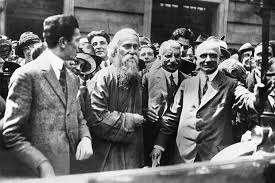
Tagore’s views of nationalism contributed to his decline in popularity in Europe and the United States, where he had initially made a considerable impact
defenseless peoples of the East.” In Beijing, China, a leaflet was circulated during Tagore’s visit which read, “Dr Tagore would have nationality and politics abolished, replacing them with the consolidation of one’s soul. These are a refuge and a source of aesthetic joy for the sluggards, but not for us. We cannot but oppose Dr Tagore, who upholds these things which would shorten the life of our nation.” In India, the Hindu nationalist Rashtriya Swayamsevak Sangh (RSS) organization reportedly forbade members from reading Tagore’s work.
Tagore’s Vision for India
When Tagore passed away in 1941, India was on the threshold of independence which would follow six years later. While he never experienced an independent India himself, he outlined clearly in his life’s work his vision for the country. For Tagore, India’s essential identity lies in its deep spiritual roots reflected in the Upanishads going back thousands of years—this identity is again characterized by a unity of its many constituent parts and peoples. As Tagore argued, “It is of this harmony, and not of a barren isolation that the Upanishad speaks.” Harmony itself, as reflected in Tagore’s understanding of the divine Unity, was of crucial importance in India and everywhere else. As he argued, “Harmony is the very basis of society.”
In contrast, Tagore believed that nationalists in India were upsetting this harmony by focusing on a fragmented and segmented understanding of identity that did not take into account the nation as it really was. This included their understanding of history and its link to social identity in the present. Examining the ideology of most Indian nationalists of his time, for example, Tagore detected a devotion to the supposed perfection of the past over the process of diverse national consolidation and coexistence. The nationalists had the belief, Tagore said, “That our forefathers, three thousand years ago, had finished extracting all that was of value from the universe.” They held “that we have come to a final completeness in our social and spiritual ideals, the task of the constructive work of society having been done several thousand years before we were born” by “superhuman” ancestors possessing “supernatural power.” This perception of past perfection meant that “all our miseries and shortcomings” are blamed on the “Other”—“the historical surprises that burst upon us from outside.”
Such a belief, which confines “the entire nation…to the past forever” means “there is no possibility of us melding with one another,” a process which is essential for a nation. It will only lead to isolation and ultimately death because, “If we insist on segregating ourselves in our pride of exclusiveness, fondly clinging to the belief that Providence is specially concerned in our own particular development...our institutions as specially fit only for ourselves, our places of worship as requiring to be carefully guarded against all incomers, our wisdom as dependent for its safety on being locked up in our strong rooms; then we shall simply await, in the prison of our own contriving, for the execution of the death sentence which in that case the world of humanity will surely pronounce against us.” Instead, India should “make a fresh start on the highway of time” with “wisdom, love and work, in the expansion of insight, knowledge and mutuality.”
In outlining his own interpretation of national identity, he described “the true Indian view” as attaining a consciousness in which we understand “all things as spiritually one.” He spoke of India’s “genius for synthesis” and “power of binding together,” and argued, “The realization of unity in diversity, the establishment of a synthesis amidst variety, —that is the inherent, the Sanatan Dharma [Eternal Order] of India. India does not admit difference to be conflict, nor does she espy an enemy in every stranger. So, she repels none, destroys none; she abjures no methods, recognizes the greatness of all ideals; and she seeks to bring them all into one grand harmony.”
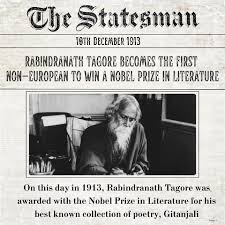
India should “make a fresh start on the highway of time” with “wisdom, love and work, in the expansion of insight, knowledge and mutuality.”
“India,” Tagore said in his Nobel Prize acceptance speech, “is there to unite all human races.”
Examining Indian culture and history, Tagore discerned generally good relations across cultural and religious boundaries in India: “Whomsoever we came into contact with we drew into the circle of relationship,” including “neighbors and villagers irrespective of race or caste. The householder was bound by family ties to preceptor and teacher, guest and wayfarer, landlord and tenant,—not ties prescribed by religion or law, but of the heart.” In India there was what Tagore described as an “adjustment of races, to acknowledge the real differences between them where these exist, and yet seek for some basis of unity. This basis has come through our saints, like Nanak, Kabir, [the Bengali Hindu saint] Chaitnaya and others, preaching one God to all races of India.” Tagore concluded, “To establish a personal relationship between man and man was always India’s main endeavor.”
Tagore, Nationalism, p. 97.
Tagore, Nationalism, p. 97.
Tagore, Nationalism, pp. 98-99.
Alam and Chakravarty, “Introduction,” pp. 13-14.
Alam and Chakravarty, “Introduction,” p. 14; Amartya Sen, “Tagore and his India,” The Nobel Prize, August 28, 2001: https://www.nobelprize.org/prizes/literature/1913/tagore/article/
Alam and Chakravarty, “Introduction,” p. 14.
Rahul Bhatia, “‘Nobody knows what I know’: How a loyal RSS member abandoned Hindu nationalism,” The Guardian, August 1, 2024.
Tagore, The Religion of Man, p. 182.
O’Connell, “Foreword to the Second Edition,” p. xii.
Tagore, Greater India, p. 86.
Tagore, Nationalism, pp. 144-145.
Tagore, Nationalism, pp. 144-145.
Alam and Chakravarty, The Essential Tagore, pp. 197-198.
Tagore, Greater India, p. 84.
Tagore, Greater India, p. 86.
Tagore, Creative Unity, p. 49.
Tagore, Greater India, p. 27.
Tagore, Greater India, p. 25.
Tagore, Greater India, p. 31.
Mohammad A. Quayum, “Nationalism, Patriotism, Cosmopolitanism: Tagore’s Ambiguities and Paradoxes (Part II),” The Daily Star, April 4, 2020.
Tagore, Greater India, p. 16.
Tagore, Nationalism, p. 119.
Tagore, Greater India, p. 16. This meant that for Tagore, the history of India was not only the history of the Hindus. He argued, “in the evolving History of India, the principle at work is not the ultimate glorification of the Hindu, or any other race.” Tagore used the metaphor of water to discuss religious identity in India, stating that Indian culture was like a “river” which initially included the “streams” of “the Vedic, the Puranic, the Buddhist, and the Jain.” Yet he explained that just as a river in a particular country includes not only its own waters but waters from afar—the Brahmaputra River, he points out, originates in Tibet but nonetheless flows into the mighty Indian Ganges—other religions have joined Indian culture. Speaking of Islam, Tagore stated that the “The Muhammadan…has repeatedly come into India from outside, laden with his own stores of knowledge and feeling
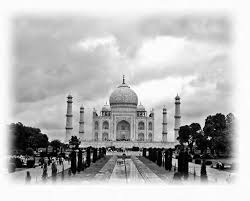
Speaking of Islam, Tagore stated that the “The Muhammadan…has repeatedly come into India from outside, laden with his own stores of knowledge and feeling
and his wonderful religious democracy, bringing freshet after freshet to swell the current. To our music, ourarchitecture, our pictorial art, our literature, the Muhammadans have made their permanent and precious contribution. Those who have studied the lives and writings of our medieval saints, and all the great religious movements that sprang up in the time of the Muhammadan rule, know how deep is our debt to this foreign current that has so intimately mingled with our life.”
and his wonderful religious democracy, bringing freshet after freshet to swell the current. To our music, our architecture, our pictorial art, our literature, the Muhammadans have made their permanent and precious contribution. Those who have studied the lives and writings of our medieval saints, and all the great religious movements that sprang up in the time of the Muhammadan rule, know how deep is our debt to this foreign current that has so intimately mingled with our life.”
When Islam arrived in India, Tagore explained, “Synthetical re-actions began almost immediately, and a common ground was in course of preparation where the boundary lines between Hindu and Muslim were growing fainter and fainter.” For centuries, Tagore said, “Hindus and Mussalmans have…been brought up together in the arms of the same Motherland.”
The same is true of the English and European Christians in India. Like groups such as the Dravidians, Aryans, Greeks, Persians, and Muslims who arrived in India before them, Tagore asserted, the English were now part of the nation: “ At last now has come the turn of the English to become true to this history and bring to it the tribute of their life, and we neither have the right nor the power to exclude this people from the building of the destiny of India.” A pluralistic, independent India, Tagore hoped, could facilitate “ a reconciliation” and “deep association” with the West. In addition to these essential influences on India, Tagore also noted the role and presence of Sikhism and Zoroastrianism, and further observed the deep connections India historically had with “The Chinese, Japanese, and Tibetan” cultures.
Tagore celebrated that, as he stated, “all the four great religions of the world are here together—Hinduism, Buddhism, Mohamedanism, and Christianity. It is evident that India is God’s chemical factory for the making of a supreme religious synthesis.”
Nationalism in many ways is about who is understood to constitute the “We” of the nation and who is considered the “Other” or outsider. Given his extensive writings on nationalism, Tagore was aware that in the modern world nation-states constitute themselves into a citizenry and pursue their policies internationally. For this they must have some basis of coming together. In India, opposition to the English alone, Tagore argued, was not enough to forge a nation. For Tagore, the only viable model was that of Indian synthesis based in love, and he was clear that it is only the diverse peoples of India collectively who should decide the affairs of the nation. Tagore asked, “Who is this ‘We’? Bengali, Marathi or Panjabi, Hindu or Mussalman? Only the larger ‘We’ in whom all these,—Hindu[,] Moslem and Englishman, and whosoever else there be,—may eventually unite shall have the right to dictate who is to remain and who is to leave.”
With India thus constituted, it could play its role on the world stage for the benefit of all humanity—because what was the world if not a macrocosm of the unity in diversity that India represented? As Tagore contended, “That we in India should attain Unity, is a much greater thing than any particular purpose which our union may serve,—for it is a function of our humanity itself.” For Indians who may feel that embracing religions like Christianity and Islam was against Hinduism, Tagore argued that it “will not be un-Hindu, it will be more especially Hindu.” Tagore was emphatic that, for example, “No holy book states Hindus must hate Muslims.” He found in India a “breadth of understanding in which the differences of East and West do not hurt, or conflict with, one another, but where both find their ultimate harmony.”
Thus, India had a mission, a sacred mission, not only to constitute itself into a modern nation incorporating all of its diverse people, but provide its model to a world in crisis. In doing so the world could benefit and follow this course towards global unity—to, in Tagore’s language, “realize the truth of the human soul in the Supreme Soul through its union with the soul of the world…it still urges us to seek for the vision of the infinite in all forms of creation, in the human relationships of love, to feel it in the air we breathe, in the light in which we open our eyes, in the water in which we bathe, in the earth on which we live and die.” He also felt that Asia in general had this similar potential as India, to illuminate the world like the Eastern morning sun and help humanity reach the ideal of unity. And he issued a warning, to India, Asia, and the world, that “unless we discover the ties which unify us and endeavor to strengthen them, we are doomed.”
In terms of a practical model from the past that India—and the world—could look to, Tagore pointed to India under Akbar the Great. Taking the title of a Tennyson poem about Akbar, Tagore called on Indians to achieve “Akbar’s Dream”—a Subcontinent united through love. As Tagore explained, “ Love is a unifying principle not a divisive one.
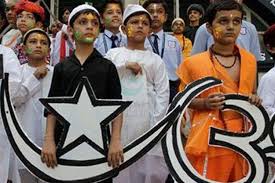
Tagore attributed much of the Hindu-Muslim conflict to “our scant knowledge of each other. We live side by side and yet very often our worlds are entirely different.”
Akbar’s attempt at resolving all the religious differences by forging a bond of love was a unifying gesture.”
Yet, new hatreds were spreading, Tagore observed, and “the lack of love is so greatly felt in this country that people have become apprehensive and restless.” Tagore saw this particularly in what he called “the terrible animosity between the Hindus and the Moslems which is growing by the day.” Tagore attributed much of the Hindu-Muslim conflict to “our scant knowledge of each other. We live side by side and yet very often our worlds are entirely different.” British administration was playing a role because, Tagore explained, “the English policy lacks that ideal of love by which Akbar tried to unite fragmented India…laws and disciplinary measures cannot unite people; you need to enter into their hearts, understand their sufferings, and have to love them sincerely,—you need to approach them, hold their hands and unite them. Trying to restore peace solely by employing police force and handcuffs may vouch for overwhelming authority but that is not exactly what Akbar’s dream was all about.” Tagore argued, “It is only through sympathetic understanding of each other’s culture and social customs and conventions that we can create an atmosphere of peace and goodwill.” For India to succeed in the future and become a truly
Tagore, Greater India, p. 82.
Tagore, Creative Unity, p. 194.
Tagore, Creative Unity, pp. 194-195.
Tagore, Greater India, p. 28.
Tagore, Greater India, p. 59.
Tagore, Nationalism, p. 27.
Tagore, Nationalism, p. 26.
Tagore, Nationalism, pp. 130-131.
Tagore, Creative Unity, p. 195.
Tagore, Greater India, p. 28.
Alam and Chakravarty, The Essential Tagore, p. 147.
Alam and Chakravarty, The Essential Tagore, pp. 146-147.
Tagore, Greater India, p. 86.
Tagore, Greater India, p. 91.
Tagore, Greater India, p. 32.
Alam and Chakravarty, The Essential Tagore, p. 142.
Tagore, Greater India, p. 90.
Tagore, Personality, pp. 167-168.
Tagore, The Spirit of Japan, p. 35.
Tagore, Greater India, p. 63.
Sanyal, “The Englishmen and the Indians,” p. 116.
Sanyal, “The Englishmen and the Indians,” p. 117.
Sanyal, “The Englishmen and the Indians,” p. 117.
Quayum, “Rabindranath Tagore,” p. 393.
Sanyal, “The Englishmen and the Indians,” p. 117.
Quayum, “Rabindranath Tagore,” p. 393. mighty nation, Tagore was adamant, it would have to reach out to the “Other” in love—exactly as Akbar did, in human to human relationships bringing together Indians of all religions and communities to fulfill their destiny and guide the people, nation, and the world to see each another as One. In the field of global race relations, for example, Tagore hoped India could “ begin this wider work of racial reconciliation throughout the world.”

Tagore saw in the US potential to lead the world in forging unity in diversity. Like India, Tagore said, the US is “welding together into one body various races”
Let us note here that Tagore saw in the US a similar potential to lead the world in forging unity in diversity. Like India, Tagore said, the US is “welding together into one body various races,” and he explained, “In my country, we have been seeking to find out something common to all races, which will prove their real unity. No nation looking for a mere political or commercial basis of unity will find such a solution sufficient. Men of thought and power will discover the spiritual unity, will realize it, and preach it.” He described the US as a “country of expectation, desiring something else than what is” which, unlike Europe, “is not pessimistic or blasé.” Tagore argued, “of all countries of the earth America has to be fully conscious of this future, her vision must not be obscured and her faith in humanity must be strong with the strength of youth. ”
The Legacy and Urgency of Tagore
Looking at the present state of both India and the world, we are far from what we may call Tagore’s Dream. Across the globe, nationalism has surged, and in India, Akbar has reportedly been removed entirely from the all-India undergraduate syllabus promulgated by the central government run by the ruling Hindu nationalist Bharatiya Janata Party (BJP).
Yet this is precisely the reason that Gurudev Tagore is needed today more than ever. For Bengalis, Tagore remains an incredibly important figure. Dr Shilpa Das Gupta, from West Bengal, India, and a senior official at American University in Washington DC, is the host of the Ohh Folk folktale storytelling podcast. When asked what Tagore means to her today, she replied, “Rabindranath isn’t just a poet I read or a melody I sang in school functions and local shows—he is the music behind my childhood memories, the scent of Shiuli (Coral jasmine) in my middle-class Bengali autumns of adolescence. He lives in my lullabies, celebrations, rebellions, beginnings, tears, and prayers. As someone who takes immense pride in being a Bengali by birth, I think, he is not just a heritage— he is bloodstream. And even today, in the chaos of reels and hashtags, his words whisper to the new generation of Bengalis: to pause, to feel, to dream deeper. Rabindranath still knows how to speak to our wounds, in a language truer than time.” Muslim Bengalis also continue to hold Tagore in deep reverence, as attested by these words by Dr Tareque Mehdi of Bangladesh which were shared with us. Mehdi, founder of the Bangla Collective which connects the global Bengali community, stated, “Rabindranath Tagore is not just a writer; he is a polymath who has seamlessly bridged the past and the present in his writings and philosophy. His life-inspired writings remain just as relevant to me and today’s generation because he captured those timeless human emotions and insights that continue to resonate across ages.”
It is time for South Asia generally, the West, and the world to recover what Bengalis already appreciate—the greatness and relevance of Tagore for our fraught world. For Tagore’s beloved India and the other nations of South Asia which have emerged after independence—Bangladesh, Pakistan, and Sri Lanka—Tagore presents a vision of unity and love both within and between nations. The independent status of the different countries should not prevent their governments and peoples from coming together in the cause of unity and forging better and closer relations. The stakes are high, as Tagore argued, “Either we shall be saved together, or drawn together into destruction.”
Then there is the importance of, as Tagore phrased it, the home and the world—the linkage of one’s own native land with humanity and the unity of all. Like other Minglers, Tagore stressed that we need to think of the welfare of our “own” people and location and the world at the same time, because all are connected. Tagore’s work is suffused with affection for Bengal—his song which serves as the national anthem of Bangladesh begins “I love you, my Bengal of gold”—and for the world at large, for him there is no contradiction. As he explained, “Man has two aspects; on the one hand he is isolated and independent; on the other hand, he is related to all. To ignore any one of these aspects would be unreal.” “The problem the world over,” he further observed, “is not how to become one through removing individual differences, but how to unite through preserving them”—this means that the solution is “Neither the colorless vagueness of cosmopolitanism, nor the fierce self-idolatry of nation-worship.” Problems facing only “one’s own nation” cannot be solved unless “the problem of the entire mankind is solved.” While we may fear the “Other” and the unknown, for example the world outside our home, Tagore wants us not to be afraid, but to know that in a profound way the world is our home. His perspective comes through clearly in these verses addressing the divine: “Thou hast made the distant near and made a brother of the stranger. / I am uneasy at heart when I have to leave my accustomed shelter, I forget that there abides the old in the new, and that there also thou abidest.”
One positive example and model Tagore gives of home meeting the world is the mela festivals of Bengal, whereupon small rural villages embrace the world at large. On such festive occasions, Tagore explained, “the village forgets its narrowness in a hospitable expansion of heart. Just as in the rains the water-courses are filled with water from the sky, so in mela time the village heart is filled with the spirit of the Universal…those who come to a mela are already in the open, holiday mood, for they have left plough and hoe and all cares behind.” However, they still retain, as the village, their own unique identity—as Tagore notes, “ Personality, at the human level, can only be realized through locale, through the immediate culture and language and land to which one belongs.” This idea is evident in Tagore’s Santiniketan school and his expressed hope: “Let the illusory geographical boundary lines vanish from at least one spot in India. Let the whole world settle there fully. Let our ‘Santiniketan’ be that spot.”
The mela and Santiniketan are examples of Tagore’s central teaching that each people, culture, religion, nation, and civilization cultivates what it is to be human in their own particular way while reaching towards the universal. It is on this basis that people should be able to have dialogue and make their contribution to a global civilization, as all are reaching towards the same unity. He stated, “every nation is a member of humanity, and each must render an account of what it has created for the weal of mankind. By the measure of such contribution does each nation gain its place.” The Sanskrit term used for civilization, sabhyatā, itself means “the state of being one with the many where there is light,” and Tagore points out that “All great civilizations have been possible only where the streams of different cultures have mingled together.” Conversely, he believed that “Only one thing has been at the root of the decline of human civilizations, and that is the perversion of, or obstruction to, human relationship.”
Tagore felt that such a process of building global human relationships could be undertaken through literature, by encouraging world literature exchange, as well as in political formations. He envisioned a world body which he believed could help bring humanity into “one nest,” by creating what he called “a ‘great federation of men…a unity, wider in range and deeper in sentiment, stronger in power than ever’, where people of all races, religions, and cultures, East and West, would come together as ‘residents of the common planet.’” After all, he said, “the West is necessary to the East. We are complementary to each other because of our different outlooks upon life which have given us different aspects of truth.” Tagore expressed hope for what he described as “a grand field for the co-ordination of the cultures of the world where each will give to and take from the other.”
In an age of advances in technology such as AI, we also should heed Tagore’s exhortation that modernity should be neither unquestionably embraced or applied in an unthinking way. As Tagore noted, “Modernism is not in the dress of nation, the Europeans...These are not modern, but merely European. True modernism is freedom of mind, not slavery of taste. It is independence of thought and action, not tutelage under European schoolmasters. It is science, but not its wrong application in life. It is not, as Kipling asserted, East and West which can never truly meet, but humanity and technology which tears us away from our humanity, with Tagore writing, “Man is man, machine is machine,/ And never the twain shall meet.”
Tagore hoped that advances in science and technology could be used to benefit humanity in its ability to coexist
Mukherjee, A Study of the Educational Thought and Experiment of Rabindranath Tagore, p. 363.
Tagore, Nationalism, p. 127.
Tagore, Nationalism, p. 124.
Tagore, Nationalism, p. 124.
Tagore, Nationalism, pp. 126-127.
“Prof. Irfan Habib addresses the AMU Community on 29 April 2025 at Arts Faculty Lounge,” Samim Asgor Ali JNU, YouTube.com, April 29, 2025: https://www.youtube.com/watch?v=jio00bh6Bhc
Mukherjee, A Study of the Educational Thought and Experiment of Rabindranath Tagore, p. 100.
Alam and Chakravarty, The Essential Tagore, p. 330.
Mukherjee, A Study of the Educational Thought and Experiment of Rabindranath Tagore, p. 182.
Mukherjee, A Study of the Educational Thought and Experiment of Rabindranath Tagore, p. 61.
Tagore, Nationalism, p. 15.
Mukherjee, A Study of the Educational Thought and Experiment of Rabindranath Tagore, p. 100.
Rabindranath Tagore, Gitanjali (Song Offerings) (London: Warbler Classics, 2021), p. 36.
Tagore, Greater India, p. 11.
Radice, “Introduction,” p. 24.
Mukherjee, A Study of the Educational Thought and Experiment of Rabindranath Tagore , p. 112.
Tagore, Greater India, p. 29.
Mukherjee, A Study of the Educational Thought and Experiment of Rabindranath Tagore , p. 365.
Mukherjee, A Study of the Educational Thought and Experiment of Rabindranath Tagore , p. 136.
See R. Radhakrishnan, “Between World and Home: Tagore and Goethe,” South Asian Review, vol. 41, no. 3-4, 2020, pp. 226-242.
Quayum, “Rabindranath Tagore,” p. 398.
Tagore, Nationalism, p. 26.
Mukherjee, A Study of the Educational Thought and Experiment of Rabindranath Tagore , p. 370.
Tagore, The Spirit of Japan, pp. 12-13.
Mukherjee, A Study of the Educational Thought and Experiment of Rabindranath Tagore, p. 362. with one another, and not to benefit only the narrow and selfish nation. He also made the point that independence from the West was not sufficient to be truly free, remarking, “political freedom does not give us freedom when our mind is not free…We must never forget in the present day that those people who have got their political
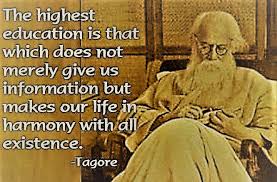
freedom are not necessarily free, they are merely powerful.”
Ultimately, Tagore put perhaps his greatest emphasis on education as crucial for bringing people together. As he said, “The deepest source of all calamities in history is misunderstanding. For where we do not understand, we can never be just.” In his own time, he stated, “All the trouble that we see now-a-days is caused by this failure of East and West to come together. Bound to be near each other, and yet unable to be friends, is an intolerable situation between man and man, and hurtful withal.” Education is the true meeting point between East and West, and with his Visva-Bharati University, Tagore endeavored to bring people together through education. The goal was to attain what Tagore called “sympathetic knowledge” about each other, and he affirmed, “Knowledge is the greatest factor in the unification of mankind.” It is also about love, establishing “the bond of love and friendship between man and man” in all our diversity. He explained, “Education is…the breaking of the shackles of individual narrowness…The highest aim of education should be to help the realization of the unity, but not of uniformity…A sound educational system should provide for the development of variety without losing the hold on the basic or spiritual unity.” All countries possessing what Tagore called true civilization, he contended, “extend free intellectual hospitality to the world through their universities.” “Civilization must be judged and prized,” he argued, “not by the amount of power it has developed, but by how much it has evolved and given expression to…the love of humanity.”
Tagore called on all of us to forge a new global civilization based not on nationalism with its militarism and “economical and political competition and exploitation,” but on spirituality and love. In the history of humanity, Tagore asserted, “men had to choose between fighting with one another and combining, between serving their own interest or the common interest of all.” Conflicts in the past in which different peoples were often geographically isolated from each other was one matter, but in the modern world, we cannot escape one another: “The races of mankind will never again be able to go back to their citadels of high-walled exclusiveness. They are today exposed to one another, physically and intellectually. The shells which have so long given them full security within their individual enclosures have been broken, and by no artificial process can they be mended again. So we have to accept this fact, even though we have not yet fully adapted our minds to this changed environment.”
The question was, as he saw it, “whether the different groups of peoples shall go on fighting with one another or find out some true basis of reconciliation and mutual help; whether it will be interminable competition or cooperation. I have no hesitation in saying that those who are gifted with the moral power of love and vision of spiritual unity, who have the least feeling of enmity against aliens, and the sympathetic insight to place themselves in the position of others will be the fittest to take their permanent place in the age that is lying before us…we have to prove our humanity by solving it through the help of our higher nature.”
Tagore was aware, living as he did in an age of national and global conflict and rapid social change brought on by modernization, of the tendency of people to dismiss those calling for love and coexistence as out of touch. He argued, “I know what a risk one runs from the vigorously athletic crowds to be styled an idealist in these days, when thrones have lost their dignity and prophets have become an anachronism.” Nevertheless, the difficult situation of the world made him even that much more motivated to promote global love and unity as the only solution. We can all do our part, including on a small scale: “If we succeed in igniting a genuine spark of fire among those who are around us, then that fire shall progress in carrying its own flag of fame…Never trust in numbers or in quantity. Truth, even though small in amount, conquers the world.”
With an optimism driven by his faith, Tagore hoped for a “new world” in which humanity will live in friendship, a world where “power becomes ashamed to occupy its throne and is ready to make way for love,” a world which “basks in the open sunlight of mind and breathes life’s free air.” Tagore dreams of a “heaven of freedom,” “Where the mind is without fear…Where knowledge is free…Where the world has not been broken up into fragments by narrow domestic walls.” Only if we can move forward, “discarding languor, breaking old habits, opening one’s eyes to the world, can our vision break free of its confinements and our soul be reborn, to feel the touch of the spirit that animates the universe.”
“O giver of thyself!...Give us strength to love, to love fully, our life in its joys and sorrows, in its gains and losses, in its rise and fall. Let us have strength enough fully to see and hear thy universe, and to work with full vigor therein. Let us fully live the life thou hast given us, let us bravely takeand bravely give…We would pray to thee to let the irresistible current of thy universal energy come like the impetuous south wind of spring, let it come rushing over the vast field of the life of man, let it bring the scent of many flowers, the murmurings of many woodlands, let it make sweet and vocal the lifelessness of our dried-up soul-life. Let our newly awakened powers cry out for unlimited fulfilment in leaf and flower and fruit.”
Let us conclude with a prayer for universal peace by Tagore that we may achieve this world through embracing the unity of all and thus be filled with life, joy, healing, and prosperity: “O giver of thyself!...Give us strength to love, to love fully, our life in its joys and sorrows, in its gains and losses, in its rise and fall. Let us have strength enough fully to see and hear thy universe, and to work with full vigor therein. Let us fully live the life thou hast given us, let us bravely take and bravely give…We would pray to thee to let the irresistible current of thy universal energy come like the impetuous south wind of spring, let it come rushing over the vast field of the life of man, let it bring the scent of many flowers, the murmurings of many woodlands, let it make sweet and vocal the lifelessness of our dried-up soul-life. Let our newly awakened powers cry out for unlimited fulfilment in leaf and flower and fruit.”
Ambassador Akbar Ahmed is Distinguished Professor of International Relations and holds the Ibn Khaldun Chair of Islamic Studies at the American University, School of International Service. He is also a global fellow at the Wilson Center Washington DC. His academic career included appointments such as Nonresident Senior Fellow at the Brookings Institution; the First Distinguished Chair of Middle East and Islamic Studies at the US Naval Academy in Annapolis, MD; the Iqbal Fellow and Fellow of Selwyn College at the University of Cambridge; and teaching positions at Harvard and Princeton universities. Ahmed dedicated more than three decades to the Civil Service of Pakistan, where his posts included Commissioner in Balochistan, Political Agent in the Tribal Areas, and Pakistan High Commissioner to the UK and Ireland.
Frankie Martin is a doctoral candidate in anthropology at American University and a senior researcher for Akbar Ahmed’s quartet of Brookings Institution Press studies on Western-Islamic relations.
Amineh Ahmed Hoti is Fellow-Commoner at Lucy Cavendish College, University of Cambridge. She was also a senior researcher for Akbar Ahmed’s quartet of Brookings Institution Press studies on Western-Islamic relations. Her most recent book is Gems and Jewels: The Religions of Pakistan (2021).
Tagore, Nationalism, p. 145.
Tagore, Creative Unity, p. 172.
Tagore, Greater India, p. 96.
Tagore, The Religion of Man, p. 234.
Mukherjee, A Study of the Educational Thought and Experiment of Rabindranath Tagore , p. 68.
Mukherjee, A Study of the Educational Thought and Experiment of Rabindranath Tagore , p. 291.
Quayum, “Rabindranath Tagore,” p. 398.
Mukherjee, A Study of the Educational Thought and Experiment of Rabindranath Tagore , p. 184.
Tagore, Sādhanā, p. 111.
Tagore, Personality, p. 218.
Tagore, Nationalism, p. 120.
Tagore, The Religion of Man, p. 157.
Tagore, Nationalism, p. 121.
Tagore, Nationalism, p. 113.
Mukherjee, A Study of the Educational Thought and Experiment of Rabindranath Tagore , p. 132.
Tagore, Nationalism, p. 61.
Tagore, The Religion of Man, p. 163.
Tagore, Gitanjali (Song Offerings), p. 19.
Alam and Chakravarty, The Essential Tagore, p. 764.
Tagore, Sādhanā, p. 134.
|
