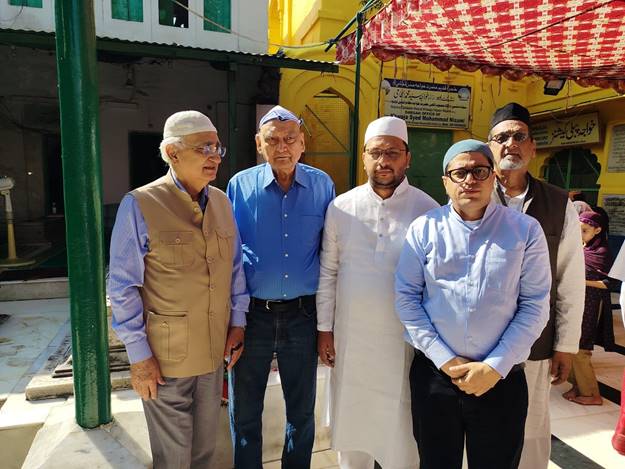
Justice Markandey Katju, Salman Khursheed and others
A Historical Visit to the Dargah of Hazrat Nizamuddin Auliyawith My Friend Salman Khursheed
By Justice Markandey Katju
Former Judge of Indian Supreme Court
Mumbai, India
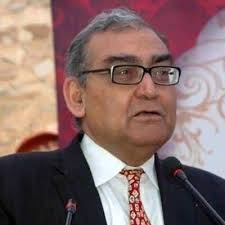
Today, Sunday, 12th October 2025 my old friend Salman Khursheed, eminent senior advocate of the Supreme Court and former Union Minister, whom I have known for about 40 years, and I made a joint visit to the dargah of famous Sufi saint Hazrat Nizamuddin Auliya in Delhi on the occasion of his 722nd Urs.
I regard this visit historical because Salman is a Muslim, whereas I am a Hindu, so this joint visit will convey a message to all that despite the diabolical and wicked efforts of certain vested interests who have in recent years been trying to polarize society and spread hatred between Hindus and Muslims in India, we Hindus and Muslims of India stand united by the Ganga-Jamuna tehzeeb against these nefarious elements.
Although an atheist, I love going to dargahs. This is because while Hindus go to Mandirs, and Muslims to Masjids, both go to dargahs (except bigots in both communities). So dargahs unite us, and whatever unites us is good for the country.
https://indicanews.com/i-am-fond-of-dargahs-justice-katju/
http://justicekatju.blogspot.com/2014/08/dargah-of-hazrat-amir-khusro.html
https://justicekatju.com/indian-pakistani-islam-is-sufi-islam-7465862c19c9
Urs are celebrations held at a dargah where a Sufi saint is buried, and it is held on his death anniversary. Now this may sound odd: a death anniversary should be an occasion to express sorrow. Why is it celebrated?
To explain this, one must know that the word ‘urs’ is an Arabic word literally meaning a wedding. It is believed that on his death, the Sufi saint was united with God, and hence this is an occasion for celebration.
https://www.hastakshepnews.com/2025/10/the-urs-of-sufi-saint-hazrat-nizamuddin.html
So two days back when I learnt that the 722nd Urs of Hazrat Nizamuddin Auliya is going on, I telephoned Salman Khursheed and told him I would like to go to the Urs along with him. Going separately would not serve the purpose, because in these days when dark clouds of communalism, promoted by some vested interests are hovering in the sky over India, a joint visit of a Hindu and a Muslim to the dargah would give a rebuff to these elements, and send a strong message that we Hindus and Muslims stand united against the communal forces, and that the very soil of India is such that it does not tolerate communalism for long. Salman immediately agreed to the idea.
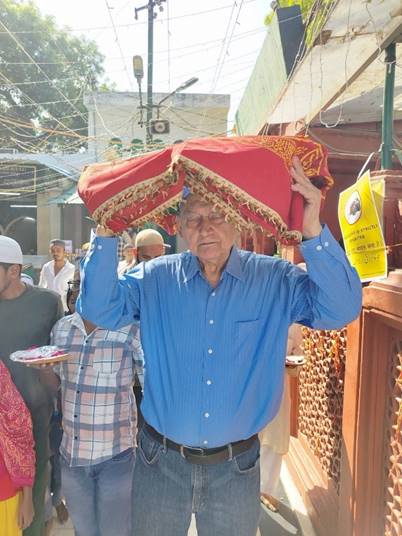
Justice Markandey Katju at the dargah of Hazrat Nizamuddin Auliya
To understand communalism we have to delve into history.
Up to 1857, there were no communal problems in India. All communal riots and animosity began after 1857. No doubt even before 1857, there were differences between Hindus and Muslims, the Hindus going to temples and the Muslims going to mosques, but there was no animosity. In fact, the Hindus and Muslims used to help each other, like brothers and sisters. Hindus used to participate in Eid and Moharram, and Muslims in Holi and Diwali. The Muslim rulers like the Mughals (there is a controversy about Aurangzeb), Nawabs of Awadh and Murshidabad, Tipu Sultan, etc. were totally secular; they organized Ramlilas, participated in Holi, Diwali, etc.
https://indicanews.com/justice-markandey-katju-emperor-akbar-is-the-father-of-the-indian-nation/
https://indicanews.com/justice-katju-the-truth-about-tipu-sultan/
https://www.ummid.com/news/2011/April/20.04.2011/justice_katju_on_british_rulers.htm
Ghalib’s affectionate letters to his Hindu friends like Munshi Shiv Naraln Aram, Har Gopal Tofta, etc. attest to the affection between Hindus and Muslims at that time.
In 1857, the Great Mutiny broke out in which the Hindus and Muslims jointly fought against the British. This shocked the British government so much that after suppressing the Mutiny, they decided to start the policy of divide and rule (see online “History in the Service of Imperialism” by B.N. Pande), as that was the only way of controlling India.
https://www.cyberistan.org/islamic/pande.htm
All communalism started after 1857, artificially engineered by the British authorities. The British collector would secretly call the Hindu Pandit, pay him money, and tell him to speak against Muslims, and similarly he would secretly call the Maulvi, pay him money, and tell him to speak against Hindus. Agent provocateurs were hired by the British, who would slaughter a cow, and throw its carcass overnight in a Hindu temple, writing on its wall ‘Allaho Akbar’, so that when Hindus saw it in the morning, they would think all Muslims are wicked people. Similarly, they would kill a pig and throw its carcass overnight in a mosque, and write on the wall ‘Jai Bajrang Bali’, on seeing which Muslims would get a similar animosity towards Hindus. This communal poison was injected into our body politic year after year and decade after decade.
In 1909, the ‘Minto-Morley Reforms’ introduced separate electorates for Hindus and Muslims. The idea was propagated that Hindi is the language of Hindus, while Urdu of Muslims (although Urdu was the common language of all educated people, whether Hindu, Muslim or Sikh in large parts of India up to 1947). The Aligarh Muslim University and Benaras Hindu University were set up to further this communal divide (a university is meant to be universal, so how can it be Hindu or Musim?). The RSS and Hindu Mahasabha were created by the British to spread hatred of Muslims, and Muslim League was created by them to spread hatred of Hindus.
At the mazhar of Hazrat Nizamuddin Auliya, Salman and I laid ‘chaadars’ on his grave. The saint never married, and his sister’s descendants manage the dargah, and are called Sajjada Nashins. The President of the managing committee is Syed Farid Ahmed Nizami, whom I had met on an earlier visit to the dargah a long time back (whose pic can be seen in one of the links in this article). I also met other Sajjada Nashins, Syed Hammad Nizami, and Syed Umar Nizami. I told them that my grandfather Dr KN Katju, then Union Home Minister, had visited this very dargah during an Urs with the then Prime Minister Nehru in 1953 or 1954.
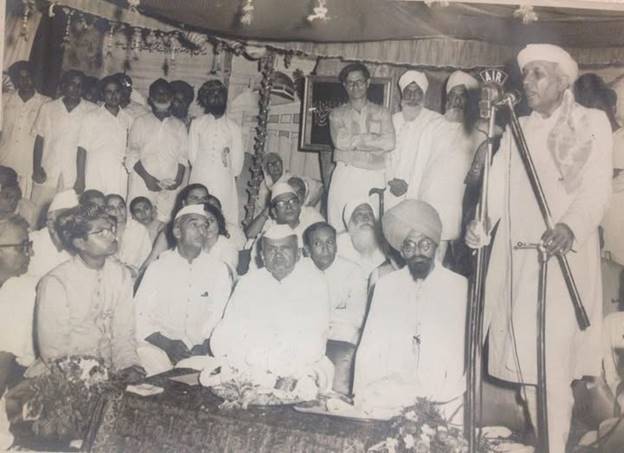
I told them that they must put up huge boards on several parts of the dargah with a famous Persian quotation of the saint :
“Har quom raast raahe
Deen-e-wah qibla gaahe ”
which means
” All religions have a separate path, but all of which lead to the same God”
https://www.facebook.com/justicekatju/posts/nizamuddin-aulia-and-amir-khusroone-day-in-delhi-the-renowned-sufi-saint-nizamud/1185546929608362/
In a country of such tremendous diversity, Emperor Akbar’s policy of suleh-e-kul or giving equal respect to all religions and communities is the only correct policy which can hold India together, and take it on the path of progress
https://thephilox.com/justice-katjus-call-for-embracing-akbars-suleh-e-kul-in-todays-political-climate/
(Markandey Katju is an Indian jurist and former judge of the Supreme Court of India who served as chairman of the Press Council of India from 2011 to 2014)