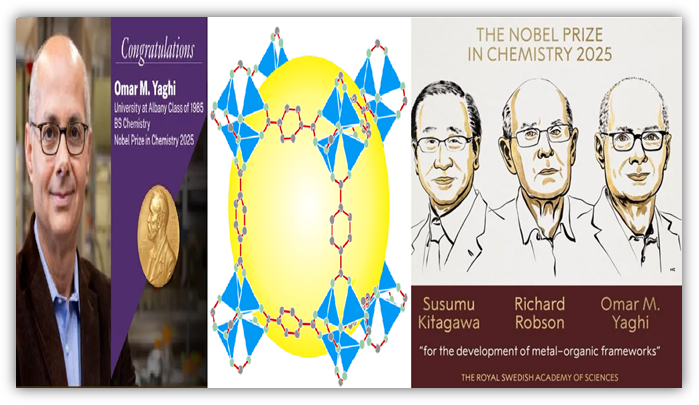
“Smart people, talented people, skilled people exist everywhere. That’s why we really should focus on unleashing their potential through providing them with opportunity.”
Omar M. Yaghi: Pursuit of Passion Leads to Nobel Laureate-Chemistry 2025
By Dr Ahmed S. Khan
Chicago, IL
Professor Dr. Omar M. Yaghi
Omar Mwannes Yaghi, a Palestinian-Jordanian-American chemist currently affiliated with the University of California, Berkeley, was awarded the 2025 Nobel Prize in Chemistry, alongside Richard Robson and Susumu Kitagawa, for their pioneering work in the development of metal–organic frameworks (MOFs). Yaghi is recognized globally as the founder of reticular chemistry, a field focused on constructing crystalline frameworks from molecular building blocks using strong chemical bonds.
Born on February 9, 1965, in Amman, Jordan, Yaghi was raised in a Palestinian refugee family that had fled Gaza during the 1948 expulsion. His childhood was marked by extreme poverty—his large family lived in a single room shared with livestock, without access to clean water or electricity. At age 15, encouraged by his father, Yaghi moved to the United States, where he began his education at Hudson Valley Community College, learning English and adapting to a new culture. He later earned his BS in Chemistry from the State University of New York at Albany, followed by a PhD from the University of Illinois at Urbana-Champaign under Professor Walter G. Klemperer. He completed postdoctoral research at Harvard University (1990–1992) with Dr Richard H. Holm as a National Science Foundation fellow.
Yaghi’s academic career began at Arizona State University (1992–1998), followed by appointments at the University of Michigan (1999–2006) and UCLA (2007–2012), where he held prestigious professorships. In 2012, he joined UC Berkeley as the James and Neeltje Tretter Professor of Chemistry. He also served as Director of the Molecular Foundry at Lawrence Berkeley National Laboratory (2012–2013) and currently leads the Berkeley Global Science Institute and co-directs the Kavli Energy NanoSciences Institute. In 2025, he was elevated to the rank of University Professor by the University of California Board of Regents, the system’s highest academic honor.
Yaghi’s most transformative contribution is the creation of reticular chemistry, a discipline he envisioned in the early 1990s. At the time, the idea of assembling crystalline materials from molecular building blocks using strong bonds was considered impractical, as most syntheses yielded amorphous solids. In 1995, Yaghi successfully synthesized crystalline metal-organic structures by linking metal ions with charged organic molecules like carboxylates. This breakthrough led to the development of MOFs, a new class of porous materials with vast applications in gas storage, carbon capture, and water harvesting.
His work has earned him numerous prestigious awards, including:
Nobel Prize in Chemistry (2025)
Albert Einstein World Award of Science (2017)
Wolf Prize in Chemistry (2018)
Gregori Aminoff Prize (2019)
VinFuture Prize (2022)
Science for the Future Ernest Solvay Prize (2024)
In addition to his academic achievements, Yaghi is an entrepreneur. He founded Atoco, a company focused on commercializing MOF and COF technologies for carbon capture and atmospheric water harvesting. In 2021, he co-founded aH2MOF, which applies reticular chemistry to hydrogen storage solutions.
Reflecting on his journey, Yaghi shared: “I started at Arizona State University in my independent career. My dream was to publish at least one paper that receives 100 citations. Now my students say that our group has garnered over 250,000 citations. So yes, it was unexpected. But again, the beauty of chemistry is that if you learn how to control matter on the atomic and molecular level, well, the potential is great. We opened a gold mine in that way.”
He emphasizes the inclusive and exploratory nature of chemistry: “The field grew, and it allowed people to come in and become stars in their own right, due to their own contribution. That’s the beautiful thing about this field—it allows scientists to find their direction, build their careers, and become pillars of the discipline.”
To young aspiring scientists, Yaghi offers this advice: “When I give lectures to younger students, some ask me, ‘How do you become passionate about something?’ I say, just pick anything around you and think deeply about what it’s made of. Dig deeper. The deeper you go, the more beauty you find in how things are constructed. You don’t need a grand plan at an early age—just follow what draws you toward a problem or a field.”