
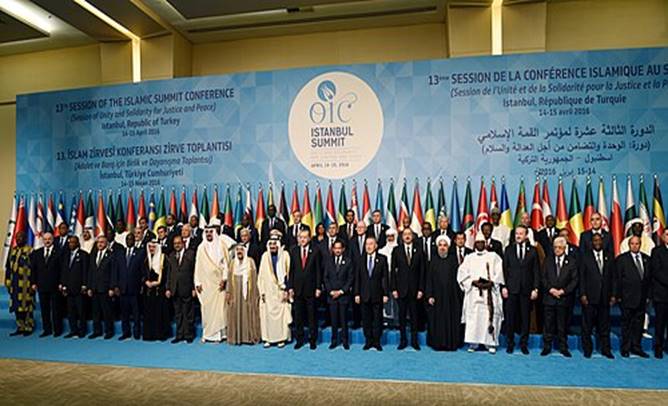
Given the current fragmented nature of the Muslim world may we not conjecture that the recent pact between Pakistan and Saudi Arabia, with chatter about the UAE, Turkey, Malaysia and other Muslim states joining them is the start of a possible nascent hegemon? In terms of population, land mass and combined economic, and military strength these countries could well form a Muslim hegemon - Wikipedia
The World Order and a Muslim Hegemon?
By Dr Akbar Ahmed
American University
Washington, DC

While attending the launch of an important new book on world order my mind inevitably drifted to relating the subject to my own area of interest—the Muslim world. Here was an area of the globe with a population of almost two billion people, yet there was no special place for them in the political categories. On the contrary, Muslims were either actively persecuted or faced discrimination in the areas covered by the four “hegemons”: the United States, China, Russia, and India, an emerging hegemon.
On 8 October 2025, at the School of International Service, American University, I was honored to be on a panel to help launch The Once and FutureWorld Order: Why Global Civilization Will Survive the Decline of the West, by the renowned scholar and Distinguished Professor Amitav Acharya (Basic Books, 2025). When Plato created the first Academy, his aim was to provide a campus for people to have a space where they could think and explore ideas. In that sense Professor Amitav’s book has fulfilled the primary Platonic intellectual purpose: his book makes the reader think. In it we travel to the past and across the world. We encounter the sophistication and complexity of human civilization and its attempts to organize order. The catchy title of the book should alert us to the promise of the rich content contained in it. There are fourteen chapters each one building on the previous chapter: for example, there is a chapter on the ancient world, “Greek Myths and Persian Power,” and this is followed by a chapter on the Roman Empire “The Wrath of Rome.” Next comes the emergence of Islam in the Chapter called “Rejuvenating the World.” “The Rise of the West” discusses the emergence of Western powers and the “The Return of the Rest” shifts the focus on the emergence of what we call the Global South. It is an exciting and fulfilling romp through world history.
Amitav’s thesis rests on three main arguments.First: Creating "world order," that is ensuring stability and dispelling "chaos" in a large part of the world at a given period, is not a monopoly, but a shared creation. It is created through separate but similar innovations by multiple civilizations and sometimes but not always through diffusion. The core ideas and mechanisms of world order—the independence of states, diplomacy, peace treaties, economic interdependence, humanitarian values, racial and religious tolerance and much more—have come to us from multiple civilizations. Second, "The West" borrowed and benefitted from some of them to fuel its rise; its imperialism and resource extraction also helped.
Third, and Amitav emphasized this point as he did not wish to be mistaken for a revolutionary Maoist or Marxist advocating the bloody downfall of the West, the decline of Western dominance need not be a "bad thing" in the long run, but an opportunity to build a more inclusive world with more ideas and pathways to stability. The key is the opportunity to end the “West vs Rest” divide and clash of civilization mindset.
Of course, before any Western political scientist there was Ibn Khaldun who explained the rise and fall of dynasties on the basis of his cyclical theory. Groups emerge from deserts and mountains to replace elites in established urban centers who they see as effete and even corrupt. Having replaced the city dwellers, in time they begin to lose what had united them and sustained them to victory: their sense of assabiya or group or community feeling. This process may take three or four generations. In time the ruling group becomes effete and therefore vulnerable to fresher groups coming from outside, intent on replacing them. The cycle thus repeats itself through history. It is a simple and deterministic theory, but more convincing than the previous ones which saw the rise and fall of dynasties and civilizations as the whims of divine power.
If we are to recognize the popular Great Power Rivalry realist theory comprising of the four hegemons presented by John Mearsheimer we are left with a looming theoretical and methodological lacuna: Where is the Muslim world with some two billion population and 57 states? The swathe of nations and communities across North Africa, the Middle East and into Central Asia are not part of any of the recognized hegemons. We know that Muslim civilization a thousand years ago was producing scholars, physicians, mathematicians, astronomers, poets and architecture and innovators at the highest level. Above all it created a world that was connected across continents. One has only to read Ibn Khaldun or Ibn Battuta to see the inter-connectedness of the world. Even today we glimpse Muslim hegemons such as the Ottoman Empire in the magnificent art and architecture in Istanbul; or read about political ideas in the tracts of outstanding Muslim political reformers like Jamaludin Afghani, Sayyed Ahmad Khan, Altaf Hussain Hali, and Allama Iqbal. Underlining the work of the reformers were three themes: the challenge of the West and the need to engage with it especially in science and technology, the importance of education especially for the youth, and the lessons of the rise and decline of Muslim history. Given the current fragmented nature of the Muslim world may we not conjecture that the recent pact between Pakistan and Saudi Arabia, with chatter about the UAE, Turkey, Malaysia and other Muslim states joining them is the start of a possible nascent hegemon? In terms of population, land mass and combined economic, and military strength these countries could well form a Muslim hegemon.
This may well be a tiny first step and a Muslim hegemon may not take shape, or may not be permitted to do so, but political scientists need to take cognizance of the presence of nations such as Turkey, Iran, Egypt and Pakistan which were once part of great Muslim civilizations and their yearning for dignity and living with honor. This is not a new dream but one explored by the towering personalities of the Muslim world like Afghani and Iqbal.
Yet even before the ink had dried on the treaty between Pakistan and Saudi Arabia, Pakistan was dragged into a full-scale military conflict with another Muslim nation, its neighbor Afghanistan, which threatened to spill from a border skirmish and heinous accusations against each other into a full-scale war . The conflict highlighted the challenge any Muslim hegemon will face.
Like Professor Amitav, Dr Kishore Mahbubani, a giant thinker in the company of global giants, has been pointing out the shift in global power from the West to the Global South. He argues, as does Professor Amitav, that for the last 2,000 years the most prominent civilizations in terms of wealth and military power have been India and China, but the last 200 years saw decline and devastation as European colonization was imposed on them. Their time has now come.
But these great global orders must ultimately succeed or fail depending on the happiness or wellness they provide their people. This promise is embedded in America’s own brilliant Declaration of Independence. Yet the record number of suicides, murders, wars, and violence in the USA today indicate a population living in a perpetual state of anxiety and uncertainty, thus negating Jefferson’s promise of “the pursuit of happiness.” Similarly, if the world order is to shift towards India and China we must ask, where is the shanti or peace, seva or service, ahimsa or non-violence promised by Hindu savants in India and the injunction to treat others as you wish to be treated by them by Confucius in China? And how will it be achieved?
Professor Amitav like Mahbubani concludes on a note of hope. This is welcome as too many global thinkers wallow in a scenario of gloom and doom. There is today an avalanche of books predicting the end of America and the gory rejection of Western civilization. Amitav’s 450 page thesis concludes with a powerful paragraph which argues that we must see the changing world order not in terms of the West vs the rest but a collaborative effort to create a new world order through the process of what Amitav calls Global Multiplexes. The last reference in the book I noted was to the great Ibn Khaldun. Amitav’s thesis is well-meaning and laudable; but many world orders go out with a bang not a whimper.
In the end, a civilization—or a world order—can only be judged by the extent and quality of well-being or happiness its citizens enjoy. By that standard most civilizations today are failing as large parts of the population are persecuted or face prejudice, even if sections of the elite enjoy above average wealth and privileges. The aim must be to promote harmony and peace for society as a whole, so that every individual in it feels part of the whole. The pursuit of happiness must be an ideal but also something that is achievable and is achieved.
(Ambassador Akbar Ahmed is Distinguished Professor of International Relations and holds the Ibn Khaldun Chair of Islamic Studies at the American University, School of International Service. He is also a global fellow at the Wilson Center Washington DC and was Pakistan High Commissioner to the UK and Ireland.)
