
Bibliotheca Alexandrina
Reconstruction of a Technological Culture in Islam -1
By Prof Dr Nazeer Ahmed
Concord, CA
This article achieves two things: It reconciles taqdeer with tadbir and it reconciles al Ghazzali with Ibn Rushd. This has seldom been attempted before.
The issues are deep. The discussion involves a confluence of philosophy, theology, kalam, empirical science, quantum physics, statistics and history and at times becomes highly cerebral. We have attempted to simplify the concepts and document our observations for those who come after us. It will also be available on www.historyofislam.com .
History can be a teacher or a tyrant. In 1095 CE, Imam Al Ghazzali, one of the most influential theologians in Islamic history, wrote in his treatise Tahaffuz al Falasafa (Repudiation of the Philosophers): “The connection (iqtirân) between what is habitually believed to be a cause and what is habitually believed to be an effect is not necessary (darûrî), according to us…(Stanford Encyclopedia of Philosophy).
Historians have long contended that this apparent refutation of cause and effect served as an effective force field blocking the advancement of science and technology in the Islamic world. Al Ghazzali’s position was challenged by Ibn Rushd (d 1198) who emphasized that cause and effect were the very basis of reason that held together the edifice of human knowledge.
Islamic civilization chose al Ghazzali over Ibn Rushd, while Europe chose Ibn Rushd over al Ghazali. As a result, Europe moved ahead in science and technology. The Islamic world, which at one time led the world in the natural sciences, lost its advantage and became subservient to Europe.
In this essay, we examine the historical context of this epic debate and offer a reconciliation of the two positions. Our approach is based on guidance from the Qur’an. Such a reconciliation is essential for creating a scientific and technological culture in the Islamic world.
Nothing less than the survival of Islamic civilization in an increasingly technological world hinges on such a reconciliation.
The distinctive character of positivistic knowledge is that it opens up avenues for the human to attain his potential through an exercise of reason. It enhances material welfare through innovation, shields the human from abject and debilitating poverty, protects life by enabling effective means of defense, provides a bulwark against disease through medical research and mitigates hunger and starvation through agricultural advancement. Indeed, it opens up a possibility (just a possibility) of heaven on earth .
Introduction
We live in extraordinary times. These are times when humankind has conquered space and searches for life on other planets. Giant telescopes seek to unlock the very origin of the known universe. Terms such as space travel, the Theory of Relativity and the Big Bang have entered into common discourse. Machine learning and robotics drive the cutting edge of technology and seek to replace human reasoning with artificial intelligence. Nano-technology unlocks the secrets of cellular biology and beckons us to a world of engineered DNA. Indeed, we are now headed into a post-human world in which the very essence of being human is challenged.
While technology drives human civilization, the Islamic world is bogged down with pointless disputes about beards, clothes and coverings. By every yardstick, be it primary education or the number of scientific papers published in respectable journals, the Islamic world lags behind the technologically advanced world. What is more significant is that the gap between Muslim societies and the technologically advanced societies is increasing at an alarming rate. The result is illiteracy, ignorance, abject poverty, cultural bankruptcy, social stagnation, technological marginalization, political and military impotence.
How did this happen? How did a civilization that led the world in science and technology for five hundred years fall so far behind? In my writings, I have highlighted several factors that contributed to this decline: the Mongol deluge (1219-1258), the Crusades (1096-1250), the loss of Spain (1236-1492), the rise of tasawwuf with its emphasis on the esoteric (thirteenth century), the opposition to the printing press (fifteenth century), neglect of naval technology (seventeenth century), loss of international trade (eighteenth century), colonization and dismantling of the traditional education systems (nineteenth century). Underlying these factors was a distancing from rational thought that grew out of the titanic collision between the philosophers and the theologians in the eighth-ninth centuries. The dialectic between al Ghazzali and ibn Rushd was the cutting edge of that debate. Unless the Islamic civilization shakes off the hangover from that debate, it cannot expect to work its way out of technological backwardness.
This article takes a fresh look at that critical moment in history when philosophy collided with theology. More than eight hundred years have elapsed since that great debate. Empirical science, which was in its infancy in the eighth century, is now a full-grown adult and it offers fresh perspectives on the issues that divided the two camps. We apply the modern understanding of classical mechanics and quantum physics and attempt to bridge the gap between philosophy, religion and science so that the Islamic civilization can move forward with confidence on the road to a technological renaissance.
The Historical Context
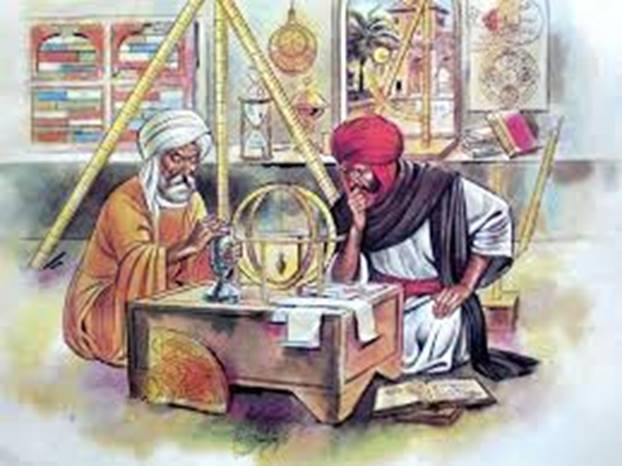
In the seventh century, the Islamic domains expanded and stretched from the Indus River in Pakistan to the Pyrenees mountains in France. This vast empire connected and welded together Asia, Africa and Europe, facilitating the movement of goods and ideas. The early Muslims, impelled by injunctions from the Qur’an and the Sunnah of the Prophet were enthusiastic and keen learners. They learned from the East and West, from India and China, Greece and Persia, molded what they had learned in an Islamic crucible and added their own stamp to the reservoir of human knowledge through new fields of learning. The Abbasid Caliph al Mansur (d 775) invited scholars from around the world to come to the capital city of Baghdad and soon the city became a magnet for men of learning. Al Mansur established an academy called Baitul Hikmah (the House of Wisdom) where scholarly books from around the world were translated into Arabic. From India came the astronomy of Aryabhatta, from Greece came the works of Aristotle, Plato and Hippocrates, from China came the technology for manufacturing porcelain and papermaking and from Iran the art of constructing windmills. Baitul Hikmah was a cosmopolitan academy. Among the scholars who worked there were Muslims, Christians, Jews and Zoroastrians. The Muslims learned the sciences of other civilizations and made their own contributions inventing the fields of algebra, chemistry, perfecting the methods of empirical science and adding to the fields of medicine, surgery, astronomy, art, music, history, geography, agriculture, engineering and philosophy.
Of all the sciences that the Muslims came in contact with, it was Greek rational thought that caught their fancy and they fell in love with its rigor and its precision. Aristotle became their hero and reason their guide. The Caliph al Mansur adopted and promoted Greek philosophy (the philosophy of the ancients as it was called) as court dogma. Muslim scholars set out to apply rational methods to physical phenomenon as well as social, cultural and religious issues with excitement and enthusiasm. These scholars were called the Mu’tazalites.
It was the heyday for rational sciences in Islam. It was the age of Harun al Rashid and Mamum, of Shehrezad and the Arabian Nights, of al Khwarizmi and al Kindi. The Mu’tazalites amalgamated the rational methods of the Greeks, the mathematics of the Indians and the technology of the Chinese, laid the foundation for empirical sciences, invented new disciplines and became torch bearers for the advancement of human civilization.
The application of classical Greek rational thought in an Islamic paradigm was not without its challenge. Of particular concern were the assumptions that the Greeks made about the nature of time and the questions surrounding cause and effect. These assumptions when applied to theological issues presented profound and fundamental doctrinal challenges to Muslim scholars.
The Greeks assumed that time was “eternal”. However, from an Islamic perspective, the acceptance of time as “eternal” would make it co-extent with God who is “wahid”, “self-subsisting” and “eternal”. This was unacceptable to the theologians. In addition, if time is eternal, then everything “other than God” was “created” in time. Specifically, was the Qur’an “created” in time? The Mu’tazalites, who were staunch Muwahids fell into a trap on this issue. They wanted to preserve the transcendence of God. Everything, “other than God”, had to be “created” “in time”. When they applied this logic to the Qur’an, they fell flat on their face. They concluded that the Qur’an was “created” by God “in time”. Needless to say, this position was unacceptable to the theologians. Resistance set in.
A second issue was cause and effect in nature. The Mu’tazalites affirmed that cause and effect were ubiquitous in nature. This position also had theological implications. If cause and effect followed one from the other mechanistically, then, how does the will of God operate in nature? Isn’t God the “doer” of all actions? Here again, the theologians took the Mu’tazalites to task and opposed them.
There were other issues of disagreement as well, namely, human free will (ikhtiar) and man’s responsibility for his actions. However, we will limit our discussion in this essay to only those issues that dealt with the phenomenon of nature and man’s interaction with it.
The position that the Qur’an was “created” “in time” caused great commotion in the Muslim body politic. The resistance to this position was led by the usuli ulema, spearheaded by Imam Ahmed ibn Hanbal. The Mu’tazalites were not tolerant of dissent. Imam Ahmed was publicly flogged for his opposition and was imprisoned. However, with each oppressive measure, the voices of protest grew louder. Faced with mounting public pressure, the later Abbasid Caliphs relented. In 846 CE, the Caliph al Mutawakkil disavowed the Mu’tazalites and banished them from his court. In turn, when the anti-Mu’tazalites won the favor of the Caliphs, they instituted a Mehna (inquisition) against the Mu’tazalites; many were punished for their views and their books were burned.
The triumph of the usuli ulema over the Mu’tazalites in 846 marks a benchmark in Islamic history. Four significant aspects of the epic confrontation between philosophy and theology in Islam stand out. First, a critique of the speculative deductions of the philosophers did not come from within; it came from the usuli ulema. Second, when a critique did emerge from the ulema, the Mu’tazalites showed an inability to stomach the critique; they increasingly turned the whip on the protesters. Third, when the tables turned and the theologians triumphed, they in turn conducted an inquisition against the Mu’tazalite and persecuted them. Fourth, in the aftermath of the confrontation, the orthodox vision of Islam came to occupy the center while philosophy was pushed to the periphery. Henceforth, the philosophers would be compelled to be reticent in their work and look over their shoulders for any broadside from the theologians.
Philosophy had lost its official patronage in the courts of Baghdad but even as it had lost, it forced theology to defend itself. A new discipline emerged, combining theology with discursive philosophy with the dual purpose of safeguarding the theological fortress from the onslaught of philosophy while at the same time making theology palatable and accessible to the masses. This new discipline was called “kalam”. The practitioners of kalam were called the “mutakallimun”.
The triumph of theology over philosophy did not relieve the ulema of the burden of justifying their positions in a rational paradigm. For instance, if cause and effect do not follow one from the other as the philosophers maintained, how do actions and reactions follow one another? Fifty years after the Mu’tazalites were discredited in Baghdad, a noted scholar al Ash’ari rose to the challenge. He advanced the theory that “time” was not continuous, that it consisted of a series of digital, discontinuous, “atomistic” increments. At each increment, the will of God intervened in accordance with His predetermined plan to make things happen. Thus, the omnipotence of God was preserved. This explanation was easy to understand, and it found broad acceptance in the Islamic world. Among those who accepted the Ash’arite cosmology were some of the greatest thinkers in Islamic history, including, the Seljuk Grand Vizier Nizam ul Mulk (d 1092) and Imam al Ghazzali (d 1111). (Continued next week)
( The author is Director, World Organization for Resource Development and Education, Washington, DC; Director, American Institute of Islamic History and Culture, CA; Member, State Knowledge Commission, Bangalore; and Chairman, Delixus Group)
