
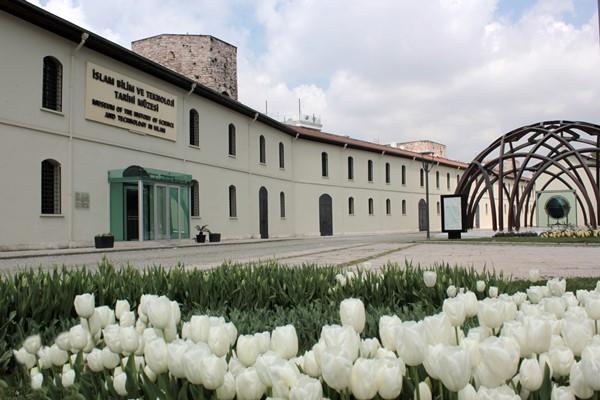
Islamic Science and Technology Museum which showcases a display of Islamic accomplishments in the sciences in Istanbul, Türkiye - Photo courtesy of Ministry of Culture and Tourism
Reconstruction of a Technological Culture in Islam – 2
By Prof Dr Nazeer Ahmed
Concord, CA
Al Ghazzali and the Geopolitical context of his works
Al Ghazzali (1056 -1111 CE) appeared on the canvas of history when the Islamic world was at the height of its political power but was riven asunder by internal ideological conflicts. In the latter part of the tenth century, the Fatimids stormed out of North Africa, capturing Egypt in 969 CE and extending their sway over Hijaz and Syria. Circa 1000 CE, their influence extended as far as Multan in Pakistan. The loss of Egypt meant that the Sunni Caliphs in Baghdad were cut off from trade routes that connected India with the trading city states of Venice, Milan and Genoa. The Fatimids in Cairo thrived even as the Abbasids in Baghdad struggled with shrinking revenues.
In the eleventh century (1040-1092), the Seljuk Turks descended from the Steppes of Central Asia, conquered most of West and Central Asia and established a vast and powerful empire stretching from Kashgar (China) to Damascus (Syria).
As Sunni Muslims, the Turks became champions and protectors of the Abbasid Caliphs in Baghdad. A test of arms between the Fatimids and the Seljuks was inevitable. They fought over control of Syria and Palestine in which the Seljuks were victorious. The response of the Fatimids was a deadly, clandestine war against their foes. The Assassins, a shadowy, disgruntled extremist group broke off from the Fatimids and waged an asymmetrical cloak and dagger war for over a hundred years against the Seljuks and other Sunni powers of Asia.
The intellectual landscape was equally turbulent. The Fatimid challenge to Sunni Islam was not just political-military, it was also doctrinal. The Fatimids believed that their version of Islam with its emphasis on the Imamate was the true Islam. They set upon converting the Sunni world to their faith, establishing schools and colleges to train the daees (proselytizers). The renowned Al Azhar university in Cairo was established in 969 CE by the Fatimid Caliph al Muiz not just as a higher citadel of learning but also as a propaganda center for Fatimid Islam. The well-trained daees spread out throughout the Islamic world, inviting the believers to shift over to the view that the first seven Imams were the true inheritors of the spiritual legacy of Prophet Muhammed (pbuh). Their esoteric ideas, often couched in secretive language, were a source of confusion in the Islamic body politic.
The Seljuks were patrons of art, architecture, poetry, education, astronomy and the mathematical sciences and their capital Esfahan became a magnet for theologians, philosophers, mathematicians, astronomers, poets and architects. The celebrated mathematician-poet Omar Khayyam, who compiled the precise Jalalian calendar worked at the magnificent court of Seljuk Sultan Malik Shah (d 1092). The great vizier Nizam ul Mulk (d 1092) was himself a writer and author of Siasat Nama, a masterpiece of political science. He established universities in Esfehan, Baghdad, Nishapur, Merv, Samarqand and Bokhara and built madrasas throughout the empire.
Al Ghazzali, arguably the most influential theologian in Islamic history, was born in Tabaran-Tus (Iran) in 1057. He received his early education in Tus and then proceeded to Nishapur where he studied under the well-known Ash’arite scholar al Juwayni. Upon the death of his teacher, he moved to Baghdad (1089) which was at the time the premier center of learning in the world. Al Gazzali’s erudition and sharp wit attracted the attention of the grand vizier Nizamul Mulk, who appointed him Professor at the prestigious Nizamiya college in Baghdad.
The Seljuks were under doctrinal pressure from the Fatimids. The Batini Assassins were wreaking havoc on the body-politic. The arguments of the philosophers were causing confusion in the minds of the people. Encouraged by Nizamul Mulk, Al Ghazzali took on the defense of Sunni orthodoxy and turned his powerful dialectic against the esoteric doctrines of the Fatimids as well as the endless argumentations of the philosophers. A theologian by training, he dived deep into the tenets of philosophy and turned its arguments against its practitioners. His Tahaffuz al Falasafa (Repudiation of the Philosophers) was a masterful thrust at the philosophers. While maintaining the importance of reason in the implementation of the Shariah, Al Ghazzali denounced the philosophers for their beliefs in the eternity of time and cause and effect in nature, going so far as to suggest that philosophers like ibn Sina were Takfireen (disbelievers).
Al Ghazzali’s Repudiation of the Philosophers
The string of madrassas and colleges established by Nizamul Mulk in the vast Seljuk empire served as vehicles for dissemination of Al Ghazzali’s ideas. The Nizamiya syllabus that was introduced into these madrassas reflected the Ash’arite positions on philosophy. It was this syllabus, with some modifications, which was used in throughout Islamic world until the nineteenth century. Some madrasas in India, Pakistan and Bangladesh use a stripped-down version of the Nizamiya syllabus even to this day.
Al Ghazzali’s knowledge was encyclopedic covering theology, kalam, philosophy, ethics, Shariah, tasawwuf and his influence was global. He wrote more than 70 books, only one of which, namely, Tahaffuz al Falasafa, is under discussion here. In this book, Al Ghazzali examines twenty of the assumptions and beliefs held by the philosophers of the day. We limit ourselves only to two of the twenty issues Al Ghazzali examines, namely, his views on the nature of time (issue 1 in Tahaffuz al Falasafa) and his position on cause and effect (issue 17 in the book).
Al Ghazzali was an Ash’arite. Like al Ash’ari, Al Ghazzali accepted the atomistic theory of time, namely, that time can be digitized and divided into miniscule, discrete packets. This position led him to claim that there was no cause and effect in nature, only “habits”. It was God who was the efficient, direct, immediate agent for all events; He caused these events either directly or through intermediaries. Al Ghazali wrote: “The connection between what is habitually believed to be a cause and what is habitually believed to be an effect is not necessary, according to us. For any two things, it is not necessary that the existence or the nonexistence of one follows necessarily from the existence or the nonexistence of the other. Their connection is due to the prior decision of God, who creates them side by side, not to its being necessary by itself, incapable of separation” (Stanford Encyclopedia of Philosophy). Citing the example of the burning of cotton by fire, he observed: “…. We say that the efficient cause of the combustion through the creation of blackness in the cotton and through causing the separation of its parts and turning it into coal or ashes is God—either through the mediation of the angels or without mediation. For fire is a dead body which has no action, and what is the proof that it is the agent?”
Al Ghazzali was concerned that the acceptance of cause and effect would preclude the possibility of miracles. He wrote: “On its negation (of natural causality) depends the possibility of affirming the existence of miracles which interrupt the usual course of nature . . . and those who consider the ordinary course of nature a logical necessity regard all this as impossible.” The philosophers maintained that there was cause and effect in nature. If cause and effect mechanistically and deterministically follow one from the other, where is the need for the intercession of God? This position, argued al Ghazzali, would contradict the omnipotence of God. (Continued next week)
(The author is Director, World Organization for Resource Development and Education, Washington, DC; Director, American Institute of Islamic History and Culture, CA; Member, State Knowledge Commission, Bangalore; and Chairman, Delixus Group)
